SKU: 59686803576
best pot for philodendron

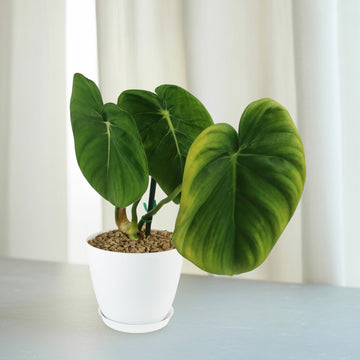
best pot for philodendron Philodendron ‘Mcdowell’

Sale price$26.72 Regular price$29.69
Save 10%

Pay in installments of $7.42 with ShopPay, AfterPay and Klarna

Shipping Estimate
USA
  • USA
  • CAN

Ships within 48 hours · Estimated delivery Sep 10 - Sep 15

Promo Codes Available:

For Your Every Summer RSVP, with Code: SUMMER15

Description

best pot for philodendron Philodendron ‘Mcdowell’The Philodendron Mcdowell is a crawling, drought tolerant plant that has lush, heart shaped leaves and a velvet like texture. This tropical plant is well known among collectors and indoor plant enthusiasts, and it is the ideal combination of easy care and captivating beauty. This crawling hybrid is a cross between Philodendron gloriosum and Philodendron pastazanum. This unique origin gives McDowell its natural adaptability to warm and humid

The Philodendron ‘Mcdowell’ is a crawling, drought-tolerant plant that has lush, heart-shaped leaves and a velvet-like texture. This tropical plant is well-known among collectors and indoor plant enthusiasts, and it is the ideal combination of easy care and captivating beauty.  

This crawling hybrid is a cross between Philodendron gloriosum and Philodendron pastazanum. This unique origin gives ‘McDowell’ its natural adaptability to warm and humid environments, as well as being tolerant to low light; which mimics the shaded conditions of tropical forest floors.

The standout feature of the Mcdowell Philodendron plant is undoubtedly its massive, heart-shaped leaves, which can reach up to 2 feet in length when grown in ideal conditions.

These leaves have a deep green hue with prominent, white-veined patterns, and their texture resembles a velvety fabric, giving the plant an exceptionally tactile allure.

It is a terrestrial grower, which means it typically crawls along the soil rather than climbing, making it ideal for low, wide pots. 

Though it rarely blooms indoors, the Philodendron 'Mcdowell' plant can produce tiny, spathe-like flowers. These blooms are not as showy as the plant's foliage and often go unnoticed, but they do emit a subtle fragrance. Flowering may occur if the plant is grown outdoors in a tropical climate or in a greenhouse that replicates its native conditions. 

As an indoor plant, Philodendron ‘Mcdowell’ not only enhances the aesthetic of a space with its dramatic foliage, but it also helps purify the air by absorbing pollutants. Like other philodendrons, it plays a role in removing toxins, making it an excellent choice for improving indoor air quality. Its lush, tropical appearance adds a sense of tranquility and vibrant greenery to any interior setting.

When and How to Water Philodendron ‘Mcdowell

Like other drought-tolerant plants, the Philodendron McDowell can handle some neglect when it comes to watering. It is important to allow the soil to dry out between waterings to prevent root rot. Overwatering can be more harmful than underwatering for this plant.  

In the spring and summer, during the growing season, you want to keep the soil slightly moist but not waterlogged. A good rule of thumb is to water it when the top inch of the soil feels dry to the touch. You can water it thoroughly typically for 1-2 weeks, allowing excess water to drain out of the pot to prevent root rot. 

In the fall and winter, during the dormant season, the McDowell Philodendron plant doesn't need as much water. You should reduce the frequency of watering to once a week. It's essential to adjust your watering schedule based on the plant's needs and the environmental conditions. Overwatering can be more harmful than underwatering for this plant, so it's better to err on the side of slightly underwatering than overdoing it. Just keep an eye on the moisture and adjust accordingly to keep your Philodendron happy and healthy!

Light Requirements – Where to Place Your Philodendron Plant 

When grown indoors, it does well in bright, indirect light for at least 4-6 hours a day. You can place it near a window where it can get filtered sunlight or even a few feet away from a window with bright, indirect light.

Just avoid placing it in direct sunlight as that can scorch its leaves. If you notice the leaves turning yellow or brown, it might be getting too much light. 

For outdoor cultivation, Philodendron McDowell can still do well in bright, indirect light. It's best to place it in a spot where it gets filtered sunlight or dappled shade.

If you're in a region with intense sunlight, make sure to protect it from direct sun exposure, especially during the hottest parts of the day.

Remember, the key is to provide it with the right balance of light – not too dim and not too bright. 

Optimal Soil & Fertilizer Needs 

When it comes to soil for your Philodendron McDowell, it thrives in a well-draining potting mix. This type of soil allows excess water to drain away, preventing waterlogging, which can lead to root rot. You can also consider adding some orchid bark or charcoal to the mix to enhance aeration and drainage, promoting healthy root growth. Planet Desert specialized potting soil, opens in a new tabGo to soil cactus mix blend 1 gal 4 qt cacti succulent dirt compost growing media that includes an organic substrate with mycorrhizae to help with the growth of a healthy root system to help your succulents thrive. 

Your Philodendron McDowell doesn't require a lot of feeding. During the growing season in spring, you can fertilize it with a balanced NPK fertilizer diluted to half strength. Feed the plant once a year to provide it with the necessary nutrients for healthy growth. During the dormant season in fall and winter, you can reduce or stop fertilizing altogether since the plant's growth slows down during this time. Always remember to follow the instructions on the fertilizer package to avoid overfeeding, which can harm the plant. With the right soil mix and proper fertilization, your Philodendron plant will continue to thrive and grace your space with its lush green foliage.

Hardiness Zones & More 

When grown indoors, with bright, indirect light keep the temperature between 65-80°F during the day and no lower than 60°F at night. Avoid placing it near drafty windows or doors as sudden temperature drops can stress the plant. Maintaining a stable temperature will help your Philodendron thrive and remain healthy indoors. 

For outdoor planting, the Philodendron McDowell is suitable for USDA hardiness zones 10-11. These zones typically have milder winters with temperatures above 30°F.

If you live in a colder climate, you can still grow it outdoors during the warmer months and bring it inside before the temperatures drop. This plant thrives in temperatures above 50°F and doesn't tolerate frost well. 

The Philodendron plants enjoy moderate to high humidity levels. Indoors, you can increase humidity by misting the plant regularly, using a humidifier, or placing a tray of water near the plant. Outdoors in humid regions, the plant will naturally benefit from the ambient moisture in the air. 

Wildlife – Philodendron Mcdowell Attracts the Following Friendly Pollinators 

The Philodendron McDowell is known to attract pollinators such as bees, hummingbirds, and butterflies with its unique flowers. These pollinators are drawn to the plant's nectar and can help facilitate the pollination process, leading to the production of seeds. By attracting these pollinators, the Philodendron McDowell contributes to the ecosystem's biodiversity and promotes plant reproduction. 

Butterflies
Bees
Hummingbirds
Lady Bugs
Multi Pollinators
Other Birds

Philodendron McDowell is mildly toxic to pets and humans, causing symptoms such as irritation and swelling if ingested. It is safe to touch and handle without any adverse effects. However, it is recommended to keep this plant out of reach of pets and children to prevent accidental ingestion.

How to Propagate Your Philodendron ‘Mcdowell 

The Philodendron McDowell can be propagate through stem cuttings. To propagate your plant, you can take a cutting with at least one node (where leaves are attached) and place it in water or directly into a well-draining potting mix. Keep the cutting in a warm and humid environment, and roots should start to develop within a few weeks. Once the roots are established, you can transplant the cutting into a larger pot with soil and continue to care for it as you would a mature plant. This method of propagation is relatively straightforward and can help you expand your Philodendron collection. 

Key Takeaways

  1. This Philodendron is a hybrid created by John Banta, a cross between Philodendron gloriosum and Philodendron pastazanum. It inherits the striking heart-shaped leaves and velvety texture from its parent plants.
  2. The Philodendron 'Mcdowell' is a crawler rather than a climber, unlike vining Philodendrons, which grow upward with support.
  3. The extremely large, heart-shaped leaves are velvety with prominent white veins, making it a popular choice among collectors. Young leaves often emerge with a pinkish hue before maturing into a deep green.
  4. As a crawler rather than a climber, Mcdowell grows horizontally across the soil, requiring a wide pot or ground space to thrive.
  5. This Philodendron plant is known for its air-purifying qualities, making it a popular choice for indoor spaces.

The Bottom Line 

Overall, the Philodendron ‘Mcdowell’ is a stunning hybrid known for its large, heart-shaped, velvety leaves with distinct white veins that give it a bold, tropical appearance. As a crawling variety, it grows horizontally, spreading across the soil, which makes it ideal for wide containers or as a ground cover in tropical gardens. This plant thrives in bright, indirect light and requires consistently moist but well-drained soil. It’s essential to let the top inch dry out between waterings to prevent root rot. High humidity (around 60-80%) and warm temperatures between 65-80°F are ideal for its growth, making it a great indoor plant, especially when a humidifier is available in drier environments. With proper care and attention, Philodendron ‘Mcdowell’ brings lush, green beauty to any space and rewards growers with its impressive, luxurious foliage. Order your very own Philodendron ‘Mcdowell’ for sale today! 

Shipping Notes
  • Free Standard Shipping on $100+ Orders to the USA.
  • Except Preorder products are shipped in 48 hours.
  • Delivery to the USA:
  1. Standard Shipping : 3-10 business days
  • If time is of the essence, please consider selecting expedited delivery for faster service.
Exchange/Return Notes
  • We offer a 30-day return/exchange service after receiving.
  • Final sale items are not eligible for returns or exchanges.
  • To process your return/exchange, please contact us at [email protected]
  • Please click here for more details>>> Return & Exchange Policy
SKU: 59686803576

Discover Niche Categories That Outsell best pot for philodendron

Top-Converting Item to Boost Your Average Order

4.7 ★★★★★
Based on 19 reviews
Sort
Highest Rating
Newest First
Oldest First
Product Reviews
R
Verified Purchase
Ronald C. Payne
Port Orchard, US
★★★★★ 5
Great Apologetic Resource
Format: Paperback
This is a great introductory resource for Christians who want to defend the hope that is within them. Habermas and Licona outline and defend a strong "minimal fact" argument for the resurrection of Jesus. In short, this historical argument argues for certain facts concerning the events surrounding the resurrection such as Jesus dying on a cross, the disciples claiming to have seen him risen, and Paul having a transforming experience of the risen Christ on the road to Damascus, etc. After arguing for all these alleged facts, the authors argue that a bodily resurrection fits the evidence better than any other theory. The strength of this argument is that it relies on multiple points each of which has a good body of evidential support. One can still claim agnosticism on the resurrection I suppose but I think that if one is honest (and philosophically open at least to be possibility of God acting in history via miracles) he or she would have to conclude that Jesus rose from the dead. As I said above, this is a great introductory work. Someone who wants to delve further should read N.T. Wright's The Resurrection of the Son of God, and works by William Lane Craig on the subject. Read the other side as well both online at Internet Infidels and through books by Christian deconverts. Both authors quote other prominent New Testament scholars to back up their points while citing the original sources behind their alleged facts, ensuring that one who is earnestly seeking can check their work and investigate the matter for herself. The book also contains charts that visually summarize the points being made in the text which makes the material easier to remember. The book deals with alternative theories and then discusses the philosophy of Naturalism. I have read better critiques of Naturalism but this book does a good job of refuting pop-Naturalism I suppose. The next part contains brief chapters defending the bodily resurrection view against the heavenly appearance view and that Jesus claimed divinity. I think these sparse chapters could have been lengthened, especially the chapter on Jesus' self-understanding to make a stronger case. The next chapter on Intelligent Design is really out of place in this book and should have been left out. If the authors wanted to give props to ID they should have done so in an Afterward or an appendix. The book is mainly about Jesus, what he was about and what happened to him, not about ID. Lastly, the book has many endnotes which I much appreciate along with an extensive bibliography which I appreciate even more. Overall this was a very edifying read and can help you when someone challenges you about the evidential basis for your faith.
WAS THIS REVIEW HELPFUL?YesReportShare
Reviewed in the United States on July 21, 2010
E
Verified Purchase
EB
Pawtucket, US
★★★★★ 5
Recommended for Pastors
Format: Kindle
Knowing why you believe what you believe is one of the hardest parts of being a Christian. Just as parents answer a child's endless supply of "why?" questions and usually run out of answers, The Case for the Resurrection of Jesus by Gary Habermas ensures that we Christians don't. It begins with "why" it is important for us to know the information provided in this book. The answer is found in God's Holy Word, I Peter 3:15, "Sanctify Christ as Lord in your hearts, always being ready to make a defense to everyone who asks you to give an account of the hope that is in you, yet with gentleness and reverence." This book takes several arguments disputing the resurrection of Christ and tears them to shreds. It demonstrates that the very sources used against the resurrection are biased and partial. The amount of information and biblical knowledge contained within is astounding. It includes a CD-ROM which is pure genius, educating the public about the resurrection. Habermas dissects common questions that argue against Jesus' resurrection, making it an easy reference for the future. For example, say the person you are witnessing to says, "The disciples stole the body;" it is easy to find the information to refute that false belief. Every known argument for why the resurrection didn't happen is accounted for in this book, and proven wrong. This book is an excellent learning tool for every Christian. I recommend it for pastors as a reference tool and a study guide, regardless of where they are in their walk with the Lord. All of life is a time to learn, and learning never stops. We can never know too much about God. With the inclusion of a detailed outline of the arguments contained in this book, the notes taken to write the book ( listed by individual chapter),and the bibliography of other reference books used in this one, there is an limitless supply of Bible studies and/or sermons. What pastor could not use this book? This book is by far one of the most useful books on the Christian faith. -- Tammy Hornbeck, Christian Book Previews.com
WAS THIS REVIEW HELPFUL?YesReportShare
Reviewed in the United States on March 28, 2016
J
Verified Purchase
Jason McDonald
Belleville, US
★★★★★ 5
Buy it for the Resurrection but Stay for the Logic
Format: Kindle
Being a huge fan of Bishop Robert Barron on YouTube, I turned to this book for a specific issue: what is the historical evidence not only that Jesus lived but that He was resurrected? In addition, I wanted something that wasn't written from the perspective of theology but from a more neutral, historical stance. Furthermore, I wanted a book that wasn't a 900 page academic treatise but a book that a layperson could read, easily, and get an overview to the historiography. AN OVERVIEW TO THE HISTORIOGRAPHY This book fulfilled that role. Whether you accept its evidence or not hinges a) on your own religious perspective and open mindedness, and b) whether you accept the veracity of many of the early writings of Christianity. Not being an expert, I can't really reach a firm conclusion on "b." The authors are clearly fervent Christians, but they do an admirable job of leaving their beliefs aside and resting their survey to the facts and the historiography. The book is an excellent overview to the logic and argument in favor of the resurrection. If you're curious or you've ever wondered whether there is any evidence... this is an excellent choice. AN EXPOSE ON LOGIC What I found surprising and enjoyable, however, was the writers' expose on logic. If x is true, then y is true. If a is not true, then b cannot be true - etc. The discussion of historical logic, above and apart from the Resurrection, was eye-opening. It made me think - a lot - about how I apply logic to my own understanding of "reality," whether a scientific theory (e.g., evolution) or a historical theory (e.g., that Christ was resurrected). For that alone, the book is worthy of the read. Did Jesus live? Was he resurrected? This book is not only a good survey of the evidence and arguments but also a wonderful adventure in logic. Read it, and you decide.
WAS THIS REVIEW HELPFUL?YesReportShare
Reviewed in the United States on December 14, 2015
C
Verified Purchase
C. Price
New York, US
★★★★★ 4
Equipping Believers to Evangelize the Resurrection
Format: Paperback
To be candid, I am not a fan of most popular apologetics -- especially on the resurrection. But when I saw that this book was 384 pages long, I thought it was perhaps an exception and would cover the issue in more detail than others. I was wrong. So why do I still rank this book so high? Because it does what it intends to do effectively. This book effectively equips Christians to witness to their friends, neighbors, and families using the historical evidence for the resurrection of Jesus. Habermas and Licona begin with a discussion about the importance of the resurrection of Jesus to Christianity. Though this seems obvious, the discussion is helpful because it wisely recommends focusing on the resurrection without getting bogged down in, presumably, issues such as inerrancy and a complete harmonization of the resurrection narratives. This is a common failing of Christians trying to share their faith. The authors' emphasis on keeping the eye on the ball extends throughout the book. After the opening chapter, the book turns to the core of the issue, the historical evidence for the resurrection of Jesus. The strength of this section is that it distills down, accurately, a high level of scholarship on the issue. Habermas and Licona present five "minimal facts." That is, they focus on five historical facts that are accepted by most scholars: 1) Jesus' death by crucifixion; 2) Jesus' disciples believed that he rose and appeared to them; 3) Paul, a persecutor of the church, has suddenly changed to faith in Jesus; 4) James, skeptical of Jesus during his ministry, was suddenly changed to faith in Jesus; and, 5) The tomb of Jesus was empty. No. 4 is perhaps more disputed than Habermas and Licona discuss (and by far the least important of the five), but the rest of the discussion accurately represents the state of historical scholarship. Although their discussion will not supplant the more probing discussions of N.T. Wright or William L. Craig, it will equip the reader to accurately present to their friends, neighbors, and family the persuasive historical evidence for the resurrection of Jesus. They fit their "minimal facts" together effectively to present a strong case for the resurrection of Jesus. Most of the rest of the book deals with various objections to the resurrection. This includes the usual suspects, such as the hallucination theory or the forgotten grave site. But it also includes others that scholars tend to ignore but which actually pop up in real conversation, such as whether Jesus could have been an alien (don't laugh, I've heard that one) and how do we know that even if there was a resurrection that God had anything to do with it. Their response effectively focuses on the context of Jesus' ministry and claims about himself. There are a few sections that appear out of place, such as the discussion of near death experiences and even the section about the existence of God. But the book closes with its strength, a helpful discussion of how to take the knowledge conveyed by the book and convince others about the resurrection of Jesus. Christians wishing to share effectively the core of their faith with those they care about will find this book very helpful. And for that reason, I recommend it.
WAS THIS REVIEW HELPFUL?YesReportShare
Reviewed in the United States on August 26, 2004
L
Verified Purchase
Liv
Port Orchard, US
★★★★★ 5
“Jesus’ Resurrection is a crucial issue”
Format: Paperback, Format: Paperback
This book is a must for everyone. The question of “Jesus” is the most important question in human history. Was Jesus real? Did Jesus die? Did Jesus rose? These questions and those like it are the most fundamental, theological questions of the human race. If Jesus was real, if Jesus died, and if Jesus rose, then what he taught is real. The author does a great job of breaking down key arguments against the resurrection, key points of why the resurrection happened, and so much more. The author provides easy breakdown charts. The book it is very easy to read for the common man. If you have an honest heart, you should read this book and see what you think. If you are a Christian, you should get this book to help with your faith, to help correct some false teachings (like a non-bodily resurrection), and to better yourself in defending the faith.
WAS THIS REVIEW HELPFUL?YesReportShare
Reviewed in the United States on June 30, 2023

recommand products