SKU: 59971242464
saving cucumber seeds for planting

saving cucumber seeds for planting Patio Snacker Cucumber (F1 Hybrid 55 Days) – Pinetree Garden Seeds

Sale price$20.67 Regular price$22.97
Save 10%

Pay in installments of $5.74 with ShopPay, AfterPay and Klarna

Shipping Estimate
USA
  • USA
  • CAN

Ships within 48 hours · Estimated delivery Sep 11 - Sep 16

Promo Codes Available:

For Your Every Summer RSVP, with Code: SUMMER15

Description

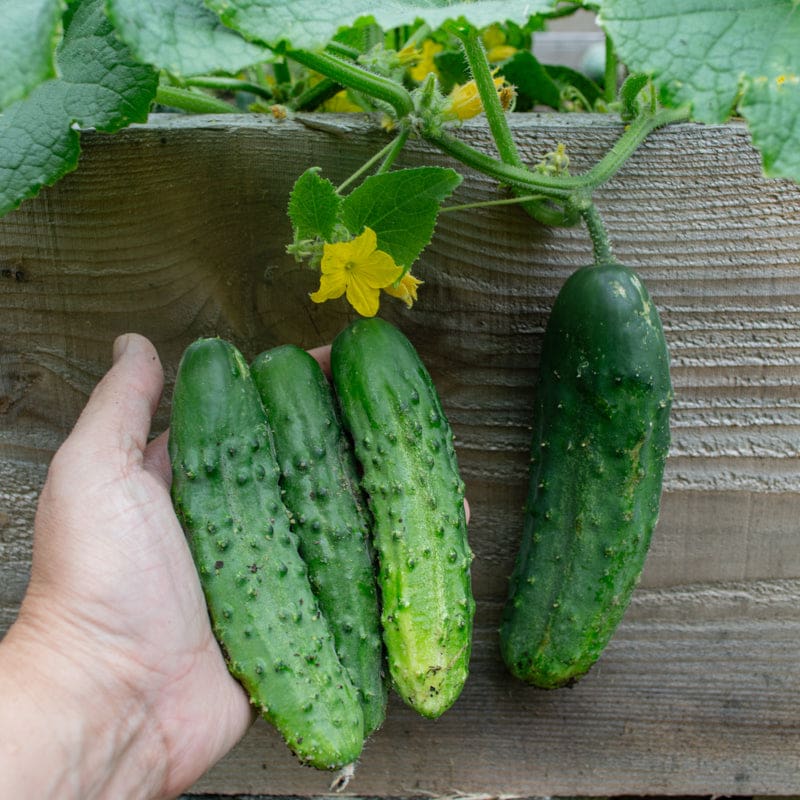
saving cucumber seeds for planting Patio Snacker Cucumber (F1 Hybrid 55 Days) – Pinetree Garden SeedsPatio snacker is a slicing cucumber bred especially for containers and raised beds, but also grows well in the ground too. Patio snackers space saving plants set fruit without pollination and produce vigorous, short branching vines with high yields and a continuous harvest. Cukes are 6 8 long, have good flavor and crunch, are bitter free with medium green skin and moderate spines. A good variety to grow in large containers with a trellis. 10 seeds

Patio snacker is a slicing cucumber bred especially for containers and raised beds, but also grows well in the ground too. Patio snackers space saving plants set fruit without pollination and produce vigorous, short branching vines with high yields and a continuous harvest. Cukes are 6-8” long, have good flavor and crunch, are bitter free with medium green skin and moderate spines. A good variety to grow in large containers with a trellis.

10 seeds


PLANTING

Cucumis sativus

Germination: 4-10 days

Germination Temperature: Optimum soil temperatures 70-85ºF

Seed Sowing Depth: 1/2-1" deep

Sowing Indoors: 3-4 weeks before the last frost. Provide 70-85ºF soil temperature. Sow 2-3 seeds per cell/pot. Sowing into individual biodegradable peat/cow pots reduces root damage when transplanting. Transplant 36-48" apart after the last frost. 

Sowing Outdoors: Sow after the last frost when the soil temperature is over 70ºF. Sow a few seeds every 36-48". 

Harvest: Check and pick every day to keep the harvest flowing.

Tips: Patio Snacker Cucumber should be planted in fertile soil, amended with compost or well-rotted manure, and kept well watered. Trellising the vines allows for good air circulation, takes up less space, and provides shade for heat-sensitive crops like lettuce. They benefit from growing on black plastic and by using row covers for weed, insect control, and more rapid growth.

Shipping Notes
  • Free Standard Shipping on $100+ Orders to the USA.
  • Except Preorder products are shipped in 48 hours.
  • Delivery to the USA:
  1. Standard Shipping : 3-10 business days
  • If time is of the essence, please consider selecting expedited delivery for faster service.
Exchange/Return Notes
  • We offer a 30-day return/exchange service after receiving.
  • Final sale items are not eligible for returns or exchanges.
  • To process your return/exchange, please contact us at [email protected]
  • Please click here for more details>>> Return & Exchange Policy
SKU: 59971242464

Discover Niche Categories That Outsell saving cucumber seeds for planting

Top-Converting Item to Boost Your Average Order

4.8 ★★★★★
Based on 29 reviews
Sort
Highest Rating
Newest First
Oldest First
Product Reviews
J
Verified Purchase
Joe S
New York, US
★★★★★ 4
ITS GOOD OIL
Size: 5 Quarts
OVERALL NOT BAD BUT USING IT TO SEASON A CAST IRON WILL CREATE A BIT TOO DARK OF A SHEEN. WISH THE MANUFACTURER MENTIONED THAT
WAS THIS REVIEW HELPFUL?YesReportShare
Reviewed in the United States on April 8, 2025
P
Verified Purchase
patricia
New York, US
★★★★★ 5
buenos
Size: 5 Quarts
Siempre compro de este aceite y es buenisimo me gusta
WAS THIS REVIEW HELPFUL?YesReportShare
Reviewed in the United States on May 5, 2026
E
Verified Purchase
E. K. Byham
Cuba, US
★★★★★ 5
An essential work in putting American history in perspective
Format: Hardcover
This is a great book. It is not a book for everyone, however. If you don't know the difference between the Pilgrims and the Puritans, and I don't mean just when they arrived, try something simpler. It is a fascinating read if you already have some knowledge. For example, had I not been familiar with Hudson River geography and history, I'm not sure I would have been able to follow Bailyn's account of New Netherland. Naturally, as in any history, the most interesting stories are those you haven't heard before. For me, that was the information about New Sweden; I even read that section first. What makes Bailyn's book great, however, is his ability to make one see material one already knows a great deal about in new ways. Although he never addressed this question per se, he helped me answer a question that has been on my mind for at least fifteen years, and on which I've done considerable research - why did the Puritans, who arrived in 1630 as staunch Presbyterians, deriding their Separatist/Congregationalist Pilgrim neighbors, declare themselves Congregationalists in 1648 in the Cambridge Platform? (In part, the answer Bailyn helped me surmise is simply that when two or three Puritans gathered together, they had at least four different theological positions. It was hard enough to reconcile them in a single congregation; a presbytery would have been impossible.) The book also caused me to reassess my whole viewpoint on early Connecticut, and I certainly came to appreciate the importance of John Winthrop, Jr. beyond his role there. It is amazing too that Bailyn covers such a wide range of issues while devoting relatively few pages to each. The review in The New York Times Book Review, at least as I recall it, was wrong. While that reviewer praised the Virginia, Maryland and New Sweden/New Netherland portions, the New England portion (about 40% of the book) was dismissed as being only of interest to genealogists. While it is true that the earlier sections were more reflective of the book's subtitle, "The Conflict of Civilizations," the New England section would be of interest to a rather small portion of the genealogical community. (For example, I learned nothing new about my only ancestor discussed in the book, William Vassall.) I doubt if that reviewer has ever seen an on-line genealogy, which frequently contain claims such as that so and so was born in 1585 in the United States. As I have already said, the New England section, like the rest of the book, does a marvelous job of putting information in perspective; something that anyone interested in history needs to do.
WAS THIS REVIEW HELPFUL?YesReportShare
Reviewed in the United States on July 10, 2013
L
Verified Purchase
LPThomas
Louisville, US
★★★★★ 4
Interesting and important book
Format: Hardcover
This book looks at the motivations and demographics of the first wave of English immigrants to flee to what was to become the USA. Interestingly written, it explores the educations, positions of and the relationships of the earliest settlers to our east coast. I read it while researching our Family Tree and finding the people connected before coming, and for generations after. The endless Indian wars were a revelation, as was the tale of the oppressed becoming the oppressors as Quaker families fled Massachusetts for New Netherlands.
WAS THIS REVIEW HELPFUL?YesReportShare
Reviewed in the United States on March 9, 2013
R
Verified Purchase
RobCargill
Whiting, US
★★★★★ 5
The Barbarous Years: The Peopling of British North America: The Conflict of... Bernard Bailyn
Format: Hardcover
A remarkable book!!! I have never read such a comprehensive book on early United States history that contained so much information I had never read before. How the status of "indentured servant" existed alongside the origins of slavery in Virginia and Maryland (along the Chesapeake Bay) was both remarkable and horrible. That a white man (typically, landowner) could have a child with a (black) slave who would become a free person at adulthood (earliest laws) created problems (they needed the "help"), so this law of the 1650s-1660s was changed! And if a white (free) woman had a child with a (black) slave, the resulting child would remain a slave! Matrilineal or patrilineal human rights, that is the question. Indentured servant, but with no expiration date. I had never before read how people in this country were real "pioneers" in the creation of slavery - at least with slavery of humans captured from the continent of Africa! It seems that whatever voices of "Christian" decency there might have been at the time - church based values or ones simply based in the hearts of people living here - they were drowned out by commercial interests or those who simply couldn't be bothered by such concerns. I hope you read this book and recommend it to your friends! Sincerely, Bob Cargill, Minneapolis
WAS THIS REVIEW HELPFUL?YesReportShare
Reviewed in the United States on April 19, 2013

recommand products