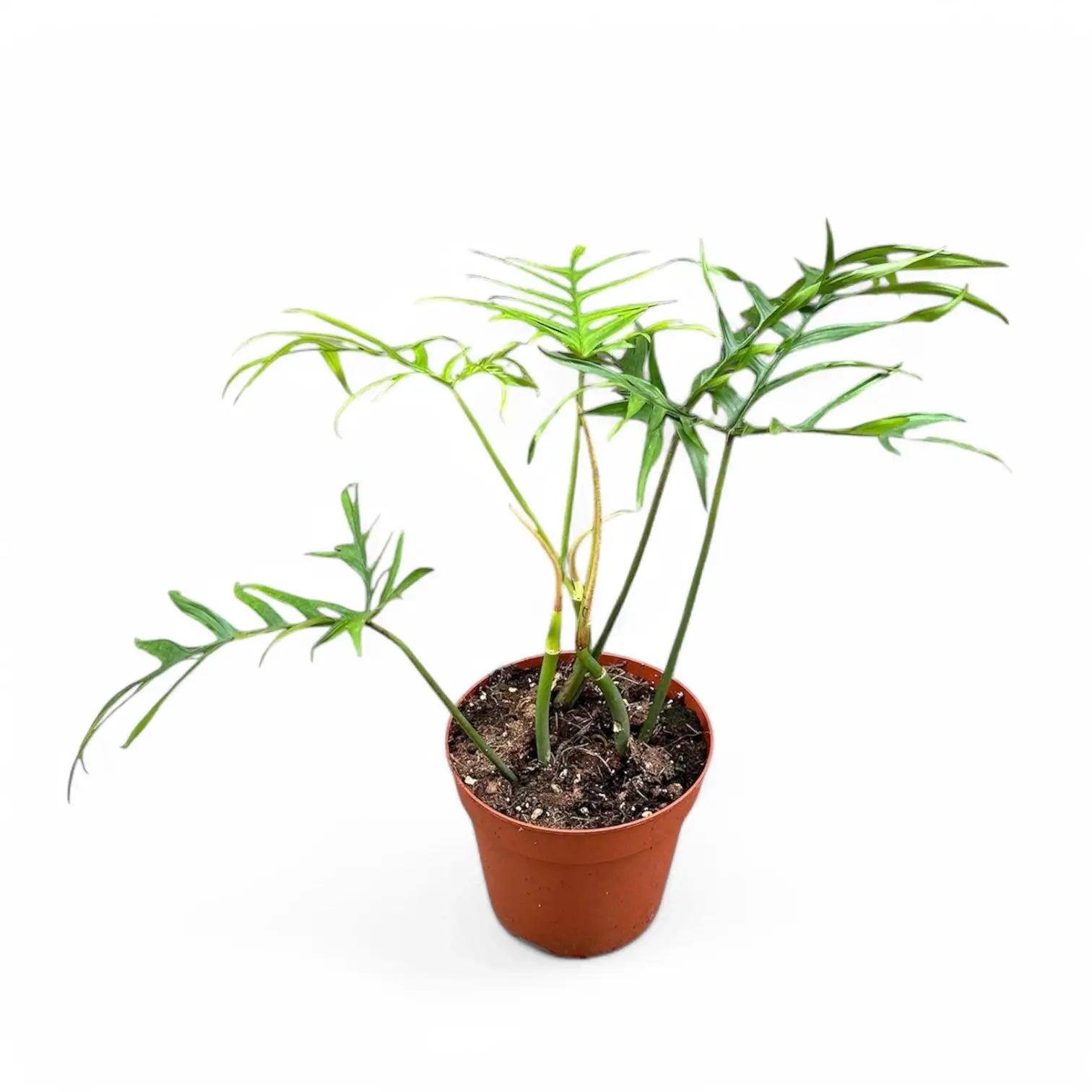
SKU: 60467822536
philodendron polypodioides care

philodendron polypodioides care Philodendron polypodioides – Foliage Factory

Sale price$22.48 Regular price$24.98
Save 10%

Pay in installments of $6.25 with ShopPay, AfterPay and Klarna

Shipping Estimate
USA
  • USA
  • CAN

Ships within 48 hours · Estimated delivery Jul 22 - Jul 27

Promo Codes Available:

For Your Every Summer RSVP, with Code: SUMMER15

Description

philodendron polypodioides care Philodendron polypodioides – Foliage FactoryPhilodendron polypodioides Philodendron polypodioides is grown for finely divided green leaves with narrow lobes and a light, almost fern like outline. Young plants may show simpler blades at first, while mature climbing growth can develop clearer pedate division and longer, more defined lobes. This climbing Araceae plant benefits from warm temperatures, bright filtered light and a support that lets the stem climb as the foliage matures. The fine leaf

Philodendron polypodioides

Philodendron polypodioides is grown for finely divided green leaves with narrow lobes and a light, almost fern-like outline. Young plants may show simpler blades at first, while mature climbing growth can develop clearer pedate division and longer, more defined lobes.

This climbing Araceae plant benefits from warm temperatures, bright filtered light and a support that lets the stem climb as the foliage matures. The fine leaf shape becomes clearer when the plant grows steadily, roots well, and develops beyond its juvenile form.

Narrow lobes and climbing growth in Philodendron polypodioides

  • Leaf shape: Pedate, divided leaves with narrow lobes that become clearer as the plant matures.
  • Leaf outline: Fine, deeply cut green foliage with a light, fern-like visual texture.
  • Growth habit: Climbing Philodendron with nodes and aerial-root growth along the stem.
  • Maturity change: Juvenile leaves can be simpler, with stronger division developing on settled climbing growth.
  • Indoor character: A vertical-growing aroid with delicate divided leaves and a slim mature outline.

Divided foliage development in Philodendron polypodioides

The fine divided outline becomes more obvious as the plant gains size. Juvenile leaves can look simpler, while settled climbing growth can produce blades with clearer lobe separation and a more defined pedate shape.

A pole, plank or board helps the stem stay upright and gives aerial roots a surface to contact. Warmth, steady moisture and an airy root zone support stronger new leaves without keeping the substrate constantly wet.

Care for Philodendron polypodioides

  • Light: Place Philodendron polypodioides in bright filtered light. Harsh direct sun can scorch or dry the narrow lobes.
  • Water: Water when the upper part of the mix has started to dry, then let the pot drain fully.
  • Humidity: Moderate to higher humidity helps divided blades expand cleanly without dry edges.
  • Temperature: Keep warm and stable, ideally above 18 °C, with protection from cold draughts and cold wet substrate.
  • Substrate: Use a chunky aroid mix with bark, mineral pieces and coarse fibre so the roots stay oxygenated.
  • Support: Add support early enough for the stem to attach before the plant becomes long and loose.
  • Pot choice: Use a free-draining pot that can hold the support securely without compacting the root zone.
  • Repotting: Repot when roots fill the pot, the mix breaks down, or the support no longer sits firmly.
  • Fertilising: Feed lightly during active growth with a balanced houseplant fertiliser at diluted strength.
  • Growth rate: Growth is usually moderate indoors, with clearer leaf division developing on warm, supported plants.

Philodendron polypodioides pruning, propagation and mineral substrates

  • Pruning: Trim damaged leaves at the petiole base or cut an overlong stem above a healthy node.
  • Propagation: Propagate from stem cuttings with at least one node and healthy aerial-root tissue.
  • Semi-hydro: Suitable for mineral or semi-hydro substrates if roots are kept warm, oxygenated and not stagnant.
  • Training: Guide young stems onto support before internodes harden and the plant starts to lean.

Philodendron polypodioides weak division, root stress and pests

  • Weak division: Juvenile growth is naturally simpler, but low light or unsupported stems can also produce smaller, less divided leaves.
  • Root rot: Dense wet substrate can damage roots and slow new leaf production.
  • Scorched lobes: Direct sun can dry or mark the narrow leaf segments.
  • Dry edges: Low humidity, underwatering or heat stress can crisp the fine leaf margins.
  • Pests: Check new growth, leaf backs, petioles and lobe bases for thrips, spider mites, mealybugs and scale.

Philodendron polypodioides safety

Philodendron polypodioides contains insoluble calcium oxalate crystals. Keep the plant away from pets and children that may chew leaves, petioles or stems.

Philodendron polypodioides name origin and botanical background

Heinrich Wilhelm Schott described the genus Philodendron in 1829 in Wiener Zeitschrift für Kunst 3: 780; the name combines Greek roots meaning “loving” and “tree.” Philodendron polypodioides was published by A.M.E. Jonker and Jonker in Acta Botanica Neerlandica 15: 143 in 1966 from Suriname material. The epithet polypodioides means Polypodium-like, referring to the fine, fern-like divided leaf outline.

The name is currently treated botanically under Philodendron pedatum, while Philodendron polypodioides remains the familiar horticultural name for this narrow-lobed plant.

With fine divided leaves and climbing growth, Philodendron polypodioides develops a light, narrow-lobed profile as it matures on support.

Shipping Notes
  • Free Standard Shipping on $100+ Orders to the USA.
  • Except Preorder products are shipped in 48 hours.
  • Delivery to the USA:
  1. Standard Shipping : 3-10 business days
  • If time is of the essence, please consider selecting expedited delivery for faster service.
Exchange/Return Notes
  • We offer a 30-day return/exchange service after receiving.
  • Final sale items are not eligible for returns or exchanges.
  • To process your return/exchange, please contact us at [email protected]
  • Please click here for more details>>> Return & Exchange Policy
SKU: 60467822536

Discover Niche Categories That Outsell philodendron polypodioides care

Top-Converting Item to Boost Your Average Order

4.2 ★★★★★
Based on 26 reviews
Sort
Highest Rating
Newest First
Oldest First
Product Reviews
A
Verified Purchase
Alexander Kobulnicky
Charlottesville, US
★★★★★ 4
The Sidekick in Early-Modern Literature.
Tom Jones is probably the most influential novel in English history, pioneering elements like complex characterization, social criticism and authorial interjection. But you already knew that. What you want to know is, is this a good book for us in the 21st century. And here, it's not so clear. The dialogue is pretty brisk, and some of the exchanges (the stereotypical Whig Mrs. Western arguing with her Jacobite brother is a particular treat) are actually funny. The latter part of the novel evolves into a farce, with a dozen characters engaged in scheming against one another, while Tom and Sophia helplessly go along. Farce works better in drama, where it has a faster pace, but it's always a welcome mode of comedy. You don't see enough farces. Some of the characters are evocative (why do I picture Blifil as looking like Ted Cruz?) but some are not: Dowling is just a lawyer, and Mrs. Miller is a good woman, like thousands who have come since, and that's all there is to it. It's not as if every character needs to, or can, be a fully realized person, but the parts of the novel spent with these human plot devices do feel mechanical. But Mr. Partridge, Tom's traveling companion, is in a different category altogether, and he just poisons the parts of the novel that he features in (chiefly the middle third). Eighteenth Century literature has a depressing reliance on goofy loose-lipped sidekicks: Mr. Partridge, Hugh Strap, Humphrey Clinker, Andrew Fairservice, Friday. Sometimes they're servants, but sometimes they're just stupid friends. Part of this must be practical: It's difficult to follow a wandering hero (and why are the heroes of these novels always wandering? But that's a different question altogether) without giving him a friend to talk to. Maybe early novelists had a hard time sketching characters who didn't have a way to discuss the ongoing action. But mostly, I think this is the bad influence of Don Quixote, which was becoming increasingly popular in England during this period. Sancho Panza is OK, and he's certainly the funniest element of that leaden tome. But Mr. Partridge *is* Sancho Panza, cowardice, superstition and all, and one Sancho Panza was more than enough. You know? There's a limited number of things that a silly, selfless, lazy pal can do, and it's hard to read about the same old doofus, yet again.
WAS THIS REVIEW HELPFUL?YesReportShare
Reviewed in the United States on April 28, 2016
D
Verified Purchase
Diana S. Long
New York, US
★★★★★ 5
Delightful and entertaining
Format: Kindle
314. The History of Tom Jones: a foundling by Henry Fielding (Novel-Audible/E Book-Fiction) 5* I read along with the Audible of the novel which I found a highly delightful and entertaining experience. The narrator, Bill Homewood, who performed the audio version of the work was excellent doing the various characters as well as the invisible narrator (author) of the story. The Synopsis is as follows: A foundling of mysterious parentage brought up by Mr. Allworthy on his country estate, Tom Jones is deeply in love with the seemingly unattainable Sophia Western, the beautiful daughter of the neighboring squire—though he sometimes succumbs to the charms of the local girls. When Tom is banished to make his own fortune and Sophia follows him to London to escape an arranged marriage, the adventure begins. A vivid Hogarthian panorama of eighteenth-century life, spiced with danger and intrigue, bawdy exuberance and good-natured authorial interjections, Tom Jones is one of the greatest and most ambitious comic novels in English literature. It is rather brilliant, and there is no lack of shenanigans as we follow Jones through his history and the reader never knows when and where the author will abruptly go off on a tangent, told in a most eloquent manner, end with a flourish and no doubt tossed his quill down and took a bow. I am either taken in by some farce or thoroughly enchanted by this author. As Fielding is rather the loquacious writer this read comes in Audible time at almost 38 hours or roughly 1,000 pages but worth every minute spent on it.
WAS THIS REVIEW HELPFUL?YesReportShare
Reviewed in the United States on December 19, 2017
H
Verified Purchase
Hawkeye
Massapequa, US
★★★★★ 5
An epic nearly 300 years old
Tom Jones is the comical history of a young man who was adopted into a rich family and faces a brother who is against him all while they grow into maturity. It’s kind of like the first part of JoJo’s Bizarre Adventure except with Jonathan and Dio being reversed and with no vampires, but there is a moment where someone gets really scared while watching the ghost in hamlet so there’s at least some notion of the supernatural. Getting into it though, it’s an easy read despite it’s length encompassing 18 books, it’s honestly fascinating that it was able to be written so cleanly considering how many gaps there must of been between these books being written, it reads to us as a consistent narrative, but to imagine the wait and changing times that must have occurred during the duration to the story is really interesting to consider. The role and function of the narrator is probably the only real glimpse of this in narrative as he’s really just talking to us in the first chapter of every book, but the narrator being so clever and charming makes the only thing of interest be him and the relationship we form to him. It’s an incredible experience that I can recommend the entire story for alone. Getting to know the narrator is like talking to an old, reliable friend and it’s worth reading into nearly 300 years on.
WAS THIS REVIEW HELPFUL?YesReportShare
Reviewed in the United States on March 27, 2021
A
Verified Purchase
Astronomere
Natrona Heights, US
★★★★★ 3
Jone's Tome
This book seems more likely to be enjoyed by literary academics than by folks looking for a good story. While Henry Fielding is indeed a learned man of letters and does write in a fine and high style with many subordinate clauses, the actual substance thereof is no better than more earthy pedestrian fare. To put it plainly, I found most of the book a rather tedious slog. This is my personal subjective opinion only as I do believe Henry Fielding is well esteemed by serious literary scholars who undoubtedly see the matter quite differently. I am judging this book purely by my own personal enjoyment of the actual narrative and plot construction, and by my difficulty in teasing out the subordinate clauses which are so bound up with this age of writing. Imagine a very learned and erudite professor trying to tell you a common bawdy tale, but taking forever to do it while using the most stuffy language. I had thought that my deeper background in reading many Victorian era novels would qualify me to enjoy this one, but the language was a little too dense to make it an enjoyable read. I was however able to follow the story as well as the side epistles the author directly addresses the reader with (which I find to be an annoying device also much used in that era). I did read the whole thing and did take pleasure in some parts, but I must confess my bias towards this earlier era of novel writing. It takes very learned men of their age and has them writing long-winded tales of inferior construction when compared against later centuries. I know this is not their fault any more than you can blame a champion athlete of his time for having his record broken decades later when methods have universally improved.
WAS THIS REVIEW HELPFUL?YesReportShare
Reviewed in the United States on July 19, 2015
O
Verified Purchase
Oren T. Bergfald
Birmingham, US
★★★★★ 5
Text is nearly 300 years old…!!! 😅😅😅
Read this publication alongside Cliff Notes. It’s a fun book, but the Latin poems and phrases can be intimidating. In addition, watch the movie. It’s an old text, so utilize resources to develop your understanding. 📚📖📙📘📗📕
WAS THIS REVIEW HELPFUL?YesReportShare
Reviewed in the United States on June 1, 2026

recommand products