SKU: 63129731460
variegated large elephant ear plants

variegated large elephant ear plants Camouflage Elephant Ear – Plant Detectives

Sale price$21.83 Regular price$24.26
Save 10%

Pay in installments of $6.07 with ShopPay, AfterPay and Klarna

Shipping Estimate
USA
  • USA
  • CAN

Ships within 48 hours · Estimated delivery Jul 17 - Jul 22

Promo Codes Available:

For Your Every Summer RSVP, with Code: SUMMER15

Description

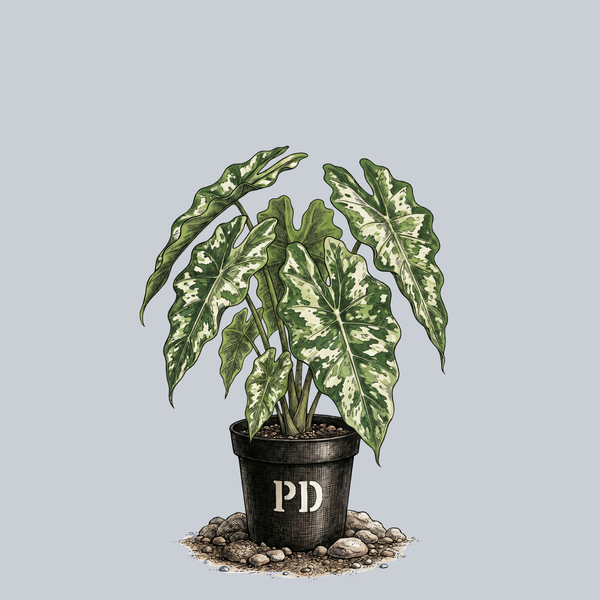
variegated large elephant ear plants Camouflage Elephant Ear – Plant DetectivesCamouflage Elephant Ear (Alocasia macrorrhiza 'Camouflage') Camouflage Elephant Ear is a striking tropical plant valued for its oversized foliage, upright habit, and dramatic variegation. Its large green leaves are splashed and marbled with lighter green, cream, and near white markings, creating a bold camouflage like pattern that stands out in containers, bright indoor spaces, patios, and tropical style plantings. This selection brings strong foliage

Camouflage Elephant Ear (Alocasia macrorrhiza 'Camouflage')

Camouflage Elephant Ear is a striking tropical plant valued for its oversized foliage, upright habit, and dramatic variegation. Its large green leaves are splashed and marbled with lighter green, cream, and near-white markings, creating a bold camouflage-like pattern that stands out in containers, bright indoor spaces, patios, and tropical-style plantings. This selection brings strong foliage impact without relying on flowers, making it especially useful where texture, scale, and color are the main design goals. With bright filtered light, warmth, humidity, steady moisture, and excellent drainage, Camouflage Elephant Ear adds collector-quality character and lush tropical structure to the landscape or interior plant collection.

Distinctive Features

Camouflage Elephant Ear produces large, glossy, arrow-shaped to heart-shaped leaves with irregular variegation that can include deep green, light green, cream, and white patches. Because the variegation varies from leaf to leaf, each plant has a unique pattern and a strong ornamental presence. The leaves are held upright on sturdy stems, giving the plant a bold vertical form that works well as a specimen in large containers or protected garden beds. Flowers may appear on mature plants as a spathe and spadix, but this Alocasia is grown primarily for its dramatic foliage and architectural habit.

Growing Conditions

  • Sun: Grows best in very bright indirect light, filtered sun, or partial shade, with protection from harsh direct afternoon sun that can scorch the variegated foliage.
  • Soil: Prefers fertile, organically rich, well-drained soil that holds light, consistent moisture while allowing good airflow around the roots.
  • Water: Keep the soil evenly moist during active growth, allowing the upper portion to dry slightly before watering again, and avoid soggy or waterlogged conditions.
  • USDA Zones: Best grown outdoors year-round only in frost-free tropical to subtropical climates, generally USDA Zones 10 to 11, and treated as a houseplant or seasonal container plant in colder regions.
  • Mature Size: Typically reaches about 4 to 6 feet tall and 3 to 5 feet wide in containers or indoor settings, with larger size possible outdoors in warm, humid, frost-free climates.
  • Habit: Forms a large upright tropical plant with bold variegated leaves rising from a clumping base on sturdy stems.

Ideal Uses

  • Focal Point: Use as a dramatic foliage focal point in large containers, bright indoor rooms, patios, courtyard gardens, poolside plantings, or protected tropical beds where its variegated leaves can stand out.
  • Collector Plant: Feature in a specialty tropical plant collection where its irregular camouflage variegation can be appreciated up close.
  • Patio Container: Grow in a large decorative pot to create bold summer foliage that can be moved indoors or protected before cold weather.
  • Tropical Garden: Pair with bananas, cannas, caladiums, gingers, ferns, and other bold foliage plants for a layered warm-season display.
  • Indoor Feature: Use in bright interior spaces with enough room, warmth, and humidity to support its large leaves and upright growth.

Low Maintenance Care

  • Watering: Water regularly during active growth to maintain even moisture, then reduce watering when growth slows in cooler seasons or lower light.
  • Humidity: Provide moderate to high humidity indoors to help reduce leaf edge browning and support clean foliage growth.
  • Light Care: Keep in bright filtered light and avoid harsh direct sun, especially on pale variegated sections that can mark or scorch more easily.
  • Fertilizing: Feed during the active growing season with a balanced fertilizer to support large foliage and steady growth.
  • Overwintering: Move container plants indoors before cold weather or protect them from frost, since this tropical plant is not reliably cold hardy in freezing climates.
  • Leaf Cleanup: Remove yellowing, damaged, or tired leaves as needed to keep the plant looking clean and encourage fresh growth.

Why Choose Camouflage Elephant Ear?

  • Unique Variegation: Displays large green leaves splashed with lighter green, cream, and white markings for a distinctive camouflage effect.
  • Bold Foliage: Produces oversized leaves that bring strong tropical texture and visual impact to containers and protected landscapes.
  • Architectural Form: Adds upright structure and height without needing flowers for ornamental value.
  • Container Friendly: Works well in large decorative pots where it can be featured outdoors in summer and protected indoors before cold weather.
  • Collector Appeal: Offers a rare, high-impact look for tropical plant enthusiasts who want foliage with unusual patterning and strong presence.

Camouflage Elephant Ear is an excellent choice for gardeners and collectors who want a tropical plant with bold scale, unusual foliage, and strong ornamental character. Its oversized variegated leaves, upright habit, and lush growth make it a standout option for bright indoor spaces, large containers, patios, and protected tropical-style plantings.

Shipping Notes
  • Free Standard Shipping on $100+ Orders to the USA.
  • Except Preorder products are shipped in 48 hours.
  • Delivery to the USA:
  1. Standard Shipping : 3-10 business days
  • If time is of the essence, please consider selecting expedited delivery for faster service.
Exchange/Return Notes
  • We offer a 30-day return/exchange service after receiving.
  • Final sale items are not eligible for returns or exchanges.
  • To process your return/exchange, please contact us at [email protected]
  • Please click here for more details>>> Return & Exchange Policy
SKU: 63129731460

Discover Niche Categories That Outsell variegated large elephant ear plants

Top-Converting Item to Boost Your Average Order

4.3 ★★★★★
Based on 24 reviews
Sort
Highest Rating
Newest First
Oldest First
Product Reviews
T
Verified Purchase
TMB
Birmingham, US
★★★★★ 5
OBSESSED!!!!!
Format: Paperback, Format: Paperback
I gave it 5 stars because it deserves the flowers. I do wish the paper was a little better quality. I think it would help make the pictures pop more. Regardless, this book is worth every penny. I haven't found anything else like it. The book is clear, concise, and isn't bogged down with too many details - just the facts m'am. It's a perfect starting reference to send someone down 101 different rabbit holes. I hope someday he puts out a hardback version on thick, slick paper with beautiful, glossy photographs. That would be lovely. For now, this will more than suffice. You get just enough about each artifact to get you going. From there, you can decide how to use your favorite search engine.
WAS THIS REVIEW HELPFUL?YesReportShare
Reviewed in the United States on November 5, 2025
A
Verified Purchase
allison
Port Orchard, US
★★★★★ 5
A great reference for Biblical factual archeology
Format: Paperback
I just received this book and I am so excited. It is a great tool and reference for Biblical studies. Each artifact has a great photograph next to the quick eye catching dates, discovery, period, keywords and Biblical passage. Then a brief but to the point description. It is simple and effective. Very easy to refer when reading your Bible or if you are just interested in archeology. Each artifact is about 2 pages and nothing more which is perfect for references. What a great book!
WAS THIS REVIEW HELPFUL?YesReportShare
Reviewed in the United States on March 1, 2025
S
Verified Purchase
sandyrouse
Carnegie, US
★★★★★ 5
Excellent and in-depth archeologic finds that authenticate Bible history.
Format: Paperback
Archeology is proving much of the Bible's history as true. This book really delves into various sites and provides a lot of detail. My type of reading.
WAS THIS REVIEW HELPFUL?YesReportShare
Reviewed in the United States on February 21, 2026
A
Verified Purchase
Angie Criss
Carnegie, US
★★★★★ 5
Great information and pictures
Format: Paperback
Great information on Biblical sites, beautiful pictures, and a pretty book as well. I gave several of these to my family for Christmas. Everyone seemed to love them. The only thing I will caution you about is that the book is small.
WAS THIS REVIEW HELPFUL?YesReportShare
Reviewed in the United States on January 22, 2026
M
Verified Purchase
Mareadas
Charlottesville, US
★★★★★ 4
Knowledgeable and delectable book.
Format: Paperback
This book shows an excellent archaeological evidence of the Bible accuracy of places, names, events, etc. and proving for the Christians that the Bible is a historical document as well as the inspired inerrant word of God. The majority of the book is interesting and delectable, I mean, the pages where the author presents archaeological facts such as the artifacts and their correlation with people, places times, events and practices recorded in the Bible. But I do not like when the author make personal assumptions and do not present any proof of that. He says: it probably be…. it may be… Here I show three cases of this conjectures;: 1.The author seems to affirm that the triumphal entry of Jesus into Jerusalem, or at least, the name of this event, was derived from the Roman triumph celebration. He says (page 231), regarding to the Roman Empire and the life of Jesus: “By the time of Jesus, the requirements and meaning of a triumphal entry had shifted slightly from its earlier roots associating it with a conquering hero, as it became even more significant and representative of kingship and divinity”. He continues to say: “In ancient Roman culture, a triumphant victor, known as vir triumphalis (“man of triumph”) would enter the city in a celebration parade wearing the laurel wreath and a purple garment, which identified him with the royal and the divine, while riding in a chariot pulled by four horses, alluding to Sol the sun god”.  But if we compare the Roman triumph celebration with the entry of Jesus into Jerusalem described in the Bible, it is not derived from the Roman culture but is the exact fulfillment of the prophesy of Zechariah 9:9. I do not see any correlation between the two celebration; Jesus did not ride a horse but a donkey to signify peace, meekness and humility. It was not a pompous entrance of a conquering hero or king wearing a expensive garment and royal crown. 2.Even though, it is not possible to identify the location of the tomb of Jesus with absolute certainty; the author states (page 199) that the tomb of Jesus is located at the Church of the Holy Sepulchre possible based on “the restoration work to the edicule and an arcosolium tomb from the Roman period found in the church of the Holy Sepulchre”. The author also affirms without giving any proof that: “Christians in Jerusalem then passed down a continuous memory of the location of the tomb (of Jesus) from the time of the burial and resurrection in AD33 until construction of the Church of the Holy Sepulchre was started in about AD326”. But where are the records of that time? The author probably based his statement on Eusebius who lived in the 3rd and 4th centuries AD. According to the history , the Church of the Holy Sepulchre was built by the Roman Emperor Constantine around 326 AD, when her mother the Queen Helena, wanted to replace the pagan temples with Christian churches; she met the Bishop Macarious of Jerusalem who determined the location where Jesus had been buried at the place where was a temple to the Greek goddess Venus. At the beginning of the construction of the church, a rock-cut tomb was found there and an edicule was built to protect the site. But later the edicule was destroyed and rebuild. More tombs has been found under this church. How to be sure or verify that this rock-cut tomb was the one where Jesus was buried? 3.The author is biased with respect to the Masoretic Text, he make a statement but does not support it with any evidence in this regard. Writing about the Dead Sea Scrolls (Page 173) he states: “And certain passages in the Masoretic text seem to have been intentionally modified to match ideas and theology of medieval Judaism.” it is a bad accusation.
WAS THIS REVIEW HELPFUL?YesReportShare
Reviewed in the United States on April 23, 2021

recommand products