SKU: 63332347849
croton mammy toxic to cats

croton mammy toxic to cats Croton Mammy

Sale price$26.25 Regular price$29.17
Save 10%

Pay in installments of $7.29 with ShopPay, AfterPay and Klarna

Shipping Estimate
USA
  • USA
  • CAN

Ships within 48 hours · Estimated delivery Oct 19 - Oct 24

Promo Codes Available:

For Your Every Summer RSVP, with Code: SUMMER15

Description

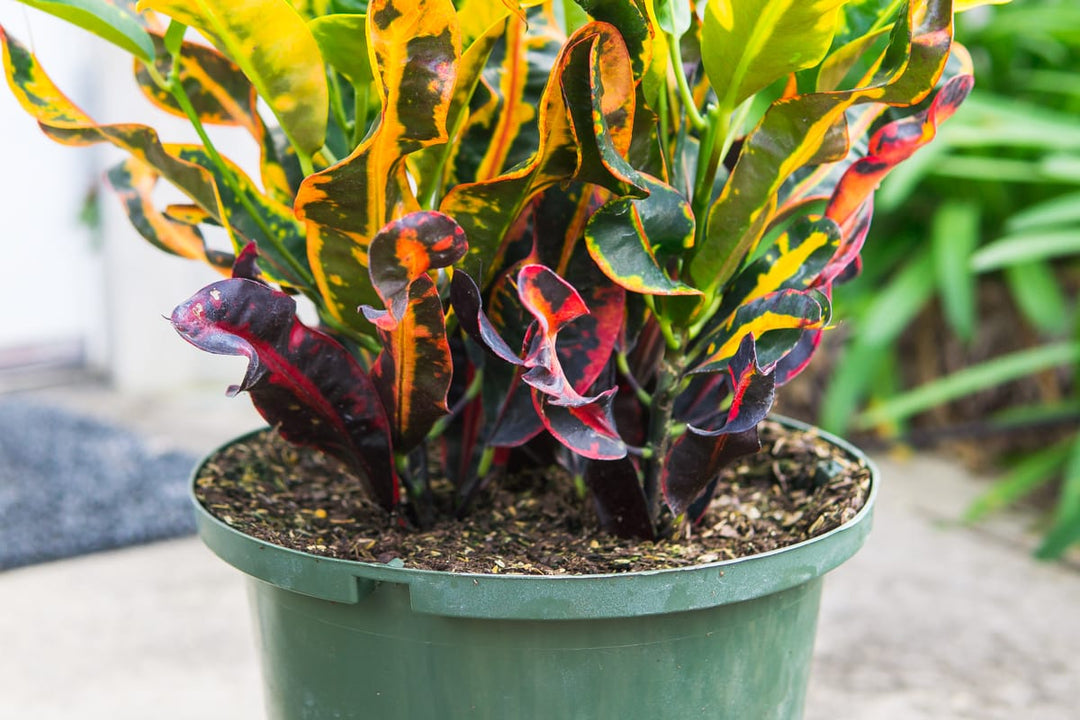
croton mammy toxic to cats Croton MammyCroton Mammy Brings You Stunning Multi Colored Foliage The Croton 'Mammy' stands out with its spectacular glossy multi colored leaves, perfect for brightening up any indoor or outdoor setting. The Mammy Croton (Codiaeum Varigatum) plant has multicolored leaves with hues of yellow, red, orange, purple, and green. The bright colorful leaves are unusual, sword shaped, with linear growth habits that lean towards the light. The leaves are evergreen and

Croton ‘Mammy’ Brings You Stunning Multi-Colored Foliage

The Croton 'Mammy' stands out with its spectacular glossy multi-colored leaves, perfect for brightening up any indoor or outdoor setting.

The Mammy Croton (Codiaeum Varigatum) plant has multicolored leaves with hues of yellow, red, orange, purple, and green. The bright colorful leaves are unusual, sword-shaped, with linear growth habits that lean towards the light. The leaves are evergreen and will stay colorful all year long as they spiral around the trunk. It is a smaller species of the popular Petra Croton variety.

Croton Red Mammy plant is suitable for growing indoors or outdoors. Growers in colder climates can keep it in containers and move Croton Mammy indoors for winter when temperatures drop below 55 F. You can keep crotons indoors as house plants all year long with the proper care. They fit into almost any room including kitchens, offices, bedrooms, bathrooms, or living rooms & add the pop of color your home decor needs!

When hardy enough to be grown outdoors in USDA growing zones 9-11, they look incredible when planted in garden beds as accent plants, incorporated into hedges, or planted into containers where the vibrant color can be seen.

Discover the Perfect Plants Difference

When you buy online from Perfect Plants Nursery, you get experts in cultivating landscape plants and houseplants. We've been a family-run farm since 1985 and deliver healthy, high-quality plants directly to your door. This ensures they arrive ready to thrive.

CROTON MAMMY CARE

The Crotons houseplants do need fertilizer annually that is applied in early spring and summer to help with growth and boost the beautiful colors that shine through the veiney leaves. It is not recommended to fertilize during fall and winter.

Croton watering is essential to keep the soil moist. Well draining soil is a must for these slow growing plants. If you are growing crotons in a pot, a drainage hole is necessary to avoid root rot. Water roughly once a week or whenever the potting soil feels dry to touch. Your watering schedule will vary depending on soil moisture, humidity, and temperatures.

There are no major Mammy Croton plant pest and disease issues and it is deer resistant.

How Much Sun Does a Croton Plant Need?

Crotons need a lot of bright sunlight. They are tropical plants native to India and require bright, direct light to thrive in warm, humid environments. A south or east facing window is best with plenty of full sun. If you are growing crotons outdoors, it can be in direct sunlight but harsh afternoon sun may scorch the leaves. They are not as sensitive as most and will grow towards the light wherever you plant them. Partial shade is best in hotter climates. The #1 sign your croton plant is not getting even sunlight is leaf drop.

How Big do Crotons Get?

The Mamey Croton height is up to 2-3 feet tall and 1-2 feet wide. It can be contained by regular pruning and shaped to any desired size. It’s perfect for growing in pots or small spaces in the garden. Mammy Croton spacing should be at least 1-2 feet apart to allow the root systems to grow to their fullest potential.

How to a Prune Croton Bush

It is not necessary to practice pruning on crotons unless it has become unruly and needs a trim. You can prune crotons at any time of the year but the very best time is in early spring before the active growing season begins. When pruning, be wary of the sap that leaks out of any pruning cuts. It can cause skin irritation. You may prune back dead leaves at any time to encourage new growth. Small pruning shears or scissors are your best tools for this practice.

*Disclaimer: Croton plants and cats do not mix well. Croton leaves are toxic to cats, dogs, and other pets so be sure to keep away and do not allow them to ingest any part of the potted plant.

Ordering the Croton Mammy online has never been more convenient, buy from Perfect Plants today and transform your home with vibrant colors.

Check our complete collection of tropical houseplants for sale.


    Shipping Notes
    • Free Standard Shipping on $100+ Orders to the USA.
    • Except Preorder products are shipped in 48 hours.
    • Delivery to the USA:
    1. Standard Shipping : 3-10 business days
    • If time is of the essence, please consider selecting expedited delivery for faster service.
    Exchange/Return Notes
    • We offer a 30-day return/exchange service after receiving.
    • Final sale items are not eligible for returns or exchanges.
    • To process your return/exchange, please contact us at [email protected]
    • Please click here for more details>>> Return & Exchange Policy
    SKU: 63332347849

    Discover Niche Categories That Outsell croton mammy toxic to cats

    Top-Converting Item to Boost Your Average Order

    4.7 ★★★★★
    Based on 25 reviews
    Sort
    Highest Rating
    Newest First
    Oldest First
    Product Reviews
    K
    Verified Purchase
    K. Ryan Kane
    Whiting, US
    ★★★★★ 4
    I enjoyed this book immensely
    Format: Paperback
    A pioneering book! It breaks new ground and proposes new ideas that are plausible. I enjoyed this book immensely. But with every pioneering book comes beliefs that may not always be what they seem. I withheld one star because there are some ideas proposed that I found hard to believe entirely. I like the fact that Dr. Schoch includes Biblical passages but I don't agree with the majority of his interpretations. For example, Ezekiel's writings and visions are not about shapes he saw in the sky that Dr. Schoch thinks are from solar outbursts or auroral displays. Instead, most of those are visions he had of the "Last Days." But he didn't know exactly what he was seeing so he did his best to describe the things he saw. The other point I would like to make is that not all of the glyphs from thousands of years ago could be describing auroral displays or solar outbursts. I would imagine that if solar flares were racing toward Earth, (1) there wouldn't be enough time to look at them and study their shapes because you would be racing for cover, (2) they would be too bright whereas nobody could actually look at them long enough to study their shapes even if they had modern sunglasses, and (3) there would be a lot more evidence of scorched and burned areas of Earth so that it would be more obvious if solar activity was what had set society back thousands of years. But I don't recall Dr. Schoch theorizing about these things. Overall the book is great and I think he right about a lot of things. Highly recommended!
    WAS THIS REVIEW HELPFUL?YesReportShare
    Reviewed in the United States on October 1, 2014
    C
    Verified Purchase
    Carol E.
    Massapequa, US
    ★★★★★ 5
    WHY YOU SHOULD BUY THIS BOOK
    Format: Paperback
    Forgotten Civilization by Dr. Robert Schoch Why should you buy this book? 1) You're already looking at it so you must have some interest in this topic. 2) Dr. Schoch has a great ability to take his, or others, theories and support them with well researched scientific data. This is helpful to those of us who are curious about alternative explanations but are still dependent on the "scientific thinking" paradigm. (He doesn't make statements like "when humans bred with aliens in 20,823 BC..."). 3) He always makes you think about conventional wisdom in a new way. For instance, in this book - the age of Easter Island statues (moai). How DID they get buried so deeply when they (conventionally) only go back to a South Pacific Polynesian settlement times?? I have stood in front of the moais on Easter Island and read many books on it's history and it never occurred to me to question the timeline. It takes that unique geologist perspective which Dr Schoch brings to his writings. 4) He introduces you to other researchers or writers that you will want to know more about. Like Thomas Brophy, Anthony Peratt, Paul LaViolette and many others. 5) The Appendices. Some excellent information on multiple topics included at the end of the book. 6) Because Dr. Schoch has gone where many others SHOULD go - against conventional archeological/historical wisdom which makes no sense. His initial theories on the age of the Sphinx as a young academic were very daring and absolutely correct. The geological community had no problem with his ideas - but Egyptologists did, and they have been after him ever since. Choosing a controversial research path has meant some changes in his academic career I'm sure, as "Academics," for all it's spouting of tremendous support for new knowledge and research is very much mired in politically correct concrete. (Go to Egypt and look for yourself. Even a casual tourist will see how wrong standard academic theories are currently). 7) I guarantee you will learn new and interesting things that just may change your life - or at the very least, change the way you think about the future. -C. Engel
    WAS THIS REVIEW HELPFUL?YesReportShare
    Reviewed in the United States on September 27, 2012
    K
    Verified Purchase
    Kindle Customer
    Houston, US
    ★★★★★ 3
    A Book About Everything and Nothing
    This was a great idea for a book and it's too bad that Mr. Schoch decided not to write it. Some of the ideas about solar events, the way the plasma manifested in the sky as it relates to ancient petroglyphs is fascinating. Mr. Schoch spent very little time in this space however (in spite of the book's title). Instead we got a brief, incomplete overview coupled with a survey of every piece of fringe science out there from the memory of water, to quantum entanglement to telepathy. There was the obligatory chapter on his work with the Sphinx of course. It always comes back to the Sphinx with this guy. Not an original thought in the book, but there was plenty of promotion of fringe science, especially the work of Paul LaViolette whose confusing and widely ignored and self-published work got several chapters. I gave the book 3 stars for its entertainment value and docked it two for not staying on point. This is still a great and fascinating subject. I wish Mr. Schoch thought so too.
    WAS THIS REVIEW HELPFUL?YesReportShare
    Reviewed in the United States on March 30, 2015
    C
    Verified Purchase
    Chongyean Cheang
    Dallas, US
    ★★★★★ 5
    An amazing book
    Format: Paperback
    Silent Spring by Rachel Carson is one book that has opened our minds to how much has gone wrong in the world. It is an immensely powerful scientific book for general readers packed full of verifiable research and data. Rachel Carson wrote the book about the widespread use of chemical pesticides that have wreaked havoc upon the water, the atmosphere, the soil, and the earth since the experiments conducted during World War II. Carson begins the book with a short chapter containing an imaginary scenario of a quiet American countryside in spring devoid of birds and other wildlife. Carson then asks a question which the book attempts to answer: "What has already silenced the voices of spring in many towns in America?" (Carson 1962) The other sixteen chapters fully detail how the use of chemical pesticides and herbicides impacts the environment and silences living species when people do not pay attention. In chapter two she makes the point that humans can alter nature. "The most alarming of all man's assaults upon the environment is the contamination of air, earth, rivers, and sea" (Carson 1962). The author demonstrates that people try to get a quick fix for their small problems but are often unaware of the consequences of their quick fix solutions. "We use the chemicals to kill weeds, insects, and pests…… They should not call insecticides but biocides" (Carson 1962). In the next chapter, "Elixirs of Death," she introduces chemicals which can harm health such as chlorinated hydrocarbons (e.g., DDT), organic phosphates, and other hydrocarbons that are more toxic than DDT such as dieldrin, Aldrin, and endrin. She tells the story of a child and family dog that was suddenly killed by the use on an endrin cockroach spray. When the chemicals are combined with one another, it leads to an unpredictable and harmful result in the atmosphere and living creatures. Carson continues in chapter 4 and five by describing the effect of pesticides in water and soil. Even though low concentrations of insecticide in the water is not detrimental, a habit of putting poison in water builds up and ends up passing into fishes, animals, and humans. DDD and DDE, the toxaphenes used in clear lakes destroy the human adrenal cortex (Carson 1962). Even though the chemicals had been deposited years ago, it was carried on in living species from generation to generation. Similarly, soil can be destroyed if it contains too many pesticides and these chemicals may remain in the ground for an extended period. The following chapter of the book mentioned that there are ways to avoid using insecticides to kill insects such as introducing different species of plants or by introducing plant-eating insects. Carson continues her analysis of the life-threatening consequences of pesticides on the surroundings in chapters 7, 8 and 9. She mentions that the entire population of living creatures, including birds and fish, was killed in sprayed areas. "Aldrin, one of the deadliest of all chemicals, was chosen to kill the Japanese beetles... After a few reports came in of dead birds everywhere…. Dogs and cats sickened" (Carson 1962). The author also provides excerpts of letters from people who lived in the areas saying that these pesticides changed the landscape of the areas in which they lived. One woman reported that the spraying of these chemicals had wiped out robins, chickadees, and cardinals. Other women from Alabama said the result of fire-ant spraying made the birds disappear overnight. Other people in Mississippi saw no land birds for miles after spraying. The author ends the chapter with the question, "Isn't it possible to help the balance of nature without destroying it? Who has the right to decide about the use of chemicals?" Chapter 10 details the death of wildlife when aerial spraying is conducted. She comments on the lack of precaution and foresight being used by the pesticide industry. "No research was done before the launch of million acres aerial campaign" (Carson 1962). It shows the lack of caution and general unawareness of the consequences of their actions. The following chapter examines the evidence that the widespread use of poisonous substances can cause the slow, prolonged destruction of human health. For example, she mentions, "DDT has been found everywhere in processed food and cooked restaurant meals" (Carson 1962). The cumulative effect of using different chemicals is that it is incorporated into our food. It is unpredictable how much it can cause harm. A huge amount of poison is everywhere; people exist in their day-to-day lives without knowing that it is even there. Carson calls it "the age of poison" (Carson 1962). Chapters 12, 13 and 14, Carson directs examines the chemicals harmful to human tissues and organs. Back in the days, we lived in fear of infectious diseases such as smallpox and cholera. Now, we are living with and facing new diseases that Carson calls "the environmental disease." The author gives many examples of the sources of the chemicals and how it reacts and is incorporated into the body. "Dieldrin can have long-term effects such as loss of memory, insomnia, nightmares, and mania" (Carson 1962). At the end of chapter 14, she mentions the statistic that one in every four Americans is developing cancer. The possible explanation is that the sale of chemicals in the market is an accepted part of our lives. She describes how she was slowly dying of cancer as she finished this book. In the next three chapters, Carson describes how insects have developed the ability to reproduce and resist the effects of the sprays. In other words, like the title of Chapter 15 states, "nature fights back." Finally, the final chapter, "The Other Road" presents alternatives to chemical control of pests. Chemical "solutions" should be stopped. Instead, an alternative way is biological solutions based on knowledge of living organisms. She gives examples such as insect sterilization, insect venom as a poison, insect killing microorganisms, and ultrasonic sound to kill mosquito larvae. "The choice, after all, is ours to make" (Carlson 1962). Overall, Silent Spring is all about how the world has changed because of our misguided actions of using harmful chemical pesticides in nature. The book opens our eyes and minds to the fact that these synthetic pesticides have poisoned all living species, destroyed the environment, and contaminated the world. I would recommend this book to all people that are interested in how much the earth is contaminated by humans and want to find a way to help keep the balance of nature without destroying it.
    WAS THIS REVIEW HELPFUL?YesReportShare
    Reviewed in the United States on February 12, 2018
    L
    Verified Purchase
    Lisa D.
    Houston, US
    ★★★★★ 5
    Book
    Format: Paperback
    Enjoyed the book
    WAS THIS REVIEW HELPFUL?YesReportShare
    Reviewed in the United States on April 27, 2026

    recommand products