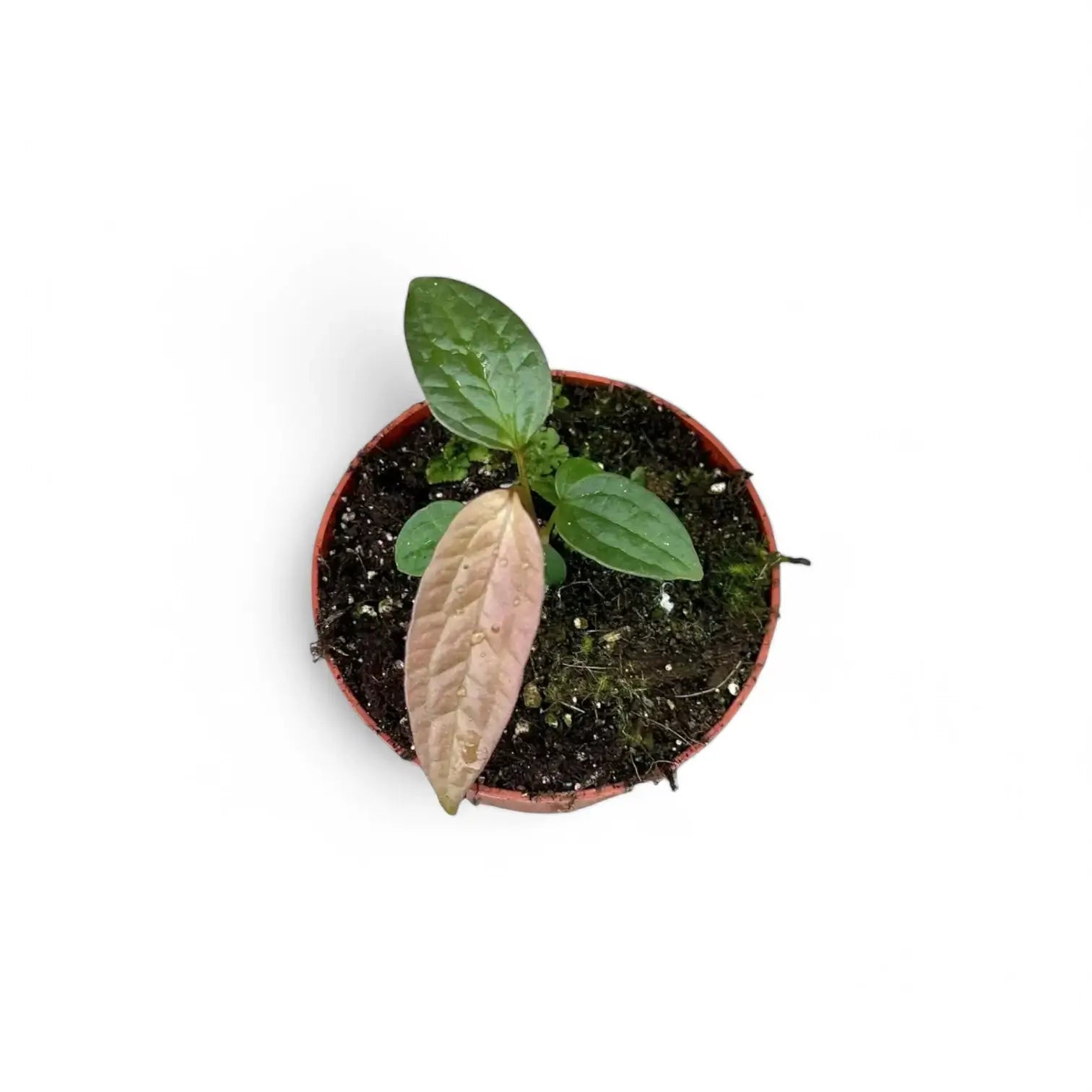
SKU: 63917803484
anthurium arisaemoides

anthurium arisaemoides Anthurium arisaemoides – Tri-Lobed Bullate Anthurium

Sale price$25.22 Regular price$28.02
Save 10%

Pay in installments of $7.00 with ShopPay, AfterPay and Klarna

Shipping Estimate
USA
  • USA
  • CAN

Ships within 48 hours · Estimated delivery Jul 28 - Aug 2

Promo Codes Available:

For Your Every Summer RSVP, with Code: SUMMER15

Description

anthurium arisaemoides Anthurium arisaemoides – Tri-Lobed Bullate AnthuriumAnthurium arisaemoides With trisect, bullate foliage and a terrestrial to occasionally epiphytic habit, Anthurium arisaemoides grows from shaded wet forest settings where stems may stay low, creep through mossy ground level areas or root near tree bases. The three part blades and raised leaf texture give it a clearly segmented appearance. This flexible habit makes the root zone especially important indoors. The plant wants even moisture and humidity,

Anthurium arisaemoides

With trisect, bullate foliage and a terrestrial to occasionally epiphytic habit, Anthurium arisaemoides grows from shaded wet-forest settings where stems may stay low, creep through mossy ground-level areas or root near tree bases. The three-part blades and raised leaf texture give it a clearly segmented appearance.

This flexible habit makes the root zone especially important indoors. The plant wants even moisture and humidity, while the base still needs air around it; a heavy, sealed mix can damage the same stems and roots that should stay active and lightly moist.

Key traits of Anthurium arisaemoides

  • Growth form: A terrestrial to occasionally epiphytic Anthurium associated with moist forest understory conditions.
  • Habit: It may stay low or grow more erect, with botanical descriptions recording stems from ground-level growth to taller creeping or upright forms.
  • Leaf blade: Leaves are trisect, meaning the blade is divided into three main segments.
  • Texture: The blades are conspicuously bullate, with a raised, uneven surface and visible relief.
  • Colour: Leaf surfaces range from light to dark green, with paler undersides and sunken netting beneath.
  • Root setting: The root zone should stay lightly moist and airy, especially around creeping or ground-level stems.

Forest context and indoor behaviour

Anthurium arisaemoides is native from Ecuador to western Bolivia, including Ecuador, Peru and Bolivia. It is associated with tropical moist to wet forest from roughly 300–2000 m, where constant humidity and filtered light shape the plant’s growth.

The trisect leaves are usually spaced along an elongate stem, with slender petioles holding the segmented blades above the base. Indoors, the plant should be kept evenly moist but never stagnant. A potting mix that includes bark, fibre and mineral pieces gives the roots air while still holding enough moisture between waterings.

Root-zone care for Anthurium arisaemoides

  • Substrate: Choose an airy organic/mineral mix that stays open around the base after watering.
  • Water: Keep the mix lightly and consistently moist, then let excess water drain fully.
  • Light: Use bright filtered light. Strong sun can mark leaves, while very dim light slows new growth.
  • Humidity: Moderate to high humidity suits new growth and reduces dry edges on tender leaves.
  • Air movement: Gentle airflow lowers the risk of base problems in a consistently moist setup.
  • Temperature: Warm, stable indoor temperatures are best. Avoid chilling the root zone while the mix is wet.

Problems to watch on Anthurium arisaemoides

  • Soft base or stem marks: Often linked to wet, compacted substrate around the crown or creeping stems.
  • Dry leaf edges: Check for low humidity, long watering gaps or roots that have dried too far.
  • Slow recovery: Cold roots and wet mix can keep the plant inactive after shipping or repotting.
  • Misshapen new growth: Crowding or dry air can affect leaves while they are still unfolding.
  • Yellow lower leaves: Remove ageing leaves only when fully spent, and check the root zone if yellowing spreads quickly.

Irritation risk for Anthurium arisaemoides

Keep Anthurium arisaemoides away from pets and children. Plant tissue and sap can irritate the mouth, eyes and sensitive skin.

Botanical notes on Anthurium arisaemoides

Anthurium arisaemoides was described by Michael T. Madison and published in Selbyana 2:249 in 1978. The species name means Arisaema-like, referring to a resemblance with the aroid genus Arisaema. The type locality is in the Cordillera de Cutucú, a humid forest region in Ecuador.

Shipping Notes
  • Free Standard Shipping on $100+ Orders to the USA.
  • Except Preorder products are shipped in 48 hours.
  • Delivery to the USA:
  1. Standard Shipping : 3-10 business days
  • If time is of the essence, please consider selecting expedited delivery for faster service.
Exchange/Return Notes
  • We offer a 30-day return/exchange service after receiving.
  • Final sale items are not eligible for returns or exchanges.
  • To process your return/exchange, please contact us at [email protected]
  • Please click here for more details>>> Return & Exchange Policy
SKU: 63917803484

Discover Niche Categories That Outsell anthurium arisaemoides

Top-Converting Item to Boost Your Average Order

4.4 ★★★★★
Based on 11 reviews
Sort
Highest Rating
Newest First
Oldest First
Product Reviews
J
Verified Purchase
JORGE E. NAVARRO
New York, US
★★★★★ 4
Kitties love it:
Style: High Mileage 150K, Size: 5 qt (Pack of 1), Configuration: 5W-30
Great product:
WAS THIS REVIEW HELPFUL?YesReportShare
Reviewed in the United States on April 23, 2026
T
Verified Purchase
Tascha F.
West Palm Beach, US
★★★★★ 5
Engaging, though-provoking sweep that will provide you with regarding this time period
Format: Hardcover
Alan Taylor is a writer who excels at contextualizing the complexity of history by creating a sort of ancestral snapshot of each person and event and placing them on a family tree, showing both their relationships to one another and to their time. This approach increases readers’ abilities to build those understandings on their own in other readings, about other times. That’s cool. In this book, he upends a more static understanding of North and South and provides a kaleidoscope of complexity with regards to individuals and social groups from regions both within and outside of our borders. In this book, Alan Taylor displays his unique brilliance at making legible the complex interplay of extremely diverse international, national, and factional agendas, political aspirations, people’s attachment to their political and social worldviews, economic aspirations, their bluster, their denial, and their honest – if not always successful – efforts. Quoting from a mind-bogglingly large reading list of academic sources, newspapers, diaries, and other historical documents, he brings people back to life in such a way that you could mentally animate what role these historical figures would play today on the world stage or even in a more intimate setting of your own office politics. He makes the complexity and uncertainty decipherable so that we can think about it, argue about it, and explore it just as we would events with which we are familiar today. A true love of history and our understanding of humanity at present are not served by infatuation with imagined, polished heroes but by complex accounts and considerations of character, influences, dreams, successes, and failures that reveal how these elements are the common denominators in all lives and across all times. Taylor does this superbly for figures North, South, enslaved, free, freed Blacks, embittered whites, Mexican, Spanish, Canadian, British, French, and Indigenous. He juxtaposes Maximilian’s wife, Carlota, sister of Leopold II, who placed faith in herself and in her husband to transform Mexico through better monarchy, with the far more egalitarian Benito Juárez, who ultimately subordinated the lives of the indigenous people in capitulating to a rising oligarchy of American investors who could rebuild Mexico. Both Carlota and Juarez are driven to varying degrees of madness by the results of their efforts. We see members of the former Confederacy who rue their violent support for the perverse and cruel institution of slavery once the war is over, alongside others who will stop at nothing to bring back the old order. And we see Northerners, who in wartime decried slavery with a furious ardor, eventually languishing in their duty to their fellows after the war was over. There are warriors for justice, warriors for oppression, realists, capitulators, power brokers, and pawns. Even the best, who are not depleted of passionate intensity for doing right, must contend with an ecosystem of others’ dreams and aspirations, which all too often run afoul of the righteous. In the end, we may be judged by others and by ourselves for what we’ve wished for: either peace and fairness or war and acquisition at any price. The book serves as a reminder to plant the right seeds and dream the right dreams…for everybody’s children. Because when the harshest frost melts away, something new will grow.
WAS THIS REVIEW HELPFUL?YesReportShare
Reviewed in the United States on July 3, 2024
A
Verified Purchase
Amazon Customer
Massapequa, US
★★★★★ 5
Carefully Researched Gives Insight To 19Th Century Occurances of: American, Canada, and Mexico!
Format: Hardcover
This book is a treasure as it covers not only the American Civil War but what intricate details are behind it and more, in addition covers the same eras for the Dominion of Canada, and French take over of Mexico along with the factors leading to "Cinco De Mayo," and more. As an avid reader of American History also as a amature historian this book is carefully detailed and gives insight to the racial and political beliefs at the life and times of the 19Th. Century. It deserves a place on your bookshelf and/or library. In these contemporary times, I am still more than pleased the the border frontiers between the Republic of Canada and United States of America remain the: "Longest Undefended Borders" in the entire globe.
WAS THIS REVIEW HELPFUL?YesReportShare
Reviewed in the United States on May 5, 2025
A
Verified Purchase
Amazon Customer
Birmingham, US
★★★★★ 4
Another Thought Provoking Book
Format: Kindle
Having read Professor Taylor's American Republics I greatly anticipated this volume in his series. The examination of both the Canadian and Mexican stories in this book along with the American Civil War helps provide context to the traditional narrative. I find his approach useful as it shows how the interactions between the US and its neighboring nations evolved. I'm hoping he continues the series
WAS THIS REVIEW HELPFUL?YesReportShare
Reviewed in the United States on September 1, 2024
R
Verified Purchase
Reflective Reader
Pawtucket, US
★★★★★ 5
A Minority View of our History
Format: Kindle
If you want to learn more about American history from the perspective of minorities, this is a crowning achievement. It is long so I focused on reading the chapters on the US and it gave me an understanding of just how brutal the challenges were but how significant the slow process of building our multicultural society was as well.
WAS THIS REVIEW HELPFUL?YesReportShare
Reviewed in the United States on April 10, 2026

recommand products