SKU: 65538533945
succulent plant necklace

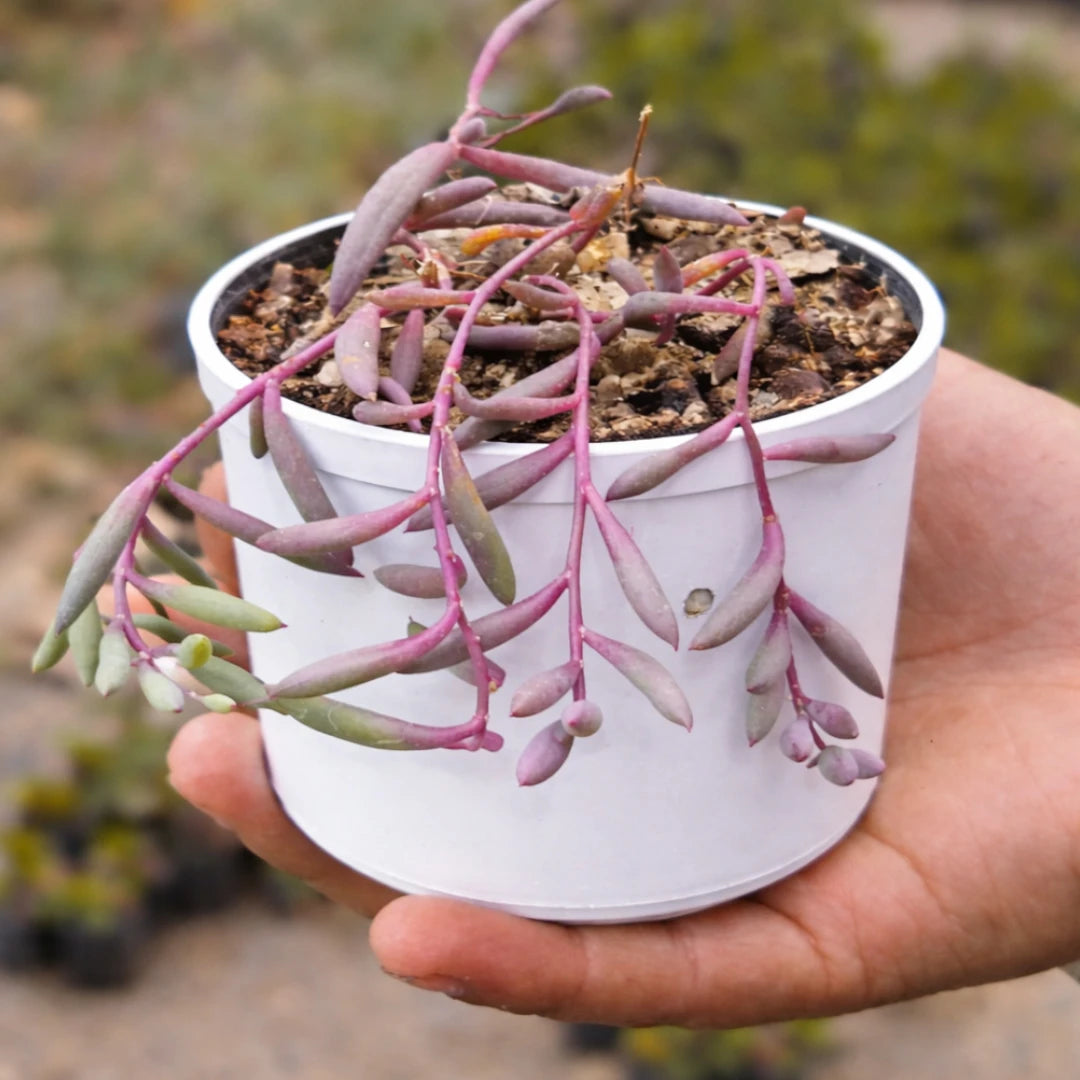
succulent plant necklace Ruby Necklace Plant – Trailing Purple Succulent

Sale price$21.40 Regular price$23.78
Save 10%

Pay in installments of $5.95 with ShopPay, AfterPay and Klarna

Shipping Estimate
USA
  • USA
  • CAN

Ships within 48 hours · Estimated delivery Oct 17 - Oct 22

Promo Codes Available:

For Your Every Summer RSVP, with Code: SUMMER15

Description

succulent plant necklace Ruby Necklace Plant – Trailing Purple SucculentDispatch in 2 3 days Country of origin: India It's Compulsory to make unboxing video of parcel for refunds within 24 hours. Bare Rooted Overview of Othonna Capensis Common Name: String of Rubies, Ruby Necklace, Little Pickles Botanical Name: Othonna capensis Family: Asteraceae Type: Succulent Mature Size: 212 inches long, 48 inches wide Native Area: South Africa Hardiness Zones: 9 11 (USDA)Othonna capensis, commonly known as the String of Rubies or

  • Dispatch in 2-3 days
  • Country of origin: India
  • It's Compulsory  to make unboxing video of parcel for refunds within 24 hours.
  • Bare Rooted

Overview of Othonna Capensis

Common Name: String of Rubies, Ruby Necklace, Little Pickles
Botanical Name: Othonna capensis
Family: Asteraceae
Type: Succulent
Mature Size: 2–12 inches long, 4–8 inches wide
Native Area: South Africa
Hardiness Zones: 9-11 (USDA)Othonna capensis, commonly known as the String of Rubies or Ruby Necklace, is a popular trailing succulent characterized by its vibrant, fleshy leaves that can turn a striking ruby red when exposed to bright sunlight. This plant is not only visually appealing but also relatively easy to care for, making it a favorite among succulent enthusiasts.

Care Instructions

Light Requirements

  • Ideal Exposure: Othonna capensis thrives in full sun to partial shade. It requires at least six hours of direct sunlight daily. Indoors, place it near a bright south-facing window or under strong grow lights to maintain its vibrant color.

Soil and Potting

  • Soil Type: Use a well-draining soil mix, such as cactus or succulent potting mix. A mixture of two parts succulent soil and one part perlite or pumice is ideal for excellent drainage.
  • Potting Tip: Ensure pots have drainage holes to prevent water accumulation.

Watering

  • Watering Schedule: Allow the soil to dry out completely between waterings. Water thoroughly when the top inch of soil is dry, typically every 1 to 3 weeks depending on environmental conditions.
  • Signs of Overwatering: Yellowing leaves or mushy stems indicate overwatering, which can lead to root rot.

Temperature and Humidity

  • Optimal Temperature: This succulent prefers temperatures between 65°F to 85°F (18°C to 29°C) and should not be exposed to temperatures below 50°F (10°C) for extended periods.
  • Humidity Needs: Othonna capensis thrives in low humidity environments typical of its native habitat.

Fertilization

  • Feeding Schedule: Fertilize sparingly during the growing season (spring and summer) with a diluted fertilizer low in nitrogen. Frequent fertilization is not necessary.

Common Issues

Pests

  • Othonna capensis can be susceptible to pests such as mealybugs and aphids. Regularly inspect the plant for signs of infestation and treat promptly if needed.

Diseases

  • Overwatering is the primary concern for this succulent. Proper watering techniques are essential to prevent root rot.

Frequently Asked Questions

  1. How often should I water my Othonna capensis?
    Water when the top inch of soil feels dry, typically every 1 to 3 weeks depending on the season and environmental conditions.
  2. Can I grow Othonna capensis outdoors?
    Yes, it can be grown outdoors in USDA hardiness zones 9 to 11 but should be protected from frost and extreme cold.
  3. Why are my plant's leaves turning yellow?
    Yellowing leaves may indicate overwatering or insufficient light. Adjust your watering habits and ensure adequate sunlight exposure.
  4.  How do I propagate Othonna capensis?
    Propagation can be done through stem cuttings. Allow cuttings to callous for a few days before placing them in well-draining soil. Keep the soil barely moist until roots establish.
  5.  Is Othonna capensis toxic?
    This plant is generally considered non-toxic; however, it’s best kept away from pets and small children who may ingest parts of the plant.By following these care guidelines, Othonna capensis can thrive, adding vibrant color and unique beauty to your indoor or outdoor garden space.
Shipping Notes
  • Free Standard Shipping on $100+ Orders to the USA.
  • Except Preorder products are shipped in 48 hours.
  • Delivery to the USA:
  1. Standard Shipping : 3-10 business days
  • If time is of the essence, please consider selecting expedited delivery for faster service.
Exchange/Return Notes
  • We offer a 30-day return/exchange service after receiving.
  • Final sale items are not eligible for returns or exchanges.
  • To process your return/exchange, please contact us at [email protected]
  • Please click here for more details>>> Return & Exchange Policy
SKU: 65538533945

Discover Niche Categories That Outsell succulent plant necklace

Top-Converting Item to Boost Your Average Order

4.4 ★★★★★
Based on 15 reviews
Sort
Highest Rating
Newest First
Oldest First
Product Reviews
R
Ruddin
New York, US
★★★★★ 5
immersive
Format: Hardcover
Once in awhile when I feel there are a lot of things pulling at me all at once, I will read this book to guide me/ give me ideas to sort out all the pulls. Highly recommended for those who find works in the connected world expect us to attend to all details and requests immediately but we know that are not the right deals for us.
WAS THIS REVIEW HELPFUL?YesReportShare
Reviewed in the United States on January 11, 2006
M
Monsop Collado Madrigal.
Whiting, US
★★★★★ 3
A Few Gems, but Not the Right Fit for Me
Format: Kindle
This book focuses on the 80/20 principle, emphasizing the importance of identifying and maximizing the 20% of activities that yield the greatest results. While it offers valuable insights on growth, creativity, and leveraging strengths, it didn’t resonate with me personally, and I found the reading experience less enjoyable. Key Takeaways: • Growth requires creating something new and meaningful, not maintaining the status quo. • Focus on your “20% spike”—your unique strengths—and develop them like an athlete. • Use the 80/20 principle to identify the most profitable parts of a business. Overall, the ideas are useful, but the book didn’t fully capture my interest or provide practical applications I could relate to.
WAS THIS REVIEW HELPFUL?YesReportShare
Reviewed in the United States on January 19, 2025
B
Verified Purchase
Bubbalicious
Battle Creek, US
★★★★★ 1
An empty-hearted effort
Format: Kindle
Managing personal efficiency is no doubt an important skill. And judging from the author's success from the first book, I assume he is a credible author. But this book is just way too shallow and lacks the evidence of any sinerity for the readers. If you are new to the concept of life efficiency management, it might be good to read his first book. If you are looking for a good framework or advice on how to achieve your goal, then you will for sure be disappointed. This whole book is just about stressing the importance of efficiency management. Absolutely anything else!
WAS THIS REVIEW HELPFUL?YesReportShare
Reviewed in the United States on October 20, 2012
G
Verified Purchase
gg
Grantham, US
★★★★★ 4
Four Stars
Format: Hardcover
great for the 80/20 library
WAS THIS REVIEW HELPFUL?YesReportShare
Reviewed in the United States on April 26, 2016
K
Verified Purchase
KT
Omaha, US
★★★★★ 5
Book Review of The Alchemist
Format: Paperback
In The Alchemist, Paulo Coelho uses diction, syntax, and the hero cycle to keep the pace of the book constant, and keep the reader intrigued. But, he does have a few flaws present in the book. The Alchemist is a book about a boy named Santiago, who goes on an adventure to find his “Personal Legend” or treasure. Coelho uses the hero cycle to add more emphasis on the plot, which overall makes the story more entertaining. In the story, the Old King tells Santiago that “when someone wants to realize his or her Personal Legend,” he will “always [be] nearby.” (67) This is an example of atonement with the father, because the Old King’s closeness creates a father like figure in him, who is there to support Santiago. The hero cycle for me made the story more enjoyable and kept me reading. Also most of the book is him trying to obtain his Personal Legend, which is “what you have always wanted to accomplish.” (23) Compared to other books I have read this year in my English class, this one was easier to follow in terms of diction. The language that Paulo Coelho uses in the novel overall is not too difficult to understand. Word choice is done very well, and lets the reader flow through the book at a constant pace. The diction also makes the book a novel for a wide range of readers. The hero cycle with the clean diction made the story very enjoyable. While reading this book, I found that it was fairly easy to understand the passage, and that it was very inviting. Paulo Coelho structures the syntax of the book in an easy-to-understand format. Throughout the book, the syntax helps the reader understand where they are on the page, and it also positively affects the pace set by the diction in the book. Towards the middle of the novel, the boy says that “An army is coming,” and he knows because he “had a vision.” This dialogue is quickly followed up by a response from a camel driver, saying that “the desert fills men’s hearts with visions.” (104) The quick pace of dialogue keeps the book driving keeps the pace constantly in motion. The syntax made it easier for me to follow the story and follow which character was speaking and what they where feeling or doing. Even though I enjoyed a great bit of the book, there was still another bit that I didn’t fully enjoy. At the beginning of the Alchemist, the book seems to go a slower speed then the rest of it. The first portion of the book has a lot to do with introducing Santiago, the plot, the setting, and more. There is a part in the story where it goes from page 35 to page 38 with very little dialogue, which I felt stopped progress of the story. The first part also has to do a lot with how he discovers his Personal Legend. It took me a little while longer to read the first part of the book then the rest because I was mostly bored while reading it. I also felt that there was more descriptive text than the rest of the book, which really dragged out the first part. In conclusion, the book has lots of great traits and only a few bad ones. I would definitely recommend this book to a friend or anyone who enjoys reading about adventure.
WAS THIS REVIEW HELPFUL?YesReportShare
Reviewed in the United States on January 12, 2016

recommand products