SKU: 66472830531
soil moisture meter nz

soil moisture meter nz Crew Soil Sensor Soil Moisture Meter – lovethatleaf

Sale price$25.71 Regular price$28.57
Save 10%

Pay in installments of $7.14 with ShopPay, AfterPay and Klarna

Shipping Estimate
USA
  • USA
  • CAN

Ships within 48 hours · Estimated delivery Jul 23 - Jul 28

Promo Codes Available:

For Your Every Summer RSVP, with Code: SUMMER15

Description

soil moisture meter nz Crew Soil Sensor Soil Moisture Meter – lovethatleaf"I really enjoy my soil moisture sensor! prior to getting one it was a whole lot of guesswork (overwatering, followed by leaving the plant to get almost drought level dry lol) I find the sensor super handy!! Use it almost every day." Grace Stanton This clever little moisture meter makes checking moisture levels fun and easy. No more digging fingers in to the soil to guess if it's time to water. No more dirt under your fingernails! The Crew Soil Sensor

"I really enjoy my soil moisture sensor! ... prior to getting one it was a whole lot of guesswork (overwatering, followed by leaving the plant to get almost drought level dry lol) I find the sensor super handy!! Use it almost every day."

Grace Stanton ⭐⭐⭐⭐⭐


This clever little moisture meter makes checking moisture levels fun and easy. No more digging fingers in to the soil to guess if it's time to water.  No more dirt under your fingernails! The Crew Soil Sensor Moisture Meter makes keeping an eye on moisture levels easy, fast and mess-free. So easy to know when your plants are ready for watering again. Plus a great price too! 


How does it work?


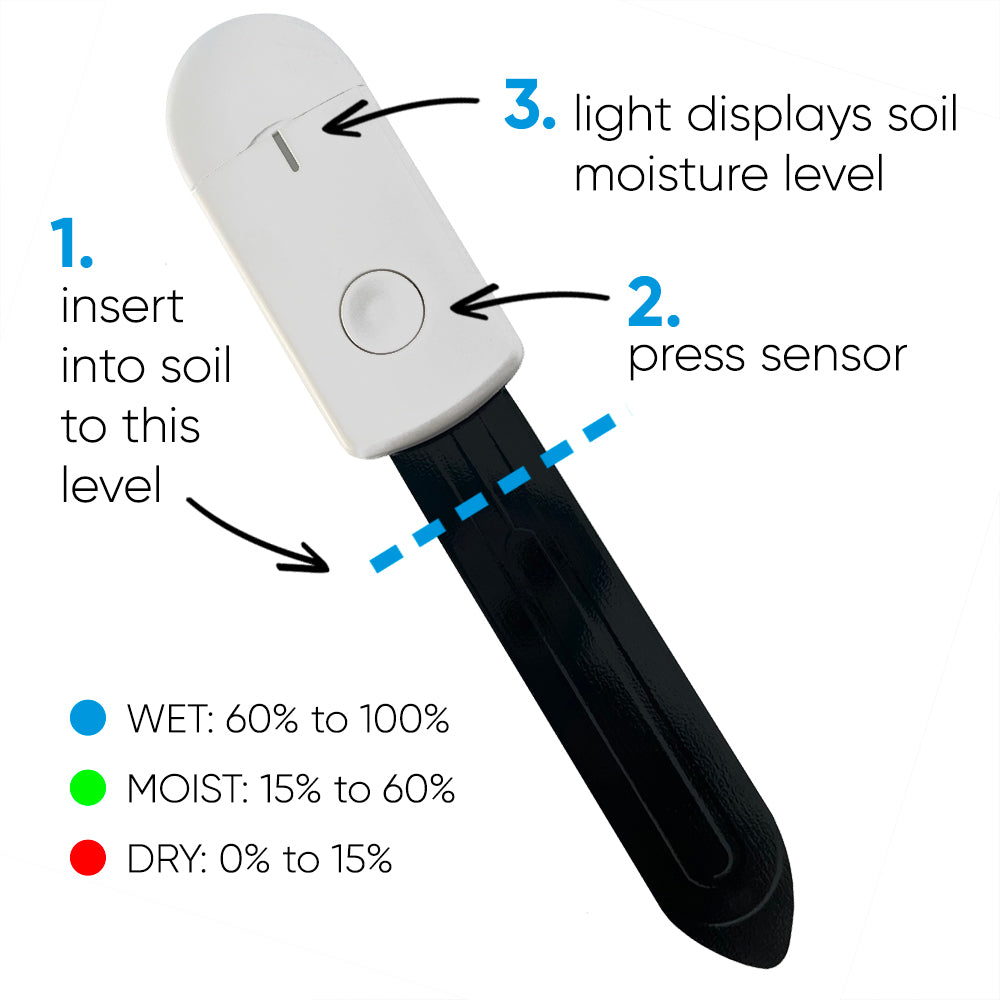
Simply slide the probe into the soil, press the sensor button, and the indicator on top will light up with what the moisture reading is down at the tip of the probe, with 3 levels

BLUE = WET > A reading of 60% to 100% moisture level.


GREEN
= MOIST > Around 15% to 60% moisture level (the happy range for most indoor plants).

RED = DRY > 0% to 15% moisture detected. Time to water (unless you want the substrate dry of course). 


Swipe through the photos to see each mode lit up. 


Leave it in one plant if you prefer, or just do the rounds checking everyone. No down-time required when shifting between plants. Just pop the probe in the soil and press the sensor for an immediate moisture level reading.


I find I forget which plant I've left it in - or where my son's left it in the house - so I ended up getting one sensor for each group of plants to make it as hassle free as possible. That way when I check up on my jungle I do a quick moisture check without having to hunt for the sensor. Easy peasy. 


What size pots is it for?


The perfect smaller size for all your small to medium size potted indoor plants. Total length is 13cms and the probe measures 7cms long1.5cms wide x about 1mm thick, So yes, it's very thin, meaning the probe slides in easily for minimal soil and root disruption.


If you have hard, compacted soil (other than needing to repot), you'll need to slide a stick or knife into the soil to break it up first, as you don't want to force the probe in to the soil. The probe is also very smooth, helping reduce soil getting stuck to it when you put it in and out. For cleaning, just wipe clean if needed, avoid running it under water.


Does the soil type matter?


Yes, as if your potting mix is so super airy it barely holds much water (like bark-based mixes used for orchids and aroids), there won't be much for the sensor to sense! You will also get borderline readings sometimes when used in airier mixes, such as flashing between green and red when moisture's down around 15%. That can happen with any mix also though when you're in-between levels. Best used with fine to medium substrates. 


Can you replace the battery?


Yep, sure can. It fits the CR2032 round lithium battery, readily available in NZ. It comes with one battery included. I'm not sure myself how long the battery lasts, but have been using a couple for my indoor jungle for coming up 6 months so far and still going strong.


What does it come with?


Nothing fancy. The sensor comes as shown in the photos, with the battery included. Definitely function over fashion at this price. Think Nokia 3310 not Apple iPhone. No fancy-pants packaging.

PS: If they still make the old Nokia 3310 my son is totally having that as his first phone. Texting and snake. What more could you want? 


How do you set it up?


Before first use: Take the cap off the top, slide out the battery (included), and remove the blue battery cover. Slide the battery back in, pop the cap back on, and you're ready to go. 


Important - Safety first


This product uses a button battery so should be kept out of reach of young children and pets. Small batteries are a choking hazard. If ingested, there is also the risk batteries may cause burns or tissue damage. If you suspect your child or pet has swallowed a button battery, always treat it as an emergency. 


Shipping Notes
  • Free Standard Shipping on $100+ Orders to the USA.
  • Except Preorder products are shipped in 48 hours.
  • Delivery to the USA:
  1. Standard Shipping : 3-10 business days
  • If time is of the essence, please consider selecting expedited delivery for faster service.
Exchange/Return Notes
  • We offer a 30-day return/exchange service after receiving.
  • Final sale items are not eligible for returns or exchanges.
  • To process your return/exchange, please contact us at [email protected]
  • Please click here for more details>>> Return & Exchange Policy
SKU: 66472830531

Discover Niche Categories That Outsell soil moisture meter nz

Top-Converting Item to Boost Your Average Order

4.8 ★★★★★
Based on 23 reviews
Sort
Highest Rating
Newest First
Oldest First
Product Reviews
A
Verified Purchase
Amazon Customer
Cuba, US
★★★★★ 5
Really pleasantly sour and delicious
Flavor Name: Tangerine, Watermelon, Blue Raspberry
Absolutely delicious and addictive! The sour is very sharp and the sweet is flavorful, not just sugary. I will buy these regularly.
WAS THIS REVIEW HELPFUL?YesReportShare
Reviewed in the United States on April 15, 2026
J
Verified Purchase
Jville
Whiting, US
★★★★★ 5
CHILDHOOD
Flavor Name: Tangerine, Watermelon, Blue Raspberry
Gosshhh these things are so good and take me right back to when I was 12 years old holy crap I can’t even remember the name of those things but we all remember them. These are they just with a different name and better I can’t believe it I’ve been searching for them since I was 15 when they disappeared. I’m writing this then going to buy more before they sell out or disappear I’m gonna stock pile not gonna get me
WAS THIS REVIEW HELPFUL?YesReportShare
Reviewed in the United States on June 1, 2026
J
Verified Purchase
James E. Egolf
Los Angeles, US
★★★★★ 5
A Clear Concise Precis of a Complex Historical Era
Format: Paperback
R.W. Southern's book titled WESTERN SOCIETY AND THE CHURCH IN THE MIDDLE AGES is a readable account of the Medieval Catholic Church from c 750 to c. 1450. Southern concisely explained the achievements, successes, and failures. According to Southern, the achievements and successes far outweighed the failures and wrong doing. Southern's book began with the special relationship between the new "barbarian" secular rulers and the Catholic clergy especially the monks and bishops. The fact that most secular rulers were not literate especially in the use of Latin, they relied on learned Catholic clergy. The Catholic clergy became crucial and both they and the secular rulers relied on each other. While Charlemagne (768-814)had a revered status as the defender of the Latin West, Southern mentioned his reliance on Catholic clergy. Charlemagne could read,but he never learned to write. He was aware of his own deficiencies and started the Palace School at Aachen where, among others, Alcuin (735-804) and other learned men expanded learning at a time called the Carolingian Renaissance. What readers should appreciate is that without Catholic clergy and monks, learning would have disappeared in Western Europe. Southern was very clear about this. The Medieval Catholic authorities faced other challenges. Long simmering feuds existed between the Byzantine Greek Orthodox Church authorities and the Latin Roman Catholic authorities. During the eighth century and again in 1054,the official reasons for tensions were the use of icons (The Iconoclastic Controversy) and the status of the Pope. As Southern wrote, these tensions were a cover for the disputes between the Italians and Byzantine Greeks over Byzantine control of parts of Italy. What the Greek Orthodox and Byzantine authorities did not want to realize was that the Latin West including the Popes were their only salvation vs. the Islamic Seljuk Turks especially after the Byzantine defeat at Manzikurt in 1071. In 1422, Pope Martin V (1417-1471)reminded the Byzantine religious and secular rulers how much they relied on the Latin West. In other words, Pope Martin V demanded concessions if the Byzantines expected help vs. the Turks. Because of the lang standing traditions the Byzantines had, they refused to face their doom which occurred in 1453. Southern's description of this dilemma was well presented. An achievement that Southern emphasized was the development of Canon Law. Increased trade, urbanization, and political power led to conflicts between secular rulers and Catholic authorities. Some of the Medieval Popes were known as "The Lawyer Popes" such as Pope Alexander III (1159-1181), especially Pope Innocent III (1198-1216), and Pope Pope Gregory IX (1227-1241). While the Popes could and sometimes used excommunication and interdict to intimidate secular rivals, the problem became acute because of too much reliance on these spiritual weapons. Not only did the Popes exert power and influence, the Catholic bishops also had considerable influence. The Cathoic bishoporics existed long befor the monastic orders and the friars. The ideal for bishops was Pope Gregory's (590-604)work titled PASTORAL CARE. Due to the bishops' position of power and status, many became too involved with poltical situations that mitigated Pope Gregory I's ideal. Bishops had to enforce discipline, show wisdom, and administer effectively. Southern mentioned some of the bishops who were effective and some who were inept. For example Bishop Odo Riguad (1247-1276) was "firm but fair." He was lenient for qualifications for those who wanted to enter Holy Orders and was reasonable, in fact kind, re reconcilation. Yet, he expected those under his authority to comply with their priestly duties. On the other hand, John Peckham who was the Archbishop of Canterbury (1279-1292)was obstinate, incompetent, and not capable for the position. After the Papal Election Decree in 1059 and the Investature Controversy, the Popes wanted the local clergy to decide on the appointment of bishops. Southern told readers that even a Pope as powerful as Pope Innocent III (1198-1216)preferred local selection. While Popes could intervene if no decision could be reached, they preferred not to impose what Southern called "The Royal Road." While the bishoporics existed prior to the monastic orders and friars, the latter groups were also crucial to the Catholic Church and the Latin West. The dominant orders included the Benedictines started by St. Benedict (480-544) whose Benedictine Rule was the standard until c. 1050. The work of the monastic orders re learning can never be underestimated especially since they wrote and hand copied books including the Bible long before the invention of the printing press. Their influnce was such that a Beneditine was made Pope-Pope Gregory I (590-604). Other orders such as the Cistertians and Augustinians later developed separate from the Benedictines. The best known of the Cistertians was St. Bernard of Clairvaux (1090-1153)whose rhetoric and conservative views were a check on unbridled enthusiams. The friars were orders of men and women who left the cloister to appeal to the masses. St. Dominic (1170-1221) started the Order of Preachers or Dominicans as a learned society of men and woman to combat heresy. The Friars Minor (the Franciscans) were started by St. Francis of Assissi (1182-1226),and these men and woman started as an order to help the poorest of the poor. Southern could have mentioned that St. Francis helped those even God ignored. The Dominicans and Franciscans became dominant teachers in Catholic universities and revived interest in Ancient Greek thought. These men and women also made signficant contributions re science and mathematics. A major reason for the creation of the friars was the gradual increase of urbanization. As Southern reminded readers, without towns, there would have been no friars. Without universities, the friars would never have been great. By the middle of the 14th. century (the 1300s), the Scholastic achievements faded because of the trivial debates. This led to a revival of Catholic mysticism such as Thomas a Kempis' (1380-1471)who wrote IMITATION OF CHRIST and later St. Ignatius Loyola's (1491-1556) SPIRITUAL EXERCISES. As Southern warned did such mysticism lead to false piety? Southern did an effective job re Medieval Catholic Church History. He could have emphasized the work of some of the giant intellects such as St. Albertus Magnus (1193-1280) and St. Thomas Aquinas (1225-1274). Southern's treatment of Canon Law was later enhanced by Berman's book titled LAW AND REVOLUTION. Students of Church History will benefit from Southern's book. It is clear, and complexities are carefully explained. The list of Popes at the end of the book can help readers to keep track of the "players." James E. Egolf November 5, 2013
WAS THIS REVIEW HELPFUL?YesReportShare
Reviewed in the United States on November 6, 2013
T
Verified Purchase
Thomas J. Burns
Lexington, US
★★★★★ 5
From the Bones of Peter
Format: Paperback
A brief forward to this work is in order. R.W. Southern stands among England's finest historical scholars of the twentieth century and was knighted by the Queen in 1975. The publisher, Penguin, has worked to bring the best of the humanities to an inquisitive public for almost a century. Southern's medieval survey is thus an eminently readable text buttressed by a profound grasp of both trends and minutiae. Our work at hand is one of seven independent works in Penguin's history of the Church series. Southern's contribution was first published in 1970 and updated in 1990. Historians are bringing more interdisciplinary tools to the study of medieval history, from climate to demographics to agriculture. Southern is the product of an earlier and more basic methodology, where the nexus of Church and Society stood as the interpretive key to an understanding of the times. I first read "Western Society and the Church" shortly after its original release in 1970. Reading it again in 2014 impressed upon me how compatible Southern's comprehensive overview stands with what we now know in greater detail about mystical movements, cold winters, trade, exploration, and plague, among other factors. Despite the wide sweep of his narrative, Southern's conclusions are drawn from meticulous examination of records, with useful numerical charts interspersed from time to time. Southern treats of the years 800-1500 CE and the provenance of the Roman Catholic Church in that era. The title's phrasing of "Western Society and the Church" is a pregnant one. The organism of the Church and western society as a whole shared a common cosmology or world vision. Medieval man did indeed understand himself to be living in a "Middle Age" between the time of Christ's first and second coming. However, Southern's overview provides many instances where the major organs of the Church and western society were hardly of one mind, either. Not surprisingly Southern devotes considerable attention to the changing Petrine ministry, which in 800 was not enjoying its finest hour. Besieged by Islam and other foreign peoples, belittled by Eastern Christianity from Constantinople, and its own house in disarray, Rome somehow maintained a religious and psychological hold in the popular mind. As reliquary of the bones of Peter, Rome and its successive bishops never entirely lost hold of mystery and supremacy in the early dark medieval era. In popular thought at the time, the pope was a living vicar of Peter. "Though men came to Rome in the first place to visit the (bones of the) Apostle, they prostrated themselves before the pope." (95) What would maintain Church order through dark times, Southern implies, was an inner sense among men of the times that God's order (and wrath) was mediated by the Church. Fractiousness between clergy and laity was common, but fear of damnation trumped all. Only the most cynical of men would knowingly dismiss hell fire And thus the Vicar of Peter became the Vicar of Christ. It did not hurt the cause that shrewd popes buttressed their positions with questionable emphases upon more ancient secular entitlements dating to the times of the Constantinian/Christian empire of the West. The heritage of Charlemagne and the forgery of the "Donation of Constantine" played their parts, but the permanent breech with the East may have been a deciding factor as well. Pontiffs such as Gregory VII came to understand their office as specific, detailed, and immediate. To speak anachronistically, popes became managers of a far flung bureaucracy of order and sanctification in what was now a Western European Roman Catholic venture. By 1100 there was plenty for popes to do. The relationship between pastoral appointments (bishops and abbots, for example) and the attendant financial compensation became quite complex. The papal office became official arbiter over disputes between various parties, to the degree that the majority of high medieval popes were drawn from the legal profession. Southern describes a medieval Church of prelates, scribes and lawyers crisscrossing Western Europe in the name of the Pope with portfolios of litigation and judgment. It does not miss the author’s attention that the papacy was also the greatest broker of spiritual reward and punishment, specifically its powers of excommunication and redemption, the latter becoming a major target of reformers at the end of the era. Southern contends that religious orders extended major spiritual and practical influence throughout the Middle Ages. In 800 the Benedictine Order, whose legacy would include spiritual efficacy, scholarship, good order, and physical enhancement of the environment, was at its apex. Southern proceeds to outline in some detail how the inevitable decline of fervor in a predominant order of the day would inspire the development of a new order to address developing contemporary concerns. As successors of the Benedictines, Southern identifies the Augustinians, the first medieval religious movement to embrace a generic rule derived directly from the Gospels as well as rigorous and moderate variants of daily life style. The next was the Cistercians, who sought to return to the letter and spirit of St. Benedict's rule. Their quest for purity and escape from the world led them to flee to the outer edges of Western Europe and consequently to develop these lands, a major social contribution. Southern sees the Franciscan and Dominican moments of the thirteenth century respectively as the Cistercian and Augustinian reforms for this later era of European society. Southern's penultimate chapters is devoted to what he called he called the fringe orders; today we would think of these in part as the Beguines and the multitude of spontaneous mystical and devotional movements associated with the fourteenth and fifteenth centuries. His final chapter, "A Confusion of Tongues," continues his account of spiritual diversification leading to early Protestant thought and practice. The tenor of this book is what one would expect of the relaxed scholar/gentleman unfolding his description of this age with a profound but understandable style. He shares a lifetime of scholarship in an inviting way to those entering the Middle Ages for the first time.
WAS THIS REVIEW HELPFUL?YesReportShare
Reviewed in the United States on March 9, 2014
J
Verified Purchase
jdee28
Los Angeles, US
★★★★★ 5
Excellent treatment of a narrow subject: how society shaped the church
Format: Paperback
This book is not a comprehensive overview of the church from 700-1500, nor is it a narrative treatment or an introduction. This book is highly selective, focusing on one central theme. Its strengths are in its organization and in the examples it gives to illustrate its theme. These examples are concrete, vivid and use quotations from original documents to excellent effect. The theme of the book is how society shaped the church. Southern examines the main institutions of the church -- the papacy, bishops, religious orders and fringe orders -- and shows how the needs and interests of society molded each. Perhaps having written on 1000-1200 in other books, for me, the strongest insights Southern makes here are on the periods 750-1000 and 1200-1500. Insights that particularly struck me: the importance of magic from 750-1000; the evolution of bishops, from supporting local rulers to supporting the pope; the importance of the Augustinian canons in the twelfth century, seeing them as one end of a pole, with the Cistercians on the other end and the Benedictines in the middle; the role of Franciscans and Dominicans in supporting scholars in the thirteenth century; and the fringe orders -- the book has one of the best treatments of the Brethren of the Common Life from the fourteenth century that I have come across. The book is highly selective. There is no treatment in this book on intellectual life (the "new learning") or artistic life, nor is there much on the heresies of the period or popular religion (the "new piety"). What the book does select to treat, it does so in a deep, highly readable, substantial way. One will definitely come away with how the demands of society molded the church. Highly recommended!!
WAS THIS REVIEW HELPFUL?YesReportShare
Reviewed in the United States on February 24, 2021

recommand products