SKU: 67173205552
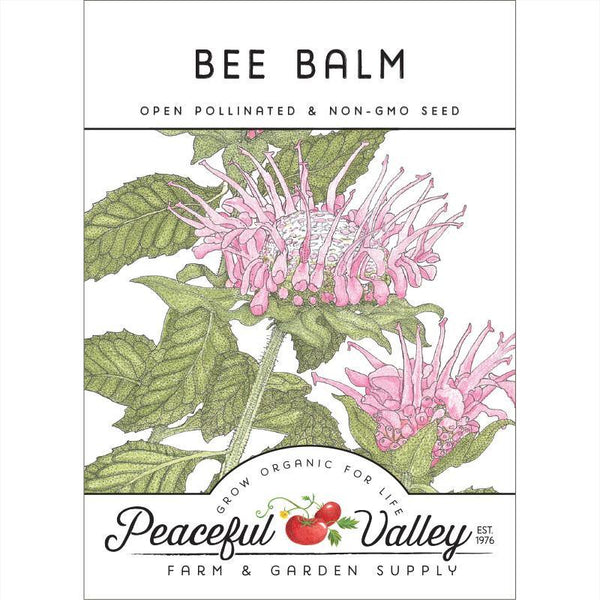
bee balm plant seeds

bee balm plant seeds Bee Balm Seeds

Sale price$22.62 Regular price$25.13
Save 10%

Pay in installments of $6.28 with ShopPay, AfterPay and Klarna

Shipping Estimate
USA
  • USA
  • CAN

Ships within 48 hours · Estimated delivery Sep 8 - Sep 13

Promo Codes Available:

For Your Every Summer RSVP, with Code: SUMMER15

Description

bee balm plant seeds Bee Balm SeedsBee Balm Monarda fistulosa Perennial Open Pollinated. Member of the mint family, also called wild bergamot, this herbaceous perennial reaches 4 feet tall with lavender colored flowers in summer. It has a long history of use as a medicinal herb and today is used to flavor herbal teas. It is enjoyable in the garden for its pleasant scent. Grows readily from seed. Sow seeds in early fall or in spring after danger of last frost has passed. Keep soil moist

Bee Balm - Monarda fistulosa

Perennial Open Pollinated. Member of the mint family, also called wild bergamot, this herbaceous perennial reaches 4 feet tall with lavender colored flowers in summer. It has a long history of use as a medicinal herb and today is used to flavor herbal teas. It is enjoyable in the garden for its pleasant scent. Grows readily from seed. Sow seeds in early fall or in spring after danger of last frost has passed. Keep soil moist for 6 weeks after planting bee balm.

Flowers: Aromatic leaves. Blooms in summer
Attracts: Attracts birds, hummingbirds, butterflies, and bees
Soil: Requires moderately fertile, well draining soil
Native: North America
USDA Zone: 4-8
Plant In: Fall or Spring
Planting Depth: 1/8"
Days to Germinate: 10-21 Days
Height At Maturity: 3'-4'
Sun/Shade Requirements: Full to Partial Sun. Partial shade.
Water Needs: Moderate Water
Approx. Seeds Per Pack: 700
 

Bee balm is native to North America. It originates from various regions across the continent, primarily in eastern and central parts of the United States and Canada. Different species of bee balm can be found in specific areas within this range.

Monarda species are well adapted to the diverse climates and ecosystems of North America, and they have been an integral part of the continent's flora for centuries. Native American tribes were among the first to recognize the value of bee balm for its medicinal, culinary, and aromatic properties, and they used it for various purposes.

Today, bee balm has become a popular garden plant not only in its native range but also in other parts of the world due to its attractive flowers, aromatic leaves, and its ability to attract pollinators like bees and butterflies. Gardeners and horticulturists have also developed various cultivars and hybrids of bee balm, further expanding its presence in gardens and landscapes around the globe.

So, while bee balm has its roots firmly planted in North America, its popularity has spread beyond its native habitat to become a beloved and versatile garden plant worldwide.


Growing bee balm (Monarda spp.) is a desirable choice for gardeners due to a multitude of reasons, encompassing both aesthetic and practical benefits. Here are several compelling reasons why someone might want to cultivate this lovely herbaceous perennial:

  1. Attracting Pollinators: Bee balm is a magnet for pollinators such as bees, butterflies, and hummingbirds. Its vibrant, tubular flowers and sweet nectar-rich blooms provide essential food sources for these beneficial insects, promoting biodiversity and supporting local ecosystems.
  2. Ornamental Beauty: With its showy, cone-shaped flower heads in various colors, including shades of red, pink, and purple, bee balm adds visual appeal to gardens and landscapes. It can serve as a striking focal point or complement other plants in mixed flower beds.
  3. Fragrance: Bee balm's aromatic leaves and blossoms release a delightful, minty scent when touched or brushed against, enhancing the sensory experience of your garden.
  4. Culinary Uses: The leaves of bee balm are edible and can be used to make flavorful herbal teas, adding a citrusy, minty zest to beverages and culinary dishes. They are also utilized in salads, marinades, and as a garnish.
  5. Potential Medicinal Properties: Traditionally, bee balm has been used in herbal medicine for its antimicrobial and anti-inflammatory properties. It can be employed to make infusions or salves for various ailments.
  6. Low Maintenance: Bee balm is generally easy to grow, making it suitable for both experienced and novice gardeners. It thrives in well-drained soil, tolerates a range of light conditions, and is relatively pest-resistant.

In summary, cultivating bee balm offers a harmonious blend of ecological benefits, aesthetic charm, culinary utility, and low-maintenance gardening, making it a compelling choice for those seeking a versatile and rewarding addition to their outdoor spaces.

Shipping Notes
  • Free Standard Shipping on $100+ Orders to the USA.
  • Except Preorder products are shipped in 48 hours.
  • Delivery to the USA:
  1. Standard Shipping : 3-10 business days
  • If time is of the essence, please consider selecting expedited delivery for faster service.
Exchange/Return Notes
  • We offer a 30-day return/exchange service after receiving.
  • Final sale items are not eligible for returns or exchanges.
  • To process your return/exchange, please contact us at [email protected]
  • Please click here for more details>>> Return & Exchange Policy
SKU: 67173205552

Discover Niche Categories That Outsell bee balm plant seeds

Top-Converting Item to Boost Your Average Order

4.5 ★★★★★
Based on 8 reviews
Sort
Highest Rating
Newest First
Oldest First
Product Reviews
C
Verified Purchase
CostEng1959
Lexington, US
★★★★★ 5
Soft and durable side and very robust exfoliating side really works
Size: 3 Count
Super absorbent, and the scrubbing side isn't too rough. I use these first thing in the morning to wash my face and wipe the sleep from my eyes, and the microfiber side of the washcloth is very soft. I highly recommend!
WAS THIS REVIEW HELPFUL?YesReportShare
Reviewed in the United States on August 1, 2025
T
Verified Purchase
Tetman Callis
Pawtucket, US
★★★★★ 5
If you're a parent, you want to read this book
Format: Hardcover
Jessica Lahey and I have never met in person, though we have been online writerly acquaintances for about five years. She has read my writings and commented on them (as has, in one case, her son, Finn), and I am professionally acquainted with her sister, Anna Jones. All this to let you know that while this comment is as unbiased as possible, there is a connection between us. THE GIFT OF FAILURE is an important book, useful and lucid. Jessica has researched many resources -- the book's bibliography is six pages of small type, listing 154 sources -- and has distilled their findings, conclusions, suggestions, prescriptions, proscriptions, warnings, and encouragements into a tight, well-structured, and eminently readable guide for the possibly perplexed American parent. If you have school-aged children, please allow me to urge you to read this book and keep it handy. The one caveat I will raise is that Jessica is writing from a certain solidly middle-class perspective, in the older definition of the middle class as a well-educated, professionally successful, and financially privileged population. Some readers may find her casual references to such luxuries as private schools, Latin classes, and schedules jam-packed with soccer games, dance lessons, and music tutorials, to be distancing. Don't let those frills distract you. They are minimal and immaterial. This book is filled in generous measure, packed down and flowing over, with insights and advice of value to any parent of school-aged children, from any segment of society. I can only wish that THE GIFT OF FAILURE had been available when I was raising my own son and trying to figure out how best to do it. (NB -- Amazon tells me that if I give this book four stars, that means "I like it," while if I give it five, that means "I love it." Well, I don't "love" it, but I more than "like" it; since I can't give it four-and-a-half stars, or 4.9, or some such, I am giving it five. It is an important book.)
WAS THIS REVIEW HELPFUL?YesReportShare
Reviewed in the United States on September 9, 2015
E
Verified Purchase
Emily Roberts, MA ‘The Guidance Girl’
Draper, US
★★★★★ 5
Get this book NOW!
Format: Hardcover
I love this book. I can't express enough gratitude to Jess for giving the world this fantastic resource. As a therapist, I see first hand what occurs when parents struggle with letting go and allowing their child learn valuable life experiences. Rather than support them through the challenging emotions they attempt to save them from these feelings, which leads to many long term problems. Parents want nothing but the best for their kids, however in many cases they get it wrong. Jess does such an amazing job of being compassionate and non-judgmental, while at the same time provides earnest advice to help readers change the way they see failure. This creates a stronger relationship between parents and their children no matter how old they are. As a parent, teacher and journalist she gets it! I love the strategies and interventions that are well-researched and effective. Everyone can learn from this book. Get it ASAP!
WAS THIS REVIEW HELPFUL?YesReportShare
Reviewed in the United States on August 30, 2015
A
Verified Purchase
Alyssa James
Charlottesville, US
★★★★★ 4
So helpful to me, as someone who works with kids
Format: Kindle
I know one of my issues at work is that I am just waiting to help the kids be done rather than to let them learn and be independent. I remind them to ask for help constantly. This is a great book to give reasons why failure is good and how to let go (to varying degrees). It hasn't totally changed what I do, but it has been a great reminder to tone down the control freak nature. I enjoyed the examples from both teacher and parent perspectives as I fall more on the education side but dip into enforcing parenting. I think this book could use some examples of kids with disabilities and some in-depth discussion on the topic. (It may have, but I've been reading this over several months.). I think such a discussion would point to how important being capable of intrinsic motivation is and strengthen the discussions already present in the book. Errorless learning, as I see it sometimes called, is a tool and sometimes I think we rely on it a bit heavily. Definitely a recommended read for educators and parents, and people in between.
WAS THIS REVIEW HELPFUL?YesReportShare
Reviewed in the United States on December 5, 2020
B
Verified Purchase
Bookphile
Whiting, US
★★★★★ 5
Practical and eye-opening guide for parents
Format: Kindle
This book had a profound effect on my thinking about how to be a parent. I don't think of myself as the type who hovers, but I'm starting to understand that I hover more than I realize. It's not that the author is advocating for hands-off parenting. Instead, she points out a lot of the ways in which parents take the reins and deny their kids all sense of control, and how detrimental that can be. We want our kids to grow up to be responsible and capable adults, but how can they do that when we take away their sense of autonomy? This book made me realize it's more important for me to teach my kids life skills like how to manage their time than it is for me to be managing every detail. My doing so comes from good intentions and a desire to see them succeed, but at the same time it conveys subtle messages to them I don't want conveyed. I read a lot of psychology and social science books because the research just plain fascinates me. While this book offers a lot of anecdotes, it's also infused with an excellent grasp of research. Lahey's background in education shines through, and her suggestions are grounded in the same evidence-based research that I've read. If kids seem different today, it's because they are, and it's not just technology that's driving this change, it's the way parents treat their children and how they view them. We want them to be successful, but in our test-driven, high achieving culture, we are sometimes guilty of emphasizing the wrong things. After reading a great deal about helpless college students, children suffering from stress-related ills, and the mental health problems plaguing universities, this book helped me form an idea as to why this may be: rather than teaching our children to work for the things they want, we're setting them on a prescribed path and sending them the message that they're only okay as long as they follow that prescribed path. Reading this book makes the mystifying question of why children don't want to take risks quite clear: because we've taught them that there's nothing worse than failure. Yet this book doesn't just discuss research, it also offers a lot of practical solutions for parents. Fair warning, though: not all of these suggestions are easy to swallow. This is where some of the pain came in for me, because I saw myself reflected in some of the behaviors Lahey suggests parents need to break. Giving her suggestions a try isn't going to be easy from a parenting standpoint, and it will require me to retrain myself as well. I also think there's a lot of value in how this book offers some very good insight into the educational system, which I think is a big benefit to parents who don't come from a teaching background. Lahey proposes that parents and teachers work as partners, and she offers suggestions for how parents can open up dialog with their kids' teachers. Considering how adversarial our current culture and politics paint the relationship between educators and parents, there is a great deal of value in this aspect of the book. It doesn't serve anyone for parents and teachers to be at one another's throats, not when both sides want the same thing. This book offers constructive ways parents can form that partnership with teachers, so that everyone can work together toward the same goal. I highly recommend this book to both parents and educators.
WAS THIS REVIEW HELPFUL?YesReportShare
Reviewed in the United States on September 29, 2015

recommand products