SKU: 67351898198
britax safe wash

britax safe wash Britax UpNGo Backless Booster Car Seat

Sale price$21.58 Regular price$23.98
Save 10%

Pay in installments of $6.00 with ShopPay, AfterPay and Klarna

Shipping Estimate
USA
  • USA
  • CAN

Ships within 48 hours · Estimated delivery Jul 20 - Jul 25

Promo Codes Available:

For Your Every Summer RSVP, with Code: SUMMER15

Description

britax safe wash Britax UpNGo Backless Booster Car SeatThe UpNGo backless seat booster gives your child the boost they need to move up into the final car seat stage and go anywhere with confidence. Designed for children from 40 120 lbs and 46 63", this booster combines the portability and convenience that parents look for with kid approved comfort and style. UpNGo is innovatively designed with PosturePlus to help encourage proper posture and seat belt positioning. It also includes a shoulder belt guide to

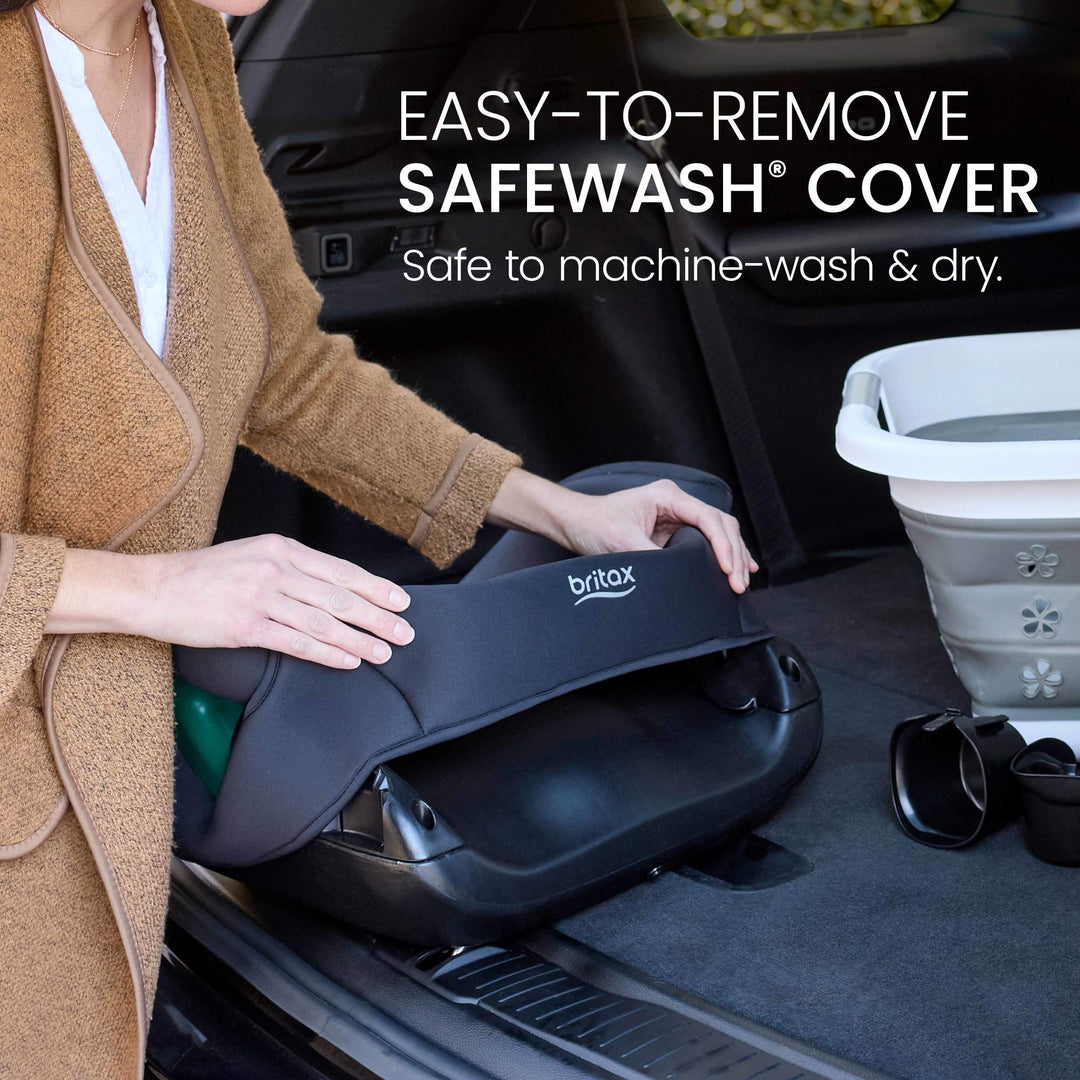
The UpNGo™ backless seat booster gives your child the boost they need to move up into the final car seat stage and go anywhere with confidence. Designed for children from 40-120 lbs and 46”-63", this booster combines the portability and convenience that parents look for with kid-approved comfort and style. UpNGo is innovatively designed with PosturePlus™ to help encourage proper posture and seat belt positioning. It also includes a shoulder belt guide to help keep the seat belt in the right place. The slim 17.1” SpaceSaver™ design means there’s more room for siblings or carpoolers, and the soft cushioning and large, padded armrests give your child that extra boost of comfort. Whether they're heading out for a shopping trip with grandma or hopping in with a friend on their way to a sleepover, they’ll feel confident navigating big-kid trips with this lightweight and easy-to-carry booster. They can keep their favorite after-school snacks and drinks close at hand in the two cup holders, which are dishwasher-safe for easy cleanup. The booster seat cover is safe to machine wash and dry, and it’s naturally flame-retardant with no added FR chemicals. The color-coded belt guides help kids learn how to buckle up correctly as they make the final car seat transition, setting them up for safety no matter where their journey takes them.

  • Boost, Buckle, Go: Belt-positioning booster lifts your child up to use the vehicle seat belt. 
  • Extended Maximum Capacity: Designed for children from 40-120 lbs and 46”-63".    
  • PosturePlus™ Contoured Seat: Helps encourage proper posture and seat belt positioning.    
  • SpaceSaver™ Design: 17.1” seat leaves plenty of room for siblings & carpoolers! This slim booster seat is designed to fit 3 across in most vehicles without compromising safety or comfort. *Britax cannot guarantee 3-across fitment in all vehicles.     
  • Lightweight & Portable: Thanks to the built-in carry handle and lightweight design, you can take this booster anywhere. Weighing under 4 lbs, it’s easy for both caregivers and kids to carry.  
  • Removable SafeWash® Cover: Safe to machine wash and dry. 
  • Naturally Flame-Retardant Fabrics: No added FR chemicals. 
  • Designed for Comfort: Kids can enjoy every ride thanks to the contoured seat with breathable foam and soft padding. Plus, the large, padded armrests provide that extra boost of comfort.  
  • 2 Dishwasher-Safe Cup Holders: Keep drinks and snacks within reach; easy to remove for cleaning between rides.   
  • Padded Carry Handle Cover: Helps ensure a comfortable grip.    
  • Color-Coded Belt Guides: Help kids learn how to buckle up safely.    
  • Shoulder Belt Guide: Helps keep the shoulder belt in the correct position, encouraging proper fitment as your big kid continues to grow. 
  • Soft & Smooth Knit Fabric: For comfort and a sleek appearance.  

Specifications

  • Dimensions: 9"H x 15.5"D x 17.1"W
  • Product weight: 3.1 lbs.
Shipping Notes
  • Free Standard Shipping on $100+ Orders to the USA.
  • Except Preorder products are shipped in 48 hours.
  • Delivery to the USA:
  1. Standard Shipping : 3-10 business days
  • If time is of the essence, please consider selecting expedited delivery for faster service.
Exchange/Return Notes
  • We offer a 30-day return/exchange service after receiving.
  • Final sale items are not eligible for returns or exchanges.
  • To process your return/exchange, please contact us at [email protected]
  • Please click here for more details>>> Return & Exchange Policy
SKU: 67351898198

Discover Niche Categories That Outsell britax safe wash

Top-Converting Item to Boost Your Average Order

4.7 ★★★★★
Based on 5 reviews
Sort
Highest Rating
Newest First
Oldest First
Product Reviews
J
Verified Purchase
James Collier
Cuba, US
★★★★★ 3
Good but misleading size
Size: 3Pack of 5 Tier (Not included planks)
Sturdy set for shelving. However dimensions are misleading. Not sure if they sent the incorrect size but the vertical distance between shelves was 11” and that’s without the shelving installed
WAS THIS REVIEW HELPFUL?YesReportShare
Reviewed in the United States on February 17, 2026
S
Verified Purchase
Sara
Fort Morgan, US
★★★★★ 5
Worked for pantry
Size: 3Pack of 5 Tier (Not included planks), Size: 3Pack of 5 Tier (Not included planks)
These turned out perfect t for a pantry. Just fyi get better dry wall anchors and you’re golden! Definitely takes two people to put up tho!
WAS THIS REVIEW HELPFUL?YesReportShare
Reviewed in the United States on February 14, 2026
R
Verified Purchase
Rich
Grantham, US
★★★★★ 5
Buy it.
This is not merely another guide to intensive care. Well-organized and detailed, it hits the right note between the things a beginner has to know (and probably has some idea about) and the things a beginner needs to know (but is clueless). It even includes a chapter on burnout. Recommended for everyone new to the ICU, and also everyone who has been around awhile. I’m going to get a lot of use from this text, I can already tell.
WAS THIS REVIEW HELPFUL?YesReportShare
Reviewed in the United States on June 19, 2018
W
Verified Purchase
W. Lonfrost
Lowell, US
★★★★★ 3
A little too beginner; doesn't translate well to USA patterns of practice
Format: Paperback
The book title really says it all, it really is the BEGINNER'S guide to the ICU for junior doctors and allied health professionals - more like an introduction to important concepts rather than a guide really. The strengths of the text come from its stated purpose of being a absolute, beginner's guide to critical care. The book would be appropriate for perhaps a 4th year med student or a intern who is very early in residency w/ little ICU experience or a newly minted APP; there's little to be gained by a advanced resident, fellow or practicing physician. The chapters are very short which provide a mere grazing-the-surface of important critical care concepts - some chapters are too short to really be useful (e.g. the paltry coverage of ultrasound in crit care (p. 159) is only 10 pages including pictures). The book, editors and authors are UK-based which makes the units of measurement, choice of drugs and some practice patterns, not consistent with what is typical in the USA. For this reason I cannot recommend this text for American learners; e.g. blood glucoses are measured in mmol/L internationally, however USA, Germany use mg/dL where a normal BG in UK may be "4.4" but in the US one might consider a normal BG "80". This carries over again with concepts of ABG's and their utility in ventilator settings, respiratory emergencies and sepsis, etc. which become more confounding when using the PaCO2/PaO2 kPa instead of the mmHg used in American ICU's. When a BEGINNER is trying to learn the FUNDAMENTALS of crit care I recommend that a learner be introduced to the concepts using data measurement they are expected to utilize in practice rather than going through the mental gymnastics of doing conversions and THEN making a treatment decision. The theme of UK and USA differences continues into drug therapy. For example when covering RSI and sedation the authors discuss the utility of sodium thiopental, however this drug has not been available in the USA for many years. In addition there were some other areas where some recommended drugs did not correlate w/ typical USA patterns and others that received hardly any mention (e.g. little mention of vasopressin as an adjunct in pressor support, other paralytics in RSI such as succinyl choline, rocuronium, CCB's and BB's in atrial fibrillation). Least of all there are multiple areas where drug/device names that refer to the same agent but would confuse a beginner starting in the USA (e.g. albuterol = salbutamol, aceteminophen = paracetamol, norepinephrine = noradrenaline, Guedel = OPA etc.). Lastly, on the topic of UK vs worldwide differences the epidemiologic data mentioned refers to UK populations making it somewhat of an abstraction of the prevalence of disease in your area of practice if you're outside the UK. Which is fine, just be aware of that. The chapters, however, are well organized and majority begin with a clinical case which I find is a approach that cements concepts in learner. If anything I feel that some are much to short, even for a beginner. I'm specifically referring to the Cardiac Arrythmias chapter (p 233). There is much to cover on this topic and the 5 pages dedicated to it is simply not enough and there is no further recommended reading. And importantly, the EKG figures were switched around on p234 and p235, which again does a beginning learner a disservice. I did find the chapters dedicated specifically to ICU concepts useful such as "Fighting the Ventilator" and "Endotracheal tube and tracheostomy problems" which cover just enough ground for the trainee. Unfortunately, none of the chapters have in-text citations with little primary references - I did have some questions regarding some chapter authors recommendations and I'm unable to look up where the works cited to review the quality of evidence. There are multiple chapter authors and unfortunately this creates some redundancies. I could only find one area where there was a contradiction between authors which one author stated there is no contraindication for insertion of a NPA in setting of base-of-skull fracture (p.79) and on the next chapter another author stating that "nasopharyngeal airway is contraindicated if there is the possibility of a base of skull injury!" (p.87) - less than 10 pages apart. Again, there's no primary texts referenced and I can't confirm where the best, up to date evidence lies. In SHORT: this is a useful text to the BEGINNER who is looking to obtain a broad overview of critical care CONCEPTS. It is pretty easy to read through and simple to digest where I a motivated learner could get through the full 440 pages relatively quickly and gain a good grasp & appreciation of the concepts of critical care. The text accomplishes its goal of being a BEGINNER'S GUIDE to ICU and explicitly identifies its target audience in the title: . . . . A Handbook for Junior Doctors and Allied Professional. I do NOT recommend the text to American trainees for the reasons above (drugs, units, differences in practice patterns) and I don't recommend the text to practicioners who have more experience.
WAS THIS REVIEW HELPFUL?YesReportShare
Reviewed in the United States on January 19, 2021
J
Verified Purchase
Jose
Dallas, US
★★★★★ 3
Material
Format: Paperback
The material is not the greatest very basic and it is all UK based
WAS THIS REVIEW HELPFUL?YesReportShare
Reviewed in the United States on February 2, 2020

recommand products