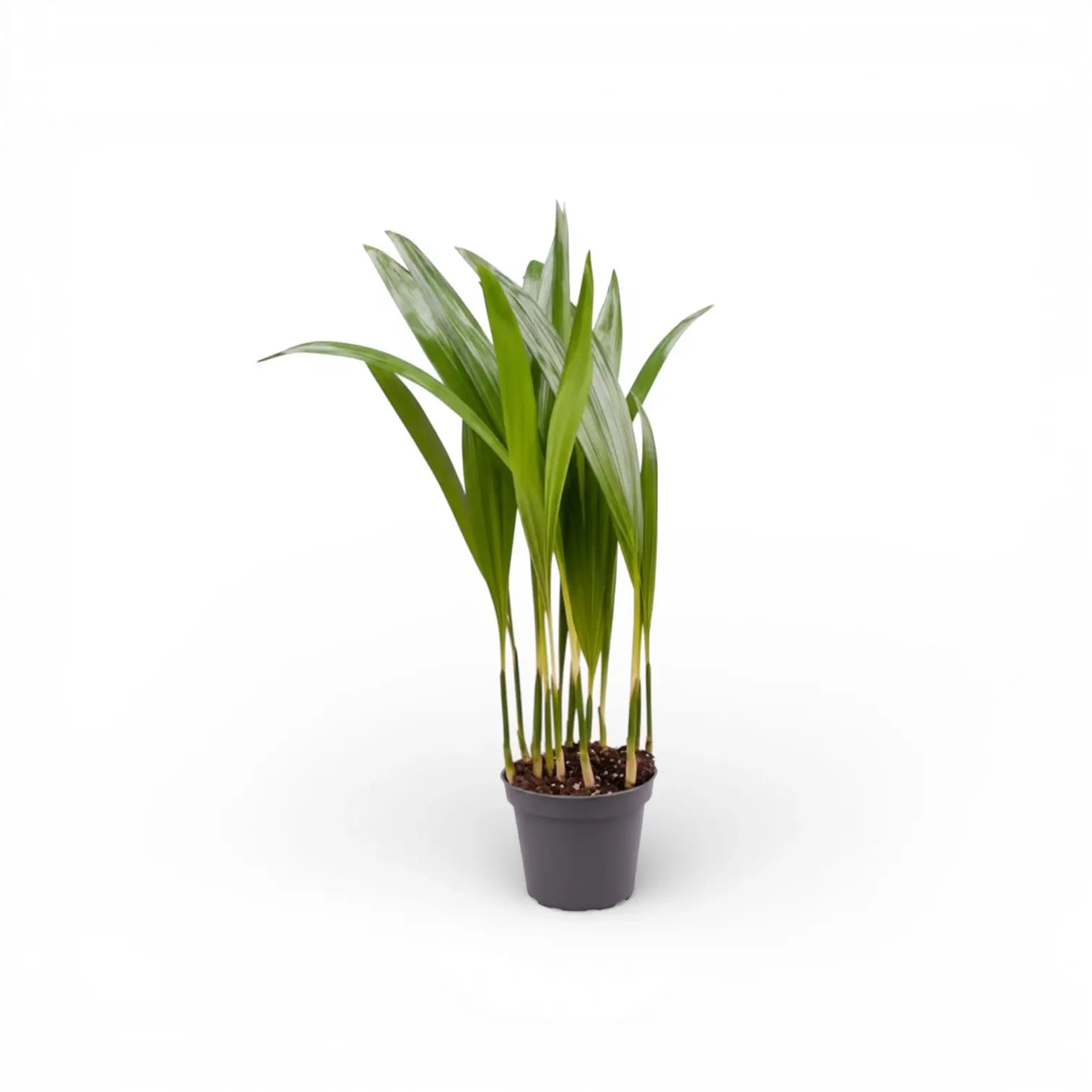
SKU: 67518000340
live palm plants

live palm plants Chrysalidocarpus lutescens

Sale price$25.71 Regular price$28.57
Save 10%

Pay in installments of $7.14 with ShopPay, AfterPay and Klarna

Shipping Estimate
USA
  • USA
  • CAN

Ships within 48 hours · Estimated delivery Sep 9 - Sep 14

Promo Codes Available:

For Your Every Summer RSVP, with Code: SUMMER15

Description

live palm plants Chrysalidocarpus lutescensChrysalidocarpus lutescens Chrysalidocarpus lutescens, still widely known under the synonym Dypsis lutescens, is a clustering palm with upright cane like stems and long, arching feather leaves. Several stems rise from the base, creating a soft, fountain shaped crown with yellow green petioles and narrow leaflets arranged along each frond. Indoors, this palm develops slowly into a broad, leafy specimen with a layered vertical outline. As the stems

Chrysalidocarpus lutescens

Chrysalidocarpus lutescens, still widely known under the synonym Dypsis lutescens, is a clustering palm with upright cane-like stems and long, arching feather leaves. Several stems rise from the base, creating a soft, fountain-shaped crown with yellow-green petioles and narrow leaflets arranged along each frond.

Indoors, this palm develops slowly into a broad, leafy specimen with a layered vertical outline. As the stems mature, they become more defined, while the fronds keep the crown airy, layered, and finely textured.

Golden cane palm details

  • Golden cane palm forming grouped yellow-green stems
  • Arching pinnate fronds with many narrow green leaflets
  • Yellow-green leaf stalks and midribs give the plant its warm tone
  • Can form a sizeable indoor floor plant over time
  • Rarely flowers indoors; mature outdoor plants may produce yellow flowers and small fruits

Eastern Madagascar origin and clumping growth

Chrysalidocarpus lutescens is native to Madagascar and belongs to the palm family, Arecaceae. In habitat and tropical cultivation it can grow as a shrub-like or tree-like palm, with multiple stems forming a broad clump. Indoors, its final shape depends on light, root space, and steady watering.

Each stem grows from a central crown. Fully brown fronds can be removed at the base, while green fronds should stay in place so the palm retains enough leaf area for new fronds. New fronds emerge from the growing points and gradually open into the palm’s feathered canopy.

Because this palm forms a clump, uneven growth is normal: some canes may sit lower while newer stems fill the centre. Turn the pot occasionally so the crown develops evenly, and keep the leaf bases open enough for inspection because pests often settle where the fronds meet the stems.

Keeping Chrysalidocarpus lutescens evenly leafy

  • Light: Use a bright, indirect position. Gentle morning or late afternoon sun suits acclimated plants, while strong midday sun behind glass can scorch fronds.
  • Watering: Keep the substrate evenly lightly moist during active growth, then let the upper layer dry before watering again. Avoid cold, saturated soil.
  • Substrate: Use an airy, well-drained palm or houseplant mix with mineral drainage material to keep the root zone open.
  • Temperature: Keep the palm warm, ideally above 18 °C, and avoid cold draughts or temperatures below about 15 °C.
  • Humidity: Average to moderate indoor humidity is workable, although very dry heated air can crisp leaflet tips. Use a humidifier where winter air becomes persistently dry.
  • Feeding: Use a low-strength fertiliser in spring and summer. Too much feed can show as yellowing or salt stress on leaflet tips.
  • Repotting: Move up one pot size when roots have filled the container, often after 2–3 years. Avoid oversized pots that keep the mix wet for too long.
  • Pruning: Remove only fully spent fronds. Cutting green fronds reduces the palm’s active leaf area.
  • Leaf cleaning: Wipe dusty leaflets gently or rinse the fronds with lukewarm water so the narrow leaflets can receive light evenly.

Frond, cane and pest checks

  • Brown tips: Often linked to dry air, irregular watering, salt build-up, or old leaf age. Check moisture pattern and flush the substrate if fertiliser salts have built up.
  • Yellowing fronds: Can follow overwatering, poor drainage, low light, nutrient imbalance, or natural ageing of older leaves. Check the root zone before feeding.
  • Mites or scale insects: Fine stippling, webbing, sticky residue, or bumps on stems and leaf bases need early inspection and treatment.
  • Collapsed stems: Soft bases usually point to root or crown stress from persistently wet, cool conditions.

Pet-safe palm status

ASPCA treats the areca palm, Chrysalidocarpus lutescens, as non-toxic to cats and dogs. Sensitive pets may still get mild stomach upset from chewing the fronds.

Accepted name and synonym note

Chrysalidocarpus lutescens H.Wendl. is the accepted botanical name for this Arecaceae species. Dypsis lutescens remains a common synonym in horticulture. The genus name refers to chrysalis-like fruits, while lutescens means turning yellow, matching the yellow tones in the flowers, stems, and leaflet midribs.

Chrysalidocarpus lutescens grows into golden cane clusters with airy fronds and a full upright palm outline.

Shipping Notes
  • Free Standard Shipping on $100+ Orders to the USA.
  • Except Preorder products are shipped in 48 hours.
  • Delivery to the USA:
  1. Standard Shipping : 3-10 business days
  • If time is of the essence, please consider selecting expedited delivery for faster service.
Exchange/Return Notes
  • We offer a 30-day return/exchange service after receiving.
  • Final sale items are not eligible for returns or exchanges.
  • To process your return/exchange, please contact us at [email protected]
  • Please click here for more details>>> Return & Exchange Policy
SKU: 67518000340

Discover Niche Categories That Outsell live palm plants

Top-Converting Item to Boost Your Average Order

4.2 ★★★★★
Based on 20 reviews
Sort
Highest Rating
Newest First
Oldest First
Product Reviews
J
Verified Purchase
jc
Battle Creek, US
★★★★★ 5
It's a great book for learning about Greek without all of the ...
Format: Kindle
More comprehensive than I originally thought it would be. It's a great book for learning about Greek without all of the memorization (although there is some) by an author who really knows his subject. I'd recommend it to anyone who wants to get deeper into Bible study but doesn't have the time for full college courses.
WAS THIS REVIEW HELPFUL?YesReportShare
Reviewed in the United States on May 31, 2015
K
Verified Purchase
Ken Hill
Dallas, US
★★★★★ 5
Very informative and well written. Check out Phrasing.
Format: Kindle
Very informative and well written. I especially like the concept of Phrasing as an aid to meditating on the Word. I don't know Greek and got a lot of value out of it.
WAS THIS REVIEW HELPFUL?YesReportShare
Reviewed in the United States on August 3, 2017
J
Verified Purchase
J. Jarvis
Bozeman, US
★★★★★ 5
accessible Greek for all
Format: Paperback
I got this book for my wife, who is a complete Greek novice. She enjoys it. And it is accessible for her. The book is divided into three sections, where each section gives an increasingly in depth summary of nt Greek. This is a great idea; if you only want to know the basics, do section 1. If you want to know a little more, perhaps do section 2 as well. Section 3 starts to get into the basics that you would hit in a first year text book. This is not a replacement for a first year textbook; this is for someone who doesn't want to commit to a first year textbook. For a extra fee, you can order helpful videos done by the author himself.
WAS THIS REVIEW HELPFUL?YesReportShare
Reviewed in the United States on May 31, 2014
H
Verified Purchase
Henry R. Ford
Pawtucket, US
★★★★★ 5
Thank you for excellent service. This book is very informational and written ...
Format: Paperback
Thank you for excellent service. This book is very informational and written in a clear and understandable manner. I have not completed reading it yet, but so far I am enjoying it.
WAS THIS REVIEW HELPFUL?YesReportShare
Reviewed in the United States on December 31, 2015
A
Verified Purchase
AL
Charlottesville, US
★★★★★ 4
VERY GOOD FOR ITS PURPOSE, SOME RESERVATIONS
Format: Paperback
To same space, WM= William Mounce. BBG=Basic Biblical Greek Grammar. This is an expanded edition of the earlier book of the same name. One will recognize many elements of the author's BBG, but this is more of "how to use Greek for exegesis" so it doesn't have a lot of paradigms etc. WM even puts in the "professor" character from the BBG 3rd ed. He has chapters on word studies, translations, textual criticism, advice on how to use commentaries, etc. It's written at an elementary level so it's an excellent guide for someone just wanting to understand more deeply the scriptures, or to check the accuracy of translations. If one wants to go more in depth, he/she can consult the intermediate grammars like Gerald L. Stevens or Wallace (that one is really detailed!). WM divides the book into sections of increasing depth - Fundamental Greek, Church G., & Functional G. He deals with verbal aspect in several places. He says tenses do have the time element in the indicative mood, but it's second to aspect. Outside the indicative, only aspect is a factor. The 3 are UNDEFINED, CONTINUOUS, and (traditional perfect) complete w/ continuing results. Whether the traditional perf/pluperfect is THE meaning of the tense, or an aktionsart, I will leave to the reader. Sometimes these 2 tenses represent a state. The traditional perfect is there much of the time, determined by the meaning of the verb and context. One should look at how the verbs are actually used (sometimes it's really hard to tell why the perfect was used). Perhaps the old proverb applies to Greek i.e. "the only hard and fast rule, is that there are NO hard and fast rules". The book is helpful for students of the word. One can learn the plan of salvation from good translations, but knowledge of the Greek can answer questions, like the seeming contradiction between (ROM 3:23 & 1 JOHN 1:08,10) with (1 JOHN 3:06,09). Or the question of why Jesus told Thomas to touch Him, but said to Mary "touch Me not" in (JOHN 20:17). Understanding the (normally) continuous/repeated of action of the present tense can answer these questions. I believe the book has a few flaws (thus 4 stars). I think WM gets some things wrong, like when he says a commentator should never say something in the Bible is clear or obvious. One might say this about figurative language - like REVELATION, but if the Bible isn't clear about say, what one must do to go to Heaven, then what's the point? Also WM says on pg 126 (2nd "dot") a student can't "argue" with a commentator or a translator - he/she doesn't know enough Greek. One doesn't have to be a scholar to be able to see when someone is putting in his/her own theology (at least there are enough clear passages in the Bible that one shouldn't have to). The great scholar A.T. Robertson mentions this on pg 389 of his "big book" - there comes a point when grammar stops and theology takes over. Even WM says there're commentaries he doesn't recommend. I recommend the book. As to the few problems, always remember what Douglas K. Stuart said in his book on commentaries "just because one is a PHD, doesn't NECESSARLY mean that he/she is right and you're wrong". Always let the Bible speak for itself.
WAS THIS REVIEW HELPFUL?YesReportShare
Reviewed in the United States on March 9, 2015

recommand products