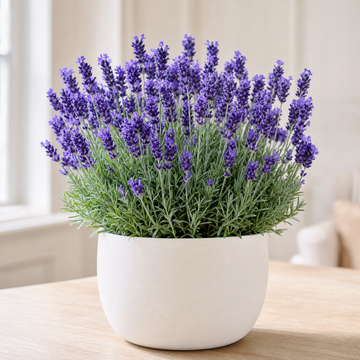
SKU: 67987698490
lavender planting guide

lavender planting guide Lavandula ‘Superblue’ Lavender

Sale price$24.62 Regular price$27.35
Save 10%

Pay in installments of $6.84 with ShopPay, AfterPay and Klarna

Shipping Estimate
USA
  • USA
  • CAN

Ships within 48 hours · Estimated delivery Jul 17 - Jul 22

Promo Codes Available:

For Your Every Summer RSVP, with Code: SUMMER15

Description

lavender planting guide Lavandula ‘Superblue’ LavenderThe Lavandua Superblue or Lavandula angustifolia Superblue, is a cold hardy, drought tolerant, and richly hued variety of lavender known for its deep blue purple flowers and ease of cultivation. This English lavender cultivar is loved for its intense, vivid blooms, which make it a striking addition to both gardens and containers. Superblue is highly prized for its aromatic foliage, drought tolerance, and ability to thrive in various growing

The Lavandua Superblue or Lavandula angustifolia Superblue, is a cold-hardy, drought-tolerant, and richly hued variety of lavender known for its deep blue-purple flowers and ease of cultivation.  

This English lavender cultivar is loved for its intense, vivid blooms, which make it a striking addition to both gardens and containers. ‘Superblue’ is highly prized for its aromatic foliage, drought tolerance, and ability to thrive in various growing conditions. As a versatile plant, it attracts pollinators and is perfect for borders, herb gardens, and rock gardens, bringing beauty and utility with its fragrant presence. 

Lavandula ‘Superblue’ is named for its exceptionally rich blue-purple flowers, which are more intense than most other lavender varieties. The Superblue lavender is native to the Mediterranean region, particularly in the rocky, sun-drenched hillsides of southern Europe. Today lavender is growing worldwide, with ‘Superblue’ flourishing in USDA hardiness zones 5-9.

One of the standout features of Lavandula ‘Superblue’ is its compact, bushy growth habit, which typically grows up to 1 foot tall and spreads about 1 foot wide. Its leaves are grayish-green, narrow, and finely textured, adding a silvery accent to its deep purple blooms.

The plant’s dense foliage creates a lush mound, making it an ideal choice for edging pathways or filling smaller garden spaces. Superblue lavender retains its neat, tidy shape with minimal pruning, adding a controlled yet vibrant touch to any landscape. 

The flowers of Lavandula ‘Superblue’ blooms in early to mid-summer and produce tall spikes of fragrant, blue-violet flowers that are highly attractive to bees, butterflies, and other pollinators. The blooms rise gracefully above the foliage, creating a visually striking contrast with the silvery-green leaves. The flowers emit a classic lavender scent, and their rich color persists throughout the bloom cycle, adding a long-lasting splash of color to garden beds and containers. 

Its flowers can be harvested and dried for use in potpourris, or sachets, bringing their calming fragrance indoors. In gardens, the plant’s fragrance can help deter pests, and its flowers attract beneficial pollinators.  

Lavender is also popular essential oil that is used in herbal medicine and aromatherapy for its soothing, stress-relieving properties. Furthermore, it’s an ideal companion plant, blending well with other drought-tolerant species like sage, rosemary, and thyme. 

When and How to Water Superblue Lavander 

The Lavandula Superblue is a drought-tolerant plant that requires minimal watering once established. This means watering the plant thoroughly when the soil is dry to a depth of about 1-2 inches. It's essential to allow the soil to dry out between waterings to prevent root rot and other issues caused by overwatering.

In the spring and summer, during the growing season, you can water the Lavandula Superblue plant approximately once every 7-10 days, depending on the weather conditions and soil drainage. It's important to adjust the watering frequency based on factors like temperature, humidity, and rainfall. During hot and dry periods, you may need to water the plant more frequently, while in cooler or rainy weather, you can reduce the watering frequency. 

In the fall and winter months, you should reduce watering to allow the plant to enter a period of dormancy. Water the plant sparingly, only when the soil is dry to the touch, about every 2-3 weeks. This reduced watering schedule helps mimic the plant's natural growth cycle and prevents waterlogging during the plant's dormant phase.

By understanding the seasonal watering needs of the Lavander Superblue plant and adjusting your watering routine accordingly, you can help promote healthy growth and ensure the plant thrives in its environment. Remember to always monitor the soil moisture levels and adapt your watering schedule based on the plant's specific requirements to maintain its overall health and vigor. 

Light Requirements – Where to Place Your Superblue Lavender 

When grown indoors it’s essential to place your superblue lavender in a location where it can receive ample bright, indirect sunlight. A south-facing window is ideal for providing the plant with the necessary sunlight it needs for healthy growth.

If a south-facing window is not available, you can supplement the light with a grow light to ensure the lavender receives adequate light exposure.

For outdoor cultivation, Lavandula Superblue plants thrive in full sunlight. These plants require at least 6-8 hours of direct sunlight daily to flourish.

Choose a spot in your garden or landscape that receives plenty of sunlight throughout the day. In regions with hot summers, providing some afternoon shade can help protect the plant from intense heat and sunburn.

Indoor Lavandula SuperBlue plants may benefit from spending time outdoors during the warmer months. If you choose to move your lavender plant outdoors, gradually acclimate it to direct sunlight to prevent sunburn. Start by placing the plant in a partially shaded area and gradually increase the exposure to full sunlight over a few days.

Optimal Soil & Fertilizer Needs

The Superblue Lavender plants prefer well-draining soil with a slightly alkaline pH level 5.9 to 6.2. A sandy or loamy soil mix with good drainage is ideal for Lavandula Superblue. You can improve soil drainage by adding perlite or coarse sand to the soil mix to prevent waterlogging, which can lead to root rot. Planet Desert has specialized potting soil, opens in a new tab that includes an organic substrate with mycorrhizae to help with the growth of a healthy root system to help your plants to thrive. 

When it comes to fertilizing Lavandula Superblue, it's important not to over-fertilize as these plants are sensitive to excess nutrients. Fertilize the plant sparingly to avoid causing damage. A balanced, NPK fertilizer formulated for flowering plants can be applied in the spring as new growth begins. Alternatively, you can use a diluted liquid fertilizer once a year during the growing season to provide your superblue lavender with essential nutrients. 

By selecting the right soil mix, ensuring proper drainage, and providing appropriate fertilization, you can help your Lavandula Superblue plant thrive and produce healthy growth and vibrant blooms. 

Hardiness Zones & More 

When growing indoors, Lavandula Superblue plants thrive bright, indirect sunlight with temperatures between 60-70°F during the day and slightly cooler temperatures at night. They prefer moderate humidity levels, around 40-50%.  

For outdoor cultivation, Superblue lavender plants are typically suited for USDA zones 5-9. They require full sunlight exposure, receiving at least 6-8 hours of direct sunlight daily for optimal growth and blooming.

They prefer temperatures ranging from 70-90°F during the day and slightly cooler temperatures at night. Lavender plants thrive in low to moderate humidity levels, around 30-40%.

Wildlife Lavandula Superblue Attracts the Following Friendly Pollinators

The Lavender Superblue plants are known to attract various pollinators and beneficial insects to the garden. The fragrant flowers of superblue lavender, like other lavender varieties, are rich in nectar, making them attractive to bees, hummingbirds, butterflies, and other pollinators. It is also resistant to deer and rabbits. 

Butterflies
Bees
Hummingbirds
Lady Bugs
Multi Pollinators
Other Birds

According to ASPCA, the SuperBlue lavender plants are considered mildly toxic to pets These compounds aren’t harmful to humans when used in culinary amounts, but consuming excessive amounts could lead to mild digestive discomfort. In recipes, lavender is safe in small amounts and is used for its pleasant floral taste.

How to Propagate Superblue Lavender 

The Superblue lavender can be propagated through stem cuttings. To do this, select a healthy stem and cut it just below a leaf node. Dip the cut end in rooting hormone before planting it in well-draining soil. Keep the cutting moist and in a warm, sunny location to encourage root growth. After a few weeks, roots should begin to form and the cutting can be transplanted into their own pot or garden bed. Remember to water regularly and provide adequate sunlight for optimal growth. 

Key Takeaways

  1. It is hardy in USDA zones 5-9 and can tolerate cooler climates than many other lavender varieties, making it versatile for a range of garden settings.
  2. It produces deep violet-blue, fragrant blooms that appear in abundance, typically from late spring through summer.
  3. It is highly drought-tolerant once established, making it suitable for low-water gardens and Mediterranean climates.
  4. A compact variety of lavender, reaching about 1 foot tall, perfect for containers, borders, and small garden spaces.
  5. It is known for its aromatic, gray-green foliage that adds beauty and fragrance to any landscape or garden.
  6. In addition to its visual appeal, lavender is also prized for its ability to be used in potpourri and for extracting essential oils. This makes it a popular choice for those looking to incorporate natural scents into their home or garden.

The Bottom Line 

Overall, LavandulaSuperBlue’ is a delightful addition to any garden, valued for its cold-hardy nature, striking long-lasting, blue-violet blooms, and enchanting fragrance. This variety is particularly known for its abundant flowers, which attract bees, butterflies, and other beneficial pollinators, adding vibrant life to your garden. It thrives best in full sun and well-draining soil, which helps prevent root rot and promotes strong growth. It’s an ideal choice for container gardens, borders, and even with an indoor accent if adequate sunlight is provided. It is drought-tolerant once established, and only requires moderate watering and a light annual pruning to encourage fresh blooms and maintain its tidy, bushy shape. With its hardy nature and fragrant appeal, Superblue lavender is perfect for creating a calming, low-maintenance landscape that enhances both beauty and biodiversity. 

Shipping Notes
  • Free Standard Shipping on $100+ Orders to the USA.
  • Except Preorder products are shipped in 48 hours.
  • Delivery to the USA:
  1. Standard Shipping : 3-10 business days
  • If time is of the essence, please consider selecting expedited delivery for faster service.
Exchange/Return Notes
  • We offer a 30-day return/exchange service after receiving.
  • Final sale items are not eligible for returns or exchanges.
  • To process your return/exchange, please contact us at [email protected]
  • Please click here for more details>>> Return & Exchange Policy
SKU: 67987698490

Discover Niche Categories That Outsell lavender planting guide

Top-Converting Item to Boost Your Average Order

4.8 ★★★★★
Based on 18 reviews
Sort
Highest Rating
Newest First
Oldest First
Product Reviews
A
Verified Purchase
Amazon Customer
Bozeman, US
★★★★★ 4
read-this-book-now
Format: Paperback
I liked the pace, the story and the characters. Sadly I found it at the end a bit confusing. I think the book needed more edition work. Otherway, it is a recommendable book if you want horror with a bit of science fiction. Be advised you'll need to use your imagination to understand certain pasages.
WAS THIS REVIEW HELPFUL?YesReportShare
Reviewed in the United States on February 13, 2026
A
Verified Purchase
angela
Chelsea, US
★★★★★ 2
Not even a good read. Pass it.
Format: Paperback
Unfortunately, this book was basically a whole lot of nothing. It was not what I was hoping for, which was on the edge of your seat scary. It was not even alittle scary. Left me with unanswered questions and confused. Sorry..I did not like this book at all.
WAS THIS REVIEW HELPFUL?YesReportShare
Reviewed in the United States on March 6, 2026
J
Verified Purchase
Jennybee
Port Orchard, US
★★★★★ 5
Easy to read and fall in love with
Format: Hardcover
one of those books that feels less like a story and more like an experience. Ray Bradbury captures the magic of summer, childhood, and all the little things in life we take for granted. I loved the way it blended nostalgia with those bittersweet moments of growing up. It’s slow at times, but that’s the beauty of it — it makes you stop and notice the small details, just like the characters do. For me, it felt like stepping back into a simpler time, but with all the emotions and lessons that still matter today. It’s warm, reflective, and beautiful. A book you don’t just read — you feel.
WAS THIS REVIEW HELPFUL?YesReportShare
Reviewed in the United States on September 20, 2025
K
Verified Purchase
Kindle Customer
Cuba, US
★★★★★ 5
Vintage Bradbury
Format: Hardcover
Ray Bradbury August 22nd 1922 - June 5th, 2012 When Ray Bradbury died reactions came from everywhere including from President Obama. Surprising to me, few mentioned the one of his works that meant so much to me and affected my life so deeply. While he was most known to the general public for his science fiction, I found his mostly autobiographical novel Dandelion Wine to be the most impactful. At the same time it best illustrated Bradbury’s incredible command of the language, his ability to stir the imagination, and the way in which he could open windows on life. I couldn’t count the number of times I would reread a single sentence and become overwhelmed with admiration and envy at how he used words to create images in the mind’s eye. All this was particularly on display in Dandelion Wine and its sequel, Farewell Summer. For Bradbury, it couldn’t be just water. “Nothing else would do but the pure waters which had been summoned from the lakes far away and the sweet fields of grassy dew on early morning, lifted to the open sky, carried in laundered clusters nine hundred miles, brushed with wind, electrified with high voltage, and condensed upon cool air. This water, falling, raining, gathered yet more of the heavens in its crystals. Taking something of the east wind and the west wind and the north wind and the south, the water made rain and the rain, within this hour of rituals, would be well on its way to wine.” Essentially, Dandelion Wine is the story of a summer in the life of a twelve year old boy as he comes to understand what it means to be alive. But it is also a time capsule for the year 1928 of life in a small town when everyone’s world was much smaller and more compact. There is horror, love, comedy, wonder, nostalgia, and human relations. Bradbury could find unique ways to describe them all. I first read Dandelion Wine in 1957 when I wasn’t much older than Douglas Spaulding, the central character. It helped me put life in perspective as I was leaving high school. I read it the second time in the early ‘80s when I introduced my daughter to it. Kelly and I sat on our front porch swing one warm summer evening and I read aloud to her the story of Bill Forrester and Helen Loomis. It was all I could do to finish it and when I did we both had tears streaming down our cheeks. Such was the power of imagination and Bradbury’s ability to stroke it to life using just words. I read it the third time in preparation for reading the sequel, Farewell Summer, written 55 years after Dandelion Wine. Like a fine wine, it had only gotten better with age. Appropriately, Farewell Summer was given to me by Kelly and I read it on summer’s eve 2012. It was the perfect beginning for yet another summer. In both books the ravine in Green Town, Illinois, based on Waukegan, Illinois where Bradbury grew up was a central feature. I couldn’t resist going to Googlearth to see if the ravine was real. It was. And, it is still there even after Waukegan had changed from a small town to a satellite of Chicago. I was pleased to simply find I could locate it. But when I zoomed in and highlighted the little tree symbol I found the ravine is now Ray Bradbury Park. Perfect! Dan Winters June 29, 2012
WAS THIS REVIEW HELPFUL?YesReportShare
Reviewed in the United States on October 24, 2013
B
Verified Purchase
BOB
Belleville, US
★★★★★ 4
One boy’s early awareness of magic and mortality
Format: Kindle
As part of my growing adolescent fascination with the work of Ray Bradbury, of course I read ‘Dandelion Wine’. However, it was one I have not revisited in almost 50 years so my recollection of it is less detailed than many of his other classic books. It’s a collection of interconnected short stories, some previously published, again set in Green Town, Illinois, the fictional counterpart for Waukegan, Illinois where Bradbury spent his first years up until the beginning of his adolescence. Many of his stories, whether they’re set in Green Town or some other anonymous Midwest town in the 20’s and 30’s resonated with me from the beginning. My father was born just a few months after Bradbury and grew up during that same time in another small town in Missouri, which I recall visiting a few times in my childhood and seeing a neighborhood not much different from Bradbury’s, and a house almost literally unchanged from the time when my father was a boy. That nostalgia, that yearning for the freshness and intensity of a child’s perception, when a boy will find magic in a birdbath and an earth-scented basement, definitely spoke to my soul and still does, 50 years later. The main character is a Ray surrogate, a twelve-year old boy named Douglas Spaulding (Bradbury’s middle name is ‘Douglas’) who has a ten-year old brother named Tom. They live with their parents, grandparents, and great-grandmother in an old house that is sturdy and roomy enough to accommodate a few boarders. One of the ‘beginning of summer’ rituals is the bottling of dandelion wine that will last the entire summer and beyond, at which point it will be a way of preserving what was memorable about the summer that just passed. ‘Hold summer in your hand, pour summer in a glass, a tiny glass of course, the smallest tingling sip for children; change the season in your veins by raising glass to lip and tilting summer in.’ During this particular summer, Doug fully realizes, for the first time, that he is alive and, conversely, that he will die. He holds mortality at bay as much as he can, with special sneakers in which he can run from one end of the town to the other and working out a clever bartering trade with the shoe salesman as a way to “buy” the sneakers. Doug could be a future salesman himself, persuading the salesman to try on a pair himself so he will know what he’s selling and how it actually feels to wear a pair. The future writer Doug also wants to document every significant event that happens to him this summer of 1928. His younger brother Tom, on the other hand, is more logical and reasonable. While Doug chronicles the events of the summer, Tom records data such as the first rainfall and other meteorological data. Tom also seems to me to be the wiser of the two, reasoning with and calming down the melodramatic Doug on more than one occasion. Everything in the town acquires new meaning to the otherwise carefree and playful Doug. There are discernible boundaries between civilization and wilderness in this little hamlet, the most notable example being the ravine: ‘The ravine was indeed the place where you came to look at the two things of life, the ways of man and the ways of the natural world. The town was, after all, only a large ship filled with constantly moving survivors, bailing out the grass, chipping away the rust.’ The death of his great grandma also occurs this summer. After a lifetime of activity and housekeeping and family keeping, she decides that she has lived long enough. She has no discernible ailment, just a “mild but ever-deepening tiredness”. She has to assure Doug and Tom that the time for doing all this activity has come to an end and that they must learn to accept it. Just as disturbing for Doug is when his best friend John Huff tells him that his father is being transferred to Milwaukee .His family is leaving on the train that evening. John is a budding young superman. He is a master pathfinder, swimmer, climber and jumper. He is also not a bully. He is kind as well as smart. As far as Doug is concerned, he is a god. For their last play activity, they play a game of hide-and-seek. Doug volunteers to be ‘it’, hoping by controlling the pace of the game to prolong John’s departure. John wraps that one up and agrees to play one more game, with him as ‘it’. With Doug and the other boys frozen into ‘statues’, John punches him on the arm gently, saying “So long” and then runs. There is even a serial killer in Green Town, referred to as The Lonely One. Young spinster Lavinia Nebbs and some of her friends are worried about the disappearance of another of their friends. Rumors of the Lonely One being on the loose abound with the deaths of two young women occurring within the past two months. With the disappearance of their friend they have ample reason to be concerned. Then they find her, lying dead on the ground. They find the police and, after he finishes questioning them, they are free to leave. Lavinia, putting on a brave front, suggests they go to a Charlie Chaplin movie to stave off their fear. This works pretty well until the film ends, the last feature of the night, and they all have to walk home in the dark. Lavinia, still trying to hide her fear behind a brave front, agrees to walk her friends home first, meaning that she’ll have to walk the rest of the way to her house by herself. Bradbury’s mastery of suspense is particularly evident in this chilling and terrifying episode. I won’t reveal the outcome. There is one episode in which Doug and Tom, primarily Doug, come to believe that a wax, fortune-telling “Tarot Witch” automaton is actually a mummified queen from ancient Egypt. In reality it is a slot machine in which you put in a penny and out comes a card with your fortune written on it. The alcoholic owner is disgusted with it and his failing slot and pinball machine business and ready to throw it in the trash heap. Doug and Tom attempt to rescue it. This sequence is long and tedious and has the effect of Tom and Huck rescuing Jim near the end of ‘Huckleberry Finn’. In both cases it’s an unwelcome diversion that detracts from the power of the novel. Overall, ‘Dandelion Wine’ works. It is not as disjointed as it seemed to me 50 years ago when I could detect the short story origins of much of it. Depicting the course of a summer is by its nature episodic. There are moments where it seems that everybody talks like Bradbury writes, even the semi-literate characters, and with a zeal and enthusiasm that gradually took over most of his later fiction. At its core, however, it captures, through a poetic filter, the magic and intensity of a child’s perception and his awareness that all this beauty surrounding us is fleeting so we may as well appreciate it as much as we can while we can.
WAS THIS REVIEW HELPFUL?YesReportShare
Reviewed in the United States on May 10, 2022

recommand products