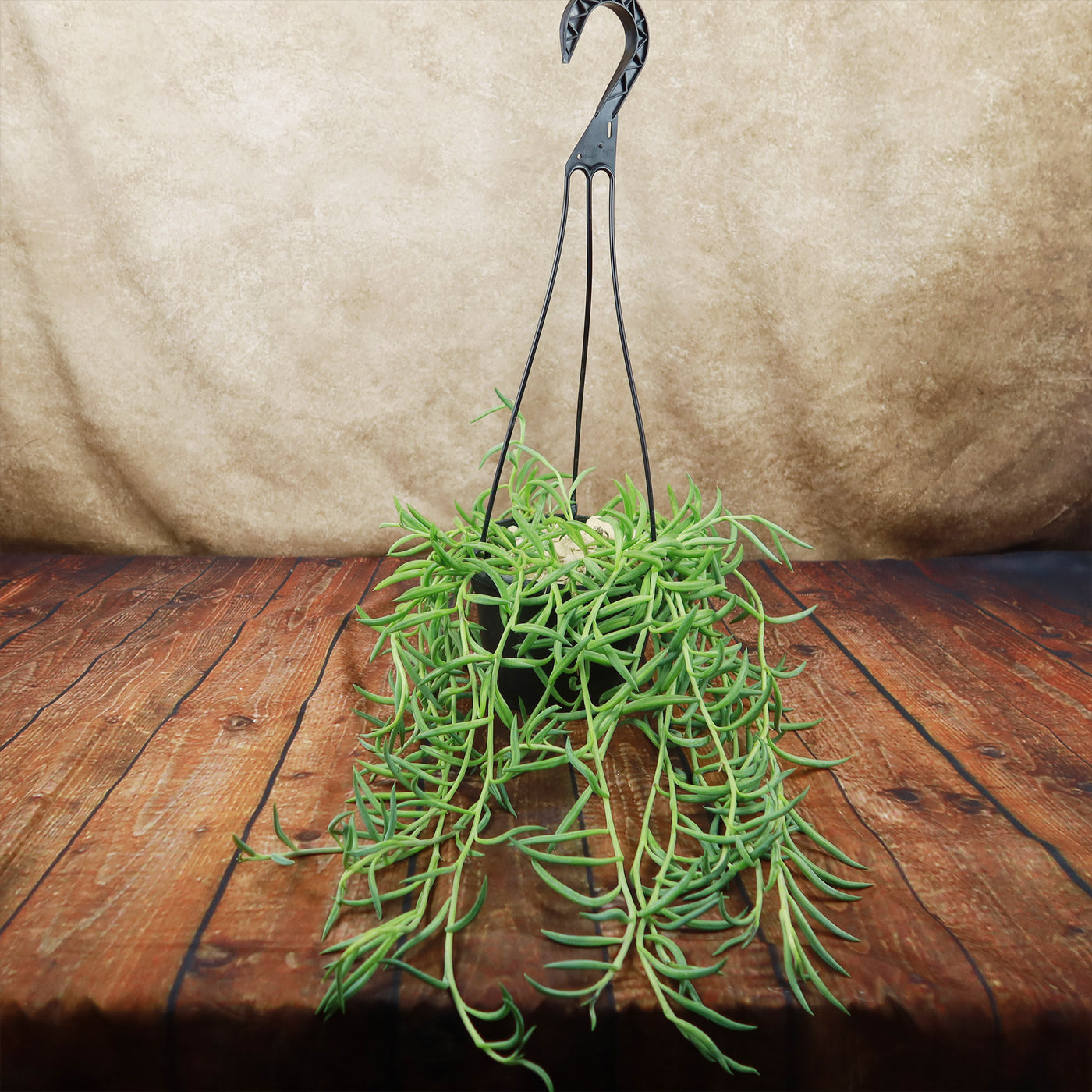
SKU: 6919250271
propagating fish hook succulent

propagating fish hook succulent Shop 'String of Fishhook Plant - Senecio radicans glauca' Care and Growing Guide

Sale price$22.47 Regular price$24.97
Save 10%

Pay in installments of $6.24 with ShopPay, AfterPay and Klarna

Shipping Estimate
USA
  • USA
  • CAN

Ships within 48 hours · Estimated delivery Sep 15 - Sep 20

Promo Codes Available:

For Your Every Summer RSVP, with Code: SUMMER15

Description

propagating fish hook succulent Shop 'String of Fishhook Plant - Senecio radicans glauca' Care and Growing GuideIntroducing the stunning string of fishhooks, scientifically known as Senecio radicans glauca, which is a trailing succulent variety of the Senecio radicans. The fish hook plant, also known as the blue pickle vine, is a hybrid trailing succulent that belongs to the Asteraceae family and is native to South Africa. The name "string of fish hook" comes from its distinctive appearance, as its leaves resemble tiny fishhooks. This fishhook Senecio plant

Introducing the stunning string of fishhooks, scientifically known as Senecio radicans glauca, which is a trailing succulent variety of the Senecio radicans.

The fish hook plant, also known as the blue pickle vine, is a hybrid trailing succulent that belongs to the Asteraceae family and is native to South Africa. The name "string of fish hook" comes from its distinctive appearance, as its leaves resemble tiny fishhooks. 


This fishhook Senecio plant features long, slender stems that cascade down, making it an excellent choice for hanging baskets or trailing down from shelves.

The stems are covered in small, cylindrical leaves that grow in pairs along the stems.

When the fishhooks plant has the proper growing conditions it grows very quickly and can get up to 32 feet tall. Whether you grow Fishhooks Senecio indoors or out, just make sure you give it room to trail!

The flowers of a string of fishhooks bloom from late summer to winter with daisy-like flowers. These delicate blooms are typically a creamy white or pale-yellow color and appear sporadically. While the Senecio flowers are not the main attraction of this hanging plant, they add a lovely touch when they do appear.

Most sites mix up the string of fishhook and string of bananas plants, but the glauca fishhook differs from the string of bananas (Senecio radicans) by having smaller, cylindrical leaves resembling fishhooks and a bluish-green color, whereas the string of bananas has elongated, banana-shaped leaves and a bright green color. Furthermore, the shape of 'Hooks' is longer and flatter than that of the string of bananas, which is rounded with a plump shape.

The Senecio radicans glauca fish hooks can be propagated from leaf or stem cuttings. This fish hook plant is not frost-hardy and winter-dormant. Avoid placing it directly under ACs, as it may cause leaves to droop. The fish hook plant looks best in hanging baskets as well as pots hung on walls. These can be grown in the driveway too. 

Watering Needs 

Succulents, like the Senecio Fish Hook plant, are excellent at withstanding drought or drought-tolerant fish hook plants. That's because the foliage of these succulent plants has the capacity to store water. Their leaves will explode if the soil is excessively wet or if you give them too much water.

Therefore, you typically only need to let the roots completely dry before watering them again. Watering them before they are completely dry can cause the roots to soak up water, which is bad because they are particularly prone to rotting. When your string of fishhook plants and roots get mushy, you'll recognize that something is wrong. 

If you notice the leaves trimming or wrinkling, this indicates that your Senecio plant needs to be watered. You ought to water these plants once every two weeks or so during the height of their growing season. 

You can dramatically cut back on that in the winter and only do it once a month. It's important to check the moisture level of the soil by sticking your finger about an inch deep into the soil. If it feels dry, it's time to water. If it still feels moist, wait a few more days before watering. 

Light Requirements

The glauca string of fishhooks prefers bright, indirect sunlight. If you are growing his hanging plant indoors it thrives when placed near a window with filtered sunlight or in a well-lit area of your home. Remember to rotate the fish hooks plant occasionally to ensure all sides receive adequate light for even growth.

When outdoors, ensure light shade and full sun indoors. Avoid exposing your fishhook plant to direct sunlight, as it can cause the leaves to burn.

If you notice the leaves stretching or becoming pale, it might indicate that the Senecio plant is not receiving enough light, so you can try moving it to a brighter location. 

Optimal Soil & Fertilizer Needs

The fishhook plant prefers well-draining soil. A good option is a succulent potting mix, which provides the right balance of moisture retention and drainage. You can also create your own potting mix by combining regular potting soil with perlite or pumice to improve drainage.

Planet Desert specializes in succulents and has specialized succulent potting soilGo to soil cactus mix blend 1 gal 4 qt cacti succulent dirt compost growing media that includes an organic substrate with mycorrhizae to help with the growth of a healthy root system to help your string of fishhook Senecios thrive.

When it comes to fertilizing, these fishhook plants don't require heavy feeding. A balanced (5-10-5) natural NPK fertilizer can be applied once a year during the growing season of spring. It's important not to over-fertilize, as this can lead to salt buildup in the soil and damage your fishhook succulent.

If the leaves start turning yellow or the Senecio succulent appears unhealthy, it may be a sign of over-fertilization, so it's best to reduce or stop fertilizing until the Senecio plant recovers.

Hardiness Zones & More 

When growing indoors, they prefer temperatures between 60-80°F during the day and slightly cooler temperatures at night. They become mushy when exposed to chilly temperatures for too long. So, throughout the winter, you should bring the pots indoors. If the air in your home is particularly dry, you can increase humidity by placing a tray of water near the plants or using a humidifier.

For outdoor cultivation, your fishhook plant is generally suitable for USDA hardiness zones 10-12. Like many other succulents, they can withstand heat well, but they can only withstand cold or moisture for a brief period of time.

This fishhook Senecio can adapt to both dry and moderately humid environments. However, they may benefit from slightly higher humidity levels, especially during the drier winter months. 

Remember, these are general guidelines, and it's always best to observe your specific plant's response to its environment and make adjustments accordingly. 

Final Thoughts

Overall, the String of Fishhooks (Senecio radicans glauca) is a fantastic trailing succulent that's perfect for hanging baskets or cascading down shelves. Its unique fishhook-shaped leaves give it a distinctive appearance. This plant loves bright, indirect light, so place it near a window where it can soak up some rays. When it comes to watering, it's best to let the soil dry out between waterings to prevent overwatering. This low-maintenance plant is a great addition to any succulent collection and adds a touch of whimsy to your space.

Give this succulent a try if you're looking for a beautiful plant Senecio radicans glauca - a string of fishhooks to care for! 

Shipping Notes
  • Free Standard Shipping on $100+ Orders to the USA.
  • Except Preorder products are shipped in 48 hours.
  • Delivery to the USA:
  1. Standard Shipping : 3-10 business days
  • If time is of the essence, please consider selecting expedited delivery for faster service.
Exchange/Return Notes
  • We offer a 30-day return/exchange service after receiving.
  • Final sale items are not eligible for returns or exchanges.
  • To process your return/exchange, please contact us at [email protected]
  • Please click here for more details>>> Return & Exchange Policy
SKU: 6919250271

Discover Niche Categories That Outsell propagating fish hook succulent

Top-Converting Item to Boost Your Average Order

4.8 ★★★★★
Based on 29 reviews
Sort
Highest Rating
Newest First
Oldest First
Product Reviews
K
Kindle Customer
Cuba, US
★★★★★ 5
A Powerful and Timely Book about Fairness and Equality in America
Format: Kindle
This book is beautifully written and deeply engaging. As a non-lawyer, I appreciated the author's ability to cut through legal abstraction to reveal what is truly at stake as the Supreme Court turns away from policies designed to expand opportunity. Driver writes, with clarity and conviction, that genuine equality demands more than the pretense that race no longer matters. The result is a powerful and thought-provoking work that reminds us the pursuit of fairness in America remains unfinished.
WAS THIS REVIEW HELPFUL?YesReportShare
Reviewed in the United States on October 5, 2025
D
Verified Purchase
Darryl L. Rowe
New York, US
★★★★★ 5
Awesome
Format: Kindle
Exactly what I needed to get started, and with a lot of useful tips on getting started. Highly recommend this book.
WAS THIS REVIEW HELPFUL?YesReportShare
Reviewed in the United States on November 3, 2024
J
Verified Purchase
Joan Phraner
Battle Creek, US
★★★★★ 5
ADHD symptoms explain our behavior, BUT they do not EXCUSE it!
Format: Paperback
I read this to my 6 year old to help reinforce his own personal awareness with topics that he struggles with or to help prevent a struggle due to his ADHD. Being aware of what we need to work on is the first step to making changes and hopefully by doing this we can prevent our children from future frustrations and disappointments within themselves. It is easier to mold them into respectful, responsible children at a younger age than it will be to break bad habits later on in life. With that said this book is one of many that we read as our "self help" kinda books. Every night I choose 1 book to add to the mix of his own book choices, depending on what I am trying to make him aware of and teach him coping skills in regards to things he struggled with that day or week. I hope this list is helpful. I know I always LOVE finding someone’s review that lists more great books on these kind of topics as I am always looking for more resources! This is a list of a few of my personal favorites age range about 4-8 Helping kids about making good choices: • That Rule Doesn't Apply to Me! (Responsible Me!) • But It's Not My Fault! (Responsible Me!) • What Were You Thinking? Learning to Control Your Impulses (Executive Function) • My Mouth Is a Volcano! (talking over/interrupting people) • What If Everybody Did That? (environmental awareness) • LarryBoy and the Foolish Fig from Faraway (making good choices when friends aren’t) • The Berenstain Bears Show Some Respect (talking nice to others) • The Berenstain Bears and the Trouble with Chores • Squirmy Wormy: How I Learned to Help Myself (more autism focused) • God, I Need to Talk to You about…. Series (very short and to the point! from child’s point of view) Lying, Bad Manners, Whining, Laziness, Sharing, Stealing, My Bad Temper, Paying Attention, Hurting Others, Disrespect, Greed, vandalism, bad words, being a bad sport, video games, bullying, cheating, homework, healthy eating. Helping kids handle their anger: • Mad Isn't Bad: A Child's Book about Anger (Elf-Help Books for Kids) • I Just Don't Like the Sound of No! My Story About Accepting No for an Answer and Disagreeing the Right Way! (Best Me I Can Be) (WE LOVE THIS BOOK!!!!) • Angry Octopus: An Anger Management Story Helping Kids keep themselves safe: In all reality we aren’t always around to keep our kids safe, but we can give them the tools they need to handle themselves if a situation arises. • A Little Book About Safety (teaches kids exactly what to do in case they get lost) (WE LOVE THIS BOOK!! Perfect for 3-5yr olds, special needs children, ALL CHILDREN) Please read these books before reading them to your child ensure they are age/maturity level appropriate. I chose just a few pages here or there when my son was 4 as a preventative measure. • An Exceptional Children's Guide to Touch: Teaching Social and Physical Boundaries to Kids (Good book to help discuss a difficult topic! I have passed this book around to many friends! Awareness is key to Prevention) • I Said No! A kid-to-kid guide to keeping your private parts private • My Body Belongs to Me Helping kids Learn about God and teaching good Morals to live by (VeggieTales) • Every Day with God: 365 Daily Devos for Boys • Growing Day by Day: 365 Daily Devos for Boys Helping Kids learn responsibility with money: • Junior's Adventures: the Boxed Set • The Berenstain Bears' Dollars and Sense • Financial Peace Junior Parent books: I have read over 30 books and these are the ones I liked • Raising Boys With ADHD: Secrets for Parenting Healthy, Happy Sons (LOVE this book, great resources. I have been using it for 3 years now. It is categorized by age and the challenges that come with that age) • Parenting Children with ADHD: 10 Lessons That Medicine Cannot Teach (APA Lifetools) • Smart Money Smart Kids: Raising the Next Generation to Win with Money • Driven to distraction • The strong willed child • Parenting isn’t for cowards (I just started reading but seem good so far)
WAS THIS REVIEW HELPFUL?YesReportShare
Reviewed in the United States on March 10, 2017
G
Verified Purchase
gayle h. swift
Houston, US
★★★★★ 5
Good Reminders to Parents & Kids, e.g., Identifying Something as "Funny" Does Not Make It Less Hurtful
Format: Paperback
What Were You Thinking? by Bryan Smith and illustrated by Lisa M. Griffin addresses common moments from a child’s life. As many parents and teachers can vouch, the answer to the title question is frequently that the child wasn’t thinking at all; they operated on impulse. Or, they were thinking but their behavior was highly unlikely to produce their expected result. This book helps kids see that doing the first thing that comes to mind may not be their best choice. It might even accomplish the opposite of their intended goal. It also shows how kids sometimes expect something to be funny when it can actually cause others–classmates, teachers, coaches and parents– to be annoyed instead of entertained. Sometimes the “cost” of the laughter they seek, far exceeds the momentary rush of any attention. The illustrations invite exploration of the book’s theme and make obvious that Braden’s idea of funny does not necessarily match his classmates” feelings. This can lead to conversations about the range of responses one can see within an entire classroom of kids. What Were You Thinking? outlines a simple four step strategy which kids can practice to help them smooth out their responses and ensure that the result they get is the one which they want. A brief Tips for Parents and Educators is included which offers further information on how to guide children to develop better impulse control. Can also open conversation about intentions & how humor doesn’t lessen the pain of hurtful remarks/behavior. AQ Lens: Kids who have experienced trauma, grief and or loss may have weak impulse control, high distractibility. Or they may have been taught negative and/or inadequate behavior strategies. In addition to learning better strategies, these kids may also have to unlearn negative strategies. This book offers another tool for helping kids fine-tune their emotional literacy and expand their menu of choices. By exploring the gap between intended goal and actual results, families can teach kids to recognize and choose strategies that serves them better. --Gayle H. Swift, ABC, Adoption & Me: A Multicultural Picture Book"
WAS THIS REVIEW HELPFUL?YesReportShare
Reviewed in the United States on July 12, 2016
L
Verified Purchase
Lynn
Houston, US
★★★★★ 5
Son's behavior changed immediately!
Format: Paperback
Our 4-yr-old son was not following directions at school. His teacher had come back from maternity leave and he had gotten into some bad habits while she was gone. After reading this book he memorized all the steps and repeats them multiple times a day. It's only been one week but he has been a different child entirely -- an angel! We had been talking to him for 9 months about "making good choices" but had never qualified that a good choice was one that makes the situation better (and a bad choice one that makes the situation worse). Apparently that was key! I'm not surprised that this was written by an educator who probably saw a lot of success by clarifying this distinction with his students. I'm sure my son's amazing behavior won't last forever, but it's great to simply know that he has it in him to control his impulses. We are going to make little print-outs of the 4 steps to let him have them at school and share these tips with his teacher so she can prompt him with the same language. Great, great book!
WAS THIS REVIEW HELPFUL?YesReportShare
Reviewed in the United States on March 16, 2019

recommand products