SKU: 6951482342
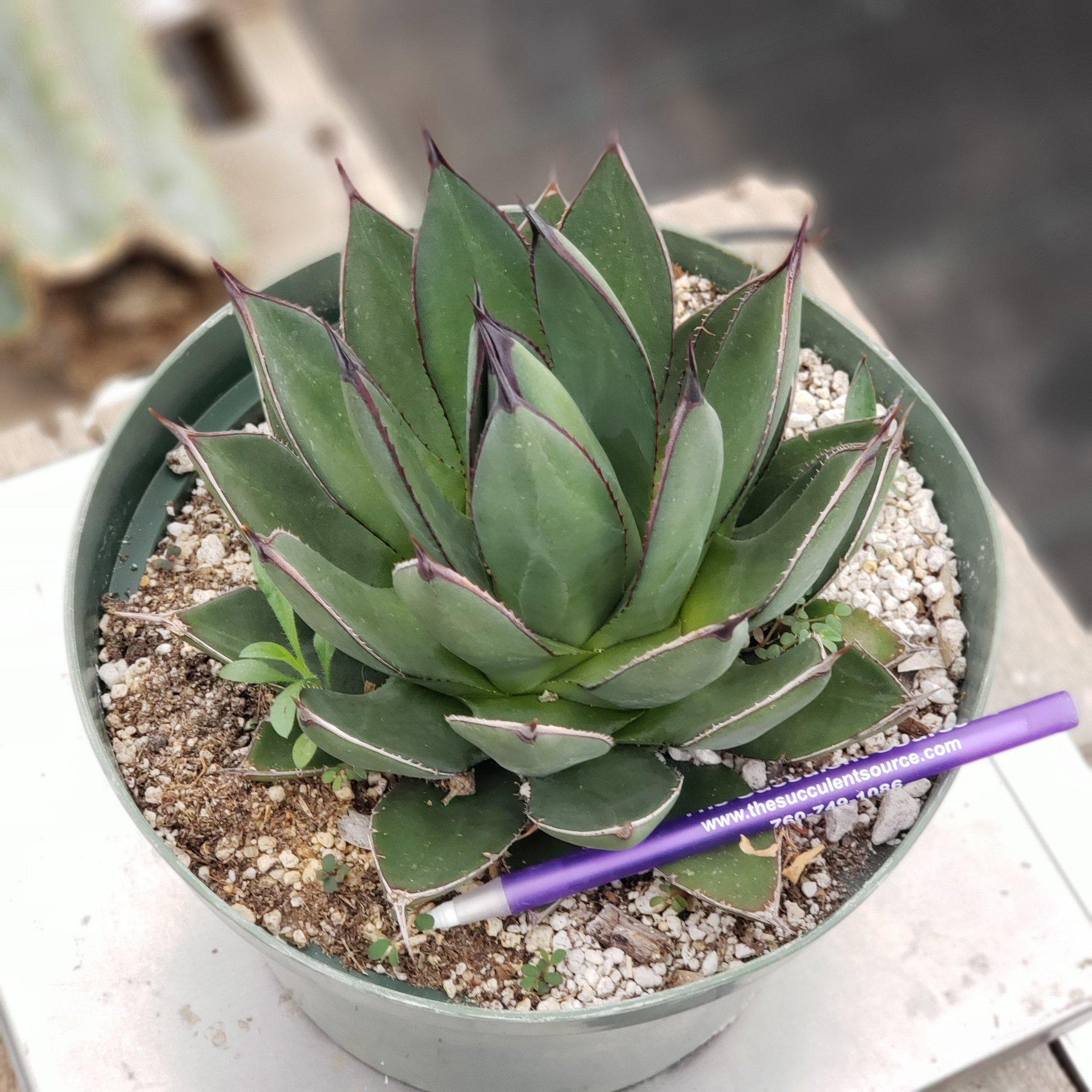
jade agave plant

jade agave plant Judes Potted Agaves

Sale price$20.70 Regular price$23.00
Save 10%

Pay in installments of $5.75 with ShopPay, AfterPay and Klarna

Shipping Estimate
USA
  • USA
  • CAN

Ships within 48 hours · Estimated delivery Jul 22 - Jul 27

Promo Codes Available:

For Your Every Summer RSVP, with Code: SUMMER15

Description

jade agave plant Judes Potted AgavesPlease Read: Agaves are simply AWESOME! Jude, our thirteen year old does the majority of all the work, and Jude gets all the money after paying for shipping costs! Direct and intense sun heat can bring out color hues that full shade does not. Aloe agave colors can vary based on time of the year, temps, sunlight, watering etc. Agave tips get bent broken, especially on the older outside edges naturally in life. As Agaves grow, you'll often trim cut the

Please Read: Agaves are simply AWESOME!

Jude, our thirteen year old does the majority of all the work, and Jude gets all the money after paying for shipping costs!

Direct and intense sun/heat can bring out color hues that full shade does not.  Aloe/agave colors can vary based on time of the year, temps, sunlight, watering etc.

Agave tips get bent/broken, especially on the older outside edges naturally in life. As Agaves grow, you'll often trim/cut the older branches/leaves to clean up their appearance and this also allows them to fit better in containers and allows room for new pups to grow and pop out!  See pics below.  We often cut the tips off our decorative ones in the yard to keep our kid legs and dog noses safe.  Sometimes tips get bent or broken during shipping regardless of how well we pack.  We will not refund you or ship out a new Agave simply because some tips are not perfect.
We do guarantee the Agaves to be healthy, and any blemishes will be outgrown in their future growth assuming they are happy in their new conditions!

Please see our Blogs on propagating and proper care Aloes and Agaves.
Individual cuttings and seeds are often available throughout the year.  Cuttings will need to be potted and given 3-4 weeks approx. to begin rooting(some may already have roots), please see our Care page on rooting.

Drought tolerant when established.   Protect from freezing temps.  Not all Agaves and Aloes like full sun, experiment with your location to see where they look their best.  Protect from freezing temps. 

***Agaves have sharp tips and edges, always handle with gloves and open box carefully with gloves!


PLEASE see Judes'  Aloe page for lots of unique and interesting Aloe options!!

Here’s some basic Agave info
Agave   – Linnaeus (1753)
Greek: agauos = of kings and heros, illustrious, hence noble
Over 300 species of Agave have been described, but only about 200 are currently recognized. Most species are monocarpic, although a few can flower several times during their life. The flowers are “perfect” with both male and female parts. Many species of Agave are bat pollinated and produce musky perfumes as attractants. Others produce sweeter odors to attract insects.

Most Agaves consist of rosettes of thick, hard, rigid but succulent leaves often with marginal teeth and usually with a lethally sharp terminal spine. Prolific vegetative growth and offsetting at the base of the plant or through stolons, usually maintains a clump of plants thus compensating for loss of flowering rosettes. A few species remain solitary, relying on seed production for survival of the species.

The interior of the leaves contains longitudinal fibers representing the vascular system. Agave leaf fiber was used by native Americans. Agave fiber from a range of species is of commercial importance, with the best quality fiber coming from the youngest leaves. Sisal (hemp) made from cultivated Agave sisalana is used to make clothing and rugs.

Carbohydrates stored in the core of several species of Agave were fermented by native Americans to make a beverage called pulque which was used in religious ceremonies. Distillation of a similar ferment made from the developing Agave flower bud is the basis for modern production of Mezcal. Only if made from the Blue Agave within Tequila, Mexico can the distillate be called Tequila.
    Shipping Notes
    • Free Standard Shipping on $100+ Orders to the USA.
    • Except Preorder products are shipped in 48 hours.
    • Delivery to the USA:
    1. Standard Shipping : 3-10 business days
    • If time is of the essence, please consider selecting expedited delivery for faster service.
    Exchange/Return Notes
    • We offer a 30-day return/exchange service after receiving.
    • Final sale items are not eligible for returns or exchanges.
    • To process your return/exchange, please contact us at [email protected]
    • Please click here for more details>>> Return & Exchange Policy
    SKU: 6951482342

    Discover Niche Categories That Outsell jade agave plant

    Top-Converting Item to Boost Your Average Order

    4.2 ★★★★★
    Based on 11 reviews
    Sort
    Highest Rating
    Newest First
    Oldest First
    Product Reviews
    V
    Verified Purchase
    V. Young
    Grantham, US
    ★★★★★ 5
    great book
    Format: Paperback
    This book was insightful yet the stories was shocking but its a dose of reality. I like the product and its great for my library.
    WAS THIS REVIEW HELPFUL?YesReportShare
    Reviewed in the United States on June 3, 2014
    M
    Verified Purchase
    mikeythereader
    Birmingham, US
    ★★★★★ 5
    Shocking
    Format: Paperback
    An informative read that will make you sick as the hanging death of people becomes a spectator sport. I knew going in I was going to be really angry about this and I was so right. It has been more than a month since I finished it and the horrific cruelty and lawlesness still makes my blood boil.And many times the "supposed law" were guilty of opening the jail or were complicit in letting this happen. It will make you think.
    WAS THIS REVIEW HELPFUL?YesReportShare
    Reviewed in the United States on November 13, 2013
    R
    Verified Purchase
    R. B. Daytona
    Lexington, US
    ★★★★★ 5
    Great book
    Format: Paperback
    Interesting approach to the study of lynching. Thought- provoking and well reasoned thesis. The author adds a new dimension to the lynching literature
    WAS THIS REVIEW HELPFUL?YesReportShare
    Reviewed in the United States on September 7, 2013
    J
    Verified Purchase
    Jerry Saperstein
    Port Orchard, US
    ★★★★★ 5
    A valuable book for non-lawyers and lawyers
    Why would non-lawyers want to read a book on persuading judges? For several reasons actually. First, many of us are involved in work that requires persuading others to adopt our views. While legal argument is substantially more formal and rule-driven than what most of us do, learning how to construct a logical argument as if it were to be delivered to the court, that Is governed by deadlines, restrictions on length, the need to adhere to established fact (or to establish those facts) and to be neither groveling nor inflammatory can be applied to selling your widgets. Perhaps more important is the fact that most people don't understand the impact of the court's decisions on our daily lives, our pocketbooks and our freedoms. Nine people sit on the Supreme Court. They cannot be removed except for the most grievous crimes and then only if Congress were to agree. More than one Justice has demonstrated that you can be senile and sit on the nation's highest court. Going down the food chain, the same applies to the federal appellate and trial courts. It is unlikely that one person in a hundred can even name a local federal district court judge and probably not one in a thousand could name the nine Supreme Court justices. Yet these men and women have tremendous impact on our lives, as do the thousands of state court justices. I am not a lawyer, but I consult to them and am not a stranger to the courtroom, writing drafts for legal briefs, doing legal research and the like. I have seen a lot of judges in action and have learned, in general, to fear them. They can - and do - cause tremendous harm through ill-considered decisions, making decisions with insufficient facts, assuming they know more than they do and myriad other reasons. They are gods in their courtrooms and if your lawyer fails to persuade them of the justness of your cause, you lose. Just how do these people reach their decisions? While justice is supposed to be blind (fat chance!), the justices are human and thus persuadable. Bryan Garner is a noted writer on legal writing. He is actually quite witty as he explains the use of the English language to lawyers who have had their understanding of words driven out of them in law school. Antonin Scalia is a hero to many for the courageousness of his decisions and dissents, his belief that the Constitution is to be strictly interpreted and his generally brilliant writing style. In 115, frequently witty, short chapters the two authors (who occasionally openly disagree) lay down their thoughts on how judges can be persuaded. It is not all about legal writing; e.g, advice to not chew your fingernails and dressing appropriately for court. They advise on giving your oral argument, which a lot of sales and marketing people would do well to read, especially the guidance to "never speak over a judge". In a sales situation, I am surprised at how often the sales person displays his or her contempt for me by not only not listening to me, but presuming they understand the point I was going to make before they spoke over me. I don't know about you, but a lot of salespeople have lost business with me for doing that. Some of the points the authors make are points of contention themselves: i.e., "swear off substantive footnotes - or not". None of the material in this book is truly new. Law students get elements of it in their first year as do some college students. A lot can be found in books on to be a better salesperson: i.e., don't chew your fingernails, etc. And a lot of it is plain commonsense. But that doesn't mean this book is unhelpful. First, it reveals in tiny part how Scalia evaluates the briefs he reads and arguments he hears, which in itself is a fascinating peek. The authors also put things many people may have forgotten through lack of use into perspective. Finally, they remind lawyers and non-lawyers alike that you often have only one shot at winning your argument so you had best put your best foot forward. Scalia and Garner show you how to do it. Overall, this is a fun, informative and helpful read. Jerry
    WAS THIS REVIEW HELPFUL?YesReportShare
    Reviewed in the United States on February 8, 2010
    R
    Verified Purchase
    Rod Sullivan
    Port Orchard, US
    ★★★★★ 5
    Like Having an Expert Looking over Your Shoulder
    I am a law professor who spent 25 years as a Plaintiff's lawyer before deciding to teach. I've been before the U.S. Circuit Courts of Appeal many times and state appellate courts a few times. One caveat to consider: I expect to be arguing before the United States Supreme Court in the future. I hesitate to be too ebullient, lest you think that I'm trying to curry favor. However, I think that this book is great. Why do I recommend it? First, it is short. This book will accomplish much of what other books try to teach about advocacy, but in many fewer pages. Secondly, it is practical. It teaches writing skills, speaking skills, and how to be persuasive with limited time. Finally, it is not just for lawyers. Anyone trying to be persuasive can apply the same skills to other situations. For those of you who are politically opposed to Justice Scalia (which, believe it or not, includes some law professors)this is a joint effort by Garner and Scalia, and they frequently disagree. Hearing both sides of the argument on how to write or speak persuasively will help you decide how you want to present your arguments. How do my political opinions and Justice Scalia's opinions mesh? Can I be fair? I think so. He's a Federalist, I consider myself an Anti-Federalist. He as supporter of administrative delegation, I think delegation of congressional responsibilities to administrative agencies is congressional abdication. In short, I'm not recommending this book because Justice Scalia and I agree on policy, because on many policy matters we don't. I'm recommending it because I think it will help you. You wont be disappointed with the book.
    WAS THIS REVIEW HELPFUL?YesReportShare
    Reviewed in the United States on January 29, 2009

    recommand products