Pay in installments of $6.06 with
 ,
,
 and
and

Shipping Estimate
USA
- USA
- CAN
- USA
- CAN
Ships within 48 hours · Estimated delivery Oct 19 - Oct 24
 Promo Codes Available:
For Your Every Summer RSVP, with Code: SUMMER15
Description
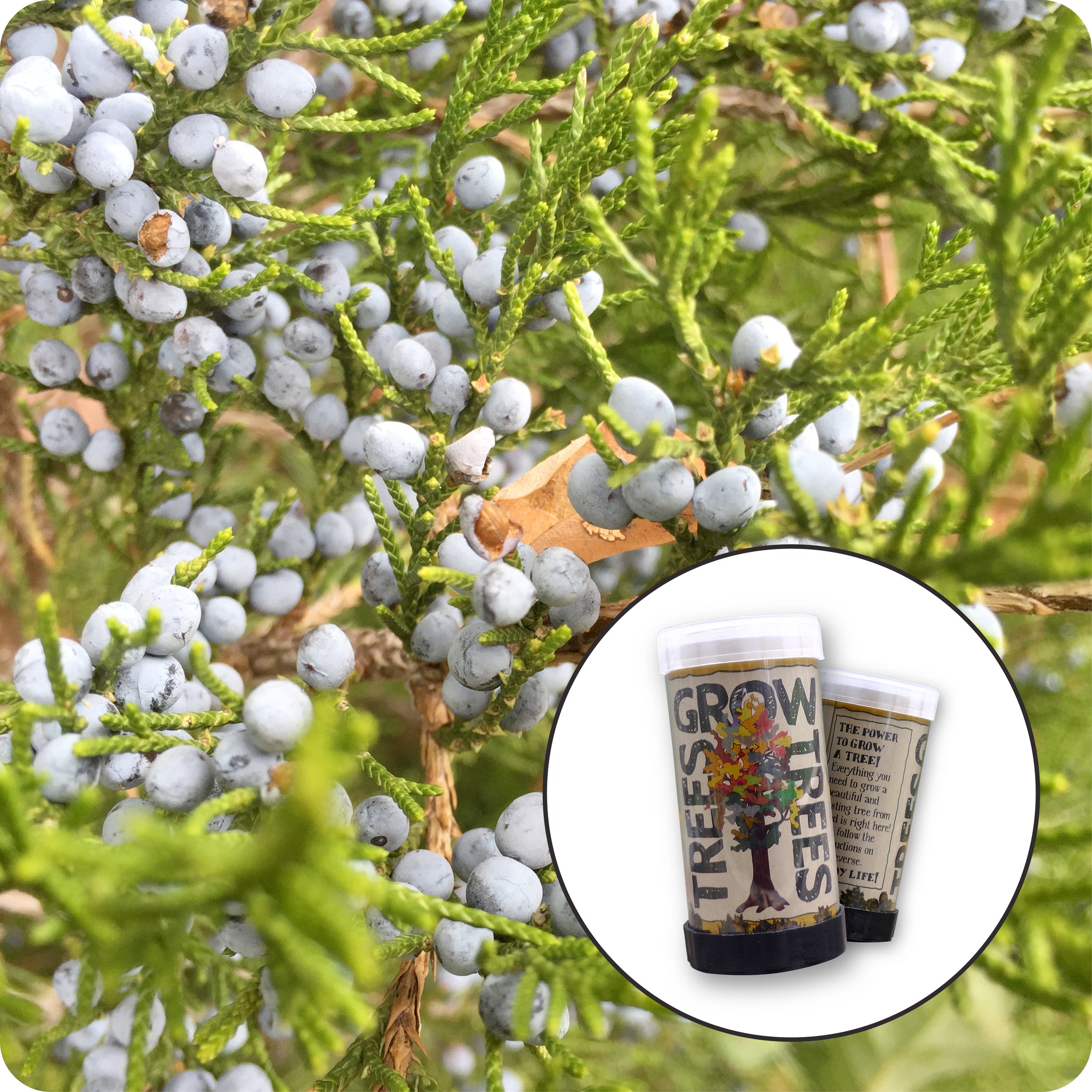
planting cedar seeds Eastern RedcedarGrow your own tree from seed! Includes absolutely everything you need to grow Eastern Red Cedar (Juniperus virginiana) from seed: seeds, growing medium, a mini greenhouse, and detailed instructions 100% guaranteed: If your seed fails to germinate or your seedling perishes, we are happy to provide free replacement seed Great for kids and adults, amateurs to experts! A universal symbol of life, regrowth and recovery, enduring friendships and new
- Grow your own tree from seed!
- Includes absolutely everything you need to grow Eastern Red Cedar (Juniperus virginiana) from seed: seeds, growing medium, a mini-greenhouse, and detailed instructions
- 100% guaranteed: If your seed fails to germinate or your seedling perishes, we are happy to provide free replacement seed
- Great for kids and adults, amateurs to experts!
- A universal symbol of life, regrowth and recovery, enduring friendships and new beginnings, a tree is a wonderful gift that will only grow in value, meaning, and beauty
About Eastern Redcedar
Eastern Redcedar, Juniperus virginiana, isn’t really a cedar at all, but a small- to medium-sized juniper tree native to eastern North America, from southeastern Canada to the Gulf of Mexico. Other common names include Eastern Juniper, Red Juniper, and Aromatic Cedar. An especially common species in the Great Plains region of the United States, Eastern Redcedar is often found growing alongside roadways and fences, and scattered across open fields.
Growing to heights between 20 – 70 feet, with trunk diameters reaching 1 – 3 feet across, this is typically an upright, symmetrical, and neatly conical evergreen tree — in the Missouri, Oklahoma and Arkansas Ozarks, Eastern Redcedar is even used as a Christmas Tree species. Foliage appears in two distinctive forms: new growth is needle-like and spiky, while older, scale-like leaves press tightly against the twig. Cones, which can grow up to 0.25 inches-long, closely resemble berry-like fruit: globose, small, and dark purple-blue with a waxy sheen. They are a favorite of the Cedar Waxwing, and support a host of other wildlife, including wild turkeys, bears, rabbits, foxes, coyotes, and deer. Bark is reddish-brown and fibrous, exfoliating in narrow strips.
The wood of Eastern Redcedar has traditionally been used in fence building for its rot resistance, and in the construction of chests and closets for its fragrance and moth-repellant qualities. Native Americans once used the wood to mark out hunting territories. The city of Baton Rouge, Louisiana (which literally means “red stick”), was so-named by the French for these red-colored marker-poles.
A particularly hardy pioneer species, Eastern Redcedar thrives under adverse conditions — both drought tolerant and cold tolerant, growing equally well in dry, acidic, rocky, sandy, and clay substrates — so much so that during the Dust Bowl drought of the 1930s, the Prairie States Forest Project encouraged farmers to plant wind breaks made of Eastern Redcedar.
Growing to heights between 20 – 70 feet, with trunk diameters reaching 1 – 3 feet across, this is typically an upright, symmetrical, and neatly conical evergreen tree — in the Missouri, Oklahoma and Arkansas Ozarks, Eastern Redcedar is even used as a Christmas Tree species. Foliage appears in two distinctive forms: new growth is needle-like and spiky, while older, scale-like leaves press tightly against the twig. Cones, which can grow up to 0.25 inches-long, closely resemble berry-like fruit: globose, small, and dark purple-blue with a waxy sheen. They are a favorite of the Cedar Waxwing, and support a host of other wildlife, including wild turkeys, bears, rabbits, foxes, coyotes, and deer. Bark is reddish-brown and fibrous, exfoliating in narrow strips.
The wood of Eastern Redcedar has traditionally been used in fence building for its rot resistance, and in the construction of chests and closets for its fragrance and moth-repellant qualities. Native Americans once used the wood to mark out hunting territories. The city of Baton Rouge, Louisiana (which literally means “red stick”), was so-named by the French for these red-colored marker-poles.
A particularly hardy pioneer species, Eastern Redcedar thrives under adverse conditions — both drought tolerant and cold tolerant, growing equally well in dry, acidic, rocky, sandy, and clay substrates — so much so that during the Dust Bowl drought of the 1930s, the Prairie States Forest Project encouraged farmers to plant wind breaks made of Eastern Redcedar.
About Jonsteen's Grow Kits
Growing a tree from seed is a magical and fascinating experience for people of all ages. Our 100% guaranteed Grow Kits provide everything you need to germinate some of the world's largest and most interesting tree species from seed — seeds, growing medium, a mini-greenhouse, and detailed instructions, which lead you through the whole process, from cold-stratifying your seeds to germination and transplanting.
About Jonsteen's 100% Guarantee
If your seed fails to germinate or your seedling perishes, we are happy to provide free replacement seed. We encourage all customers experiencing difficulties growing their trees to contact us through our toll-free "Tree Help Line" (1-888-387-3379).
Shipping Notes
- Free Standard Shipping on $100+ Orders to the USA.
- Except Preorder products are shipped in 48 hours.
- Delivery to the USA:
- Standard Shipping : 3-10 business days
- If time is of the essence, please consider selecting expedited delivery for faster service.
Exchange/Return Notes
- We offer a 30-day return/exchange service after receiving.
- Final sale items are not eligible for returns or exchanges.
- To process your return/exchange, please contact us at [email protected]
- Please click here for more details>>> Return & Exchange Policy
4.2 ★★★★★
Based on 26 reviews
Sort
Product Reviews
★★★★★ 4
Enchanting
Format: Kindle
"Queen of Roses" by Briar Boleyn is a delightful and refreshing reimagining of the classic tale of King Arthur, with a captivating twist that places the spotlight on Morgan, a character who has often been overshadowed in traditional retellings. Boleyn's creative decision to shift the narrative perspective to Morgan breathes new life into the story, offering readers an intriguing and compelling look at the Arthurian world from an entirely different angle.
One of the most commendable aspects of this book is its incorporation of Fae elements, which adds an enchanting layer of magic and mystery to the already familiar Arthurian setting. Boleyn skillfully weaves the world of the Fae into the narrative, creating a captivating backdrop against which the events of the story unfold. This addition not only adds depth to the world-building but also provides ample opportunities for twists and turns that keep readers thoroughly engrossed.
However, while the book boasts numerous strengths, it does have one noticeable flaw: the characterization of Morgan. While it is reasonable to create a flawed and complex protagonist, it appears that at times, Morgan's character becomes overly difficult and hard to relate to. Her persistently negative perception of one of the main male characters, who is a potential love interest, despite his efforts to support and assist her, may come across as somewhat irrational and could test the patience of some readers. Striking a balance between a strong, independent character and one who can recognize genuine support and affection could have enhanced the overall reader experience.
Nonetheless, the allure of "Queen of Roses" lies in its innovative approach to the Arthurian legend and its skillful blending of fantasy elements into a familiar narrative. Boleyn's evocative prose draws readers into a world where magic, destiny, and fate entwine, leaving us eager to uncover the mysteries that unfold within the pages.
I received a free copy of this book via Booksprout and am voluntarily leaving a review.
WAS THIS REVIEW HELPFUL?YesReportShare
Reviewed in the United States on July 28, 2023
★★★★★ 5
An action-packed dark romantasy
Format: Kindle
I loved this book! Queen of Roses is an Arthurian-inspired dark romantasy that is the first book in the Blood of Fae series. The story follows Morgan, the princess of Camelot who is rumored to be part fae. Fueled by prejudiced hatred and a mistrust of fae blood, Morgan’s abusive father strips her of her birthright and hands it to her half-brother, Arthur. Instead of becoming queen, Morgan is commanded to join the temple of the goddesses when she comes of age.
However, Arthur turns into a psychopathic, power-hungry, fae-hating king as he ages. He develops malevolent plans and commands Morgan to find an ancient weapon with legendary power. Although Morgan is wary of Arthur’s intentions, she embraces the opportunity to go on a journey and potentially change her fate.
The story picks up from there and we follow Morgan on her quest to find the ancient relic. It’s full of high stakes adventure, mystery, tension, banter, forced proximity, hidden magic, self discovery, and betrayal. This first installment of the series intricately develops the world building and character development. There’s little romance in this book, but it is evident that it is a slow burn that will continue to develop throughout the remainder of the series.
Overall, I loved the world building, the epic fantasy, Morgan’s journey of self discovery, and all of the twists and turns that set the stage for the future installments. I can’t wait to see what happens next!
WAS THIS REVIEW HELPFUL?YesReportShare
Reviewed in the United States on April 7, 2024
★★★★★ 4
Arthurian Fae Quest…say less.
Format: Kindle
A fae centered Arthurian tale unlike any I’ve read so far. The author did a great job at descriptive world building, with scenes easily playing out in my minds eye. There was plenty of action, suspense, and even a touch of horror. An enemies to lovers, slow burn romance, a quest, with plot twist and turns aplenty. There was a love triangle, which I’m not usually a fan of but, it played out well in this story line. The FMC, Morgan Pendragon, was so blatantly naïve, yet I typically expect as much in a ‘book one’ of a series, especially one that features a fairly sheltered princess. I was happy to read that in spite of this, she still showed a strong sense of morals, fire, and spine. Now our MMC? Kairos Draven, aka Void’s Edge. Oh, how I’m a sucker for a smoking’ hot grumpy warrior alpha with a witty mouth, and a strong sense of “touch her and die” attitude, so you know who held all my cards. That ending? Just made me swoon all the harder. Now add a battlecat that rivals the size of a horse…and well Ms. Briar Boleyn you have well and truly stolen my heart. I’m excited to see where the story goes from here, and follow along to see more of the characters growth. I went into this story fairly blind, and I think I enjoyed it all the more because of it.
Once the story got going, it had me in an absolute chokehold and it was difficult to put down.
WAS THIS REVIEW HELPFUL?YesReportShare
Reviewed in the United States on May 12, 2024
★★★★★ 3
Not a bad start
Format: Kindle
3 stars
Thank you Netgalley and Briar Boleyn for the ARC!
A camelot/king Arthur retelling with fae. I was hooked by the idea of this book immediately and was eager to jump into this world.
• slow burn
• enemies to lovers
• who did this to you
Morgan Pendragon watched her mother die by her father's hand when she was just eight years old, hiding under the bed. Morgan is believed to have the tainted blood of the fae in her veins and is cast aside so that her fathers illegitimate son, Arthur, can become the king. She's seen his cruel treatment of the fae firsthand, so when he sends her on a journey to find a fae weapon she seizes the opportunity to do more with her life. Along the way, she finds more than she could have imagined.
I don't know a whole lot about King Arthur and Camelot but I had a lot of fun with this story! The plot has some similar tropes to popular romantasy books (From blood and ash) but there's enough originality here that it doesn't feel like I'm reading a copy. I liked how the fae were different in appearance than what is typical in most fantasy books I've read. In this book they have blue hair, violet skin and a wide range of other characteristics. I thought that the world building was easy to follow and I could easily immerse myself into this world. After reading the blurb I kept wondering when she was going to go on the journey to find Excalibur and it doesn't happen until around the 45% mark.
The story is a bit slow at times but starts to pick up once they begin their journey to find Excalibur. The John Wick style Inn was a fun concept that I enjoyed reading about.
There are a lot of similarities to this and FBAA and I would have liked to have it be a little more different, but I'm hoping book two will have the story turn into something of its own. Overall I enjoyed reading this story and I'm looking forward to reading book two especially after that ending.
WAS THIS REVIEW HELPFUL?YesReportShare
Reviewed in the United States on May 27, 2023
★★★★★ 5
Unraveling Fate and Fae: A Captivating Journey in "Queen of Roses"
Format: Kindle
"Queen of Roses" by Briar Boleyn is a dark fantasy romance that masterfully combines elements of myth, magic, and romance with a captivating King Arthur retelling infused with a Fae twist. From its intricately woven plot to its compelling characters, this novel delivers an immersive reading experience that will leave readers eagerly anticipating the next installment.
At its core, "Queen of Roses" is an enchanting tale of forbidden love and destiny, featuring an exceptionally slow-burn romance that ignites with the intensity of an enemies-to-lovers trope. Against a backdrop of magic and mythical creatures, the story unfolds with tension, banter, and forced proximity, drawing readers into a world filled with love, friendships, self-discovery, and betrayal.
While the novel excels in world-building, character development, and plot intricacies, some readers may yearn for a bit more fire and spice in certain aspects of the narrative. However, the promise of future developments in the series offers hope for an even more dynamic and engaging story to come. I know I personally cannot wait to get into book 2.
With a cliffhanger ending that leaves hearts racing and minds reeling, "Queen of Roses" succeeds in immersing readers from start to finish. Its dark and twisted fantasy elements are expertly balanced with moments of adventure, action, and unexpected twists, keeping readers on the edge of their seats until the very last page.
As the story delves into complex themes and explores the depths of its characters' struggles and desires, it's important to note that "Queen of Roses" may contain triggering content. Readers are advised to check the trigger warnings before diving into this captivating tale.
Overall, "Queen of Roses" is a must-read for fans of dark fantasy romance, offering a mesmerizing journey that will leave readers eagerly anticipating the next chapter in the series. With its lush prose, intricate storytelling, and unforgettable characters, this novel is sure to leave a lasting impression on all who venture into its enchanted world.
I want to extend a heartfelt shoutout to the author for granting me the opportunity to dive into "Queen of Roses" through NetGalley. It has been an absolute pleasure to explore the captivating world and characters crafted with such skill and imagination. Thank you for entrusting me with this glimpse into your enchanting world.
WAS THIS REVIEW HELPFUL?YesReportShare
Reviewed in the United States on April 1, 2024