SKU: 7186726947
bunny ear cactus soil

bunny ear cactus soil Buy Cinnamon Prickly Pear Phoenix, AZ | O. microdasys

Sale price$19.95 Regular price$22.17
Save 10%

Pay in installments of $5.54 with ShopPay, AfterPay and Klarna

Shipping Estimate
USA
  • USA
  • CAN

Ships within 48 hours · Estimated delivery Sep 1 - Sep 6

Promo Codes Available:

For Your Every Summer RSVP, with Code: SUMMER15

Description

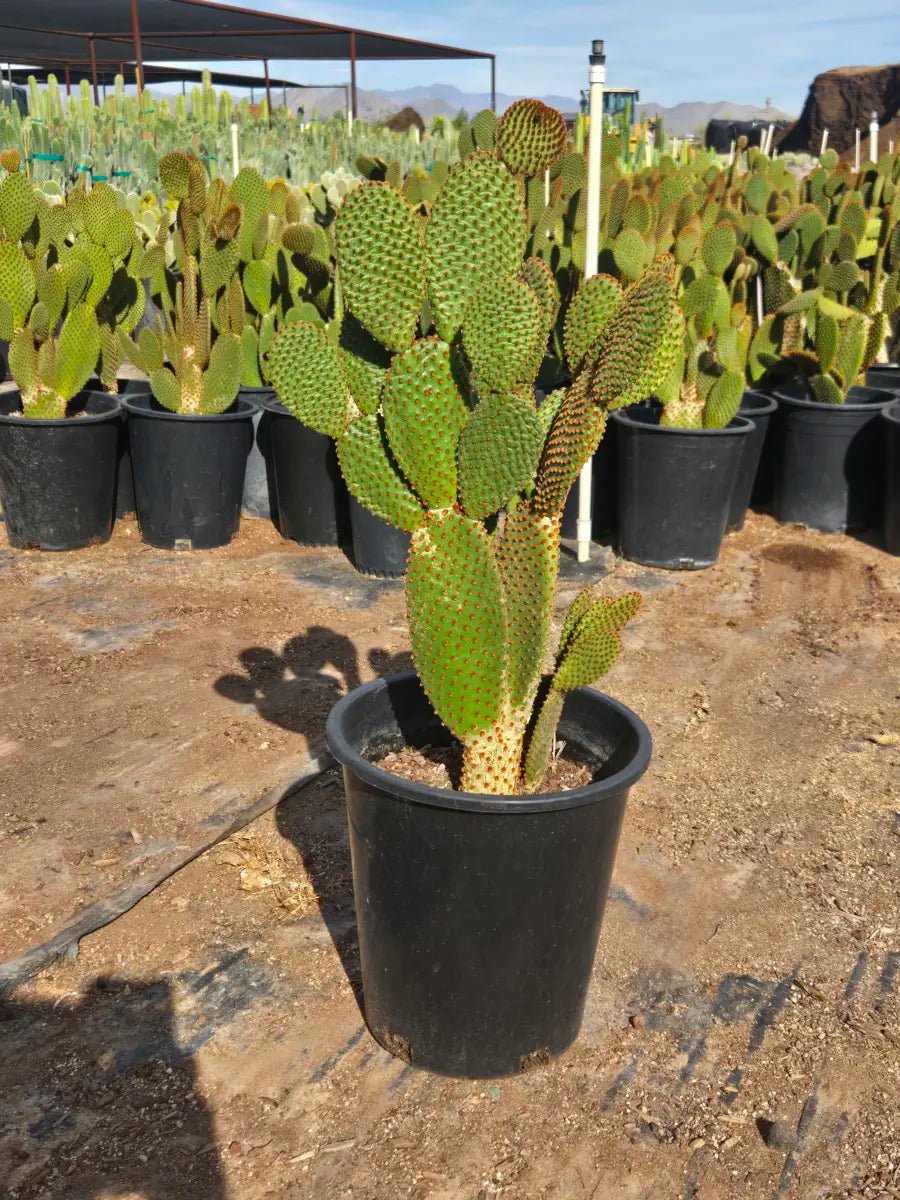
bunny ear cactus soil Buy Cinnamon Prickly Pear Phoenix, AZ | O. microdasysPhoenix's Warmest Bunny Ear Cactus Cinnamon Brown Dots That Glow in Desert Light Cinnamon Dot Prickly Pear (Opuntia microdasys 'Cinnamon') is the warm toned sibling of the classic Bunny Ear Cactus family and one of the most unique small cacti you can grow in the Phoenix Valley. This compact Mexican native forms neat, bushy clumps of bright green pads covered in dense clusters of reddish brown glochids that give the plant a warm, cinnamon speckled

Phoenix's Warmest Bunny Ear Cactus — Cinnamon-Brown Dots That Glow in Desert Light

Cinnamon Dot Prickly Pear (Opuntia microdasys 'Cinnamon') is the warm-toned sibling of the classic Bunny Ear Cactus family — and one of the most unique small cacti you can grow in the Phoenix Valley. This compact Mexican native forms neat, bushy clumps of bright green pads covered in dense clusters of reddish-brown glochids that give the plant a warm, cinnamon-speckled appearance. Growing just 1–2 feet tall and 2–3 feet wide, it's perfectly sized for containers, rock gardens, and accent plantings. In late spring, it may produce yellow to orange blooms that complement the warm-toned dots beautifully. Whether you're building a desert container collection in Scottsdale, adding warm texture to a Gilbert rock garden, or creating a unique indoor display in Tempe — Cinnamon Dot Prickly Pear adds warmth, character, and zero-fuss charm.

Cinnamon Dot Prickly Pear Plant Details

Attribute Detail
Scientific Name Opuntia microdasys 'Cinnamon'
Common Names Cinnamon Dot Prickly Pear, Cinnamon Bunny Ear Cactus
Mature Height 1–2 feet
Mature Width 2–3 feet
Growth Rate Moderate — 1–2 new pads per season in Phoenix
Sun Full sun to partial shade (6+ hrs ideal). Handles reflected heat.
Water Very low once established. Highly drought-tolerant.
USDA Zones 9–11 (Phoenix is Zone 9b–10a)
Soil Well-draining sandy or loamy soil. Adapts to Arizona caliche with added drainage.
Foliage Evergreen — bright green pads year-round
Bloom Color Yellow to orange, late spring to early summer
Special Feature Dense cinnamon-brown glochids create a warm, speckled appearance

Cinnamon Dot Prickly Pear Uses in Phoenix Landscapes

Container and Patio Gardens

Cinnamon Dot Prickly Pear is one of the best cacti for decorative containers. Its compact size and warm-toned dots make it a conversation piece on any patio, porch, or pool deck. Use a wide, shallow pot with well-draining cactus mix and a gravel top-dressing. Pair with its White Dot sibling for a stunning warm-and-cool contrast in matching pots on a Scottsdale courtyard or Chandler front entry.

Rock Garden Accent

The cinnamon-brown dots create beautiful warm contrast against gray decomposed granite, flagstone, and light-colored boulders. Plant among a curated desert bed with Agave, Golden Barrel Cactus, and Desert Spoon for a textured, low-water rock garden. The compact form means it won't outgrow its space — perfect for small planting pockets and garden vignettes.

Indoor Desert Display

Like its White Dot cousin, Cinnamon Dot does well indoors near a bright, south-facing window. Its small size and moderate growth make it ideal for windowsill collections, sunroom displays, or as a living sculpture on a desk or shelf. Just ensure good drainage and minimal watering indoors.

Color-Contrast Companion Planting

Plant Cinnamon Dot alongside White Dot Prickly Pear for a striking warm-and-cool pairing. The cinnamon-brown and white glochid clusters create visual contrast on otherwise identical plant forms — one of the most eye-catching combinations in desert container and rock garden design. Add a Purple Prickly Pear behind them for a three-color desert palette.

Best Time to Plant Cinnamon Dot Prickly Pear in Phoenix

Fall (October–November) is ideal for planting. Warm soil promotes root growth while cooler air reduces transplant stress, giving the plant 6–8 months to establish before its first Phoenix summer. Spring (February–April) is the second-best window. Avoid summer planting when possible — the extreme heat makes establishment harder for small plants.

How to Plant Cinnamon Dot Prickly Pear

  1. Dig wide, not deep — excavate a hole 2x the root ball width but only as deep as the root ball itself.
  2. Check for caliche — break through any hardpan layer for drainage. Standing water will rot cactus roots quickly.
  3. Backfill with amended soil — mix native soil with 30–40% pumice, perlite, or decomposed granite for sharp drainage.
  4. Spacing — 2–3 feet apart for a grouped planting; 3–4 feet for standalone specimens.
  5. No water basin needed — keep the grade flat or slightly mounded to prevent water pooling around the base.
  6. Gravel mulch — 2–3 inches of decorative gravel around the base keeps moisture away from the crown and prevents rot.

Watering Cinnamon Dot Prickly Pear in Phoenix

First Year Watering Schedule

  • Weeks 1–2: Water deeply every 3–4 days to settle soil around roots.
  • Month 1–3: Every 7–10 days, deep and slow.
  • Month 3–6: Every 2–3 weeks.
  • After Year 1: Little to no supplemental water needed. Once a month during extreme summer heat is more than sufficient. No winter irrigation required.

Drip Irrigation

If using drip, place a single 0.5–1 GPH emitter 8–12 inches from the base. Run it very infrequently — overwatering is the most common mistake with this cactus. Once established, it can survive on rainfall alone in most Phoenix Valley locations.

How fast does Cinnamon Dot Prickly Pear grow in Phoenix?
Moderately. Expect 1–2 new pads per growing season. A 1 gallon plant will fill out to its mature 2 foot spread in about 3–4 years with minimal care.

Is Cinnamon Dot Prickly Pear drought tolerant once established?
Extremely. This is one of the most drought-tolerant plants you can grow. Once established, it thrives on rainfall alone and needs almost no supplemental water.

What's the difference between Cinnamon Dot and White Dot Prickly Pear?
Both are varieties of Opuntia microdasys with the same growth habit and care needs. The difference is the glochid color — Cinnamon Dot has warm reddish-brown clusters while White Dot has white clusters. Both make excellent companions when planted together for color contrast.

Can Cinnamon Dot Prickly Pear grow indoors?
Yes — it's one of the few prickly pears that does well indoors. Place it near a bright south or west-facing window, use well-draining cactus mix, and water sparingly. It makes an excellent desk or windowsill plant.

Will it produce flowers?
It can produce yellow to orange blooms in late spring to early summer, though flowering is less consistent in cultivation than in wild plants. The warm cinnamon-dotted pads are the main attraction regardless of bloom.

You May Also Like

  • White Dot Prickly Pear — Same adorable bunny ear shape with bright white dots instead of cinnamon. Plant them together for beautiful warm-and-cool contrast.
  • Beavertail Prickly Pear — Spineless pads with stunning magenta-pink spring blooms. Another compact, pool-friendly prickly pear.
  • Baby Rita Prickly Pear — Compact purple-tinted pads with bright magenta flowers. A colorful dwarf prickly pear perfect for small spaces.
  • Blind Prickly Pear — Smooth, virtually spineless pads with a clean modern look. Great for pool areas and high-traffic landscapes.
  • Purple Prickly Pear — Dramatic purple-tinted pads that intensify in cold and drought. Pairs beautifully with both Bunny Ear varieties.

How Many Cinnamon Dot Prickly Pear Do I Need?

Cinnamon Dot is a compact prickly pear that matures just 2 to 3 feet wide, so it shines in containers and small planting pockets rather than long runs. Plant single as a container or rock-garden accent, or in a small cluster of 3 spaced about 2.5 feet apart for a fuller low mound. For a low accent border, figure roughly 2.5 foot centers:

Border Length Plants Needed (2.5 ft spacing)
5 ft 2 to 3 plants
10 ft 4 to 5 plants
15 ft 6 to 7 plants
20 ft 8 to 9 plants

The reddish-brown glochids detach on contact and are tedious to remove from skin, so keep pots and plantings off the edges of walkways, patios, and pool decks.

Cinnamon Dot Prickly Pear Season-by-Season in Phoenix

  • Spring (Feb to Apr): New pads flush as soil warms, and the plant may open yellow-to-orange blooms in late spring. A strong second planting window once frost risk passes.
  • Summer (May to Sep): Tough in heat and reflected sun, though in the most brutal west-facing spots a little afternoon shade keeps the pads from scorching. Monsoon humidity (Jul to Sep) is the time to back off water so the fast-draining mix never stays soggy.
  • Fall (Oct to Nov): Prime planting season. Warm soil and mild air let this small plant settle in before winter.
  • Winter (Dec to Jan): Evergreen green pads hold, but this is a frost-tender Mexican species. Expect damage in the mid to upper 20s°F: site it in a warm microclimate, grow it in a pot you can move, or cover it on hard frost nights.

At a Glance

✔ Heat-Loving (Reflected-Heat Tolerant)   ✔ Drought-Tolerant   ✔ Evergreen   ✔ Low-Maintenance   ✔ Deer & Rabbit-Resistant

Plant It With

  • Crested Microdasys: a crested cousin in the same Opuntia microdasys family, perfect alongside for a collector's container grouping.
  • Baby Rita: a compact purple-tinted dwarf prickly pear that adds color contrast next to the warm cinnamon dots.
  • Beavertail Prickly Pear: a low, magenta-blooming prickly pear that fills the next size up in a small desert bed.
  • Blind Prickly Pear: a smooth, fuller prickly pear that anchors the back of a rock-garden vignette.

Is Cinnamon Dot Prickly Pear Right for Your Yard?

Cinnamon Dot is an ideal fit for containers, rock-garden pockets, and small warm-toned accents in a bright spot with sharp drainage, and it is one of the few prickly pears that also does well indoors at a sunny window. Give it fast-draining soil and protect it from hard frost. It is not a fit for an unprotected, frost-exposed bed or for a low-spine planting near a pool deck or busy walkway, where the fine detaching glochids become a nuisance.

Shipping Notes
  • Free Standard Shipping on $100+ Orders to the USA.
  • Except Preorder products are shipped in 48 hours.
  • Delivery to the USA:
  1. Standard Shipping : 3-10 business days
  • If time is of the essence, please consider selecting expedited delivery for faster service.
Exchange/Return Notes
  • We offer a 30-day return/exchange service after receiving.
  • Final sale items are not eligible for returns or exchanges.
  • To process your return/exchange, please contact us at [email protected]
  • Please click here for more details>>> Return & Exchange Policy
SKU: 7186726947

Discover Niche Categories That Outsell bunny ear cactus soil

Top-Converting Item to Boost Your Average Order

4.7 ★★★★★
Based on 15 reviews
Sort
Highest Rating
Newest First
Oldest First
Product Reviews
R
Verified Purchase
R. C. Harris Jr.
Massapequa, US
★★★★★ 5
"Clearly the definitive biogrophy for generations to come."
Format: Hardcover
I have read many books about Joseph Smith the prophet, but none have been so informative and balanced as this one. Some of what makes this so brilliant is the autor's choice to include as much information as possible - regardless of it's implications. Richard L. Bushman does not shy away from the controversial, presenting Joseph as somebody who I can finally relate to as a human being, rather than some kind of perfect "way up there" godlike being that Primary and Sunday School (intentionally or not) portray him. It was a relief for me to read of Joseph's mistakes in addition to his many amazing accomoplishments as a prophet, mayor, general, presidential candidate and much more. I love how honest Brother Bushman is in the book's preface: "A believing historian like myself cannot [...] pretend nothing personal is at stake. For a character as controversial as Smith, pure objectivity is impossible. What I can do is to look frankly at all the sides of Joseph Smith, facing up to his mistakes and flaws. Covering up errors makes no sense in any case. Most readers do not believe in, nor are they interested in, perfection. We want to meet a real person." Brother Bushman has "undertaken to explore a side of Joseph Smith not adequately examined in other biogrophies: his religious thought." Thus, we are able to peer into the mind and thoughts of the prophet - to a degree never before accomplished. What motivated him to make the choices he made? Why did he sometimes seem to "lie" in regards to poligamy, the danites, his political motivations, etc? Why was he so "secretive" of his past, the BOM translation, his early visions, etc? All of these and other questions are addressed and we are given a deeper understanding by peering into the mind and "religious thought" of the prophet. For those wondering how much of Brother Bushman's previous work 'Joseph Smith and the beginnings of Mormonism' is contained in this work, he answers that in the preface: "Large portions of chapters 1, 2, 3 and 5" are recycled in this book. I can't praise this book enough. I loved it so much that I bought a second copy to loan out to friends from church. (Yes, I am an active LDS.) I also bought a copy for my Dad for Christmas. I highly recommend it to anyone who is interested in a true and balanced history of Joseph Smith, the prophet. It is true that it shows "negative" sides to the prophet, but these are all very well documented and could not be ignored. I for one appreciate the inclusion of all the facts, not just the ones that place Joseph in a good light. It is as historian Terry L. Givens states on the back cover: "Clearly the definitive biogrophy for generations to come. The most balanced, thorough, and insightful treatment to date--truly a masterful work."
WAS THIS REVIEW HELPFUL?YesReportShare
Reviewed in the United States on December 28, 2005
A
Verified Purchase
Amazon Customer
Fort Morgan, US
★★★★★ 4
Good material for seminary class or testimony meeting, questionable history and biography
Format: Hardcover
Bushman' preface tells us that this "biography" is a "believers" perspective on Joseph Smith's life and time. Thus, Bushman's book is valuable as insight into how devout, believing, practicing Mormons view Joseph's life. To me, as a "gentile", the book seems like great material for a seminary class or a testimony meeting. The basic Mormon "testimony" statement goes something like "I have a testimony of the truth of the Book of Mormon and that Joseph Smith is a prophet of God." I also imagine that this book might be good material for missionary training. But I have some problems with the historical scholarship. (See the end of my review.) Regardless of my problems with Bushman's text, Joseph Smith is an interesting and complicated character. He has had a lasting impact, and fathered a religion that has members around the world. His life, as well as the religion and church he founded, is well worth studying. But then the same could be said of Ellen White, L. Ron Hubbard, Mary Baker Eddy, and many others. Bushman does give us a valuable, well written (but at times tedious), insight into a believer's perspective on Joseph. But the value of this book as history and biography is problematic. When the historical evidence suggests conflicting interpretations, or negative interpretations, of Joseph, and exposes some of the "rough edges", Bushman never deviates from his testimony that Joseph Smith is a prophet of God. Consequently Bushman always seems to be able to smooth the edges of this "rough stone rolling". In doing so there are some misrepresentations and omissions which diminish the value of this book as a serious study of Joseph's life and times. Bushman has solved the biography problem for believing Mormons who have waited over 60 years for an alternative, and antidote, to Fawn Brodie's "No one Knows my History". But I don't think he has transcended Brodie's work. If you are not a believing Mormon, a better introduction to Joseph Smith would be Robert Remini's short biography (182 pages), "Joseph Smith". Then tackle Bushman's tome (561 pages of text). Problems with Bushmans text: 1. Bushman, as Mormon historians and General Authorities have done for over 100 years, misrepresents and distorts the perspective of Josiah Quincy. A century ago B. H. Roberts claimed that Quincy was "on our side". In the prologue (pp. 1-7), Bushman represents Quincy as a benign "puzzled skeptic". In fact Quincy saw Joseph and his religious movement as an "evil fanaticism" and likens Joseph to Thomas Muntzer (Mulhausen) and Jan van Leydon (Munster). This is clearly stated in the opening paragraph of Quincy's essay, along with comments about "demoralizing doctrines", "still darker revelations", and the assertion that Joseph's religion is "subversive of every duty which we claim from the citizen". ( For the significance of the references to Mulhausen and Munster see Norman Cohn, The Pursuit of the Millennium, pp. 234-280 and Anthony Arthur, The Tailor-King). My concern is not with the merits of Quincy's essay. (You can read Quincy for yourself at [...]) Rather it is that Bushman's representation of Quincy as a benign "puzzled skeptic" is at best inaccurate. Quincy's puzzlement is of a very different nature than Bushman would have us believe. I think Quincy's statements might be closer to what Bushman call the "anti-Mormon argument" (p. 510). But Quincy's personal position on Joseph and his followers would be closer to Thomas Gregg's (p. 532). There are three other misrepresentations of Quincy. Towards the end of the book, Bushman quotes Quincy as saying the Nauvoo temple architecture is "odd and striking"(p. 504). But Quincy also said the temple was "grotesque"! In short he was not favorably impressed. On page 522 Bushman says "Quincy was surprised to hear Joseph invite a Methodist to preach from a Mormon pulpit." In Quincy's text the Methodist minister was clearly surprised at the invitation. But Quincy does not reveal his reaction to this invitation. Given Quincy's descriptions of the banter between Joseph and the minister, I think it would be more appropriate to say Quincy was at best amused. On page 560 Bushman says "Quincy saw in him `that kingly faculty that directs, as by intrinsic light." Bushman puts a period at the end of this quote when there should have been an ellipsis. The sentence concludes "the feeble or confused souls who are looking for guidance." Why did Bushman suggest that the sentence ended at "intrinsic light"? What was Quincy trying to say by this remark? Quincy clearly recognized Joseph as a natural and charismatic leader. While Quincy acknowledged Joseph's leadership strengths, this apparent compliment has to be tempered by the reference to "feeble or confused souls"? Also consider the Mulhausen and Munster references. I don't think that Quincy was in awe of Joseph, or impressed with Joseph in a positive way. Yet in the paragraph that contains this quote, Bushman is expressing his own sense of awe and marvel at Joseph's life and accomplishments. Bushman is entitled to his view of Joseph. But I don't think he is entitled to suggest that Quincy shared his view. 2. Bushman's discussion of the "View of the Hebrews" as a source for Joseph's writing the Book of Mormon (p. 96), fails to cite B. H. Roberts' extended essay documenting similarities between the two books. My concern is not with the merits of Roberts essay. The problem is that Bushman completely ignores Roberts essay in discussing this topic, as well as Roberts essay on archeological evidence for the Book of Mormon. (p. 92) (Roberts essays are published by Signature Books: "Studies of the Book of Mormon", 1985, [...]) I could cite more problems but I would greatly exceed what I think is the appropriate length for an Amazon review.
WAS THIS REVIEW HELPFUL?YesReportShare
Reviewed in the United States on March 26, 2006
S
Verified Purchase
Scooter Reviews
Los Angeles, US
★★★★★ 5
Like a freight train coming through...
Format: Paperback
I skimmed through a friend's paperback version and quickly realized that this book would require much more careful reading and study. I bought the Kindle version and spent 2 months carefully going through it. I honestly do not know how I missed this book when it came out and I'm embarrassed that it took me 7 years to find it. Like most LDS readers and reviewers here, this completely different approach to the Prophet's history throws you off while at the same time sucking you in. What's amazing to me is the way that Bushman tackles head-on the "problems" and "difficulties" with LDS history. As my title suggests, Bushman is like a freight train coming through Church history and it is a very welcome middle ground to both the Church version and the anti-Mormon version. As someone who has studied this stuff extensively, there was so much new for me in the book. For example, although I knew about the Zions Camp March, I never had actually learned that the whole expedition was an attempt to take back Jackson County lands by military means. Also present in the book are things that I've wondered but never been able to ask, such as all the different aspects of Joseph's practice of polygamy- including lying to Emma, sex with multiple wives, and marrying women who were already married. Bushman is unflinching and I feel this approach is vital for the internet age. As the "Joseph Smith Papers" continue to get published giving writers the good sources materials, I expect more of this open kind of historical inquiry to be written. Joseph's bad temper, his trusting of untrustworthy people, and his mismanagement of multiple situations need to be studied alongside his incredible accomplishments and daring. I agree with Bushman, who quotes Yale scholar Harold Bloom, that the King Follet discourse is one of the best sermons ever delivered in America. Bushman has a whole section dedicated to this one discourse, the climax of Joseph's theology and given at a time when so many things were going wrong for Joseph. I also agree with Bushman that it is a mystery why the King Follet discourse has not been canonized by the Church since it is equal to or superior to many of the revelations currently in the Doctrine & Covenants. Fantastic book and I would give it more stars if I could. The only drawback for me was that Bushman starts by describing Joseph's grandparents and parents before he gets to Joseph and this part bored me a little, but is important for putting Joseph in his historical context. Bushman's scholarly credentials are top-notch and LDS readers will be surprised at how the depth of Bushman's understanding of American history gives more meaning to early LDS church history. Although a patriarch and devout LDS member, Bushman is also one of the preeminent scholars of American history and it comes through in the book. I can see this being a huge benefit to non-Mormon readers who want to approach Joseph from a historical perspective than a believers' perspective. If you like this, I highly recommend you also read the author's "On the Road with Joseph Smith" which is a diary of Bushman's experiences with the book before and after it's release. Also, read Terryl Given's books starting with "By the Hand of Mormon".
WAS THIS REVIEW HELPFUL?YesReportShare
Reviewed in the United States on April 18, 2012
A
Verified Purchase
Alex Thompson
Belleville, US
★★★★★ 5
Very fair and academic
Format: Paperback
Very good book. I agree with the authors conclusion and felt the portrayal was both fair and academical.
WAS THIS REVIEW HELPFUL?YesReportShare
Reviewed in the United States on May 21, 2026
C
Verified Purchase
C. Rohner
Cuba, US
★★★★★ 5
As Close As You Will Get To Objectivity
Format: Paperback
If you have read "No Man Knows My History," you have to read "Rough Stone Rolling." The former biography was written by Fawn Brodie, a scholar who grew up LDS but left the church disenchanted and not believing that Joseph Smith was what he claimed to be--a prophet. The latter written by Bushman, a practicing LDS scholar who believes that Joseph Smith was a prophet. In the preface of "Rough Stone Rolling," Bushman makes the legitimate point that there will never be consensus on Joseph Smith's character or achievements. Furthermore, he confesses that as a believing historian, pure objectivity is impossible. Nonetheless, I think he comes closer to pure objectivity in this history than any other I have read on Joseph Smith. This has to be one of the best biographies I have ever read. The book is well written, loaded with historical fact, and any assumptions that are made are within detailed, historical contexts. Unlike Brodie's biography, it is very difficult to ascertain Bushman's own opinion. If he had not confessed his belief in the preface, you would wonder. Nowhere does Bushman try to convince you that Smith was a prophet and he is not afraid to explore Joseph Smith's weaknesses and shortcomings as a man. I am a believer so I admit that I may just relate to Bushman better than Brodie. Still, I know many practicing Mormons that would not like this book simply because they have to have Joseph Smith on a pedestal, untouchable, and locked in a glass case. I also know many faithful non-Mormons who believe that a prophet is certainly not a god but is definitely something more than human. Such readers will probably not care for this book either. I believe Joseph Smith was a prophet but I also know he was a man with weaknesses, like every other prophet that came before him. In Bushman's own words, "flawless characters are neither attractive or useful." This is a history of a man; it is not scripture. After boldly claiming heavenly visions, Joseph Smith penned a few great books of scripture that are well worth reading if you really want to explore the faith. Fawn Brodie takes the title for her biography from Joseph Smith's own admission in 1844 that "No Man Knows My History" and paints, in her opinion, the delusion and deceit behind Smith's confession. Bushman takes the title for his biography from Joseph Smith's own admission in 1843 that he is a "Rough Stone Rolling" and gives you the most real, honest, and fair assessment of his life that I have ever read. He gives you the man Joseph Smith, with his strengths and weaknesses, and leaves the opinions to the reader.
WAS THIS REVIEW HELPFUL?YesReportShare
Reviewed in the United States on November 15, 2013

recommand products