SKU: 74479873716
original aloe vera plant

original aloe vera plant Buy 'Large Aloe Vera Plants - Aloe barbadensis' Care and Growing Guide

Sale price$24.41 Regular price$27.12
Save 10%

Pay in installments of $6.78 with ShopPay, AfterPay and Klarna

Shipping Estimate
USA
  • USA
  • CAN

Ships within 48 hours · Estimated delivery Sep 5 - Sep 10

Promo Codes Available:

For Your Every Summer RSVP, with Code: SUMMER15

Description

original aloe vera plant Buy 'Large Aloe Vera Plants - Aloe barbadensis' Care and Growing GuideIntroducing the fabulous Aloe Vera plant also known as Aloe barbadensis 'miller,' it is also known as a medicinal aloe and burn plant. The Aloe vera plant is by far the most popular out of over 400 varieties of the Aloe genus. This incredible tropical succulent is not your average houseplant. It's a superstar known for its leaves, which hold a magical aloe vera gel for soothing sunburn and as a popular drink to help your stomach. This large Aloe vera

Introducing the fabulous Aloe Vera plant- also known as Aloe barbadensis 'miller,' it is also known as a medicinal aloe and burn plant. The Aloe vera plant is by far the most popular out of over 400 varieties of the Aloe genus.

This incredible tropical succulent is not your average houseplant. It's a superstar known for its leaves, which hold a magical aloe vera gel for soothing sunburn and as a popular drink to help your stomach.

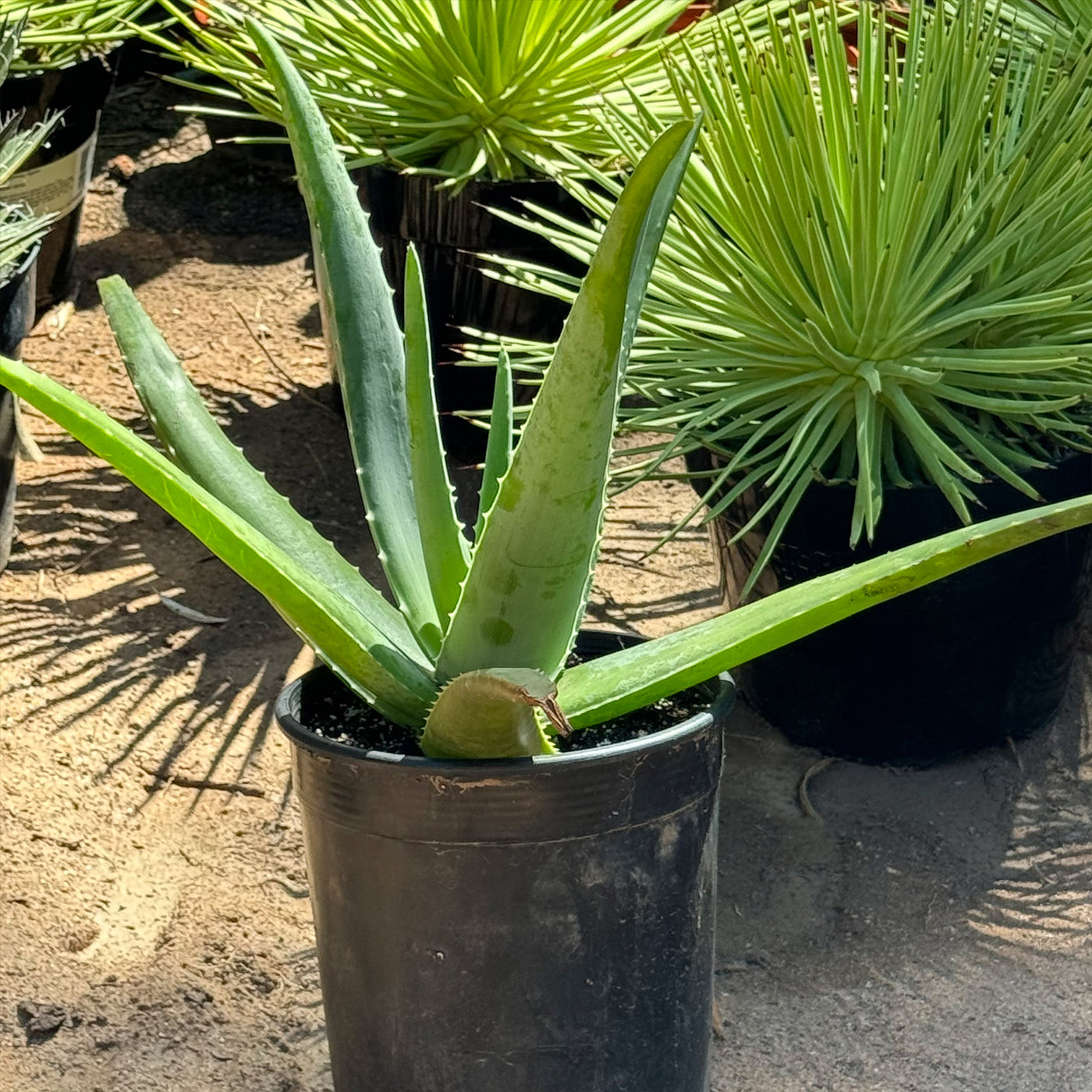
This large Aloe vera plant boasts fleshy lance-shaped grey-green leaves with small white teeth along the edges growing out from a starfish-like basal rosette. 

The edible aloe vera flowers burst into bloom in vibrant shades of yellow at the tips of their stalks when given favorable conditions. Only mature plants will yield flowers, so you'll have to wait at least four years to see an aloe vera bloom. However, in some growing conditions (especially hybrid plants), the flowers can sometimes appear with orange or reddish hues. 

This fast-growing succulent can grow into a large aloe vera plant up to 3 feet tall and 2 feet wide and even produce adorable pups that you can repot or share as delightful gifts with fellow plant enthusiasts.

How to Get Aloe Vera Gel from the plant to use on your skin

  1. Choose and Cut a Leaf: Select a large, healthy leaf from the bottom of the plant. Use a sharp knife to cut the entire leaf off at the base.
  2. Prepare the Leaf: Let the leaf sit upright in a container for 10–15 minutes to allow the yellow sap (aloin) to drain out. This sap can be irritating to the skin.
  3. Slice and Extract the Gel: For a small amount of gel, cut a section from the leaf rather than using the whole thing. Slice the leaf lengthwise to expose the gel. Use a spoon or knife to scoop out the clear gel.
  4. Apply or Store: Apply directly to your skin for soothing relief. Store extra gel in an airtight container in the fridge for a few days.

Aloe vera juice has many benefits for humans, this succulent rich in antibacterial, antioxidant, and anti-inflammatory properties, may enhance digestion, blood sugar levels, and oral health, although certain compounds, particularly aloin, may cause digestive discomfort and other side effects.

An aloe vera indoor plant is a great addition to any home, as it is easy to aloe vera care for and provides a variety of aloe vera benefits. 

According to the American Academy of Dermatology, Aloe vera has anti-inflammatory properties that can help in wound healing. It can also help to moisturize the skin and prevent peeling.

When and How to Water Your Aloe Vera 

As a desert dweller, watering the aloe vera succulent may be tricky, it may shrivel and die if given too little water, but it may also easily rot when given excessive water. So be careful not to overwater your aloe plantyou only want to give it enough to keep it from drying out completely, not drown it! 

A good rule of thumb is to water the Aloe plants deeply and then allow the soil to dry out completely before watering again. In the spring and summer, during the growing season, watering can be done once every 2-3 weeks.

During the winter months, when aloe vera is in a dormant period, it can be watered even less frequently. If you live in a rainy climate, consider planting aloe in gravel or stones. 

It is also important to note that aloe vera plants are sensitive to water quality. They prefer water that is low in minerals and salts, so it is best to use distilled or filtered water. Tap water can be used, but it should be left out for 24 hours before watering the plant to allow the chlorine to evaporate.

Light Requirements - Where to Place Your Aloe Vera Plant 

When growing indoors as a houseplant, place the aloe vera a few feet away from the south-facing window that receives plenty of sunlight, but it is important to avoid direct sunlight, as this can cause the leaves to burn. If the aloe plant is not receiving enough light, the leaves will start to droop and turn brown. In this case, it may be necessary to move the aloe vera plant to a brighter location. 

When planted outdoors, your Aloe plants need their daily dose of sunshine like a beach-loving teenager needs their favorite tunes!

They thrive on at least 6 to 8 hours of direct sunlight, soaking up those glorious rays with joy.

But wait, before you go dragging your aloe plant from its cozy shady spot into the blazing sun, be cautious. That sudden move can dry out your leafy buddy and leave it looking as yellow as a lemon.  

Now imagine you live in one of those cooler climates where clouds have permanent residency or if your home lacks these sunny windows altogether.

Fear not; you can use artificial lights – they're like little suns in bulb form! Hang them about one to two feet above your precious plant during daylight hours (that's roughly 16 hours per day) and watch it flourish happily amidst dim interiors.

Optimal Soil & Fertilizer Needs 

Aloe vera plants prefer well-draining soil that is a mixture of sand, perlite, and peat moss. It is critical to avoid soil that retains excessive moisture, as this can cause root rot. Instead, make or buy a well-draining potting mix, or ideally use our specialized succulent potting mix soil for aloe vera that contains 5 natural substrates and mycorrhizae to promote the development of a strong root system that helps your succulent to thrive.  

In terms of fertilizer, aloe succulents do not require a lot of nutrients. They can be fertilized once a year in the spring with a balanced fertilizer (NPK) of 5-10-5 in ratio. It is important not to over-fertilize the aloe plant, as this can lead to root burn. 

Hardiness Zones & More 

When grown indoors as a houseplant, aloe vera plants prefer a warm and dry environment. They thrive in temperatures between 60°F and 80°F. Aloe vera is a succulent, so it's adapted to arid conditions and doesn't do well in overly humid environments. Aim for a humidity level of around 30% to 40% for your indoor aloe vera plant.

In the United States, this is mostly an indoor plant, but if you live in southern Florida or Hawaii then you can cultivate it outdoors in USDA zones 9-11

Aloe vera can tolerate temperatures as low as 40°F for short periods, but prolonged exposure to freezing temperatures can damage or kill the plant. If you live in a colder climate, it's best to keep your aloe vera indoors or provide protection during winter months.

Aloe vera plants prefer dry air and do not require high levels of humidity. They can tolerate low humidity levels and do not need to be misted or placed in a humid environment. 

Wildlife - Aloe Vera Attracts the Following Friendly Pollinators

Aloe vera plants attract a variety of friendly pollinators, including bees, butterflies, and hummingbirds. These pollinators are essential for the reproduction of aloe vera plants, as they help transfer pollen between flowers, ultimately leading to the production of seeds. Additionally, these pollinators play a crucial role in maintaining biodiversity and ecosystem health.

Butterflies
Bees
Hummingbirds
Lady Bugs
Multi Pollinators
Other Birds

According to the ASPCA, the Aloe vera can be mildly toxic to pets and humans. It is rare but can occur if consumed in large quantities and can cause abdominal cramps, diarrhea, and electrolyte imbalances. It is important to consult a healthcare professional if you experience any adverse effects from consuming aloe vera.

How to Propagate Your Aloe Vera Plant

To propagate your aloe vera plant, you can separate the offsets or "pups" that grow at the base of the main plant. Gently remove these pups and plant them in their own pots with well-draining soil to encourage root growth. Water sparingly until they establish themselves, and place them in a sunny spot to promote healthy growth.

Aloe Vera: The Natural Sunburn Remedy


Aloe vera gel is known for its ability to moisturize the skin, it helps soothe burns and sunburns, as well as being known for its anti-inflammatory and antibacterial properties.

Aloe Vera is also rich in vitamins and minerals that are essential for healthy skin. It is best to use pure aloe gel extracted directly from an aloe vera plant.

To use aloe vera gel to soothe sunburns, cut off a piece of the large aloe vera leaf and open it to reveal the gel.

To maintain the aesthetic appeal of your aloe plant, it is advisable to cut off the entire leaf of the large aloe vera plant when cutting one. Just chop the leaf off as close to the main stem as you can. Cutting leaves from the base of the plant is always preferable. These leaves will be thicker since they are older. If you cut off the tip of a leaf, it will eventually turn brown at the tip because cut leaves keep their scars.

Key Takeaways

  1. Aloe vera is renowned for its medicinal properties, particularly its soothing gel, which is widely used for treating burns, wounds, and skin irritations. Its natural compounds, like aloin and acemannan, have anti-inflammatory and healing properties.
  2. When cut, aloe vera can seal its own wounds by producing protective latex, showcasing its remarkable survival mechanism in harsh environments.
  3. Aloe vera is not just a skincare savior; it also purifies indoor air by removing harmful pollutants like formaldehyde and benzene, making it a great addition to homes and offices.
  4. Native to arid regions, aloe vera thrives in minimal water conditions. It stores water in its thick, fleshy leaves, allowing it to endure prolonged droughts.
  5. The inner gel of aloe vera leaves is edible and used in drinks and food for its health benefits, such as aiding digestion, boosting immunity, and providing hydration. Always ensure proper preparation to remove any bitter or toxic compounds.
  6. The presence of yellow flower buds is a strong indicator of the edible variety.

The Bottom Line

Overall, Aloe vera is a popular plant known for its healing properties and versatility. It has gained popularity for its ability to help heal wounds, cuts, and burns, including sunburns. The gel inside the aloe vera leaves contains soothing and moisturizing properties that can provide relief and promote healing. In terms of care, aloe vera is relatively low-maintenance. It thrives in well-draining soil and requires moderate watering. It prefers bright, indirect sunlight but can tolerate some shade. 

A lot of people have a hard time finding large aloe vera plants, but here at Planet Desert, we regularly have large sizes in stock. Don't miss out on adding an Aloe vera plant for sale to your garden! Order now and enjoy its beauty for years to come. 

Shipping Notes
  • Free Standard Shipping on $100+ Orders to the USA.
  • Except Preorder products are shipped in 48 hours.
  • Delivery to the USA:
  1. Standard Shipping : 3-10 business days
  • If time is of the essence, please consider selecting expedited delivery for faster service.
Exchange/Return Notes
  • We offer a 30-day return/exchange service after receiving.
  • Final sale items are not eligible for returns or exchanges.
  • To process your return/exchange, please contact us at [email protected]
  • Please click here for more details>>> Return & Exchange Policy
SKU: 74479873716

Discover Niche Categories That Outsell original aloe vera plant

Top-Converting Item to Boost Your Average Order

4.5 ★★★★★
Based on 16 reviews
Sort
Highest Rating
Newest First
Oldest First
Product Reviews
K
Verified Purchase
Karen Mcwilliams
Waukegan, US
★★★★★ 5
A MUST READ BOOK ABOUT OUR HEALTH CRISES--REVIEWED BY AN EDUCATOR, PUBLISHED WRITER, AND BOOK REVIEWER
Format: Paperback
I am a former teacher, school librarian, published author, and book reviewer for the Society of Children's Book Writers and Illustrators, as well as judge and book reviewer for the IPPY and MOONBEAM BOOK Awards. Many years ago I was diagnosed with GUILLAIN-BARRE SYNDROME. Since I was diagnosed with this terrible neurological disease, I have continued to experience symptoms which I ignored while finishing my BA and MA degrees, teaching in several school systems including Department of Defense Overseas Schools, and traveling around the world. Even though I was often ill and constantly plagued with symptoms of my disease, I ignored the problems and did not see neurologists or undergo transfusions and/or infusions, as well as be a guinea pig for the huge variety of experimental drugs. I workout daily, eat nutriciously, and try to always be positive, laugh, and have fun. Many people have died from my disease. And I wonder if I am still alive due to NOT SEEING DOCTORS and undergoing UNPROVEN or FLAWED PROCEDURES and DRUGS. Dr. Brawley's book showed me that my choices probably helped me to be active and live, not experience an early death while doctors harmed me with their techniques. I have briefly reviewed Dr. Brawley's outstanding book which helped me to conclude that I made the best choices by not seeing neurologists over the years. Also, I was afraid my neurological disease would be labled a "PRE EXISTING CONDITION" which my insurance policies would not cover. Otis Webb Brawley, author of HOW WE DO HARM; A DOCTOR BREAKS RANKS ABOUT BEING SICK IN AMERICA, is an oncology (Cancer) professor at Georgia's prestigious Emory University as well as the Chief Medical and Scientific Officer of the American Cancer Society. Using personal anecdotes from past patients, Dr. Brawley illustrates many things which are wrong with our medical system as well as medical and nonmedical groups and doctors who need to totally change this system. Every page was packed with specific information about medical problems with protocol, procedures, chemotherapy, and uninformed patients who blindly follow doctors' suggestions as to the best way of treating thier cancers. Much of the medical research is flawed making it almost impossible for patients to research their diseases and make intelligent choices. It is imperative that everyone, men and their well-meaning wives, read about the patient, Ralph, whose wife urged him to get a free PROSTATE PSA TEST in a mall which led to horrendous FLAWED procedures which 'caused him misery and pain until he died an early death. Dr. Brawley thought prostate screening was not at all useful for anyone without symptoms. I also think that many tests we have are just to generate money for doctors and the groups they work for. In fact, just this week they are now saying women should not have MAMMOGRAMS every year as I did since I turned forty. Now the recommendation is for women to have mammograms every three to five years. Dr. Brawley said in his book that women more often find their own cancer, and mammograms should not be taken on a yearly basis. This book was the best nonfiction book I have read in years. But I was disappointed Dr. Brawley did not write a chapter on the FDA, though he referred to the organization many times. I was also interested in more specific information about drugs, particularly STATINS which are taken by most people over 50 even though they have many serious side effects. One chapter was titled GUILLAIN-BARRE SYNDROM but only mentioned the disease briefly. I am a former librarian, and like most librarians look for BIBLIOGRAPHIES, GLOSSARIES, INDEXES, and CHARTS and GRAPHS illustrating important things to better illustrate the text. In the back of the book Dr. Brawley does include specific NOTES about information in each chapter. I could only read a few pages of this information packed book per day, because there was so much information I wanted to retain. I urge every adult of both genders and any age to read this book. And if you are capable and not disabled, volunteer to help the various advocacy groups who are attempting to change our hea;th system. This book was published two years ago before Barack Obama presented his new health care plan, therefore there is nothing in the book about it. Dr. Brawley, I am looking forward to another book from you about the goings on at the FDA, since they release many drugs which are later involved in class action suits. Also, cholesterol and cholesterol drugs should be examined in detail like you did oncology. Also, Dr. B, please have your publisher publish this book in a LARGE PRINT EDITION!!! I first saw Dr. Otis Brawley on BOOKTV.ORG weeks ago. I was so impressed with Dr. Brawley's speech which was perfect as well as his honesty that I bought HOW WE DO HARM. Go to BookTV.org and look for the video of Dr. Brawley's speech. Karen Joan McWilliams, Naples, FL
WAS THIS REVIEW HELPFUL?YesReportShare
Reviewed in the United States on July 6, 2014
J
Verified Purchase
jwt99
Port Orchard, US
★★★★★ 5
Horror stories about health care, Breast Cancer, PSA Test
Format: Hardcover
I could not put this book down. I would say this is a must read for anyone that might get or who has cancer. Also anyone who has a chronic health problem should put this book in their library. I think Dr. Brawley gives compelling examples that illustrate how our health care systen is broken. Read this book! This is an excellent book unless you are a quack, a greed driven doctor or drug rep. Dr.Brawley points out that we should not waste valiable tax money or even insurance money on unproven cures or on drugs that cost 10-20 times as much as a proven drug. All medical care should be research based, rational and above all "do no harm". I hate to tell you this, but we as a country cannot afford to waste massive amounts of money anymore. If we don't get serious about health care it will break the country. We cannot afford to transfer wealth to quack doctors or for procedures that don't work. A spinal fusion costs about $80,000 yet 80% of the research says it does no good and it does a lot of harm. Is this any way to run a health care system? If you don't believe Dr. Brawley read the research for yourself. Use a little of your time to dig and see if he is telling the truth. A lot of the raw research is locked up tight and hard to access and not easy for a lay person to understand. We must rely on honest doctors like Dr. Brawley to tell us the truth about our healthcare system The chapters on the "PSA" test for prostate cancer were shocking to say the least. All the examples about the breast cancer problems are on point. My wife went through this several years ago and thank goodness we had a doctor whose first words were us was " I don't give any treatment that has not been through a double blind study." We feel like my wife received excellent treatment without receiving too much treatment. Too much can be as bad as too litttle as Dr. Brawley states. Dr. Brawley points out through his examples that "raw greed" on the part of hospitals, doctors and drug companies has layed waste to our health care system. The economic incentives are all on the side of more care not appropriate care. There is a vast difference between the two. Thank you Dr. Brawley.
WAS THIS REVIEW HELPFUL?YesReportShare
Reviewed in the United States on February 8, 2012
B
Verified Purchase
BostonProfessionalCouple
Lake Worth, US
★★★★★ 4
Fabulous book but seems a little biased
Format: Hardcover
I read a lot on the healthcare system and also have a biology PhD and a healthcare-related career, so I read 'How We Do Harm' with real interest and found that I tremendously enjoyed it, largely due to its distinctive and refreshing down-to-earth, no-holds-barred, friend-of-the-people style attack on many different sacred cows of the healthcare system. He exposes ignorance, shysterism, laziness and other commonplace human failings AMONG HIS FELLOW PHYSICIANS, where these everyday human foibles have an enormous impact on the life and death and quality of life of the patients treated by them. And he is not just any physician, he is the Chief Medical and Scientific Officer of the American Cancer Society. It reads like the system has turned on itself. This is a 'People's History' of the current healthcare system. The language is carefully unacademic and the cases he chooses are heart-wringing for the most part. I think there is much to learn from the diverse cases he selects, and he goes after problems originating with patients and their families as well as doctors and the system. If each of the problems that Dr. Brawley characterizes were systematically addressed, we would have a somewhat better and MUCH cheaper system - I think essentially a Canadian system, even if there were multiple payors. Once everyone followed the same rules and there was little role for physician discretion, and little role for new therapies until massive clinical studies achieved definitive conclusive results, inefficiencies in the system would be dramatically reduced, and many patients would receive better care. The problem with this objective, IMHO, is that the heterogeneity of cancer and the rate of advance in this particular field would not be well-served by a system where no new therapies were paid for until they had achieved p values of <0.05 in clinical trials IN THE PRECISE PATIENT POPULATION of the patient who needs treatment. Some cancers are so rare that this would never happen. In other cases, new research information evolves in small case series that wouldn't meet Dr. Brawley's standards but would provide vital information for selection of therapy. All-in-all, Dr. Brawley appears overly philosophically committed to the concept of clinical certainty, iron-clad treatment paradigms, and saving the system money. I'm all for saving the system money, but Dr. Brawley goes after cancer screening with the dedication of a hero confronting his nemesis. He barely acknowledges the potential for good to come from screening. For example, he is dismissive of the value provided by lung cancer screening, in spite of a roughly 50,000 patient randomized controlled study that showed a 20% reduction in cancer mortality in heavy smokers who received screening! This was without even specifying how these patients were treated - the 20% reduction in the leading cause of cancer mortality was simply from looking for a spot on the lung, and then letting the doctor and patient decide what treatment to pursue. I see that as a tremendous breakthrough. Dr. Brawley sees it as a roughly even set of risks and benefits that the system presumably should hesitate to fund. (Updated August 2013 to note that the U.S. Preventive Services Task Force has now issued a strong recommendation for CT screening of heavy smokers for early detection of lung cancer, based primarily on the data above. "As many as 20,000 deaths a year could be prevented by screening", according to Michael LeFevre, MD, co-vice chair of the task force). The book is well worth reading; but there are other intelligent, reasonable viewpoints on the burning thesis presented by this book, and one unfortunately comes away with the impression that Dr. Brawley would not acknowledge this. I found myself comforted by the fact that other checks and balances in the system will limit Dr. Brawley's impact on cancer treatment paradigms, even with his role at the ACS.
WAS THIS REVIEW HELPFUL?YesReportShare
Reviewed in the United States on June 20, 2012
T
Verified Purchase
Thomas M. Loarie
Alexandria, US
★★★★★ 5
Intellectual Dishonesty, Malfeasance, and Conflicts of Interest...
Format: Hardcover
In "How We Do Harm,' author Otis Webb Brawley, M.D., shares his healthcare system experience from his early days at the Pritzker School of Medicine (University of Chicago), as a resident at University Hospitals of Cleveland, as a fellow at the National Cancer Institute, and as a physician specializing in medical oncology at Grady Hospital in Atlanta. Brawley has both the experience and credentials to call our attention to the systemic failures of a system that our politicians call the "best in the world (ignorance is elegant)." He is recognized as an outstanding physician-scientist who serves today as the chief medical and scientific officer of the American Cancer Society, and as professor of hematology, oncology, medicine, and epidemiology at Emory University In this book, the author takes the reader on a "guided tour of the back rooms" of the American healthcare system. He charges that "no incident failure in American medicine should be dismissed as an aberration...failure is the system, a system in which helping patients is not the point. Economic incentives dictate that the patient be ground up as expensively as possible with the goal of maximizing the cut of every practitioner who gets involved." Brawley's view is that of skeptic and health-reform advocate. Brawley uses his personal experience and stories to show how our system "fails to provide care when care is needed and fails to stop expensive, often unnecessary, and frequently harmful interventions." He feels one antidote to sure the ills of the system would be to base the system on science. His stories include: 1. The treatment provided to a woman whose breast fell-off due to cancer. 2. Misguided collegiality among physicians. "Should I tell the patient that the previous doctor was incompetent? And get hauled into court for slander?" 3. The saving of Mr. Huzjak whose daughter, despite his condition, wants everything to be done to save his life. "We never give up" when the humane thing is to give up. 4. The Wallet Biopsy - the reason why people are turned away from private hospitals and end up at public hospitals like Grady. 5. Treating colon cancer Colon Cancer. "If you are poor, black, and uninsured, you get no care until its too late. But if you are rich, white, and insured, you face another deadly menace, doctors (some socially prominent) who are just plain bad. Expensive drugs and tests that patients don't need." 6. The implantable defibrillator, and the growing disparity between the insured and the uninsured which increases as technology improves. 7. Procrit, Nexium, Vioxx, Intensity Modulation Radiation Therapy and other approved drugs and therapies that are leading patients to serious complications, and/or a worsening of disease, or death. And how overtreatment may be beneficial to everyone but the patient - doctors, hospitals, and the pharmaceutical industry. 8. The perverse incentive system in which has extended the standards of care enormously from three decades ago due to the willingness of insurance companies to pay and the willingness of private physicians to make a buck. Brawley, by "breaking the ranks about being sick in America," points to his Jesuit education as a foundational experience for his life journey. A Jesuit teacher, Fr. Richard Polakowski, early in his life taught "Say what you know, what you don't know, and what you believe - and label it accordingly." Along the way, Brawley developed a set of maxims what would shape his life: 1. Be a man for others. Find work where you can make a difference. Use your God-given gifts to improve the lot of others. Always focus on improving the lot of others. Do this for the greater glory of God. 2. Be binary, know right and wrong. Be truthful. Have the courage to speak truth to power. 3. Never worry about people thinking you are different. Realize, people, both black and white, will try to discourage you. They will try to get at your self- confidence. 4. You will be tested. Always know your subject matter better than anyone else. You must be good. You must stand up to scrutiny. 5. Do not let the naysayers make you feel you cannot do something. They will call you arrogant. They will call you aloof. They will question your intelligence...spite them by succeeding. 6. Do not tolerate fools. Don't compromise on excellence. 7. Never let people put you down. 8. Feel sorry for people who see no challenges to overcome. Feel sorry for the selfish. Feel sorry for the fools. Remember you have character they cannot understand. Relish you have overcome challenges they could never overcome. As someone who has worked for over 40 years in healthcare, Brawley's book resonated with some of my own experiences. His perspective, while not inclusive, has great value. However, he fails to note the role of government in shaping the system we have today - diagnosis related groups (DRGs), resource-based relative value scale (RBRVS), CMS CP codes, Medicare and Medicaid cost shifting, and, for me personally, the role of the FDA in driving up the cost of medical innovation. Much of what he describes as systemic failure can be attributed to government intervention. The private sector's greediness is a response, much like Wall Street's and the public's greedy response to the government's "everyone should own a home" policy which led to the Great Recession of 2007-2009.
WAS THIS REVIEW HELPFUL?YesReportShare
Reviewed in the United States on October 30, 2012
T
Verified Purchase
T. Burns
Massapequa, US
★★★★★ 5
A MUST read for any patient with cancer or for a physician
Format: Kindle
I would give this book 6 stars if I could. The book talks about medical care and cancer care in the United States. The care that many receive is very limited for the poor and poorly managed for the rich or well insured. We need treatments that have a scientific basis and a proven track record. Often Patients get pushed into testing that has not been shown to prolong life or decrease morbidity. A good example is PSA testing. The potential therapies can kill you or drastically take away quality of life. Would you take a test that might lead to wearing diapers for the rest of you life and not prolong your life ? If Your PSA is elevated does your doctor offer you 3 or 4 possible treatments and compare possible and likely outcomes? Is there any financial incentives for the proposed therapy? Is there an expensive piece of equipment that needs to be paid for? Have you been given a list of alternatives and expected outcomes? Unfortunately the current medical health care system is flooded with ignorance, apathy and often greed. Consumers (patient) need to know something about their disease. They must become active players. They should ask for proof that this therapy is better than another therapy. They also need to be able to ask their doctors "how many of these have you done and what outcomes have you had?" They need real expectations. If you have localized prostate disease that has a low risk of metastasis then why get the prostate ripped out ? Maybe it can be watched for 4 - 5 years before surgery and diapers and impotence. Greed? Yes boys and girls somebody has to pay for that 3 million dollar particle accelerator at your local hospital. Why should it be your life and body for some unproven therapy? Unfortunately education is a very difficult thing to do. You can tell I loved this book. Why is it the USA has such poor health outcomes? Over treatment can cause harm. Bone Marrow transplants for breast cancer is proof of the harm.
WAS THIS REVIEW HELPFUL?YesReportShare
Reviewed in the United States on July 7, 2014

recommand products