SKU: 74540619213
plant papaya seeds

plant papaya seeds Papaya – UJAMAA SEEDS

Sale price$22.37 Regular price$24.86
Save 10%

Pay in installments of $6.21 with ShopPay, AfterPay and Klarna

Shipping Estimate
USA
  • USA
  • CAN

Ships within 48 hours · Estimated delivery Jul 23 - Jul 28

Promo Codes Available:

For Your Every Summer RSVP, with Code: SUMMER15

Description

plant papaya seeds Papaya – UJAMAA SEEDSCarica Papaya Approximately ~12 seeds per packet. Germination: 71% Packed for 2025 Native to tropical regions of the Americas, particularly southern Mexico and Central America this tropical fruit plant is now cultivated in most tropical countries. In the continental USA it will thrive in zones 9 10. It also does well in Hawaii (zone 12). The papaya tree is a fast growing, herbaceous plant (producing soft flexible green stems above the ground). This

Carica Papaya

Approximately ~12 seeds per packet.

Germination: 71% Packed for 2025

Native to tropical regions of the Americas, particularly southern Mexico and Central America this tropical fruit plant is now cultivated in most tropical countries. In the continental USA it will thrive in zones 9 – 10. It also does well in Hawaii (zone 12).

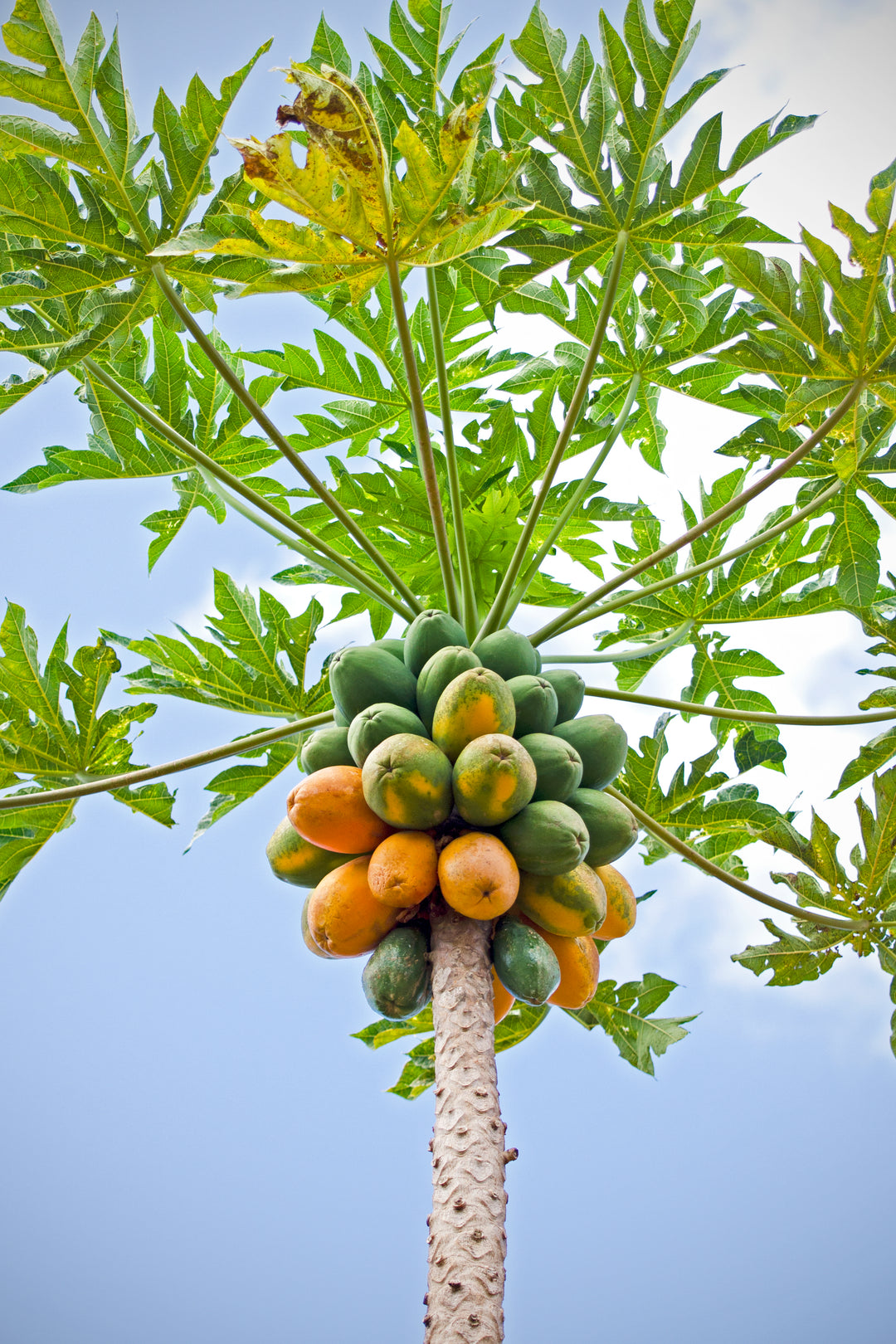
The papaya tree is a fast-growing, herbaceous plant (producing soft flexible green stems above the ground).   This tree can reach up to 33 feet (10 meters) in height, growing rapidly and fruiting within three years.

Small and sparsely branched, with leaves arranged spirally at the top of the trunk, the papaya tree leaves are large, lobed, and palmate. The leaves can reach up to 24 inches (60 centimeters) in diameter.

Usually fragrant and tubular in shape, papaya tree flowers are small, white to cream-colored. With a hermaphrodite flower, which can self-pollinate, male and female hermaphroditic flowers can occur on the same plant.

The fruit is a large berry, ripening to a large, oval or pear-shaped berry, that is amber to orange hue when soft. Skin color ranges from green to yellow or orange as it ripens. They can weigh between 1 to 20 pounds. The flesh is sweet, juicy, and typically orange or red when ripe, with black seeds clustered in the center. Papaya have a shallow but extensive fibrous root system.

Papaya is consumed raw when ripe, either without skin or seeds, and cooked when unripe, often in curries, salads, or stews. Papaya skin, pulp, and seeds contain several phytochemicals, including carotenoids and polyphenols, as well as benzyl isothiocyanates and glucosinates.

Growing Guidance for Carica Papaya

Prefers tropical and subtropical climates. Ideal temperature range:  70-90°F (21-33°C). Sensitive to frost and prolonged cold weather. Requires high humidity and ample sunlight. Well-draining, fertile soil is crucial. The pH range should be 5.5 to 7.0. Avoid waterlogged or compacted soils.

Planting, Spacing, & Watering: Best propagated from seeds. Seeds should be sown fresh, directly into the soil or in containers. Plant seeds about 0.4-0.8 inches (1-2 centimeters) deep. Germination occurs within 2-3 weeks. Space plants 6 to 10 feet (1.8 to 3 meters) apart. Ensure adequate air circulation to prevent diseases. Regular, deep watering is essential. Maintain consistent moisture but avoid waterlogging. Drip irrigation is recommended for optimal growth.

Fertilization: Balanced fertilizer rich in nitrogen, phosphorus, and potassium. Apply fertilizer every 2-3 months. Supplement with micronutrients such as magnesium, zinc, and iron if needed. Minimal pruning required. Remove dead or diseased leaves to promote air circulation and reduce pest problems.

Pest and Disease Management:  Common pests: aphids, whiteflies, fruit flies, spider mites. Common diseases: papaya ringspot virus, anthracnose, powdery mildew. Integrated pest management (IPM) strategies, including biological control, can be effective. Regular monitoring for signs of stress, pests, and diseases. Mulching around the base can help retain soil moisture and suppress weeds.

Harvesting: Fruits typically mature within 6-9 months after flowering. Harvest when the skin starts to turn yellow. Use a sharp knife to cut the fruit from the tree to avoid damage. Papaya plants have a relatively short lifespan, typically producing fruit for 3-4 years.

By following these guidelines, you can expect healthy growth and productive yields of Carica papaya in suitable climates and vegetation zones.

GUIDELINES - FALL SOWING TREE SEEDS-PDF FOR PRINTING

KEEP SEEDS REFRIGERATED FOR LONG TERM STORAGE PRIOR TO SCARIFICATION TREATMENT BELOW.

GROWING INFORMATION

Scarification

Soak in water, let stand in water for 24 hours

Stratification

None required

Germination

Sow seed 1/8” deep, tamp the soil, keep moist but not wet


Shipping Notes
  • Free Standard Shipping on $100+ Orders to the USA.
  • Except Preorder products are shipped in 48 hours.
  • Delivery to the USA:
  1. Standard Shipping : 3-10 business days
  • If time is of the essence, please consider selecting expedited delivery for faster service.
Exchange/Return Notes
  • We offer a 30-day return/exchange service after receiving.
  • Final sale items are not eligible for returns or exchanges.
  • To process your return/exchange, please contact us at [email protected]
  • Please click here for more details>>> Return & Exchange Policy
SKU: 74540619213

Discover Niche Categories That Outsell plant papaya seeds

Top-Converting Item to Boost Your Average Order

4.8 ★★★★★
Based on 29 reviews
Sort
Highest Rating
Newest First
Oldest First
Product Reviews
M
Verified Purchase
Michael H
Omaha, US
★★★★★ 5
Why wasn’t MacArthur court martialed?
Format: Hardcover
If there is a better book about overcoming the impossible, please send the title. Leadership at every level except the very top as well as the esprit de corps of USMC carried the day against overwhelming numbers of Chinese armies ( yes, armies - hundreds of thousand against USA and USMC troops). The Korean War doesn’t get the respect it deserves. Emperor MacArthur sat on his butt in Tokyo refusing to believe he could be wrong while Chinese armies crossed the Yalu intent on destroying the 1st MARDIV and the USA units east of the Chosin Reservoir. He spent one night in Korea during the entire war until President Truman fired his ass and rightly so.
WAS THIS REVIEW HELPFUL?YesReportShare
Reviewed in the United States on August 22, 2025
J
Verified Purchase
John G
Houston, US
★★★★★ 5
Comprehensive analysis of the Chosin Reservoir campaign
Format: Hardcover
Excellent excellent review and analysis of the Chosin Resevoir campaign. The author examines the battle day-by-day from the Marines, Army, and Chinese Army perspective. This should be a required reference when studying the battle to understand lessons learned. So often books on this campaign are fragmented. In this book, he put the exciting descriptions of the action in the context of the broader campaign. I really appreciated how he included Task Force McLean/Faith which often gets omitted. After reading a number of books on this battle, I knew what was going to happen, but have to admit that it was hard to put this book down. HIGHLY highly recommended.
WAS THIS REVIEW HELPFUL?YesReportShare
Reviewed in the United States on March 15, 2025
W
Verified Purchase
W. Bonkosky
Port Orchard, US
★★★★★ 5
Lots of info about an iconic USMC battle.
Format: Hardcover
This excellent book should be required reading in Marine Corps Boot Camp! Both Mao Tse-Tung and the commander of the 10's of 1,000's of Chinese "volunteers" who tried to surround and annihilate the 1st Marine Division at Chosin acknowledged that the 1sdtMarDiv was the best division in the American Armed Forces. And the Marines there proved they were correct in that assumption! I am proud to have served in that very division as a peacetime Marine, 1956 - '58.
WAS THIS REVIEW HELPFUL?YesReportShare
Reviewed in the United States on January 31, 2025
D
Verified Purchase
Douglas B. Schonour
Massapequa, US
★★★★★ 5
I have a better understanding of the heroes who fought in the early days of the Korean War.
Format: Kindle
The author takes the reader from the landings at Inchon, the drive to the Yalu River, and the retreat and evacuation to the south. I can't imagine the conditions these brave men endured as they fought the hordes of Chinese in order to escape a frozen hell.
WAS THIS REVIEW HELPFUL?YesReportShare
Reviewed in the United States on January 16, 2025
T
Verified Purchase
Tascha F.
Draper, US
★★★★★ 5
Engaging, though-provoking sweep that will provide you with regarding this time period
Format: Hardcover
Alan Taylor is a writer who excels at contextualizing the complexity of history by creating a sort of ancestral snapshot of each person and event and placing them on a family tree, showing both their relationships to one another and to their time. This approach increases readers’ abilities to build those understandings on their own in other readings, about other times. That’s cool. In this book, he upends a more static understanding of North and South and provides a kaleidoscope of complexity with regards to individuals and social groups from regions both within and outside of our borders. In this book, Alan Taylor displays his unique brilliance at making legible the complex interplay of extremely diverse international, national, and factional agendas, political aspirations, people’s attachment to their political and social worldviews, economic aspirations, their bluster, their denial, and their honest – if not always successful – efforts. Quoting from a mind-bogglingly large reading list of academic sources, newspapers, diaries, and other historical documents, he brings people back to life in such a way that you could mentally animate what role these historical figures would play today on the world stage or even in a more intimate setting of your own office politics. He makes the complexity and uncertainty decipherable so that we can think about it, argue about it, and explore it just as we would events with which we are familiar today. A true love of history and our understanding of humanity at present are not served by infatuation with imagined, polished heroes but by complex accounts and considerations of character, influences, dreams, successes, and failures that reveal how these elements are the common denominators in all lives and across all times. Taylor does this superbly for figures North, South, enslaved, free, freed Blacks, embittered whites, Mexican, Spanish, Canadian, British, French, and Indigenous. He juxtaposes Maximilian’s wife, Carlota, sister of Leopold II, who placed faith in herself and in her husband to transform Mexico through better monarchy, with the far more egalitarian Benito Juárez, who ultimately subordinated the lives of the indigenous people in capitulating to a rising oligarchy of American investors who could rebuild Mexico. Both Carlota and Juarez are driven to varying degrees of madness by the results of their efforts. We see members of the former Confederacy who rue their violent support for the perverse and cruel institution of slavery once the war is over, alongside others who will stop at nothing to bring back the old order. And we see Northerners, who in wartime decried slavery with a furious ardor, eventually languishing in their duty to their fellows after the war was over. There are warriors for justice, warriors for oppression, realists, capitulators, power brokers, and pawns. Even the best, who are not depleted of passionate intensity for doing right, must contend with an ecosystem of others’ dreams and aspirations, which all too often run afoul of the righteous. In the end, we may be judged by others and by ourselves for what we’ve wished for: either peace and fairness or war and acquisition at any price. The book serves as a reminder to plant the right seeds and dream the right dreams…for everybody’s children. Because when the harshest frost melts away, something new will grow.
WAS THIS REVIEW HELPFUL?YesReportShare
Reviewed in the United States on July 3, 2024

recommand products