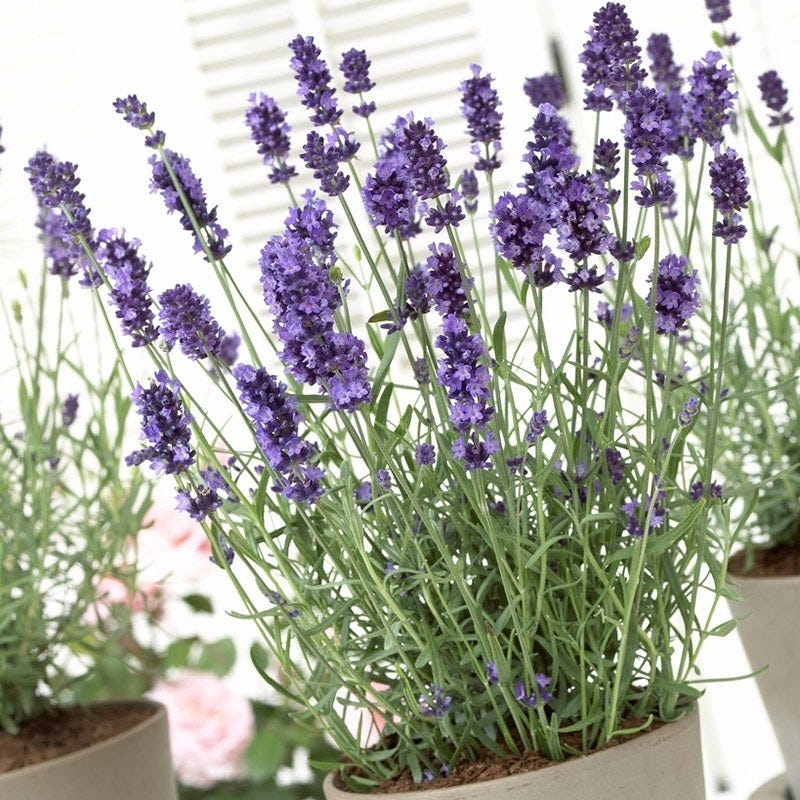
SKU: 75525908351
lavender potted plants for sale

lavender potted plants for sale Hidcote English Lavender | Purple | Plant

Sale price$21.68 Regular price$24.09
Save 10%

Pay in installments of $6.02 with ShopPay, AfterPay and Klarna

Shipping Estimate
USA
  • USA
  • CAN

Ships within 48 hours · Estimated delivery Aug 29 - Sep 3

Promo Codes Available:

For Your Every Summer RSVP, with Code: SUMMER15

Description

lavender potted plants for sale Hidcote English Lavender | Purple | Plant18 24" tall x 18 24" wide. 'Hidcote' Lavender is a standout English variety known for its strong fragrance and winter hardiness. Gardeners growing lavender at the northernmost edges of its range can plant 'Hidcote' for its improved ability to survive winter and reappear the following spring. Tall, purple blue flower spikes add visual interest to garden borders, walkways, and rock gardens, and also make this lavender a great choice for mass plantings

18-24" tall x 18-24" wide. 'Hidcote' Lavender is a standout English variety known for its strong fragrance and winter hardiness. Gardeners growing lavender at the northernmost edges of its range can plant 'Hidcote' for its improved ability to survive winter and reappear the following spring. Tall, purple-blue flower spikes add visual interest to garden borders, walkways, and rock gardens, and also make this lavender a great choice for mass plantings - expect to attract a lot of pollinators wherever you plant it! 'Hidcote' has a notably-high essential oil content and is often used for making soap, potpourris, sachets and dried floral arrangements. Also a great choice for culinary uses.

---------------

Success with Lavender:

Originating in the Mediterranean, lavender prefers hot sunny days, dry air, and non-enriched, well-drained soil. While that’s great news for those gardening in the West, nowadays lavender can also be successfully grown in higher-humidity areas of the East and Pacific Northwest very successfully by remembering its basic needs. Be sure to pick a variety that is matched to your area. Depending upon your location and your desired use, there are lavenders for almost any setting. Next, follow the four basic elements to ensure lavender success:

1. SUN Lavender loves sun. Plant them in a sunny location where there is plenty of air circulation. Six to eight hours of sun is best, but some afternoon shade is fine in the hotter climates of the Southwest.

2. AIR Good air circulation is essential, especially in areas of high humidity. Lavender is not fond of damp, still air, which makes it prone to root rot. In humid areas, plant them with ample spacing, keeping in mind the mature size of your plant when in bloom and allowing for a bit extra space for good circulation.

3. SOIL Well-drained soil. This is perhaps the most important factor in success with lavender. One rule of thumb from is that the soil should be loose enough to dig with your hands, and not cake-like. You can add sand or small gravel to recreate this consistency if your soil is too compact. In areas where drainage may be a problem, mound the soil up to create a raised row or stand-alone mound.

In humid areas especially, a 1-2” mulch of pea sized gravel or white sand will do two things – it will help improve drainage, and it will reflect heat and light back up into the plant. More heat = more fragrant blooms! If you use a weed barrier, make sure it is breathable so the soil can drain and the roots can breathe. Gardeners struggling with growing lavender successfully in humid areas are encouraged to try planting Lavender Phenomenal.

4. WATER During the first year of your lavender’s growth it needs to establish a good root system. It will require regular watering (unless you’re experiencing healthy rain fall). Starting in the second year, your lavender will need less water, as it becomes the water-thrifty plant you’re hoping for, but to get there it needs to grow deep roots in year one. By the end of year three it will have reached its mature size and shouldn’t need any extra water. If water is needed, water in the morning, and deeply, to help root growth. A mature lavender plant is happy with only 9-12 inches of rain per year, but remember, with the right variety and good drainage lavender can thrive with more water.

Learn How to Grow Lavender in Detail.

Shipping Notes
  • Free Standard Shipping on $100+ Orders to the USA.
  • Except Preorder products are shipped in 48 hours.
  • Delivery to the USA:
  1. Standard Shipping : 3-10 business days
  • If time is of the essence, please consider selecting expedited delivery for faster service.
Exchange/Return Notes
  • We offer a 30-day return/exchange service after receiving.
  • Final sale items are not eligible for returns or exchanges.
  • To process your return/exchange, please contact us at [email protected]
  • Please click here for more details>>> Return & Exchange Policy
SKU: 75525908351

Discover Niche Categories That Outsell lavender potted plants for sale

Top-Converting Item to Boost Your Average Order

4.6 ★★★★★
Based on 12 reviews
Sort
Highest Rating
Newest First
Oldest First
Product Reviews
S
Verified Purchase
sandyrouse
Lexington, US
★★★★★ 5
Excellent and in-depth archeologic finds that authenticate Bible history.
Format: Paperback
Archeology is proving much of the Bible's history as true. This book really delves into various sites and provides a lot of detail. My type of reading.
WAS THIS REVIEW HELPFUL?YesReportShare
Reviewed in the United States on February 21, 2026
A
Verified Purchase
Angie Criss
New York, US
★★★★★ 5
Great information and pictures
Format: Paperback
Great information on Biblical sites, beautiful pictures, and a pretty book as well. I gave several of these to my family for Christmas. Everyone seemed to love them. The only thing I will caution you about is that the book is small.
WAS THIS REVIEW HELPFUL?YesReportShare
Reviewed in the United States on January 22, 2026
M
Verified Purchase
Mareadas
Lowell, US
★★★★★ 4
Knowledgeable and delectable book.
Format: Paperback
This book shows an excellent archaeological evidence of the Bible accuracy of places, names, events, etc. and proving for the Christians that the Bible is a historical document as well as the inspired inerrant word of God. The majority of the book is interesting and delectable, I mean, the pages where the author presents archaeological facts such as the artifacts and their correlation with people, places times, events and practices recorded in the Bible. But I do not like when the author make personal assumptions and do not present any proof of that. He says: it probably be…. it may be… Here I show three cases of this conjectures;: 1.The author seems to affirm that the triumphal entry of Jesus into Jerusalem, or at least, the name of this event, was derived from the Roman triumph celebration. He says (page 231), regarding to the Roman Empire and the life of Jesus: “By the time of Jesus, the requirements and meaning of a triumphal entry had shifted slightly from its earlier roots associating it with a conquering hero, as it became even more significant and representative of kingship and divinity”. He continues to say: “In ancient Roman culture, a triumphant victor, known as vir triumphalis (“man of triumph”) would enter the city in a celebration parade wearing the laurel wreath and a purple garment, which identified him with the royal and the divine, while riding in a chariot pulled by four horses, alluding to Sol the sun god”.  But if we compare the Roman triumph celebration with the entry of Jesus into Jerusalem described in the Bible, it is not derived from the Roman culture but is the exact fulfillment of the prophesy of Zechariah 9:9. I do not see any correlation between the two celebration; Jesus did not ride a horse but a donkey to signify peace, meekness and humility. It was not a pompous entrance of a conquering hero or king wearing a expensive garment and royal crown. 2.Even though, it is not possible to identify the location of the tomb of Jesus with absolute certainty; the author states (page 199) that the tomb of Jesus is located at the Church of the Holy Sepulchre possible based on “the restoration work to the edicule and an arcosolium tomb from the Roman period found in the church of the Holy Sepulchre”. The author also affirms without giving any proof that: “Christians in Jerusalem then passed down a continuous memory of the location of the tomb (of Jesus) from the time of the burial and resurrection in AD33 until construction of the Church of the Holy Sepulchre was started in about AD326”. But where are the records of that time? The author probably based his statement on Eusebius who lived in the 3rd and 4th centuries AD. According to the history , the Church of the Holy Sepulchre was built by the Roman Emperor Constantine around 326 AD, when her mother the Queen Helena, wanted to replace the pagan temples with Christian churches; she met the Bishop Macarious of Jerusalem who determined the location where Jesus had been buried at the place where was a temple to the Greek goddess Venus. At the beginning of the construction of the church, a rock-cut tomb was found there and an edicule was built to protect the site. But later the edicule was destroyed and rebuild. More tombs has been found under this church. How to be sure or verify that this rock-cut tomb was the one where Jesus was buried? 3.The author is biased with respect to the Masoretic Text, he make a statement but does not support it with any evidence in this regard. Writing about the Dead Sea Scrolls (Page 173) he states: “And certain passages in the Masoretic text seem to have been intentionally modified to match ideas and theology of medieval Judaism.” it is a bad accusation.
WAS THIS REVIEW HELPFUL?YesReportShare
Reviewed in the United States on April 23, 2021
H
Verified Purchase
Harold Lau
Omaha, US
★★★★★ 5
Great Worth
Format: Paperback
The Book That Must Be Read!
WAS THIS REVIEW HELPFUL?YesReportShare
Reviewed in the United States on April 18, 2026
B
Verified Purchase
brooke
Fort Morgan, US
★★★★★ 5
Great purchase
Format: Paperback
Loved this purchase! Very in depth and images are great.
WAS THIS REVIEW HELPFUL?YesReportShare
Reviewed in the United States on February 16, 2026

recommand products