SKU: 76132369297
bulk flower seeds cheap

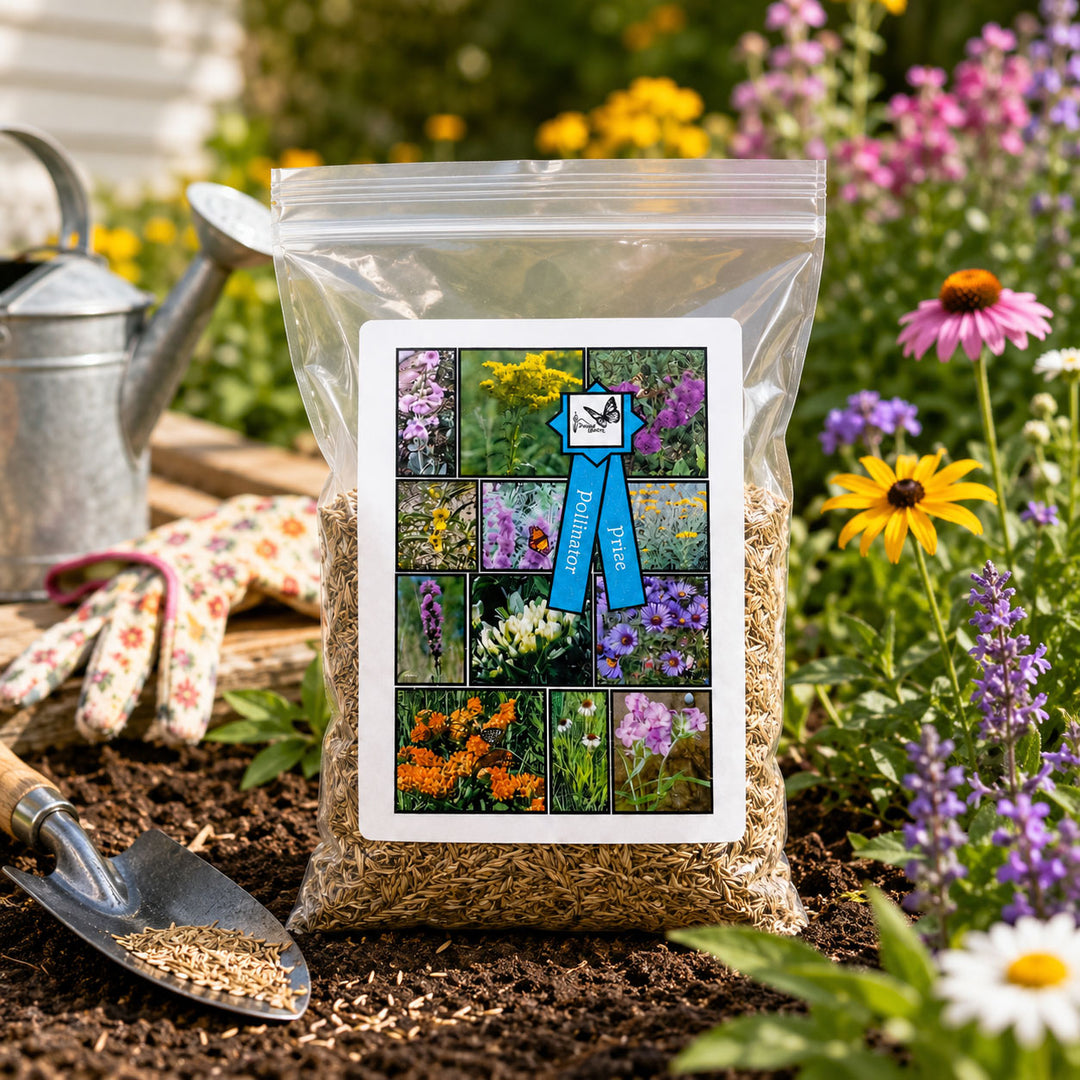
bulk flower seeds cheap Pollinator Prize Native Nebraska Flower Seed Mix | 2.03 oz

Sale price$21.32 Regular price$23.69
Save 10%

Pay in installments of $5.92 with ShopPay, AfterPay and Klarna

Shipping Estimate
USA
  • USA
  • CAN

Ships within 48 hours · Estimated delivery Oct 13 - Oct 18

Promo Codes Available:

For Your Every Summer RSVP, with Code: SUMMER15

Description

bulk flower seeds cheap Pollinator Prize Native Nebraska Flower Seed Mix | 2.03 ozAll seeds are packaged with born on dates based on the year of purchase. Product images are for reference only and may not reflect the exact packaging, label details, or born on date of the item received. The Pollinator Prize Seed Mix is one of our most diverse native wildflower blends, featuring more than 65 species selected for their exceptional value to pollinating insects. Developed using species recognized by both the Natural Resources

All seeds are packaged with born-on dates based on the year of purchase. Product images are for reference only and may not reflect the exact packaging, label details, or born-on date of the item received.

The Pollinator Prize Seed Mix is one of our most diverse native wildflower blends, featuring more than 65 species selected for their exceptional value to pollinating insects. Developed using species recognized by both the Natural Resources Conservation Service (NRCS) and the Xerces Society, this mix contains plants rated as having high or very high pollinator value.

With blooms spanning from early spring through late fall, this mix provides a continuous source of nectar and pollen throughout the growing season. The blend includes a wide variety of native wildflowers, including several uncommon species, creating a vibrant and ecologically rich habitat for bees, butterflies, moths, and other beneficial pollinators.

Some species will germinate and bloom during the first growing season, while others may require additional time to establish. Patience is essential when creating a native pollinator planting, with optimum establishment typically occurring within two to three years.

This mix contains approximately 160 seeds per square foot, providing twice the recommended broadcast seeding rate for quicker and denser establishment. Minimum seeding rates are 40 seeds per square foot when drilling and 80 seeds per square foot when broadcasting.

Key Features:

  • Contains 65+ native species of high or very high pollinator value
  • Based on NRCS and Xerces Society pollinator plant recommendations
  • Bloom period from early spring through late fall
  • Includes a greater number of uncommon native species
  • Supports a wide diversity of pollinators and beneficial insects
  • Optimum establishment typically occurs within 2–3 years

Coverage: Up to 500 Square Feet
Seeding Density: Approximately 160 Seeds per Square Foot

Disclaimer: While every effort is made to include the species listed, substitutions of comparable native species may be necessary due to seed availability.

Common Name Scientific Name % by Weight
sideoats grama Bouteloua curtipendula 24.92
showy partridge-pea Chamaecrista fasciculata 9.97
blue grama Bouteloua gracilis 6.23
Virginia wild-rye Elymus virginicus 6.23
easter white prairie-clover Dalea candida 4.98
Canada milk-vetch Astragalus canadensis 3.74
purple prairie-clover Dalea purpurea 3.74
tall dropseed Sporobolus compositus 2.49
Slimflower scurfpea Pediomelum tenuifolium 2.49
gray-prairie-coneflower Ratibida pinnata 2.49
pale purple coneflower Echinacea pallida 1.99
hoary vervain Verbena stricta 1.50
plains coreopsis Coreopsis tinctoria 1.25
wild licorice Glycyrrhiza lepidota 1.25
wild prairie rose Rosa arkansana 1.25
narrow-leaf coneflower Echinacea angustifolia 1.06
purple poppymallow Callirhoe involucrata 1.00
New Jersey tea Ceanothus americanus 1.00
redroot New Jersey tea Ceanothus herbaceus 1.00
sawtooth sunflower Helianthus grosseserratus 1.00
sensitive brier Mimosa nuttallii 1.00
cobaea penstemon Penstemon cobaea 1.00
pitcher sage Salvia azurea 1.00
rosinweed Silphium integrifolium 1.00
western ironweed Vernonia baldwinii 1.00
tall boneset Eupatorium altissimum 0.87
Lemon beebalm Monarda citriodora 0.78
Sullivant's milkweed Asclepias sullivantii 0.75
butterfly milkweed Asclepias tuberosa 0.75
Canada tick-clover Desmodium canadense 0.75
rough gayfeather Liatris aspera 0.75
wild-bergamot Monarda fistulosa 0.75
long-beak sedge Carex sprengelii 0.62
purple lovegrass Eragrostis spectabilis 0.62
Junegrass Koeleria macrantha 0.62
spider milkweed Asclepias viridis 0.62
thick-spike gayfeather Liatris pycnostachya 0.62
false boneset Brickellia eupatorioides 0.50
Illinois tick-clover Desmodium illinoense 0.50
dotted gayfeather Liatris punctata 0.50
shell-leaf penstemon Penstemon grandiflorus 0.50
tube penstemon Penstemon tubaeflorus 0.50
prairie phlox Phlox pilosa 0.50
American germander Teucrium canadense 0.50
western spiderwort Tradescantia bracteata 0.37
Missouri goldenrod Solidago missouriensis 0.31
candle anemone Anemone cylindrica 0.25
Joe Pye weed Eutrochium purpureum 0.25
Virginia mountain mint Pycnanthemum virginianum 0.25
New England aster Symphyotrichum novae-angliae 0.25
grey goldenrod Solidago nemoralis 0.20
showy-wand goldenrod Solidago speciosa 0.20
bushy seedbox Ludwigia alternifolia 0.15
meadow anemone Anemone canadensis 0.12
ground-plum Astragalus crassicarpus 0.12
tall cinquefoil Drymocallis arguta 0.12
Curly cup gumweed Grindelia squarrosa 0.12
everlasting Pseudognaphalium obtusifolium 0.12
heath aster Symphyotrichum ericoides 0.12
silky aster Symphyotrichum sericeum 0.12
plains wild indigo Baptisia leucophaea 0.10
Culver's root Veronicastrum virginicum 0.10
golden alexander Zizia aurea 0.10
plains evening primrose Oenothera serrulatus 0.06


Prairie Legacy dedicated to preserving and restoring native plant communities through exceptional botanical and environmental consulting services. Owner Kay Kottas has provided botanical education for more than 20 years, leaving a lasting legacy through university teaching, research projects, and professional collaboration with public and private agencies. Through Prairie Legacy Inc., Kay shares her deep expertise in native plants with clients and communities alike. Based in Western, Nebraska.

Shipping Notes
  • Free Standard Shipping on $100+ Orders to the USA.
  • Except Preorder products are shipped in 48 hours.
  • Delivery to the USA:
  1. Standard Shipping : 3-10 business days
  • If time is of the essence, please consider selecting expedited delivery for faster service.
Exchange/Return Notes
  • We offer a 30-day return/exchange service after receiving.
  • Final sale items are not eligible for returns or exchanges.
  • To process your return/exchange, please contact us at [email protected]
  • Please click here for more details>>> Return & Exchange Policy
SKU: 76132369297

Discover Niche Categories That Outsell bulk flower seeds cheap

Top-Converting Item to Boost Your Average Order

4.2 ★★★★★
Based on 29 reviews
Sort
Highest Rating
Newest First
Oldest First
Product Reviews
G
Verified Purchase
Goldry Bluzco
Grantham, US
★★★★★ 5
Sheds Light On A Dimly Perceived Period
Format: Kindle
This book is clearly intended for those of us (non-historians) curious about what is a dimly perceived period of North American colonial history. Living as I do in Tidewater Virginia, I consider myself fairly well versed with the earliest years of English settlement or invasion, depending on your point of view. But, I was wrong. I had, of course, read about the wretched first two years of the Jamestown enterprise, but I had no idea just how ghastly the conditions of the first twenty years of the English colonial period were. Wave after wave of newcomers simply starved or died of disease in those years. The mortality rate was shocking. So many people were dying off that the local Indians did not even think it necessary to kill these newcomers (which proved a mistake, of course). And this was not just at Jamestown. For example, the author says that in any given year in one county 30 to 40% of the children under the age of eight were orphans. And the origins of many of these earliest colonists -- orphans dumped by local churches, beggars snatched off of urban streets, prisoners marched from gaol to waiting ships, many poor people literally kidnapped or tricked into emigrating -- was eye-opening. Talk about the refuse of British society. (As an aside, anyone whose humble immigrant ancestors came to Virginia in those years can forget about doing any genealogical research. You will never find the answers to your questions.) This does tend to be a bleak read. One of the things that jumped out at me was the sad, repetitive tale of European-Indian relations. It mattered not where one was. Virginia, Maryland, Delaware, New Amsterdam, New York, the pattern is always the same. Trade and early friendly relations were quickly undermined by misunderstandings, stupidity, devious tricks, alcohol, and land disputes that led to attack and counter attack and massacres on both sides. One of the things I did enjoy was the Indians' views of Christianity. Those mentioned by the author viewed it as little more than a strange dream. When the concept of a universal god was explained to them they laughed and called it a silly fable. I can only agree. My respect for their powers of reasoning and perspicacity rose immeasurably. Just who was the savage?
WAS THIS REVIEW HELPFUL?YesReportShare
Reviewed in the United States on July 30, 2013
J
Verified Purchase
J. Grattan
Lexington, US
★★★★★ 4
Interesting, but a little scattershot (3.75*s)
Format: Paperback
One thing is for certain, in this highly detailed work by the author, there is no attempt to sugarcoat the European experience in emigrating to America in the 17th century. He examines Virginia, the Chesapeake area, New York, and New England. In the initial stages merely surviving was an accomplishment. Most of the early settlers were clueless about overcoming the harsh conditions that they found, not to mention the savagery that the natives unleashed upon them without warning. A large supply of the weak and vulnerable facilitated this peopling of America, despite the dreadful conditions. In addition, as the author shows in great detail, are the conflicts among the settlers. America was settled during a time of great political and religious clashes in England. Most of the settlers were Protestants, but held widely differing, contentious views about religious practice. Much of the governance of the colonies was autocratic, inept, and harsh. A good many of the settlers were indentured by contract for years and thereby were practically slaves, in contrast to the well connected who were granted huge estates. But even then, the author points out that the living standards for even the rich were terrible by European standards. The book is definitely more sociology than historical. One learns about the origins of the settlers across America and the implications for the possibility of robust communities. The author definitely does not hold back on naming thousands of settlers across the colonies; it is difficult to slog through all of that. The book does seem a little scattershot in its organization and subject matter.
WAS THIS REVIEW HELPFUL?YesReportShare
Reviewed in the United States on June 10, 2017
G
Verified Purchase
Gordon Hastings
Charlottesville, US
★★★★★ 5
UNDERSTANDING THE COLONIAL POPULATING OF THE NEW WORLD. AN ACADEMIC WORK.
Format: Paperback
Pulitzer Prize winning author Bernard Bailyn writing The Barbarous Years opens a sweeping and authoritative discourse into the peopling of North American between 1600 and 1675. From Jamestown, Virginia to Plymouth and the Massachusetts Bay Colony, who were these individuals who braved three plus months voyages on small, crowded and disease infested ships to arrive at the edge of the American wilderness? You will learn not only who they were but why some succeeded while others were destined to fail. images No one needs tout Bailey's credentials as historian and researcher. He is brilliant. However, what is most remarkable is his ability to keep the subject flowing, fascinating and understandable for the lay reader. Bailyn delivers in brilliant digital display the complexity and challenges of the people responsible for the early settlement of North America. Think of this: Why did the Jamestown fail numerous times? Why did the Catholics establish a foothold in Maryland and the Finns and Swedes in Delaware? Why did The Massachusetts Bay Colony begin to work from day one.? Was it religious fervor or the composition of the settlers themselves? What role did the varied Native American tribes play in the success or failure of early settlement. How did the Pilgrims differ from the Puritans and the aforementioned from the Quakers and the Dutch? Were indentured servants a precursor to slavery? Winthrop, Bradford ,Stuyvesant, Keift, Underhill, King Philips War. The Barbarous Years that marked the original settling of America is a most accurate title for the book. Adventurers, scoundrels, orphans, preachers, doctors, lawyers, Native Americans, politicians, merchants and perhaps most important, the hundreds of unnamed families with children who came to America during the Great Migration of the 1630s , bringing with them the skills and the ethic to permanently settle on the land. The " New World" was British North America during its early settlement but Bailyn clearly identifies the complexity of cultures, trade and geography that would eventually become America. The Barbarous Years is a fabulous foundation for understanding colonial America's formative years. Also by Bernard Bailyn: The Ideological Origins of the American Revolution, The Ordeal of Thomas Hutchinson, and Voyages to the West, which won a Pulitzer. A wonderful different perspective of the settlement of the Massachusetts Bay Colony comes from reading Anya Seton's historical novel Winthrop Women. A second suggestion is Philbrick's book Mayflower. Search Gordonsgoodreads.com for overviews of both.
WAS THIS REVIEW HELPFUL?YesReportShare
Reviewed in the United States on April 30, 2014
D
Verified Purchase
Dr. Kevin M. Derby
Natrona Heights, US
★★★★★ 5
A Sweeping, Memorable Book From One of America's Greatest Historians
Format: Paperback
Bernard Bailyn offered this third volume of his “Peopling of British North America” by looking back at a far earlier period. Instead of looking at the 1760s and 1770s, Bailyn turned his attention to the seventeenth century. Always a fine writer, especially for an academic, Bailyn presented a sweeping look at the founding of Virginia, Maryland, New York, New England and other parts of the Atlantic coast. Bailyn was able to cover a great deal of ground, looking at Native Americans, Swedes, the Dutch and a host of various religious groups from England from the Pilgrims to Catholics. Scholars and general readers alike will profit from this look at the rough, often bloody, birth of America. It is easily one of the most memorable additions to colonial American history in recent years. Highly recommended.
WAS THIS REVIEW HELPFUL?YesReportShare
Reviewed in the United States on April 15, 2020
S
Verified Purchase
Sheldon Sharray
Boise, US
★★★★★ 5
Perfect for law students taking criminal procedure
Format: Paperback
Goes perfectly with the textbook for law students and for anyone that needs to know the rules of criminal procedure. Very well put together.
WAS THIS REVIEW HELPFUL?YesReportShare
Reviewed in the United States on November 5, 2025

recommand products