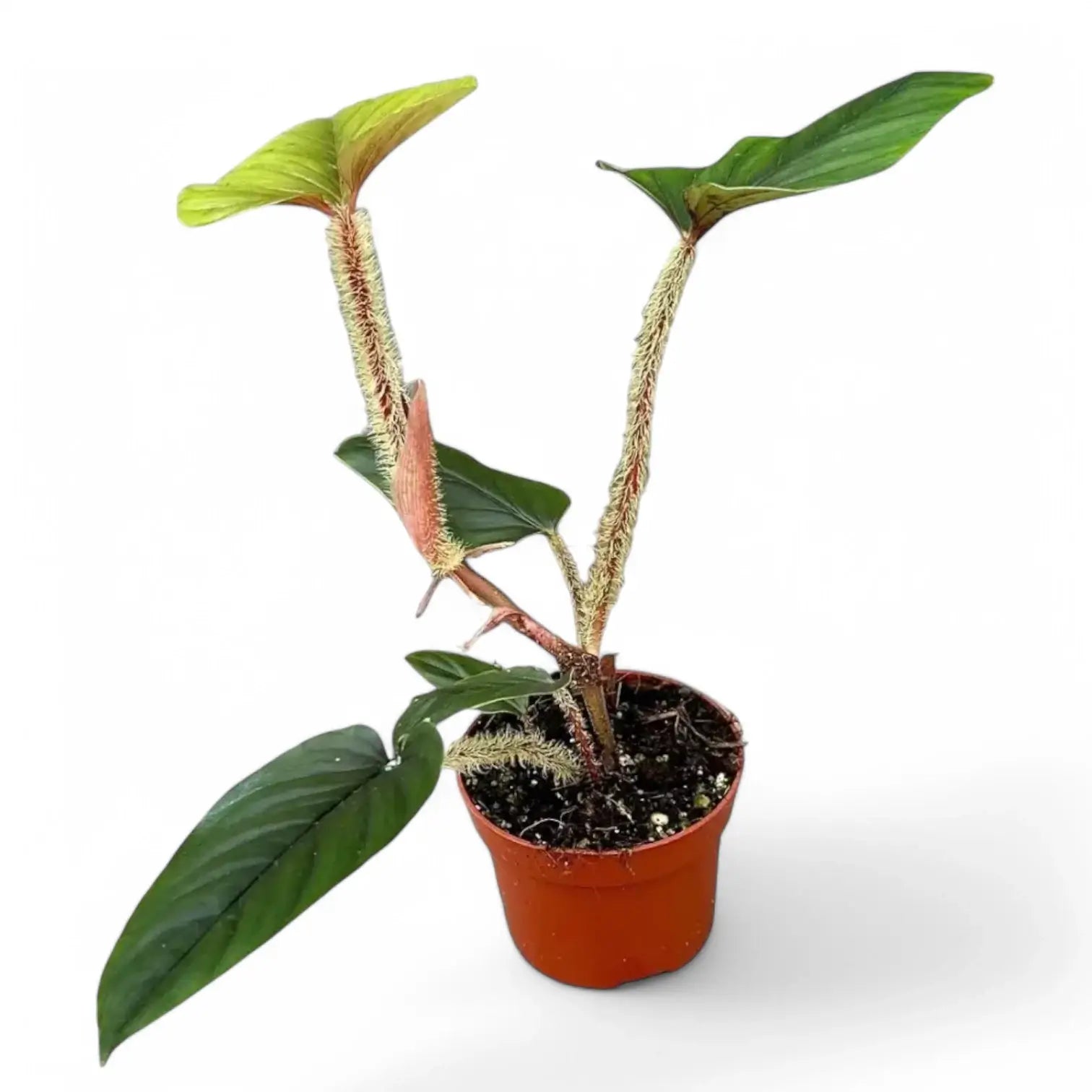
SKU: 76318433883
hairy stem philodendron

hairy stem philodendron Philodendron serpens – Hairy Stems & Glossy Hearts

Sale price$19.92 Regular price$22.13
Save 10%

Pay in installments of $5.53 with ShopPay, AfterPay and Klarna

Shipping Estimate
USA
  • USA
  • CAN

Ships within 48 hours · Estimated delivery Jul 24 - Jul 29

Promo Codes Available:

For Your Every Summer RSVP, with Code: SUMMER15

Description

hairy stem philodendron Philodendron serpens – Hairy Stems & Glossy HeartsPhilodendron serpens Hook. f. rare hairy petiole Philodendron from the Andes Philodendron serpens is a hemiepiphytic climber native to the premontane and lower montane forests of the Andes in Colombia (Nario) and Ecuador (Carchi, Pichincha, Pastaza). Described in 1871 by Joseph Dalton Hooker, it is instantly recognisable by its cordate green leaves and petioles densely covered in short, recurved hairs. In habitat it climbs mossy trunks in humid,

Philodendron serpens Hook.f. – rare hairy-petiole Philodendron from the Andes

Philodendron serpens is a hemiepiphytic climber native to the premontane and lower montane forests of the Andes in Colombia (Nariño) and Ecuador (Carchi, Pichincha, Pastaza). Described in 1871 by Joseph Dalton Hooker, it is instantly recognisable by its cordate green leaves and petioles densely covered in short, recurved hairs. In habitat it climbs mossy trunks in humid, shaded understories between 500 and 1 500 m elevation, a setting that informs its care in cultivation.

Foliage and growth highlights

  • Blades: Cordate to broadly cordate leaves, 30 – 45 cm long, 14 – 18 cm wide, leathery yet flexible, with a cordate base and acuminate tip.
  • Petioles: Covered with dense retrorse trichomes (short, backward-curving hairs) that create a tactile, “serpent-like” texture.
  • Growth habit: Scandent climber; produces aerial roots for anchorage and benefits from textured vertical supports.

Juvenile to mature development

Juvenile foliage is smaller, softer, and smoother. As the plant matures and gains height on a pole, blades broaden, texture deepens, and petiole hairs become denser. Appressed contact at each node improves hydraulic efficiency, encouraging larger leaves and maintaining petiole hair density.

Native range and ecology

  • Distribution: Andes of southern Colombia (Nariño) and northern to central Ecuador (Carchi, Pichincha, Pastaza)
  • Elevation: ~500 – 1 500 m above sea level
  • Habitat: Premontane wet forest and cloud forest edges; shaded, mossy slopes with constant humidity and organic-rich substrates

Care essentials for thriving Philodendron serpens

  • Light: Bright, indirect light for compact growth and strong leaf colour; avoid prolonged direct sun.
  • Water: Keep the mix evenly moist; let the top 2 – 3 cm dry before rewatering. Always ensure free drainage.
  • Humidity: ≥70 % RH is ideal; excels in plant cabinets, terrariums, or enclosed high-humidity displays with airflow.
  • Temperature: Optimal 18 – 29 °C; avoid drops below 13 °C or heat above 32 °C.
  • Substrate: Airy aroid blend (~35 % coco coir, 30 % fine orchid bark, 20 % perlite, 10 % compost, 5 % horticultural charcoal).
  • Feeding: Balanced liquid fertiliser at 25 – 50 % label rate every 4 – 6 weeks during active growth.
  • Support: Moss or fibre pole; secure the stem at each node to encourage appressed climbing and larger foliage.

Propagation and alternative culture

  • Stem cuttings: Take one-node cuttings below an aerial root; root in moist sphagnum, water, or semi-hydro.
  • Air layering: Useful for larger, established stems to maintain vigour.
  • Semi-hydro: Adaptable with gradual transition; maintain steady nutrient solution and good root aeration.

Inflorescence

Produces a green spathe enclosing a pale green to white spadix. Flowering is rare in cultivation and mainly of botanical interest; foliage and petiole features are the primary ornamental appeal.

Common issues and targeted solutions

  • Pests: Monitor for thrips, spider mites, and mealybugs; treat early with insecticidal soap, neem oil, or horticultural oils.
  • Yellowing leaves: Often from overwatering or poor drainage; adjust watering and refresh mix.
  • Browning tips: Low humidity; raise RH and keep watering consistent.
  • Drooping: Underwatering or temperature stress; correct promptly.
  • Stunted growth: Increase light, ensure nutrient supply, and check for root congestion.

Conservation note

Not currently assessed by the IUCN, but its natural habitat is fragmented by land-use change. Ethical sourcing from cultivated stock supports both horticulture and wild populations.

Order Philodendron serpens

Add Philodendron serpens to your high-humidity collection for its lush cordate leaves and rare, tactile petioles. With filtered light, consistent moisture, and vertical training, it becomes a living showcase of Andean rainforest character.

Shipping Notes
  • Free Standard Shipping on $100+ Orders to the USA.
  • Except Preorder products are shipped in 48 hours.
  • Delivery to the USA:
  1. Standard Shipping : 3-10 business days
  • If time is of the essence, please consider selecting expedited delivery for faster service.
Exchange/Return Notes
  • We offer a 30-day return/exchange service after receiving.
  • Final sale items are not eligible for returns or exchanges.
  • To process your return/exchange, please contact us at [email protected]
  • Please click here for more details>>> Return & Exchange Policy
SKU: 76318433883

Discover Niche Categories That Outsell hairy stem philodendron

Top-Converting Item to Boost Your Average Order

4.7 ★★★★★
Based on 25 reviews
Sort
Highest Rating
Newest First
Oldest First
Product Reviews
K
Verified Purchase
Kevin M. Frad
Battle Creek, US
★★★★★ 5
Micro Ingredients Organic Matcha makes a good anytime tea.
Size: 32 Ounce (Pack of 1)
Micro Ingredients Organic Matcha Green Tea Powder delivers exactly what it promises: a clean, earthy, first-harvest matcha that balances approachability with authenticity. It’s a versatile and surprisingly smooth everyday matcha. The flavor leans toward earthy, grassy, and mildly nutty, with a gentle bitterness that feels natural rather than harsh.
WAS THIS REVIEW HELPFUL?YesReportShare
Reviewed in the United States on April 3, 2026
R
Verified Purchase
Robert haney
Port Orchard, US
★★★★★ 5
Great. Just as good as fancy stuff But dose not pair with peppermint.
Size: 16 Ounce (Pack of 1)
If you're making Macha lattes or mixing the match with anything, this is perfect! No need to buy the expensive ceremonial level stuff unless you're drinking ONLY Macha. This is honestly perfect for everything. Mix 2 of its provided spoonfuls with 1/2 cup of kettle hot water and stir, maybe even add more matcha until a bit thick, pour over a glass full of ice (should fill half the glass if full of ice) as the last half as milk with a pump of your favorite syrup. Mine is strawberry, my gf's is Vanilla. Peppermint was not good, though fyi.
WAS THIS REVIEW HELPFUL?YesReportShare
Reviewed in the United States on June 1, 2026
R
Verified Purchase
Ronald DiMaggio
Lowell, US
★★★★★ 4
Makes It Green; Doesn't Taste as Clean
Size: 16 Ounce (Pack of 1)
It is matcha. It makes things green. For all intents and purposes, this is enough for the typical matcha user. For those with a bit of an upturned nose to anything that's "inferior" to matcha, then this is not for you. By taste, this product is not as good on the tastebuds as, say, Jade Leaf. It doesn't do matcha justice and, in my opinion, does not mix that well when making lattes. In terms of color, this one is also paling in comparison when by itself, but when added to other things as a flavoring agent or colorant, then it does the job as well as it can. I am not saying this matcha is bad at all. I think if it comes down to drinking, save your money and get some Jade Leaf or equivalent ceremonial grade matcha. You WILL taste the difference. Now if you're going to be making a lot of baked goods or cooked goods? This wouldn't be that bad—you don't want an overbearing matcha taste anyway and the shade of green this produces is not THAT bad.
WAS THIS REVIEW HELPFUL?YesReportShare
Reviewed in the United States on October 19, 2025
B
Verified Purchase
Bill Pinches
Port Orchard, US
★★★★★ 5
Contemporary translation of a set of Christian classics
Format: Hardcover
How did the New Testament come to be formed? What books were left out? What did some of those books say? These are some of the questions on the minds of many curious people today. Too often, local congregations ignore these questions, to the detriment of the church. But these questions about Christian origins are very, very real in the hearts and minds of many people today. Now, from one of the most significant writers about Christian origins today comes a completely new edition of the Apostolic Fathers -- the letters of Clement, the letters of Ignatius, the letter of Polycarp, the Martyrdom of Polycarp, the Didache, the Epistle of Barnabas, the fragments of Papias and Quadratus, the Epistle to Diognetus, and the Shepherd of Hermas. These were early Christian writings that are generally attributed to church leaders of the late first and early second centuries CE (and, in most cases, are probably authentic). Clement, for example, was an early leader in Rome (circa 96 CE); Ignatius wrote a number of letters to churches in various cities (circa 110 CE), sort of following in the footsteps of Paul. This two-volume set replaces the classic edition of the Apostolic Fathers in the Loeb Classical Library edited by Kirsopp Lake nearly a century ago. As with all books in the Loeb Classical Library, the original (in this case, Greek) text is presented on the left-hand pages, and an English translation is presented on the right. The text is extremely readable, and the introductions to each of the books are clear, succinct, and to the point. Some of these books almost made it into the New Testament! The epistles of Clement are found in some early New Testament manuscripts and were widely read in the early churches. The Shepherd of Hermas may have been the most widely read book by early Christians. Several of these books were probably written before some of books in the New Testament. In an age in which people are asking questions about the origins of Christianity and the authority of the scriptures, it is crucial that we have at least a basic understanding of our early history. In my mind, a decent familiarity with the Apostolic Fathers -- as well as the Dead Sea Scrolls and the Nag Hammadi library -- is essential. This two-volume set is extremely valuable. Ehrman's critical textual work, his contemporary translations, and his up-to-date introductions are a welcome addition to current literature. The trained scholar will delight in having a new critical edition of the Greek text . . . but an ordinary lay reader could also profit tremendously from reading some of these early Christian writings that were not deemed to be sufficiently close to the first generation of apostles to make the cut into the New Testament.
WAS THIS REVIEW HELPFUL?YesReportShare
Reviewed in the United States on August 12, 2006
A
Verified Purchase
Anne
Lowell, US
★★★★★ 5
Great stuff!
Format: Hardcover
Hey evangelicals get off your butts,(or sit down on your butts) and read the fathers of the church you're supposed to be a part of. Great stuff!
WAS THIS REVIEW HELPFUL?YesReportShare
Reviewed in the United States on September 5, 2015

recommand products