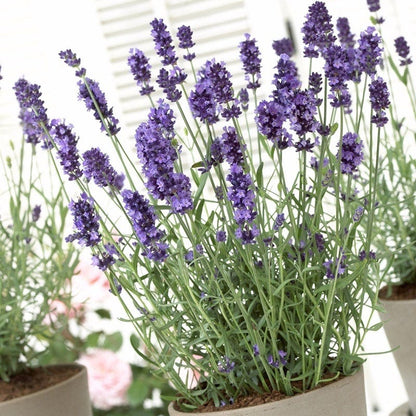
SKU: 76397504259
english lavender plant in pot

english lavender plant in pot Hidcote English Lavender, Lavandula

Sale price$18.89 Regular price$20.99
Save 10%

Pay in installments of $5.25 with ShopPay, AfterPay and Klarna

Shipping Estimate
USA
  • USA
  • CAN

Ships within 48 hours · Estimated delivery Sep 10 - Sep 15

Promo Codes Available:

For Your Every Summer RSVP, with Code: SUMMER15

Description

english lavender plant in pot Hidcote English Lavender, Lavandula18 24" tall x 18 24" wide. 'Hidcote' Lavender is a standout English variety known for its strong fragrance and winter hardiness. Gardeners growing lavender at the northernmost edges of its range can plant 'Hidcote' for its improved ability to survive winter and reappear the following spring. Tall, purple blue flower spikes add visual interest to garden borders, walkways, and rock gardens, and also make this lavender a great choice for mass plantings

18-24" tall x 18-24" wide. 'Hidcote' Lavender is a standout English variety known for its strong fragrance and winter hardiness. Gardeners growing lavender at the northernmost edges of its range can plant 'Hidcote' for its improved ability to survive winter and reappear the following spring. Tall, purple-blue flower spikes add visual interest to garden borders, walkways, and rock gardens, and also make this lavender a great choice for mass plantings - expect to attract a lot of pollinators wherever you plant it! 'Hidcote' has a notably-high essential oil content and is often used for making soap, potpourris, sachets and dried floral arrangements. Also a great choice for culinary uses.

---------------

Success with Lavender:

Originating in the Mediterranean, lavender prefers hot sunny days, dry air, and non-enriched, well-drained soil. While that’s great news for those gardening in the West, nowadays lavender can also be successfully grown in higher-humidity areas of the East and Pacific Northwest very successfully by remembering its basic needs. Be sure to pick a variety that is matched to your area. Depending upon your location and your desired use, there are lavenders for almost any setting. Next, follow the four basic elements to ensure lavender success:

1. SUN Lavender loves sun. Plant them in a sunny location where there is plenty of air circulation. Six to eight hours of sun is best, but some afternoon shade is fine in the hotter climates of the Southwest.

2. AIR Good air circulation is essential, especially in areas of high humidity. Lavender is not fond of damp, still air, which makes it prone to root rot. In humid areas, plant them with ample spacing, keeping in mind the mature size of your plant when in bloom and allowing for a bit extra space for good circulation.

3. SOIL Well-drained soil. This is perhaps the most important factor in success with lavender. One rule of thumb from is that the soil should be loose enough to dig with your hands, and not cake-like. You can add sand or small gravel to recreate this consistency if your soil is too compact. In areas where drainage may be a problem, mound the soil up to create a raised row or stand-alone mound.

In humid areas especially, a 1-2” mulch of pea sized gravel or white sand will do two things – it will help improve drainage, and it will reflect heat and light back up into the plant. More heat = more fragrant blooms! If you use a weed barrier, make sure it is breathable so the soil can drain and the roots can breathe. Gardeners struggling with growing lavender successfully in humid areas are encouraged to try planting Lavender Phenomenal.

4. WATER During the first year of your lavender’s growth it needs to establish a good root system. It will require regular watering (unless you’re experiencing healthy rain fall). Starting in the second year, your lavender will need less water, as it becomes the water-thrifty plant you’re hoping for, but to get there it needs to grow deep roots in year one. By the end of year three it will have reached its mature size and shouldn’t need any extra water. If water is needed, water in the morning, and deeply, to help root growth. A mature lavender plant is happy with only 9-12 inches of rain per year, but remember, with the right variety and good drainage lavender can thrive with more water.

Learn How to Grow Lavender in Detail.

Shipping Notes
  • Free Standard Shipping on $100+ Orders to the USA.
  • Except Preorder products are shipped in 48 hours.
  • Delivery to the USA:
  1. Standard Shipping : 3-10 business days
  • If time is of the essence, please consider selecting expedited delivery for faster service.
Exchange/Return Notes
  • We offer a 30-day return/exchange service after receiving.
  • Final sale items are not eligible for returns or exchanges.
  • To process your return/exchange, please contact us at [email protected]
  • Please click here for more details>>> Return & Exchange Policy
SKU: 76397504259

Discover Niche Categories That Outsell english lavender plant in pot

Top-Converting Item to Boost Your Average Order

4.5 ★★★★★
Based on 30 reviews
Sort
Highest Rating
Newest First
Oldest First
Product Reviews
J
Verified Purchase
Julie Lowe
Bozeman, US
★★★★★ 5
Their is one God and he loves you!
Format: Hardcover, Format: Hardcover
This is a great translation of the Septuagint translated from Greek to English. A great buy for anyone wanting to read , study or gain more understanding of the Bible.
WAS THIS REVIEW HELPFUL?YesReportShare
Reviewed in the United States on October 11, 2025
P
Verified Purchase
Paul Stevenson
Lowell, US
★★★★★ 5
A careful, scholarly work
Format: Hardcover
The introduction to this book does a great job of laying out the challenges of translating an ancient translation. It is not, however, aimed at people without a significant background in Hebrew, Greek and translation theory. I give credit to the authors of the introduction, Albert Pietersma and Benjamin G. Wright, for specifying the nature of the translation and its audience. Taken from Nida and Taber, _The Theory and Practice of Translation_ (Leiden: Brill, 1982), p. 31: "a translation in the present-day literary language, so as to communicate to the well-educated constituency." The translators chose this group "on the assumption that it is most probably this audience that has a more than passing interest in traditions of biblical literature other than their own" (p. xiv). I think they are right about this. "Translating an ancient text can only be described as a profoundly difficult undertaking.... "The difficulties of the undertaking are certainly not decreased when one attempts to translate an ancient translation into a modern language. If translating is an act of interpreting, as linguists suggest it is, rather than a simple transfer of meaning, a Greek interpretation of a Hebrew original can be expected to reflect what the translator understood the Hebrew text to mean. The end result is therefore inevitably to some degree a commentary written at a specific historical time and place by an individual person, whose understanding of the Hebrew will often have been at variance with our own, though at times perhaps equally viable." (p. xvi) Indeed, back when I was a linguist- and translator-in-training at the Summer Institute of Linguistics (early 1980s), I was taught the rather simplistic model of translation as a mere transfer of meaning. Experience, though, has taught me that this is virtually impossible. A text of any level of sophistication above that of a stop sign is full of cultural assumptions, lexical polysemy, syntactic ambiguity, and so forth. Any translation is perforce an interpretation. The only way to even begin to compensate for this, if the readers of the translations are not scholars trained in the relevant fields, is to include a massive set of footnotes. The average reader is just not going to take the time to read such a set of notes, even if they are included. The majority of traditional religious readers of a Bible translation are not prepared to deal with the challenges that such footnotes would present to their existing understanding of the text. The New English Translation of the Septuagint is aimed at those who already have at least some of the relevant scholarly background and are not averse to acquiring more.
WAS THIS REVIEW HELPFUL?YesReportShare
Reviewed in the United States on February 8, 2019
K
Verified Purchase
Kim
West Palm Beach, US
★★★★★ 5
Best Bible Ever!
Format: Leather Bound
This Bible is my new favorite. The leather is so soft. Best purchase , best Bible
WAS THIS REVIEW HELPFUL?YesReportShare
Reviewed in the United States on April 24, 2026
T
Verified Purchase
Todd Heminger
Los Angeles, US
★★★★★ 5
Great size.
Format: Leather Bound
We bought this for our son in college. He loves the size. He brings it to church and studies from it at school. Great Bible. He enjoys taking notes in it.
WAS THIS REVIEW HELPFUL?YesReportShare
Reviewed in the United States on December 1, 2024
A
Amanda Jackson
Lexington, US
★★★★★ 4
Pages are a little thin but nice Bible.
Format: Leather Bound
This Bible is a great option for someone with good eyesight, as the print is on the smaller side. I personally prefer larger print, but the smaller text does make it more compact and convenient to carry. I got this for my daughter in college, and it’s perfect for her since she likes to take notes during sermons. The leather cover is very nice and adds a quality feel. I do wish the pages were a bit thicker, as there is some show-through from writing on the other side—something to keep in mind for a journaling Bible. Overall, it’s a nice, basic option for jotting down notes and reflections.
WAS THIS REVIEW HELPFUL?YesReportShare
Reviewed in the United States on March 31, 2026

recommand products