SKU: 77059805863
succulent that looks like pencil cactus

succulent that looks like pencil cactus Pencil Cactus

Sale price$23.71 Regular price$26.34
Save 10%

Pay in installments of $6.58 with ShopPay, AfterPay and Klarna

Shipping Estimate
USA
  • USA
  • CAN

Ships within 48 hours · Estimated delivery Oct 19 - Oct 24

Promo Codes Available:

For Your Every Summer RSVP, with Code: SUMMER15

Description

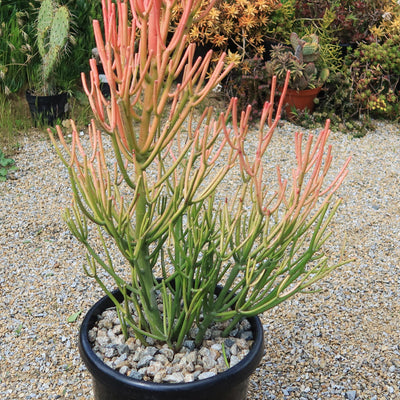
succulent that looks like pencil cactus Pencil CactusIntroducing the Pencil Cactus, botanically known as Euphorbia tirucalli Fire Sticks (also called Sticks on Fire), a striking succulent prized for its sea coral like appearance and vibrant, loosely branching pencil thin stems that develop brilliant shades of green, orange, and red. Native to Southern Africa, this unique succulent belongs to the Euphorbiaceae (spurge) family, not the cactus family (Cactaceae), though it is commonly referred to as Pencil

Introducing the Pencil Cactus, botanically known as Euphorbia tirucalli ‘Fire Sticks’ (also called Sticks on Fire), a striking succulent prized for its sea coral-like appearance and vibrant, loosely branching pencil-thin stems that develop brilliant shades of green, orange, and red.

Native to Southern Africa, this unique succulent belongs to the Euphorbiaceae (spurge) family, not the cactus family (Cactaceae), though it is commonly referred to as “Pencil Cactus” because of its cactus-like form and upright growth habit. It is also known by several other common names, including fire sticks plant, sticks on fire succulent, fire plant, red pencil tree, milk bush, and Euphorbia tirucalli ‘Rosea’.


When exposed to direct sunlight, the tips turn red, which is why they are also called firesticks.

This fast growing evergreen succulent can grow up to 30 feet tall and 10 feet wide, forming a thicket of brilliantly colored vertical stems with loose branches.

The unusual stems of this firestick plant, which are as thin as pencils, have a reddish-golden hue that becomes yellow in the summer and red again in the winter.

The pencil cactus flowers boast vibrant yellow, pink, or orange blooms in the summer and spring, making them a true showstopper in any garden.

The pencil cactus is extremely drought tolerant and hard to kill, and as a result, is a great, low-maintenance, easy-care plant for your home or garden.

You can grow your pencil cactus indoors year-round as a houseplant. If planting outdoors, it's best to do so in the spring when temperatures are warm and stable. This cactus grows faster than many other cacti, making it a striking addition to your garden or home.

If you cut your pencil cactus, be careful—the thick, white sap is toxic and can cause skin irritation, burns, or severe eye irritation if it gets into your eyes. While highly irritating, some cultures have historically used it in traditional medicine for treating growths like warts and tumors, though it is not safe for home remedies. Always wear gloves when handling the plant and wash your hands thoroughly if you come into contact with the sap.

When and How to Water Your Pencil Cactus 

This pencil cactus firestick plant can withstand droughts and doesn't need to be watered frequently to survive. Watering these perennial succulents should be done every 3–4 weeks or when the soil feels dry. Let the soil completely dry out between waterings, and if in doubt, give your fire plant a little more time before watering again.  Less water is needed for humid locations and indoor spaces. Pay attention to how the pencil cactus looks and adjust the watering accordingly.

Remember that succulents in the desert can go for weeks or even months without water, so water them sparingly during their rest phase and moderately during their active growing season.

Pro Tip

Most people like to see the red tips that give this Euphorbia tirucalli its firestick name. Note that it is stress that causes the tips to go red. So, the art is to stress the firestick plant a bit, but not too much. So, give it a lot of light and water it less than other succulents, so it is thirsty but not dying of thirst.

Overwatering can also cause the Euphorbia tirucalli 'Firesticks' tips to turn red, but it can also lead to root rot and other problems. So, if your pencil cactus is not turning red in full sun, it's possible that it's not experiencing enough stress to produce the anthocyanin pigments or that it's receiving too much water.

Light Requirements - Where to Place Your Pencil Cactus 

Like most succulents, indoors, the Euphorbia tirucalli firesticks need bright, indirect sunlight to thrive, so choose the brightest area in the house.

Potted indoor pencil cacti require four hours of direct sunlight, which can be achieved by locating them on a sunny south or west-facing windowsill. 

If you are growing these firestick succulents outdoors, make sure that they receive at least six hours of direct sunlight per day.

Partial shade may be tolerated as long as your pencil cactus gets the majority of the sunlight that it needs when it's planted outside. This succulent plant won't thrive if left in the shade for a long time. Its colors become more vibrant the more sunlight it receives.

In order to avoid sunburn, it is preferable to acclimatize your pencil cactus first before moving it outdoors or increasing the amount of sunlight it receives.

Optimal Soil & Fertilizer Needs 

The firestick Euphorbia is a succulent plant that likes very airy, porous, nutrient-rich soil with a pH of 5.5–6.5. Succulents require fast-draining soil that dries completely between waterings. Ideally, you want to use our specialized potting mixGo to soil cactus mix blend 1 gal 4 qt cacti succulent dirt compost growing media that contains 5 natural substrates and organic mycorrhizae to promote the development of a strong root system that helps your Euphorbia firesticks Pencil Cactus to thrive. 

When it comes to fertilizing your pencil cactus plant, it only needs a small amount of fertilizer applied once a year in spring. Cacti prefer a fertilizer with lower doses of NPK, with a maximum ratio of 5-10-5 that is higher in phosphorus than nitrogen.

Hardiness Zones & More 

When growing indoors as a houseplant, the Euphorbia firestick can tolerate temperatures between 65 °F and 75 °F. Your Euphorbia firestick plant performs well in temperatures above 30 °F. However, it can withstand temperatures below that, but only for short periods of time.

In the United States, the Euphorbia tirucalli is mostly an indoor plant, but if you live in southern Florida or Hawaii then you can cultivate it outdoors in USDA zones 10 -11.

Growing these pencil cacti in containers is the best option if you live in an area with harsh winters.

By doing this, you can bring your Pencil Cactus indoors during the winter or any time there's a chance of frost or snow. Normal house humidity is fine for this Euphorbia, but it prefers dry conditions. 

Wildlife - Euphorbia tirucalli Attracts the Following Friendly Pollinators

The Euphorbia tirucalli flowers attract a variety of pollinators, such as bees, butterflies, and hummingbirds, with their bright colors and sweet nectar. These pollinators play a crucial role in the ecosystem by helping to fertilize plants and promote biodiversity.

Butterflies
Bees
Hummingbirds
Lady Bugs
Multi Pollinators
Other Birds

According to ASPCA, the Euphorbia tirucalli 'Firesticks' is mildly toxic to humans and pets. It can irritate the skin, eyes, and gastrointestinal tract. However, it is safe to touch as long as precautions are taken to avoid contact with the sap. Wear gloves when handling this plant to prevent any potential skin irritation.

How to Propagate Your Pencil Cactus

When it comes to pencil cactus propagation, one common method is through stem cuttings. Simply take a cutting from a healthy pencil cactus, let it dry for a few days, and then place it in well-draining soil. Another method is through division, where you carefully separate the offsets or side shoots from the main plant and plant them individually.

Key Takeaways

  1. The stems of firesticks are as thin as pencils (hence the name) and turn a fire-red in the winter.
  2. Euphorbia Firesticks is a stunning variety that changes color with the seasons, turning bright red or orange tips in cooler temperatures or full sun.
  3. This succulent has a rapid growth rate, reaching up to 30 feet tall when grown outdoors, with a branching, upright form.
  4. During the spring and summer, the yellow flowers bloom in clusters on the end of the branch, usually for just a few days.

The Bottom Line

Overall, the pencil cactus (Euphorbia Firesticks) is a unique and striking succulent plant that adds a touch of elegance to any space. With its slender, pencil-like stems and vibrant green color, this sticks-on-fire cactus can truly be a showstopper. However, it's important to remember that the pencil cactus is not a true cactus but rather a succulent. It requires minimal care, preferring bright light and well-draining soil. By providing proper pencil cactus care, you'll have a beautiful and unique Euphorbia firestick plant that will thrive for years to come. 

Shipping Notes
  • Free Standard Shipping on $100+ Orders to the USA.
  • Except Preorder products are shipped in 48 hours.
  • Delivery to the USA:
  1. Standard Shipping : 3-10 business days
  • If time is of the essence, please consider selecting expedited delivery for faster service.
Exchange/Return Notes
  • We offer a 30-day return/exchange service after receiving.
  • Final sale items are not eligible for returns or exchanges.
  • To process your return/exchange, please contact us at [email protected]
  • Please click here for more details>>> Return & Exchange Policy
SKU: 77059805863

Discover Niche Categories That Outsell succulent that looks like pencil cactus

Top-Converting Item to Boost Your Average Order

4.3 ★★★★★
Based on 17 reviews
Sort
Highest Rating
Newest First
Oldest First
Product Reviews
S
Verified Purchase
Subaroo
Port Orchard, US
★★★★★ 3
Lots of complaints, but I still enjoyed it.
Format: Paperback
This is my very first graphic novel of any sort, so this is my intro to the medium. The quality of the book is nice and each page is in full color. Other reviewers have said that the artwork is hastily done, I am not experienced enough with graphic novels to know, but I enjoyed the pictures nonetheless. The "story" follows a British soldier and his journey from 1914 to the end of the war. It is a Forrest Gump adventure in which the character was either there, or he was almost there, or he mentions a significant event and how it affected him. As a result, the book does not flow at all. One page you are in France, then the Middle East, then Russia. And the scenes on each page lack a lot of dialoug and are disjointed in the action sequences. Also, some of the images are duplicated (sometimes even on the same page), and I found more than a few typos (missing commas and "here" instead of "hear"). Like I said, I haven't read any other graphic novels, but this looks like low quality work because I can tell the "BLAM"s and "BANG"s, and the speech bubbles are added via computer. They stand out from the page and takes away from the immersion. I don't know if all comics do this, but I hope not. I would have expected more information about the war since the "story" was so poor, but it was just a gereral overview. I think the best part was the beginning with the assassination of Ferdinand. I had high hopes after that but the rest was kinda meh. I read it twice. So even with all my issues, it wasn't that bad. I'm planning on buying the WW2 ones as well.
WAS THIS REVIEW HELPFUL?YesReportShare
Reviewed in the United States on May 20, 2016
D
Verified Purchase
D. Ryan
Grantham, US
★★★★★ 5
An insightful concise book by Vansant
Format: Paperback
In this NORMANDY 102-page full-color trade, in 15 chapters of 6 to 10 pages each, Vansant covers various chronological aspects of the Normandy invasion, from U.S. entry into the war in Europe, up through planning and execution of "Operation Overlord", the final Normandy seige with gliders, paratroopers, air combat and the beach invasions, the liberation of Paris from the Nazis, up through August 1944. Vansant's NORMANDY is remarkably informative for such a concise volume. And its attention to detail in accurately illustrating uniforms, tanks and planes is greatly appreciated. My one complaint is the 6" by 9" size of the book. I would have preferred a standard 7" X 10" size trade, that is the standard for comic book trade collections. It is a sturdy book with a tight binding, and a slightly larger size would make the book to be less difficult to pry open, and the art easier to appreciate in a larger size. I also wish Vansant had included more panels of maps, detailing the movements of troops at points througout the vast scope of what is described in NORMANDY. Vansant's work is worth seeking out, in its accurate portrayal of various battles throughout history, from the Nazi battles, to the Civil War, to the Pacific War. And as far as I know, Vansant got his start illustrating the Vietnam war in Marvel's THE 'NAM for several years, back in the mid/late 1980's. And two other World War II stories in SAVAGE TALES (1987) issues 7("Tiger Tiger", about a Panzer tank fighting in Russia) and 8 ("Chindits", about British jungle fighters in Burma in 1944). Vansant's newer work is slightly rougher than his 80's/90's work, but still very precise and detailed. I'd compare his work to that of Sam Glanzman, Gray Morrow, John Severin and Michael Golden. And it's great to see a comics illustrator drawing war stories that makes an effort to tell a story with more than just a riproaring action story, but one where you walk away with factual information about actual combat. Chapter 14 ,"The Killing Ground", hit me especially hard in portraying the bloodbath horrors of war. I wouldn't want to be one of the Nazis in that bombarded field of 10,000 bodies. I previously purchased BATTLE GROUP PEIPER by Vansant(1991) , which despite being in black-and-white and a shorter 32-page historical comic book, was in some ways more interesting to me than NORMANDY, because it followed one Waffen SS commander (Peiper) through the weeks of Battle of the Bulge. (Peiper is breifly mentioned in the NORMANDY book, although "Battle of the Bulge" events in BATTLE GROUP PEIPER occur after the events depicted in NORMANDY.) The only other weakness (unlike the 1991 separate 32-page BATTLE GROUP PEIPER story I mentioned above) is that in the scope of the 102-page NORMANDY book it focuses on an overview narrative, rather than spending any length of time on any one soldier or commander, and is therefore less personal than BATTLE GROUP PEIPER is. And is more of an overview synopsis. But still loaded with compelling and informative history.
WAS THIS REVIEW HELPFUL?YesReportShare
Reviewed in the United States on August 29, 2013
P
Verified Purchase
Pvt. W. G. Kirby Amazon Customer
New York, US
★★★★★ 5
The "comic book" of my youth grows up.
Format: Paperback
Hey, you've got to love these new "Graphic Novels" of the present day. Way back in the day of he 1950s and 60s, I used to scoop up change wherever it was left laying about( no, not service tips and I didn't steal from my family or friends, but I always saved the change and kept it when it was ok...) I could go to the news stand and for a dime or less, all of the DC comic heroes were mine...and Sgt. Rock, the Haunted Tank, Gunner and Sarge( BUDDA- BUDDA) , were all mine too. Art work was great, stories good to....to a kid and it seem to more than a few adults too. I remember the shock when the costs went to 12 cents...then to 15 cents...then girls and life came along and the comics stayed in boxes in the basement. But the comic book survived. Now they are larger, better printed, perfectly bound with stiffer covers...and a bit more costly..but worth it. And there's a myriad of novels to select from. So I'm collecting comics again, it seems. And the term " comics" does not apply any longer, if it did back in the day! No comedy in these stories told now..."graphic" is a better description...but not lurid or extreme as the old " pre- code comics" were. This graphic novel is the story of the Allied forces and their endeavors from June 5 through early August 1944, the Normandy Campaign. It's in full color and GRAPHIC detail of the carnage faced by the line soldiers of both sides in battle. Historically it's right on the button for dates, locations, quotations, etc. Equipment is shown correctly in version, color and useage. The historical events are explained so that anyone of any age who can read will learn and be entertained. Bach in my day ( here we go again), there was a series on comics of this same nature put out by Dell Publishing on WWII historical events. Detail, color, etc. just as we have in this modern publication, but in a smaller size. The Bataan Death March, Pearl Harbor, John Kennedy and PT-109 , and so on we're a few of those topics..boy, I wish Mom hadn't cleaned out the box I had of those... I even recall the artist who illustrated most of those comics, a Navy destroyer veteran named Sam Glanszman. The illustrators of this book are in the same league as Sam! Don't miss this one. If more military history is to be done in this format, they've got my pocket change !
WAS THIS REVIEW HELPFUL?YesReportShare
Reviewed in the United States on July 20, 2013
J
Verified Purchase
Joseph J. Truncale
Alexandria, US
★★★★★ 5
An interesting and detailed graphic novel that tells the story of the Normandy invasion.
Format: Paperback
One of the most important battles of World War 11 was D-Day. This excellent illustrated graphic novel covers the Normandy invasion in more detail than I expected. The main generals and other important figures are mentioned in this book. The decisions that were made which turned the battle for the Allied forces are explained, as well as Hitler's mistake of not listening to his Generals makes this book a great read. The book is organized into fifteen chapters. They are as follows: Chapter (1) Second Front Now. (2) How peaceful the land looked. (3) Hitting the beaches. (4) Blooding Omaha. (5) The skin of their teeth. ((6) The tigers of Villers-Bocage. (7) Death in the Hedgerows. (8) The devil's children. (9) The capital of ruins. (10) Blood and thunder. (11) The cobra strikes. (12) "Come and get us!" (13) Third army rampage. (14) The killing ground. (15) :Aux barricades!" In conclusion, this beautifully illustrated graphic novel will be of interest to anyone who desires a brief overview of this important World War 11 battle, which was the turning point in the war. It may motivate readers to seek out more detailed information on the Normandy invasion. Rating: 5 Stars. Joseph J. Truncale (Author: Never Trust a Politician: A critical review of politics and politicians)
WAS THIS REVIEW HELPFUL?YesReportShare
Reviewed in the United States on October 18, 2013
M
Verified Purchase
M. Heiss
Los Angeles, US
★★★★★ 4
This one's in color
Format: Paperback
This book was glorious. It presented the invasion vividly. The Allied forces sure kicked Rommel's butt, and although the American forces had many casualties, the Germans were defeated. After the Allies liberated France, people revealed hidden Tri-Color French flags. I was interested to learn about the problem of French hedgerows and how an American sargent (Curtis Cullin) improvised a brush-cutter out of the beach barricades in order to leave the tanks less vulnerable as they crossed the fields. Thank you Curtis! The book also talked about a German tank commander named Michael Wittmann and his Tiger tank. This was a powerful weapon that destroyed a group of Shermans very quickly and then took out part of a convoy. The allies finished him off by using British Fireflies (a British type of tank) that sent a disabling shot into the tank. Michael Wittman and his crew escaped. There was good tank action in this book. It feels like you're stuck in the middle of battle, but you're safe. But you're watching in horror. The drawings of the Avro Lancasters were really great. That's my favorite British plane. The air war made the difference in the invasion's success. If it weren't for the RAF and the Allied air forces, the invasion might not have succeeded. I'm eleven years old, and this is a really good book. I learned a lot. This book had really good maps, and it was in color. That helped me a lot. The blood was not too bloody -- just scribbles. Parent note: my son says blood and guts included.
WAS THIS REVIEW HELPFUL?YesReportShare
Reviewed in the United States on February 6, 2014

recommand products