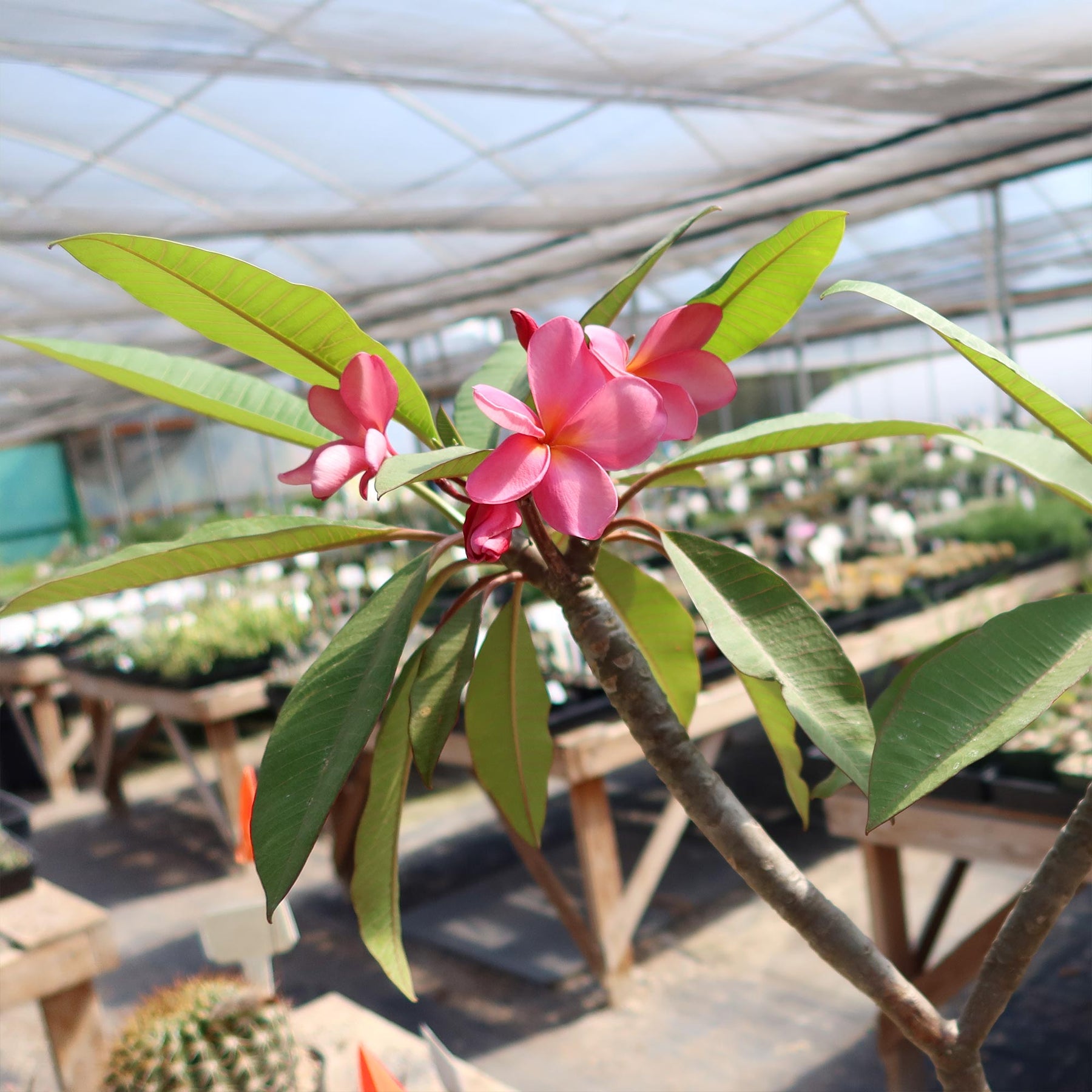
SKU: 77875571047
plumeria plant indoor or outdoor

plumeria plant indoor or outdoor Pink Frangipani

Sale price$23.62 Regular price$26.25
Save 10%

Pay in installments of $6.56 with ShopPay, AfterPay and Klarna

Shipping Estimate
USA
  • USA
  • CAN

Ships within 48 hours · Estimated delivery Sep 6 - Sep 11

Promo Codes Available:

For Your Every Summer RSVP, with Code: SUMMER15

Description

plumeria plant indoor or outdoor Pink FrangipaniThe Pink Frangipani, known as Plumeria rubra, is one of the most iconic tropical flowering trees, loved for its vibrant blooms and exotic fragrance. This plant has gained worldwide popularity as a symbol of paradise, often associated with tropical resorts, beaches, and exotic gardens. Its ability to thrive in warm climates and produce long lasting flowers makes it a favorite in landscapes, courtyards, and as a striking container plant. Beyond beauty,

The Pink Frangipani, known as Plumeria rubra, is one of the most iconic tropical flowering trees, loved for its vibrant blooms and exotic fragrance. This plant has gained worldwide popularity as a symbol of paradise, often associated with tropical resorts, beaches, and exotic gardens. Its ability to thrive in warm climates and produce long-lasting flowers makes it a favorite in landscapes, courtyards, and as a striking container plant. Beyond beauty, the tree has deep cultural importance in various regions, symbolizing immortality, love, and spirituality. 

This Plumeria plant, also known as Frangipani, Temple Tree, or simply Plumeria, has various cultural names. In Hawaii, the blossoms are popularly used to make leis, while in India and Southeast Asia, the flowers are considered sacred and are often planted near temples. Its wide range of cultural associations adds to its appeal, making it more than just a garden plant; it’s a living tradition. 

At maturity, the Pink Frangipani typically reaches 25 feet tall, with a spread of 20 feet.

Its moderate growth habit and spreading canopy make it suitable as both a focal specimen tree and a shade provider in gardens and landscapes. 

It can also be pruned and trained for smaller spaces or grown in large containers for patios.

The flowers are undoubtedly its most striking feature. Blooming in shades of pink, sometimes with yellow or white centers, the five-petaled flowers exude a sweet, exotic fragrance.

They typically appear from spring through fall, lasting for months, and are well-loved by pollinators. The flowers are waxy in texture, giving them durability even after being picked, which is why they are popular in leis and floral arrangements. 

A unique aspect of the Pink Frangipani is its symbolic and practical uses. In Hawaiian culture, the way a Plumeria flower is worn in the hair signifies relationship status: on the left ear for being taken and on the right for being available. In addition, the tree is drought-tolerant, thriving in arid conditions once established, which makes it both beautiful and resilient. Its combination of ornamental charm, cultural symbolism, and adaptability ensures it remains one of the most cherished tropical plants worldwide. 

When and How to Water Your Pink Plumeria 

Pink Plumeria Frangipani need regular watering during their active growing season, especially when in bloom. The Pink Plumeria prefers watering once every 7-10 days, needs very little water of about every 3–4 weeks, in its dormant season. 

From spring through summer, during the growing season, the Pink Plumeria needs a deep soak every 7–10 days, allowing the top 2–3 inches of soil to dry out between waterings. This keeps the roots hydrated enough to support active leaf growth and stunning flowers while preventing root rot. Consistent but not excessive watering will encourage healthy blooms and lush foliage. 

From fall through winter, in the dormant season, Pink Plumeria rubra requires only a light watering every 3–4 weeks, or not at all if grown outdoors in rainy climates. The plant naturally slows down growth and conserves energy, so overwatering during this time can harm the roots. Less is always better during dormancy. 

Light Requirements – Where to Place Your Frangipani Pink 

When growing indoors, Pink Plumeria rubra should be placed in the sunniest window available, ideally south-facing, where it can receive 6–8 hours of direct light.

If natural light is limited, supplement with a strong grow light to keep growth healthy and prevent legginess.

When grown outdoors, Pink Plumeria rubra thrives in full sun with 6–8 hours of direct light daily, making patios, gardens, and open yards the perfect spots.

Partial shade is tolerated in very hot climates, but full sun ensures the strongest blooms and most vibrant growth.

Optimal Soil & Fertilizer Needs 

The Pink Plumeria rubra grows best in well-draining soil, enriched with nutrients, and benefits from balanced fertilizer once a year in spring. Planting them in ordinary soil will result in compacted roots, stunted growth, and most likely root rot. Instead, make or buy a well-draining potting mix, or ideally, use our specialized potting mix, opens in a new tabGo to soil cactus mix blend 1 gal 4 qt cacti succulent dirt compost growing media that contains 5 natural substrates and mycorrhizae to promote the development of a strong root system that helps your pink Frangipani to thrive. 

For fertilizer, Pink Plumeria rubra benefits from a balanced NPK fertilizer once a year during the active growing season. Fertilizers high in phosphorus (middle number) support abundant flowering, while nitrogen-heavy blends should be avoided to prevent excess leafy growth. 

Hardiness Zones & More 

Pink Plumeria can be grown outdoors year-round in USDA zones 10-11, where winters are frost-free. 

In colder regions (most of the US), they are typically grown in containers and brought indoors during the winter. 

It thrives in full sun and dry climates but can tolerate humidity as long as soil drainage is excellent.  

In colder regions, plumerias should be moved indoors during the winter months when temperatures drop below 40°F.  

How to Grow the Best Plumeria Pink Indoors 

When growing indoors, the plant thrives in temperatures between 65–80°F with moderate humidity. Position it near a south- or west-facing window where it can receive at least 6 or more hours of direct sunlight daily, as insufficient light will limit flowering. 

If natural light is lacking, supplement with a grow light to encourage strong growth and vibrant blooms. Ensure there is good airflow around the plant, which helps prevent fungal issues and keeps the foliage healthy.

During the growing season, regular watering with the soak-and-dry method and balanced fertilization will support lush foliage and abundant flowers, while slightly reducing care in the dormant months allows the plant to rest. With the right balance of light, warmth, and care, Plumeria Pink can flourish indoors just as beautifully as it does outdoors. 

Wildlife Pink Plumeria Flowers Attract the Following Friendly Pollinators 

The Pink Plumeria rubra flowers attract pollinators like butterflies, bees, and even hummingbirds, adding life and movement to your garden. Their sweet fragrance and bright colors are a natural magnet for these visitors. 

Butterflies
Bees
Hummingbirds
Lady Bugs
Multi Pollinators
Other Birds

According to the ASPCA, Pink Plumeria rubra is mildly toxic to pets if ingested. However, it is safe to touch and handle, making it a popular choice as a houseplant. 

How to Propagate Your Frangipani Pink 

Pink Plumeria rubra is most commonly propagated through cuttings, which root easily in warm, well-draining soil. To propagate, cut a healthy stem 18 inches long in spring or early summer, allow the cut end to dry and callus for several days, then plant it in a sandy soil mix. Keep the soil lightly moist but not wet until roots establish, usually within 4–6 weeks. Once rooted, the cutting will begin to push out new leaves and eventually flower. 

Key Takeaways

  1. Pink Plumeria rubra is highly drought-tolerant, making it a low-maintenance choice for warm gardens.
  2. It produces fragrant, tropical flowers in shades of pink, red, and yellow that attract butterflies and hummingbirds.
  3. The plant can be grown both indoors and outdoors, adapting well as a sun-loving houseplant or garden centerpiece.
  4. It is a long-lived and resilient plant, tolerating dry conditions and poor soil once established.
  5. Propagation by cuttings is easy, allowing gardeners to expand their collection or share plants with others.

The Bottom Line 

Overall, the Pink Frangipani (Plumeria rubra) is more than a flowering tree—it’s a plant steeped in culture, beauty, and symbolism. With its vibrant pink blossoms, intoxicating fragrance, and adaptability to warm climates, it has earned a lasting place in gardens across the globe. Whether admired for its ornamental value, its use in traditions, or simply for the sense of paradise it evokes, this plant continues to enchant garden enthusiasts and travelers alike. 

Shipping Notes
  • Free Standard Shipping on $100+ Orders to the USA.
  • Except Preorder products are shipped in 48 hours.
  • Delivery to the USA:
  1. Standard Shipping : 3-10 business days
  • If time is of the essence, please consider selecting expedited delivery for faster service.
Exchange/Return Notes
  • We offer a 30-day return/exchange service after receiving.
  • Final sale items are not eligible for returns or exchanges.
  • To process your return/exchange, please contact us at [email protected]
  • Please click here for more details>>> Return & Exchange Policy
SKU: 77875571047

Discover Niche Categories That Outsell plumeria plant indoor or outdoor

Top-Converting Item to Boost Your Average Order

4.8 ★★★★★
Based on 21 reviews
Sort
Highest Rating
Newest First
Oldest First
Product Reviews
R
Verified Purchase
Roselis Correos Silega
Draper, US
★★★★★ 3
Excelente
Size: 60 Count (Pack of 1)
Buena
WAS THIS REVIEW HELPFUL?YesReportShare
Reviewed in the United States on April 7, 2026
Y
Verified Purchase
yicenia
Charlottesville, US
★★★★★ 5
Good quality
Size: 60 Count (Pack of 1)
Excellent product good smell and size stomach upset
WAS THIS REVIEW HELPFUL?YesReportShare
Reviewed in the United States on November 10, 2025
C
Verified Purchase
Christopher Middleton
Fort Morgan, US
★★★★★ 5
Great value, quality ingredients, absolute MUST-HAVE!
Size: 60 Count (Pack of 1)
Can’t believe how cheap these are! I’m on my second bottle and i can tell when I’ve forgotten to take them as I feel a bit sluggish. These help with energy, my skin looks more ‘glowy’ and I tend to be in a more chipper mood. Another awesome plus to these are the extra Ingredients specifically for women’s health; cranberry being one less supplement To worry about.
WAS THIS REVIEW HELPFUL?YesReportShare
Reviewed in the United States on August 17, 2019
P
Verified Purchase
Paul R. Waibel
Birmingham, US
★★★★★ 5
Defining Christian Education
What distinguishes a truly Christian education from what a student might receive from a secular university or college, or one that is merely "church-related"? Renewing Minds by David S. Dockery is an attempt at defining Christian higher education. Dockery is a noted scholar and President of Union University (TN), a liberal arts college which is fast becoming one of the premier Christian universities in America. As defined by Dockery, Christian education is all about instilling in students a Christian world and life view that prepares them "to think Christianly, to think critically, to think imaginatively," thus "preparing them for leadership and preparing them for life" (26-27). The goal is not to brainwash or program students in a particular doctrinal or theological point of view. The one who has a Christian liberal arts education need not fear the challenges of secular scholarship. Rather, the educated Christian is able to appreciate the culture in which be or she lives while being "able to bring truth to bear on the prevailing zeitgeist of that culture" (111). Armed with a Christian worldview firmly rooted in biblical revelation, the Christian is able to challenge "the presuppositions of our contemporary culture, both secular and Christian [emphasis added], which in their current forms seems to be pragmatic, disjointed, and unconnected" (113). Christian higher education must take place in a university setting that "is not a church" but "a faith-informed, faith-affirming, and grace-filled community. . ."(141). It is a community of believers seeking truth within an atmosphere of academic freedom operating within the limits set by the historic orthodox faith. It is an academic community in which the faculty are active scholars and teachers, and where the students are pursuing an intellectual understanding of their faith and not merely pursuing the skills and knowledge necessary for employment. Whether you are a parent seeking a Christian college or university for a child, or simply one who desires a better understanding of what Christian higher education really is, Renewing Minds is must reading.
WAS THIS REVIEW HELPFUL?YesReportShare
Reviewed in the United States on March 25, 2008
A
Allen Mickle
Omaha, US
★★★★★ 5
Best Book on the Integration of Faith and Learning
Format: Paperback
A problem area in Christian ministry is the area of Christian higher education. As we continue to progress through the 21st century we continue to see the decline of the Christian higher education movement. What was once a strong area in the Christian ministry, Christian higher education is failing. The Bible College movement has been in decline for sometime. Schools are folding without the students or the funds to stay open. Most people are going to secular colleges and universities over Christian schools. One of the major problems with Christian higher education has been the failure to critically interact with the movement and offer an approach to dealing with this decline. David Dockery has helped fill this void with his recent volume, Renewing Minds. Dockery, President of Union University in Jackson, TN, is extremely qualified to write in this capacity. A clear and thoughtful theologian, he has extensive experience in the areas of leading and administrating a Christian higher education institution. Not only has he lead Union University he also serves as chairman of the board of the Council for Christian Colleges and Universities. With recommendations from J. I. Packer, R. Albert Mohler, Chuck Colson, and a foreword by Robert P. George of Princeton University, this is a volume that should be seriously considered by all who love Christian education. In Chapter 1, Dockery highlights the problem in America. He writes, "I believe that the integration of faith and learning is the essence of authentic Christian higher education and should be wholeheartedly implemented across the campus and across the curriculum. This was once the goal of almost every college in America. This is no longer the case.... What happened was a loss of an integrated worldview in the academy. There was a failure to see that every discipline and every specialization could be and should be approached from the vantage point of faith, the foundational building block for a Christian worldview" (pp. 5-6). Tracing the history of the departure of American schools into secularism and surveying the kinds of Christian higher education institutions in North America leads to a defense of the system derived from Matthew 22:36-40 and the Great Commandment to love the Lord your God with your mind! The rest of the book explains how to go about obeying the Great Commandment in Christian higher education. Chapter 2 builds on this by explaining from the Scriptures the role of the Christian higher education institution and deals especially with the role of the Church, and therefore the Christian higher education institution in society. Chapter 3 explains the process of shaping a Christian worldview and the impact on this on Christian higher education. Chapter 4 is about reclaiming the Christian intellectual tradition. Dockery writes here after tracing the history of the Christian intellectual tradition "Certainly we all learn apart from the great Christian intellectual tradition, apart from the vantage point of faith. But we cannot connect these things into a unified whole, we cannot fully understand the grand metanarrative; we cannot truly grasp how to explore and engage the issues in history and science, business and health care, apart from this approach to learning. Thus we must seek to sanctify the secular because Jesus Christ has come to earth" (p. 84). Chapter 5 addresses the issues of integrating faith and learning. Chapter 6 addresses the necessary concept of developing a place of belonging and community where scholars, educators, staff, and students live together, share, serve, and learn. Chapter 7 begins to offer practical ways of establishing this grace-filled academic community. Chapter 8 articulates how to develop a theology of Christian higher education. Developing this theology would have positive implications for the academic community and the individual. Chapter 9 serves as the culmination of the book with thinking globally about the future. With the changes in communication we must embrace the new in order to communicate the orthodoxy of the past into a new global world. This means listening as much as talking especially as global Christianity begins to reflect non-Western images, positions, and principles. Christian higher education does not just simply say the West is best but listens to all Christian voices in order to best communicate the timeless truth in new ways. This is then concluded by an extensive bibliography on the integration of faith and learning. Dockery's book fills a great need in the area of Christian higher education. He states the issues and the problems, traces the history of Christian higher education, articulates a biblical defense of the integration of faith and learning as well as a comprehensive theological defense. Not only does he articulate this at an academic level but he does not neglect the spiritual aspect of things, emphasizing not just "smart" Christians but "spiritual" Christians. The movement from "theory" to "practice" in Dockery's book is exceptional. I hardly find anything in it that I would disagree with or anything I wish I say that I did not see in the book. It is an even handed treatment that should be read by those who care about Christian higher education and especially those involved in Christian higher education. May we see a renewal of a close integration of faith and learning on our campuses as we emphasize the great truth that all truth is God's truth. May we raise up godly men and women who are passionate about the truth and about serving Christ in the world around them through the Great Commission. And may those of us involved in Christian higher education lead the way through authentic spirituality grounded in the truth. Highly recommended!
WAS THIS REVIEW HELPFUL?YesReportShare
Reviewed in the United States on October 10, 2009

recommand products