SKU: 79447201370
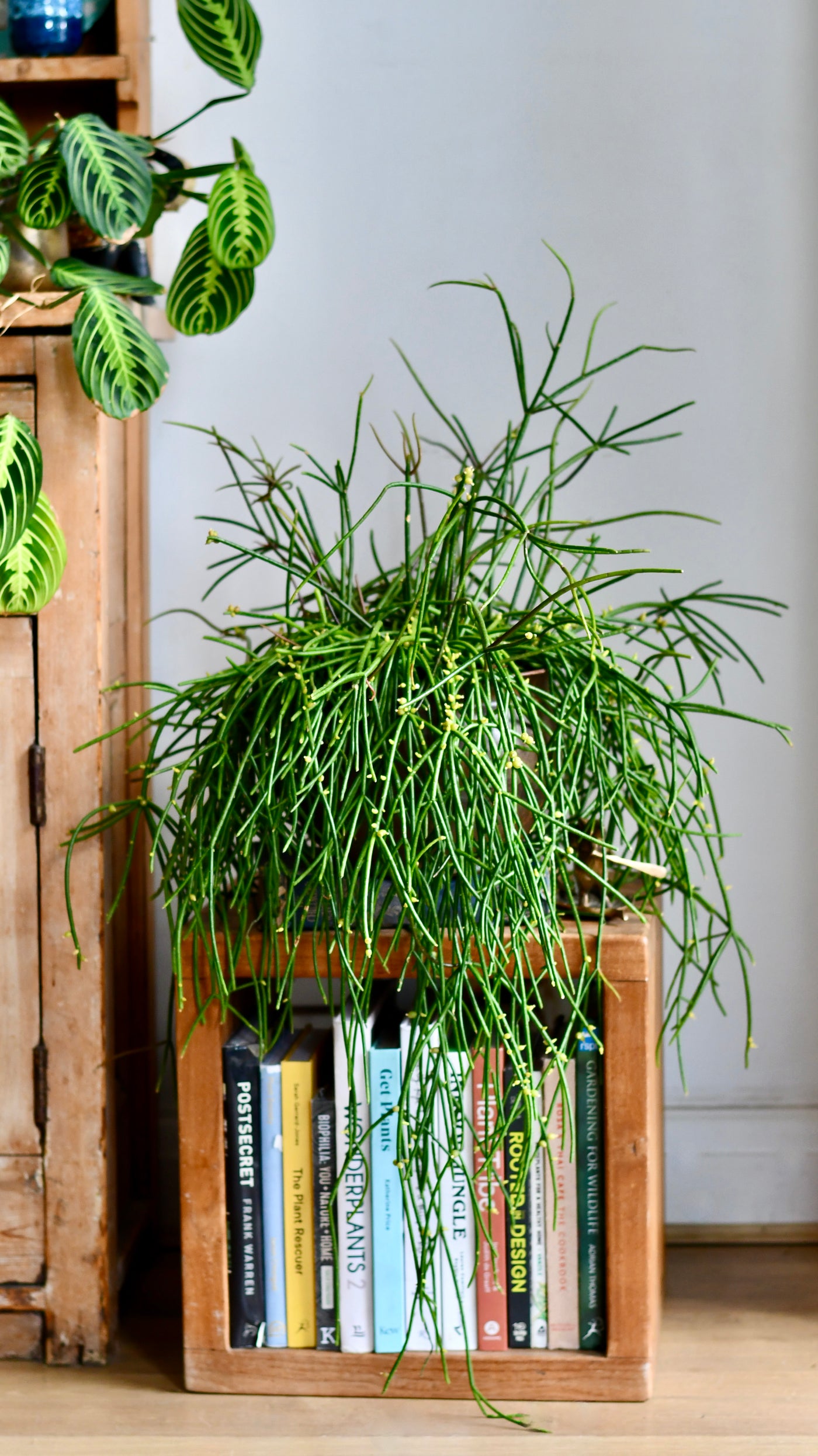
rhipsalis indoor plant

rhipsalis indoor plant Rhipsalis baccifera

Sale price$26.09 Regular price$28.99
Save 10%

Pay in installments of $7.25 with ShopPay, AfterPay and Klarna

Shipping Estimate
USA
  • USA
  • CAN

Ships within 48 hours · Estimated delivery Sep 14 - Sep 19

Promo Codes Available:

For Your Every Summer RSVP, with Code: SUMMER15

Description

rhipsalis indoor plant Rhipsalis bacciferaAs Rhipsalis baccifera, also known as mistletoe cactus, is a epiphytic cactus species native to tropical and subtropical regions of Central and South America, the Caribbean, and Florida. It is commonly found growing in the wild in trees, where it uses its aerial roots to attach itself to bark and absorb nutrients and moisture. Rhipsalis baccifera grows in a pendulous, trailing manner with long, thin, and cylindrical stems that can reach up to 6 feet

As Rhipsalis baccifera, also known as mistletoe cactus, is a epiphytic cactus species native to tropical and subtropical regions of Central and South America, the Caribbean, and Florida. It is commonly found growing in the wild in trees, where it uses its aerial roots to attach itself to bark and absorb nutrients and moisture.

Rhipsalis baccifera grows in a pendulous, trailing manner with long, thin, and cylindrical stems that can reach up to 6 feet (1.8 meters) in length. The stems are covered with small, scale-like leaves that are barely noticeable, and they produce small, white, star-shaped flowers followed by red, berry-like fruits.

In terms of care, Rhipsalis baccifera is a relatively easy plant to grow, making it a popular choice for beginners. It thrives in bright, indirect light and prefers temperatures between 15-29°C. This plant is also adaptable to low-light conditions, but it will not thrive in direct sunlight, as it can burn the leaves.

Rhipsalis baccifera prefers a well-draining soil mix that is slightly acidic and should be watered thoroughly but allowed to dry out slightly between watering. Overwatering can lead to root rot, so it's essential to make sure the soil is not constantly wet.

When styling this plant in your home, it's essential to consider its trailing nature. You can hang it in a hanging basket or place it on a high shelf or tall plant stand, allowing the stems to cascade down. Alternatively, you can train the stems to grow upwards by using a support structure, such as a moss pole.

Overall, Rhipsalis baccifera is an excellent choice for those looking for a low-maintenance, unique, and eye-catching plant that will thrive in most indoor environments.

Rhipsalis make a great houseplant gift for friends or family - surprise them with rainforest style! If you are giving Rhipsalis as a gift, make sure you include your message at the basket stage.  We’ll deliver the houseplant along with a free, handwritten card - and we’ll leave out the paperwork with the price on!

Please Read Carefully before Ordering 

Rhipsalis baccifera is a delicate plant that requires careful handling during packing and transportation. Despite our best efforts, it is important to note that this plant may break or sustain damage during shipping. While we are happy to ship this beautiful plant to you, we regret to inform you that we cannot offer refunds for any breakages that may occur. However, it is important to keep in mind that Rhipsalis Baccifera is a resilient plant that can readily recover from any damage. With proper care and attention, this plant will soon thrive in its new environment, and its beauty will continue to brighten your space.

Rhipsalis care level

This plant is easy to care for, and great for beginners.

Where should I put this plant?

Likes bright indirect light, it will also enjoy a sunny spot, so it’s not a fussy plant but will burn in full sun.

How should I water this plant?

Water when the top two inches of soil are dry; make sure you don’t overwater this plant.

Should I feed this plant?

Feed once a month in spring and summer with liquid plant food. Why not try our own vegan, organic plant food?

When developing our original Happy Houseplants’ Organic Tropical Plant Food, we decided not to tinker with it too much, so you'll find no chemical supplements in this 100% cruelty-free vegan product. Our indoor plant fertiliser is handmade on the edge of Dartmoor National Park in Devon, exclusively for Happy Houseplants, and has been developed by the team at Happy Houseplants and expert horticulturists with decades of experience. Many people struggle to understand how to feed houseplants, but our original vegan plant food has been designed to make feeding houseplants simple. 

Our organic indoor plant food is made from Seaweed, harvested sustainably. Seaweed provides a delicate blend of growth hormones and micronutrients that is perfect for all indoor plants. Houseplants grow throughout spring, summer and autumn, so they will benefit from organic fertiliser during this time to encourage flowering and keep them healthy and well. 

Is this plant suitable if I have pets?

This plant is toxic to cats and dogs.

What size is this plant?

W15cm x H30cm, W21cm x H50cm 

For some great advice on general houseplant care, why not have a look at the video we’ve made for you? Click Here

All our plants are supplied in a plastic nursery pot

Shipping Notes
  • Free Standard Shipping on $100+ Orders to the USA.
  • Except Preorder products are shipped in 48 hours.
  • Delivery to the USA:
  1. Standard Shipping : 3-10 business days
  • If time is of the essence, please consider selecting expedited delivery for faster service.
Exchange/Return Notes
  • We offer a 30-day return/exchange service after receiving.
  • Final sale items are not eligible for returns or exchanges.
  • To process your return/exchange, please contact us at [email protected]
  • Please click here for more details>>> Return & Exchange Policy
SKU: 79447201370

Discover Niche Categories That Outsell rhipsalis indoor plant

Top-Converting Item to Boost Your Average Order

4.0 ★★★★★
Based on 16 reviews
Sort
Highest Rating
Newest First
Oldest First
Product Reviews
V
Verified Purchase
V. Toniolo
Cuba, US
★★★★★ 3
One of the better food, diet, and health books available, but with significant drawbacks
Format: Kindle
Paul and Shou-Ching Jaminet present the most cogent argument in favor of ancestral-style eating that I have ever read. In fact, I never really understood the logic behind Paleo until I read Perfect Health Diet. I applaud their scientific rigor and willingness to challenge dietary dogma, Paleo or otherwise. There is no question that removing all grains and legumes from one's diet is incredibly effective for people with autoimmune diseases and some other chronic, intractable health conditions. But when taking the evolutionary perspective on human diets it's also important to recognize that many cultures have thrived on grains and legumes for millennia, and humans have evolved some clever ways to extract nutrients from foods that would otherwise be toxic through the use of prolonged soaking, sprouting, and fermentation, all techniques that are very effective at reducing seed toxicity. I think that properly prepared grains and legumes can be a nutritious part of our diets, at least for those of us who do not suffer from autoimmunity. Stephen Guyenet has written excellent posts on legumes (wholehealthsource.blogspot.com/2013/11/beans-lentils-and-paleo-diet.html) and grains (wholehealthsource.blogspot.com/search/label/lectins). I also wish that the Jaminets had delved a little bit deeper into the subject of fatty fish from a sustainability standpoint. They recommend that we eat fatty fish, but make no mention of seafood sustainability and the importance of avoiding farmed fish, especially farmed (aka "Atlantic") salmon. Farmed fish are fed soy, corn, and pellets made of smaller fatty fish like anchovies and sardines. Entire small fish fisheries off the coast of Western South America are being destroyed in order to feed our hunger for farmed salmon, while we have plenty of small fatty fish we can eat (but choose not to) here on the west coast of North America (herring, sardines, anchovies, etc.). I bet that the fat profile (3:6 ratio) of farmed salmon is not nearly as good as that of wild salmon and smaller cold water fish. That said, I highly respect and follow their writing and will continue to look forward to their excellent work.
WAS THIS REVIEW HELPFUL?YesReportShare
Reviewed in the United States on January 28, 2014
J
Verified Purchase
Jean
Charlottesville, US
★★★★★ 5
Understanding and Making the Best of Our Emotions
I am honored to write a review on this book, as I am heartfully thankful for how my mind was opened to a better consciousness of emotions. It was amazing to realize that our emotions are not an innate part of us, but have been established from interactions with others, especially early in our life by learning from our parents and siblings. Learning emotions is a part of our thinking process. With this knowledge, my approach to emotions has fundamentally changed. Emotions are how we react and how we perceive truth. Emotions become a part of who we are and how others perceive us. The book enlightened my perception and gave me a whole new way of viewing myself and how my emotions may not have matured. With this understanding, the book gives us advice on how to learn to improve (mature) our emotions. First by knowing and followed by determination to learn. The presentation of methods to make improvements with planning and accountability to oneself gives hope and is reassuring. We can learn to mature our emotions. When we have achieved our goals of self-emotional maturity, the book further has methods to share with others (especially family) to bring us together in a positive open way. This book has been a real eye-opening to me. I recommend the reading of this book to spread this awareness. A positive way forward with means to achieve a better life. The book is very thorough and provides documented ways to do the planning and accountability to accomplish goals. Always thinking positively. My thanks to the Author.
WAS THIS REVIEW HELPFUL?YesReportShare
Reviewed in the United States on September 30, 2025
C
Verified Purchase
chumpo
Alexandria, US
★★★★★ 5
Parenting is not easy, but this book certainly helps to do it right!
I am glad I read ths book. Parenting is not easy. There is no cookbook for parenting. Each child is unique. What I enjoyed about the book is that it is very practical. It describes real scenarios about child paret interactions and lays out the problems and solutions to address them. There seems to be a fair amount of incorporation of approaches used in twelve step programs which stress taking personal inventory and analyzing my role in each situation. Seeking help from different sources is key, therapists, literature. I wish this book had come out earlier. I am definitely going to use the steps suggested in the book.
WAS THIS REVIEW HELPFUL?YesReportShare
Reviewed in the United States on September 24, 2025
R
Verified Purchase
Robert R Stoyko
Carnegie, US
★★★★★ 5
Very readable treatment of a difficult topic
I thought the book was very easy to read and written as if Mike was in a room with you chatting about this important topic. I think the book is a great resource for anyone dealing with either personal challenges or interpersonal issues with friends, coworkers or family members. A very informative book that deals with a difficult topic in an easy to read writing style.
WAS THIS REVIEW HELPFUL?YesReportShare
Reviewed in the United States on October 14, 2025
G
giner
Chelsea, US
★★★★★ 4
Good read
"I know you were once an child with dreams but I once your child with my own dreams." Is a quote that relates to this book.While it needs to be edited more and some mistakes fixed, this has allowed me and many others to understand our parents better and work towards fixing what they have done or even what they failed to do.
WAS THIS REVIEW HELPFUL?YesReportShare
Reviewed in the United States on February 20, 2026

recommand products