SKU: 79749433295
dragon succulent

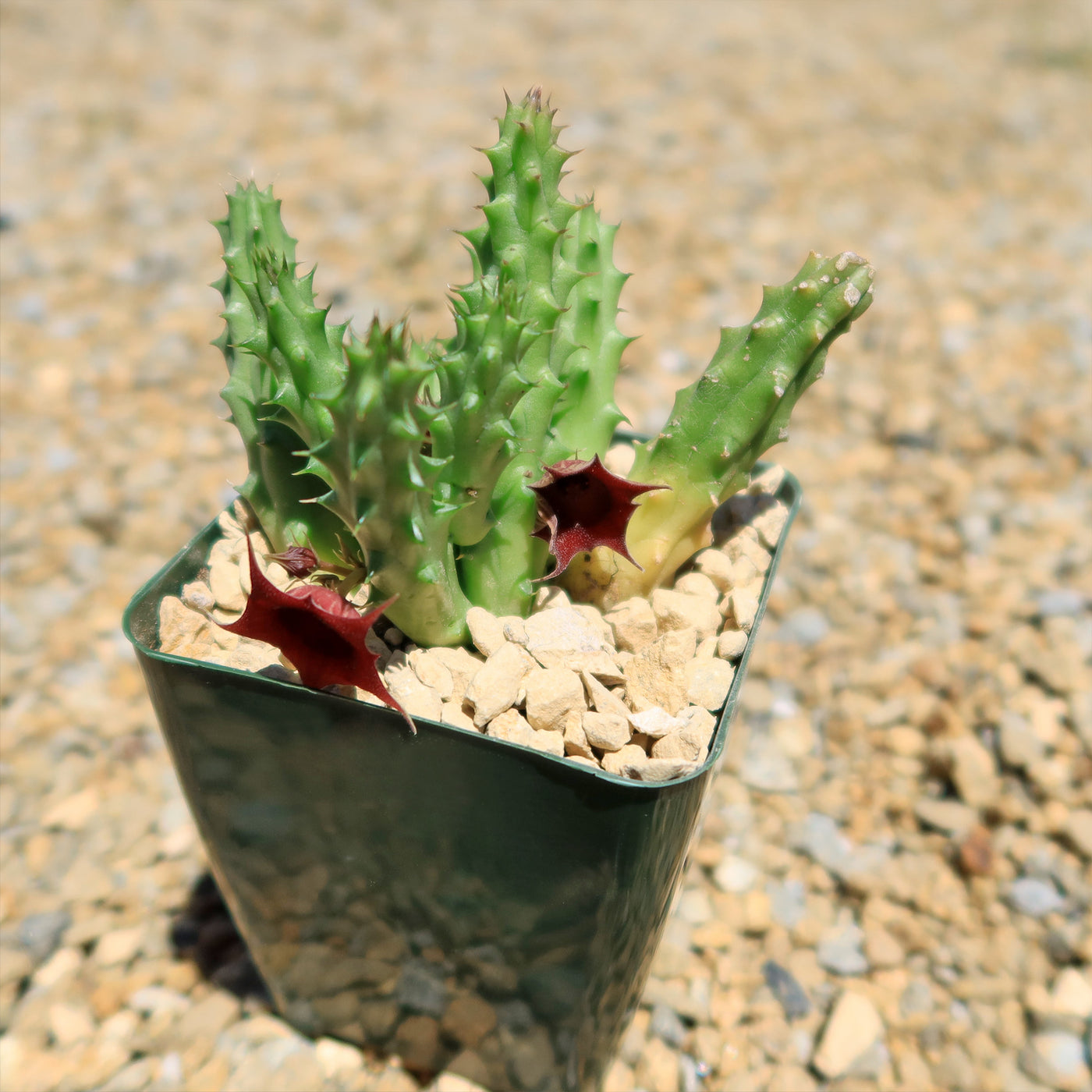
dragon succulent Red Dragon Flower

Sale price$23.43 Regular price$26.03
Save 10%

Pay in installments of $6.51 with ShopPay, AfterPay and Klarna

Shipping Estimate
USA
  • USA
  • CAN

Ships within 48 hours · Estimated delivery Oct 18 - Oct 23

Promo Codes Available:

For Your Every Summer RSVP, with Code: SUMMER15

Description

dragon succulent Red Dragon FlowerThe Red Dragon Flower, botanically known as Huernia schneideriana, is a fascinating and increasingly popular flowering succulent admired for its unusual dragon like blooms and sculptural stems. The stems usually grow upright when young but gradually begin to spread, trail, or droop as the plant matures, making it especially attractive in hanging baskets, shallow pots, and decorative containers. Despite its cactus like appearance, the Red Dragon Flower

The Red Dragon Flower, botanically known as Huernia schneideriana, is a fascinating and increasingly popular flowering succulent admired for its unusual dragon-like blooms and sculptural stems. The stems usually grow upright when young but gradually begin to spread, trail, or droop as the plant matures, making it especially attractive in hanging baskets, shallow pots, and decorative containers.

Despite its cactus-like appearance, the Red Dragon Flower is not a true cactus. It is a soft-stemmed succulent with fleshy, water-storing stems that help it thrive in dry conditions. Its common name, “Dragon Flower,” comes from its dramatic, deep red, star-shaped flowers, whose textured petals and bold colors resemble the scales or open mouth of a mythical dragon.

Like many desert-adapted succulents, Huernia schneideriana has evolved to thrive in hot, arid, rocky environments.

Its thick green stems typically grow 12 inches tall and feature soft, tooth-like ridges that resemble tiny thorns, giving the plant its distinctive cactus-like look without the sharp spines.

The true highlight of this plant is its extraordinary flowers. The blooms are relatively small, usually 1 to 2 inches wide, but incredibly eye-catching and unforgettable.

Each flower displays a deep purple-black center surrounded by a velvety reddish-black interior and brownish-red exterior, creating a dramatic, almost otherworldly effect.

Its natural drought tolerance and resilient growth habit make it an excellent choice for both beginners and experienced growers seeking a hardy, low-maintenance succulent.

Unlike many other members of the Huernia genus and carrion flower relatives, whose blooms can produce a strong, unpleasant odor, Huernia schneideriana has a much milder scent, making it far more suitable and enjoyable as an indoor houseplant.

When and How to Water Your Red Dragon Flower

The Red Dragon plant prefers light and infrequent watering, much like the dry conditions of its native Eastern African habitat. This succulent grows best when watered using the “soak and dry” method, where the soil is watered thoroughly and then allowed to dry out completely before the next watering.

Water your Red Dragon Flower about every 2 to 3 weeks during the active growing season, then reduce watering once a month in dormant season.

In the spring and summer, you may need to water your red dragon flower more frequently as it actively grows. Always use a pot with drainage holes and allow the soil to fully dry between waterings to keep the plant healthy.

In the fall and winter, you should reduce the frequency of watering to prevent overwatering and potential root issues. Wrinkled or slightly soft stems are common signs that it may need watering.

Remember, it's always better to underwater than to overwater Huernia succulents like the red dragon flower. This will help ensure the health and longevity of your Huernia schneideriana.

Light Requirements - Where to Place Your Red Dragon Succulent

When growing indoors, place the red dragon flower on a sunny windowsill or near a south facing window where it can receive around 4 to 6 hours of sunlight daily.

If the stems start turning yellow or brown, it may be getting too much direct sun.

Move it slightly away from the window or provide light shade during the hottest part of the day. 

When growing outdoors, it thrives in bright sunlight or partial shade and grows best with around 4 to 6 hours of direct morning sunlight daily.

Since intense afternoon sun can be too harsh for its delicate stems, place it in a location with bright, filtered light during the hottest part of the day.

If your Red Dragon Flower is not receiving enough light, it may become leggy and pale in color. In areas with limited natural sunlight, you can use a grow light to provide the extra light needed for healthy and compact growth.

Optimal Soil & Fertilizer Needs 

The red dragon flowers favor very airy, sandy soil that drains well. Planting them in ordinary soil will result in compacted roots, stunted growth, and most likely root rot. Ideally, you can use our specialized succulent potting mix that contains 5 natural substrates with organic mycorrhizae to support healthy root development and stronger growth.

When it comes to fertilizing your red dragon flower, it's best to do so sparingly. You can use a diluted, low nitrogen fertilizer or a balanced succulent fertilizer with an NPK ratio such as 5-10-5. Avoid over fertilizing, as too much fertilizer can damage the roots and lead to weak or leggy growth.

Hardiness Zone & More 

In the United States, the red dragon flower is mostly an indoor plant, but if you live in southern Florida or Hawaii, then you can cultivate it outdoors in USDA zones 9 to 11.

It prefers warm temperatures between 65°F and 80°F and thrives in warm, dry conditions, but should be protected from temperatures below 50°F.

As for humidity, it is well-adapted to dry and arid environments. It can tolerate low humidity levels, making it a great choice for drier climates or indoor environments with lower humidity. 

How to Grow as an Indoor Houseplant 

The Red Dragon Flower can adapt very well as an indoor houseplant when given enough light and warmth. Place it near a bright window where it can receive several hours of sunlight daily, preferably gentle morning sun combined with bright indirect light. East or south facing windows are usually the best spots. 

Keep the plant in a warm area with temperatures between 65°F and 80°F, and protect it from cold drafts or temperatures below 50°F. It prefers low humidity and dry conditions, making it well suited for typical indoor environments. 

Wildlife – Red Dragon Flowers Attract the Following Friendly Pollinators 

The Red Dragon Flower can attract pollinators such as bees, butterflies, moths, hummingbirds, flies and small gnats. These insects help pollinate the blooms in nature. The flowers may also attract tiny beetles and other beneficial insects that are curious about the plant’s unique appearance. 

Butterflies
Bees
Hummingbirds
Lady Bugs
Multi Pollinators
Other Birds

According to ASPCA,  Huernia schneideriana is considered mildly toxic to pets and humans. It is best to keep the plant out of reach of curious pets and small children. Wearing gloves while pruning or propagating can also help prevent skin irritation. 

How to Propagate Your Red Dragon Flower 

You can propagate your plant through stem cuttings. The best time to propagate is during spring or summer when the plant is actively growing.

Use a clean, sharp knife or scissors to cut a healthy stem from the parent plant. Let the cutting dry and callous for 1 to 2 days before planting to help prevent rot. Place the cutting in a warm spot with bright indirect light while it develops roots. Within a few weeks, new roots and growth should begin to appear.

Key Takeaways

  1. The Red Dragon Flower is a unique succulent prized for its exotic, velvety blooms that instantly stand out in any plant collection.
  2. It is a low maintenance plant that thrives with minimal watering, making it perfect for busy plant owners and beginners.
  3. Its compact, trailing stems make it a beautiful choice for decorative pots, shelves, and hanging baskets.
  4. The plant grows well indoors with bright light and can reward you with eye catching blooms during the warmer months.
  5. It can thrive both indoors and outdoors making it a versatile succulent for many growing spaces.

Final Thoughts

Overall, the Red Dragon Flower (Huernia schneideriana) is truly a captivating and unique succulent. With its vibrant red color, dragon-like flower shape, and fascinating history, it's no wonder why it's a favorite among succulent enthusiasts. Whether you choose to grow it indoors or outdoors, providing it with the right conditions, such as well-draining soil, bright indirect sunlight, and temperatures within its preferred range, will help it thrive. With its low maintenance needs and stunning appearance, the red dragon flower is sure to add a touch of beauty and intrigue to any succulent collection!

Shipping Notes
  • Free Standard Shipping on $100+ Orders to the USA.
  • Except Preorder products are shipped in 48 hours.
  • Delivery to the USA:
  1. Standard Shipping : 3-10 business days
  • If time is of the essence, please consider selecting expedited delivery for faster service.
Exchange/Return Notes
  • We offer a 30-day return/exchange service after receiving.
  • Final sale items are not eligible for returns or exchanges.
  • To process your return/exchange, please contact us at [email protected]
  • Please click here for more details>>> Return & Exchange Policy
SKU: 79749433295

Discover Niche Categories That Outsell dragon succulent

Top-Converting Item to Boost Your Average Order

4.3 ★★★★★
Based on 12 reviews
Sort
Highest Rating
Newest First
Oldest First
Product Reviews
D
Verified Purchase
Divan
Massapequa, US
★★★★★ 5
This book is a 'Fraud'... perhaps not
Format: Paperback
This is my first Review ever on Amazon and I am doing this for the love of Hafiz. I am originally of Persian origin and a life long lover of Hafiz... Have visited his tomb and the beautiful city of Shiraz. For people who are looking for a perfect translation, let me tell you that this is not it, not even close. To translate Hafiz, is to try and reproduce Shakespeare in another language and have it somehow come out with the same texture for the modern age (perhaps impossible). So reading Hafiz in Farsi requires years and years of cultural, intellectual and spiritual studies. To me he was an enlightened artist that had walked the esoteric Sufi path to full and authentic comprehension/liberation, in the process one can sense his love for existence and connection to the source (his own being). It feels like he had reached a place where like any great artist he had the necessary tools developed physically/mentally/intellectually to be able to translate his mystical experiences fluently and effortlessly into an external art form (in his case lyric poetry and who knows what else). I am explaining my understanding of him/her to make a point here. Mr. Ladinsky has somehow connected to the essence of Hafiz. In order to comprehend Hafiz in another language (and a whole different time/setting), one has to somehow try the impossible and reproduce the texture by trying to remove vague cultural, intellectual and spiritual references with ideas and thoughts that resonate with people today. Ladinsky has tried and somehow succeeded with giving us a glimpse (just a glimpse) of Hafiz and his loving/playful spirit. In my opinion, this book is mainly an intro to Hafiz, but even an intro is enough to open the door for those that like to venture deeper. In Iran Hafiz (or Hafez) and his main and perhaps only book 'Divan' is read like an Oracle (like the I Ching) - with intention and perhaps a lingering question one opens up to a page to receive his guidance. Well this book, carries the same fire if you're able to get past your ideas of right and wrong and just tune into it. For many Iranians (lots of my own friends), this book brings up a lot of challenges and I can understand that because it's so different from the original, but yet if you are able to realize that his poetry was from over 600 years ago, from a time when the culture was so different and language was a lot more evolved, than maybe you can put into context what this book is actually doing. And yes, language was more evolved, just look at the older writings by poets and writers and it should be obvious (that's a whole other subject). Mr. Ladinsky, has tried his best and this seems like the only book so far that allows one to get a glimpse of Hafiz in the english language, but he also does fall short in many aspects obviously (There probably isn't anyone that could perfectly translate Hafiz, even in Iran people argue about the deeper meanings of most of his writings). Hafiz's words are from another dimension and brought to life in Farsi, so to truly feel Hafiz, one has to study Farsi.
WAS THIS REVIEW HELPFUL?YesReportShare
Reviewed in the United States on July 27, 2022
D
Verified Purchase
David Bankston
Chelsea, US
★★★★★ 5
Music of the Spheres
Format: Paperback
For me, Like many others who have read Dan Ladinsky's unique versions of Hafiz, I find them an ever fresh fountain. These poems hold the essence of experiential spirituality, the possibility of unlimited creativity, the ocean of love, the sweet agony of longing, and the unbearable joy of ectsasy. It is difficult to remember that these miraculous jewels sprang from a life (Hafiz's)that was not without difficulty. The images here are startling and often hilarious and irreverent. But I think that most important Hafiz expands our ability to imagine and understand God. I grew up as a fundamentalist Christian and it never occurred to me that God could be as tender as this, "When the violin can forgive the past It starts singing. . . . You will become such a drunk laughing nuisance That God will then lean down And start combing you into His hair." Here is Hafiz's breathtaking yet practical image of unconditional love, "Even after all this time The sun never says to the earth "You owe me." Look what happens with a love like that, It lights the whole sky." In GREETING GOD Hafiz exquisitely describes spiritual longing this way, ". . .Tonight there is a jeweled falcon singing In a blessed pain using the tongue of Hafiz." I have given more than a few copies of THE SUBJECT TONIGHT IS LOVE as gifts. Now I'll give the gift of THE GIFT. I am a singer and a songwriter and I hear songs in these poems. Thank you Dan Ladinsky! You are like the "jeweled falcon" singing with "the tongue of Hafiz." Many blessings David Bankston, DMA
WAS THIS REVIEW HELPFUL?YesReportShare
Reviewed in the United States on November 3, 2000
J
Verified Purchase
Jav M
Alexandria, US
★★★★★ 5
Quick and valuable read
Format: Paperback
I love this book. It’s not a sit down and read it through (unless you want to!). It’s a sit, turn to a random page, and read. Sit with it for a bit and think. It’s great poetry and always is insightful. I often purchase this as gifts for friends and is great to have on a “coffee table” or lamp stand.
WAS THIS REVIEW HELPFUL?YesReportShare
Reviewed in the United States on August 1, 2024
A
Verified Purchase
anonymous name
Draper, US
★★★★★ 5
Blessed Ruin: Lessons on the Stages of Love
Format: Paperback
Having already been enchanted by Daniel Ladinsky's previous rendererings of Hafiz in _I Heard God Laughing_ and _The Subject Tonight is Love_, Ladinsky's present effort is worthy of no less acclaim. In fact, his choices this time from the _Divan_(250 poems) bring home with exquisite precision that Hafiz, the Perfect Master is in fact, a Master of Love. The reader gets the clear message in Ladinsky's portrait that Hafiz has intermalized to perfection his teacher's (Mohammad Attar)lessons on the manifold levels of love and its demands: "I saw it was Hafiz who wrote all your notes of sadness, But also etched and gave you Every ecstatic wince of joy your face, body and heart has ever known." (p.38). This is no "New Age" nonsense, which at its worst hails the light and avoids the shadow, Hafiz (though seducing the beginner lover by his promises of sweetness and tenderness, that God could actually "become an infant in your arms"[p,56]) cautions that he "hold's the Lion's Paw whenever I dance."(p.57). Western culture has not received such lessons on divine love since Jesus and Plato, and unfortunately, the fresh images of their teachings on love have all been but lost to humanity, save a small remnant of sketches. Ladinsky's Hafiz both assures and challenges the seeker because any fully-alive being with such capacity for loving as Hafiz dwarfs our puny notions of western romantic love without shaming or condemning it. Only encouraging like a true teacher with compassion would: "You ask for a few words of comfort and guidance. I quickly kneel at your side offering you this whole book . . . Here's a rope, tie it around me, Hafiz will be your companion for life."(p83). Hafiz's language of love utilized the metaphor of his time and culture as Jesus incorporated the images of parable. Ladinsky courageously steps out of line (as surely did Hafiz) and takes the risk to be mundane without being irreverent when describing the labyrinth that is the heart: "There are different wells within your heart. Some fill with each good rain. Others are far too deep for that." (p76) Ladinsky's Hafiz teaches us of a divine being who walks among and talks with and celebrates his creation; yet challenges it to stretch beyond its boundaries of self-interest: " I want both of us to start talking about this great love. As if you , I, and the sun were all married and living in a tiny room, helping each other to cook, do the wash, weave and sew, care for our beautiful animals."(p.180). Ladinsky's fine portrait of this 14th century Perfect Master gives the West the certain bugal cry that God is not dead, but it is we who are dead to God. The success of this book will measure how many of us are indeed alive here, and how many are really interested in the more mature lessons of loving.
WAS THIS REVIEW HELPFUL?YesReportShare
Reviewed in the United States on July 27, 2001
L
Verified Purchase
L. D. Weimer
Birmingham, US
★★★★★ 5
One need not be Christian or Muslim or whatever to appreciate his poetry with its deep feelings of connectedness and love of lif
Format: Paperback
The book has a lovely, reasonably long, introduction to Hafiz, his time, and fellow poets which helps to create an open and curious mind for the poems that follow. Although I was familiar with several Hafiz poems before, most of this book was new to me. It is a fairly thick book, with the poems spread lightly on the pages. Plenty of white space surrounds and set off the poems so that although there are many, many poems in the book, they are not crowded. Hafiz celebrates god in a way that is rich and exuberant. One need not be Christian or Muslim or whatever to appreciate his poetry with its deep feelings of connectedness and love of life. In fact, as a Buddhist, I find it is exactly that sensitivity to life, to joy, to the world around, and to other beings around us that offers the greatest illumination. This poetry is wonderful to read just before sleep, or any time, and is a fine addition to any library.
WAS THIS REVIEW HELPFUL?YesReportShare
Reviewed in the United States on April 4, 2015

recommand products