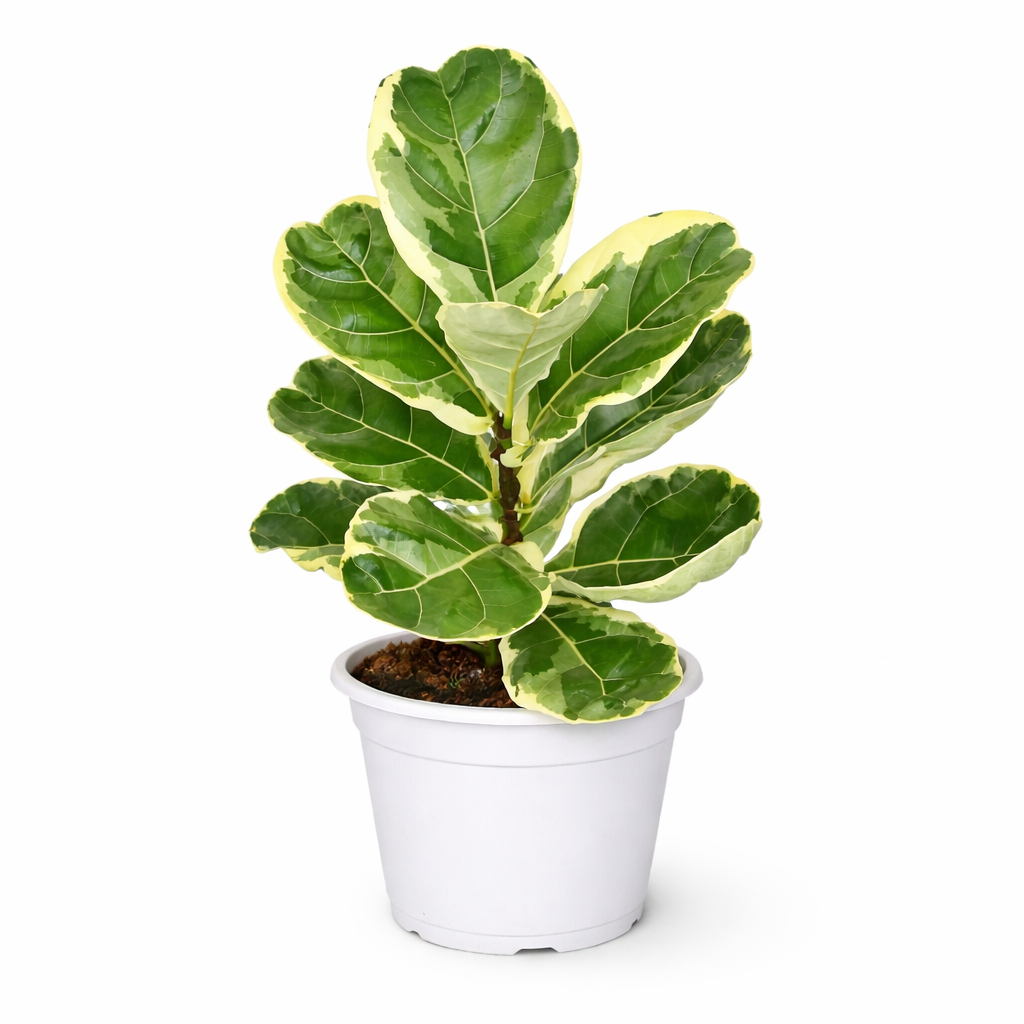
SKU: 80682929052
buy variegated fiddle leaf fig

buy variegated fiddle leaf fig Variegated Ficus Lyrata (Variegated Fiddle Leaf Fig)

Sale price$25.66 Regular price$28.51
Save 10%

Pay in installments of $7.13 with ShopPay, AfterPay and Klarna

Shipping Estimate
USA
  • USA
  • CAN

Ships within 48 hours · Estimated delivery Oct 20 - Oct 25

Promo Codes Available:

For Your Every Summer RSVP, with Code: SUMMER15

Description

buy variegated fiddle leaf fig Variegated Ficus Lyrata (Variegated Fiddle Leaf Fig)The Variegated Ficus Lyrata the Variegated Fiddle Leaf Fig is among the rarest houseplants in the world. The standard Fiddle Leaf Fig is already beloved for its enormous, lyre shaped leaves lyrata, Latin for lyre, the instrument its leaf silhouette resembles and the variegated form takes those same dramatic leaves and layers them in an irregular, tri tonal pattern of dark glossy green at the centre, soft olive green in between, and sweeping cream to

The Variegated Ficus Lyrata — the Variegated Fiddle Leaf Fig — is among the rarest houseplants in the world. The standard Fiddle Leaf Fig is already beloved for its enormous, lyre-shaped leaves — lyrata, Latin for lyre, the instrument its leaf silhouette resembles — and the variegated form takes those same dramatic leaves and layers them in an irregular, tri-tonal pattern of dark glossy green at the centre, soft olive-green in between, and sweeping cream-to-white margins and patches toward the edges. Native to the lowland rainforests of West Africa, it grows into a sculptural, upright tree of 1.5–3 m indoors. Commercially, it is produced by only a handful of specialist growers, primarily in Thailand. Owning one is a genuine statement of collection.

⚠️ The Golden Rule — Find Its Spot and Leave It There The Variegated Fiddle Leaf Fig is acutely sensitive to being moved, rotated, or disturbed. Each time its orientation to light changes, it must recalibrate — and during that adjustment it drops leaves. Choose the brightest, most stable position in your home, place it there, and do not move it again unless absolutely necessary. Even turning it to ensure even growth is not recommended until the plant is fully settled. Consistency is everything with this plant.
💡 Cream Sections Have Less Chlorophyll — What This Means The cream and white variegated areas cannot photosynthesise. The plant relies entirely on its green sections for energy — making it a slower grower than plain Ficus lyrata and more sensitive to low light. It also means the cream sections scorch and brown faster than the green in direct sun or dry air. Bright, consistent, indirect light is the non-negotiable foundation of good care.
☀️

Light

▾

The brightest spot in your home — as close to a window as possible without direct sun touching the leaves. An east-facing window or a south/west-facing window with a sheer curtain is ideal. 6–8 hours of bright filtered light daily. Gentle morning or late afternoon sun can be tolerated once the plant is established. Never move the plant once settled — position it correctly from the start.

💧

Watering

▾

Allow the top 50% of soil to dry before watering — roughly every 10–14 days. Water thoroughly with lukewarm filtered or rainwater until it drains freely, then empty the saucer. The variegated form is more sensitive to over and underwatering than the plain green — a moisture meter is a worthwhile investment. Maintain a consistent watering schedule; irregular watering triggers leaf drop.

💦

Humidity

▾

50–70% preferred. A humidifier nearby is ideal — the cream sections show edge damage sooner than the green in dry air. Keep well away from AC vents, fans, radiators, and heating sources. Do not mist directly — water on the leaves promotes bacterial and fungal infections, to which Ficus lyrata is particularly susceptible.

🌱

Growing Media

▾

Light, fast-draining mix: 50% quality potting soil, 30% perlite, 20% orchid bark. pH 6.0–7.0. A pot with excellent drainage holes is non-negotiable — standing water at the roots is the primary cause of root rot. The plant prefers to be slightly root-bound; repot only when roots visibly emerge from drainage holes, moving up one pot size in spring.

🌾

Feeding

▾

Balanced liquid fertilizer at half strength every two weeks in spring and summer. Use lukewarm water. Stop feeding entirely in autumn and winter. Over-feeding causes leaf drop — less is more. Wipe the large leaves with a soft damp cloth monthly to remove dust, which impedes photosynthesis.

⚠️ Common Issues & Quick Fixes

Leaf Drop

▾

The most common Ficus lyrata complaint — triggered by being moved, rotated, cold drafts, irregular watering, or low light. Identify and fix the cause, then leave the plant completely undisturbed. New leaves will emerge once conditions stabilise. Do not overwater in response to stress — this compounds the problem.

Brown Spots or Edges on Cream Sections

▾

Direct sun, dry air, or tap water minerals. Move to pure indirect light, boost humidity, and switch to filtered or rainwater. Do not mist — it causes bacterial spotting. Existing brown areas are permanent; new growth will be healthy once conditions improve.

Brown Spots with Yellow Halo — Bacterial Infection

▾

Bacterial leaf spot — the most serious Ficus lyrata disease. Caused by overwatering, misting, or poor drainage. Remove affected leaves immediately with clean scissors. Reduce watering significantly, improve drainage, stop all misting, and ensure good air circulation. Do not let water sit on the leaves.

White Raised Dots on Leaves

▾

Completely normal — these are cystolyths, natural calcium carbonate crystal deposits in the leaf cells. They cannot be wiped off and require no treatment. Do not mistake them for pests or disease.

Spider Mites or Scale

▾

Inspect leaf undersides and stems regularly. Wipe with a soft damp cloth then treat with diluted neem oil or insecticidal soap every 5–7 days for 3 weeks. Maintain humidity above 50% to deter spider mites. Do not spray neem oil in direct sunlight.

📋 Quick Plant Profile

Botanical Name Ficus lyrata Warb. 'Variegata'
Name Meaning lyrata = Latin for lyre — the leaf silhouette resembles the ancient stringed instrument
Family Moraceae (mulberry family)
Origin West Africa; lowland tropical rainforest
Variegation Pattern Tri-tonal: dark green centre, olive-green mid, cream-to-white margins and irregular patches
Rarity Extremely rare — commercially produced by specialist growers primarily in Thailand
Golden Rule Find its spot and do not move it — position changes trigger leaf drop
Light Brightest spot available; bright filtered; no direct midday sun; do not rotate
Watering Top 50% dry; lukewarm filtered water; consistent schedule; no saucer standing water
Humidity 50–70%; humidifier preferred; no misting — causes bacterial leaf spot
Temperature 18°C–27°C; stable and consistent; no cold drafts or sudden changes
Mature Height 1.5–3 m indoors; up to 25 m in the wild
Pot Preference Slightly root-bound; repot only when roots emerge from drainage holes
Do Not Mist Water on leaves causes bacterial leaf spot — use humidifier instead
White Dots on Leaves Cystolyths — natural; not pests; do not treat
Ideal For Serious Collectors, Statement Indoor Trees, Bright Living Rooms
Care Level Advanced — consistency and stability are the foundations of success
Shipping Notes
  • Free Standard Shipping on $100+ Orders to the USA.
  • Except Preorder products are shipped in 48 hours.
  • Delivery to the USA:
  1. Standard Shipping : 3-10 business days
  • If time is of the essence, please consider selecting expedited delivery for faster service.
Exchange/Return Notes
  • We offer a 30-day return/exchange service after receiving.
  • Final sale items are not eligible for returns or exchanges.
  • To process your return/exchange, please contact us at [email protected]
  • Please click here for more details>>> Return & Exchange Policy
SKU: 80682929052

Discover Niche Categories That Outsell buy variegated fiddle leaf fig

Top-Converting Item to Boost Your Average Order

4.6 ★★★★★
Based on 17 reviews
Sort
Highest Rating
Newest First
Oldest First
Product Reviews
A
AR Shaw
Boise, US
★★★★★ 4
Rival witch families and friendship
Format: Paperback
Read if you like: 🧙‍♀️ Young witches 🌈 Inclusive representation 🤝 Found family & healing 🌲 Small-town magic 2️⃣ POV 📍 A holler in rural North Carolina Cattywampus follows Delpha and Katybird, two girls from rival witch families who are forced into close proximity and slowly begin to form an unlikely friendship. As old grudges and local legends surface, both girls must confront family expectations, hidden truths, and what it really means to belong. This was such a sweet and heartfelt middle grade read. I loved watching Delpha and Katy’s friendship grow, especially given the history between their families. The twist involving Delpha’s father added emotional depth, and the healing that unfolds by the end was really satisfying. Cozy, thoughtful, and grounded in a strong sense of place, this story beautifully balances magic with big feelings and growth.
WAS THIS REVIEW HELPFUL?YesReportShare
Reviewed in the United States on January 31, 2026
S
Verified Purchase
Sarah E. Cannon
Carnegie, US
★★★★★ 5
Sometimes Two Wrongs DO Make A Right!
Format: Hardcover
I devoured this book in a weekend; it's just wonderful. Delpha and Katybird are strong, clever, kick-butt kids with a fantastic circle of caring and colorful characters around them. Cattywampus is a big, spooky, cinematic adventure with its heart in all the right places, and I loved it.
WAS THIS REVIEW HELPFUL?YesReportShare
Reviewed in the United States on August 9, 2020
P
Verified Purchase
P. Goldberg
Lexington, US
★★★★★ 5
Witchy and wonderful
Format: Hardcover
This book is absolutely delightful in every possible way.
WAS THIS REVIEW HELPFUL?YesReportShare
Reviewed in the United States on August 5, 2020
S
somethingexcellent
San Leandro, US
★★★★★ 5
It's rare to see this kind of representation in a book for tweens, and I am 100% here for it!
Format: Hardcover
My 9-year-old daughter loved this book. It's about two 6th grade witches (Delpha and Katybird) from rival Appalachian families who are learning how to use their magic. The book is told from both of their points of view. As a parent, I was pleasantly surprised by the different types of representation in this book and how sensitively they are handled. Delpha's dad left her and her mom when Delpha was little, and they now live in poverty. Delpha's mom is struggling to pay the bills and sells her family heirlooms to Katybird's grandparents, who run a small museum. Katybird is intersex (androgen sensitive) and believes this is messing with her magical powers. Katy's brother Caleb is Deaf and communicates with sign language. Another character, Tyler, has two moms. It's super rare to see this kind of representation in a book for tweens, and I am 100% here for it. There's a great scene where Katy reflects on attending another girl's "first moon party" and the attendees share stories about getting their first periods. When the other girls hear that Katy will never have a period due to her androgen sensitivity, they are shocked and treat her with pity and say they will pray for her. Katy is upset because she already loves and accepts herself. "As if making babies was the whole point of me existing," she thinks to herself. I seriously loved this example of how well-intentioned behavior can be hurtful. I also liked how characters getting their first periods is treated as something magical and worthy of celebration. There is so much about this book that is like a breath of magical fresh air. In addition to all the beautiful inclusive elements woven into this book, it's just really FUN. There is a pet raccoon, an enchanted outhouse, zombies, and hexes that go wrong. The only minor complaint my daughter had was that the plot relies repeatedly on the two main characters being separated and looking for each other. Otherwise, this book was a winner with our young reader. Write more books, Ash Van Waterloo! We love you!
WAS THIS REVIEW HELPFUL?YesReportShare
Reviewed in the United States on March 24, 2021
A
Annie
Houston, US
★★★★★ 5
Emotional development...
Format: Hardcover
Cattywampus Ash Van Otterloo This is the story of Delpha McGill, a girl that doesn’t like rules or keeping secrets. Delpha lives in a small town in rural Appalachia, Howler’s Hollow, where magic is not permitted. She discovers her grandmother’s hidden book of spells which she is determined to use to help her mother. Katybird Hearn has her own reasons for wanting to get her hands on the book of spells and has resolved nobody is going to stand in her way. She comes from a long line of witches. In the midst of their squabble, they unintentionally allow a curse to escape. The curse is so evil it wakes their dead ancestors, the Hearns and the McGills, The two girls must learn to work together if they are going to save the town from the zombies. The author uses great sensitivity in incorporating androgen insensitivity in the plot. Androgen insensitivity syndrome is a condition that affects sexual development before birth and during puberty. People with this condition are genetically male, with one X chromosome and one Y chromosome in each cell. Because their bodies are unable to respond to certain male sex hormones (called androgens), they may have mostly female external sex characteristics or signs of both male and female sexual development. Poverty, sorcery, fears, friendship, and ignorant biases are all a part of this book. Author Ash Van Otterloo portrays life in a southern country town in the mountains and he does so without being demeaning or patronizing. The characters are well fleshed out. While magic is part of the plot, it is merely a means to showcase the emotional development of the two girls. This is a fast-paced read. The target audience is 10-13 years of age.
WAS THIS REVIEW HELPFUL?YesReportShare
Reviewed in the United States on March 15, 2021

recommand products