SKU: 80990284340
paw bear succulent

paw bear succulent Cotyledon tomentosa Bear's Paw

Sale price$18.41 Regular price$20.45
Save 10%

Pay in installments of $5.11 with ShopPay, AfterPay and Klarna

Shipping Estimate
USA
  • USA
  • CAN

Ships within 48 hours · Estimated delivery Sep 5 - Sep 10

Promo Codes Available:

For Your Every Summer RSVP, with Code: SUMMER15

Description

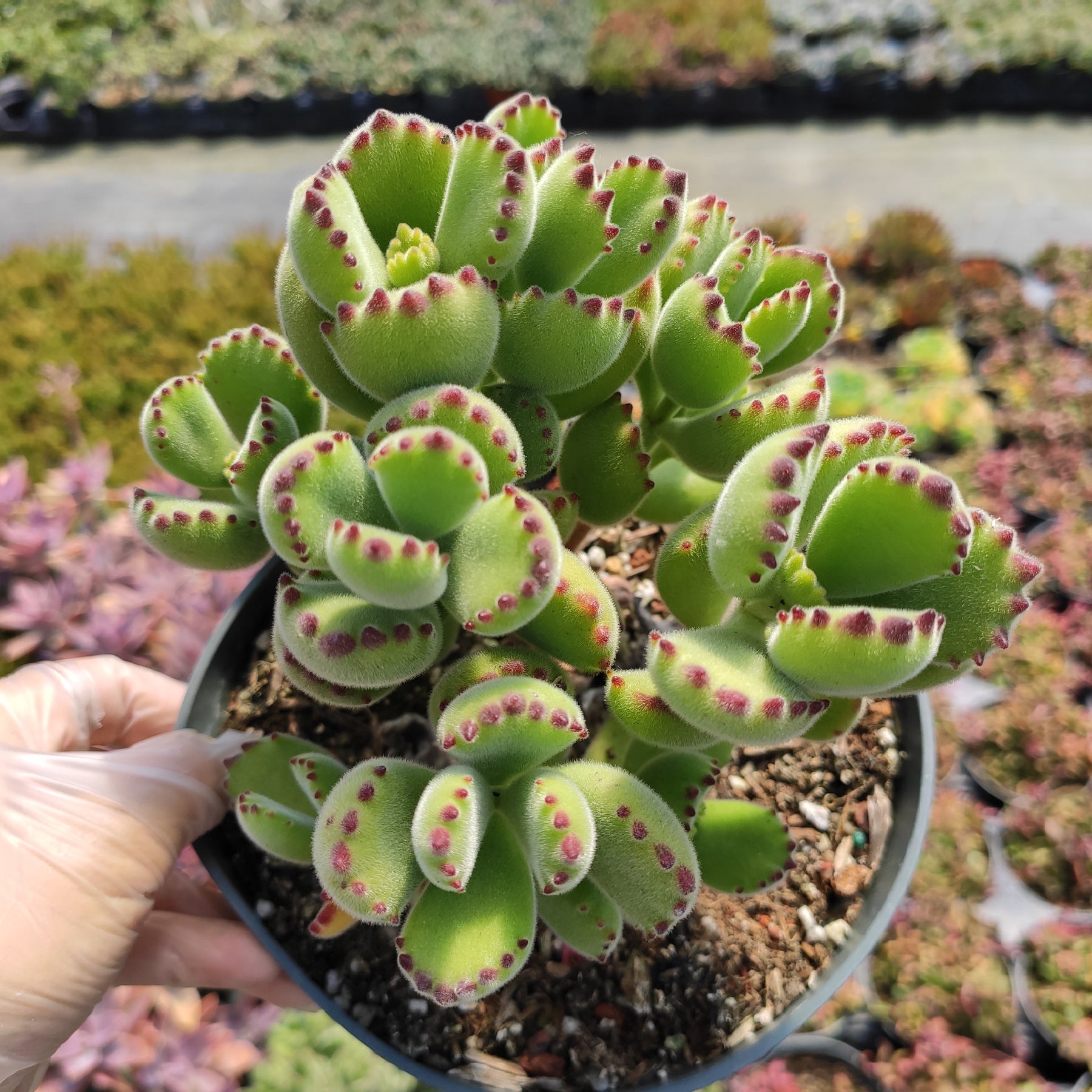
paw bear succulent Cotyledon tomentosa Bear's PawCotyledon tomentosa Bears Paw is a perennial succulent plant in the family of Crassulaceae. The plant is much branched, with green stems, fertile fleshy leaves, decussate, ovoid, green, and densely white short hairs. The leaves have red claw like teeth at the tips, dichotomous cymes, yellow florets, and flowers from July to September. This species is native to the Cape Province of South Africa. It prefers a warm, dry, sunny and well ventilated

Cotyledon tomentosa Bear’s Paw is a perennial succulent plant in the family of Crassulaceae. The plant is much branched, with green stems, fertile fleshy leaves, decussate, ovoid, green, and densely white short hairs. The leaves have red claw-like teeth at the tips, dichotomous cymes, yellow florets, and flowers from July to September.

This species is native to the Cape Province of South Africa. It prefers a warm, dry, sunny and well-ventilated environment. Too high temperatures in summer will make it dormant. Avoid cold and excessive humidity. Propagation methods include cuttings. This species has beautiful leaf shape and color, delicate and small flowers, and leaves resembling the paws of a bear, which is a peculiar form and very cute, with high ornamental value.

The leaf blade of the bear child is fleshy, spatulate, densely white tomentose, the lower part of the entire margin, the leaf tip with brown teeth, like a small Bear’s Paw, very cute. It’s elegant, unique and beautiful, and can be used as a small indoor potted plant.


Care Tips

Light: Likes light, and it can grow vigorously and in a more beautiful condition in a well-lit environment. Except for the strong light in summer, it can be placed in a place with good light and more sunshine in all three seasons. If it is in the shade for a long time, the Bear’s Paw will easily grow and the overall ornamental value will be greatly reduced.

Water: All succulents are drought tolerant and fear water logging, and bear’s paws are no exception. Watering it can be done according to the method of dry and wet, and the soil does not need to be watered if it is not dry. During the growing season, it is usually watered once a week, but in other stages, watering should be strictly controlled because the roots could be damaged by overwatering.

Soil: The soil must be loose, permeable and water-permeable, and the soil should be changed once every year or two to avoid soil caking. You can prepare your own nutritious soil when you maintain it, or you can buy special soil for succulent plants directly.

Potting: It is recommended to use ceramic pots, ceramic pots have a certain degree of permeability, clay pots lose water too fast, plastic pots retain water too strong, and poor permeability.

Temperature: Like a warm environment (high temperature requirements). High temperature in summer and low temperature in winter need to take timely temperature control measures. Summer needs to strengthen ventilation, timely blocking of strong light, the best temperature control at 86°F (30 ℃) or less, winter needs to move to a warm room, temperature control at about 50°F (10 ℃) only, the minimum should not be less than 41°F (5 ℃).

Humidity: Bear’s paw grows well in average household humidity levels when grown indoors. Does not like too much humidity. Normal household humidity is good for this plant.


Shipping & Handling

    • The 2 Inch Cotyledon tomentosa Bear's Paw plants are shipped with the pot and soil
    • The 4 Inch and larger plants are shipped bare roots without the pot and soil:
    • You will receive a very similar plant to the one shown in the photos; shape and color may vary
    • Ship within USA & its outlying territories only
    • Please visit Order Processing & Shipping info page for additional details


    Care Instructions

    Please visit our Succulent Care info page for more details.

    To ensure the health of succulents, it is important to plant them in porous, well-draining soil. Succulents require little watering, but don't like to sit in wet soil. To create an adequate cactus mix, simply add pumice, perlite, or grit to cactus soil to provide the proper drainage.

    Make sure to leave drought periods between waterings to prevent the plant from water-logging.


    Weather Conditions

    • When ordering, be mindful that living succulents can be damaged by the cold weather.
    • If you live in an area that is below 40 degrees Fahrenheit, please add a shipping warmer to your order or consider purchasing plant until the weather is more suitable.
    • Shipping Warmer: 72+ Hours Heat Packs available for $1.7 each
      Shipping Notes
      • Free Standard Shipping on $100+ Orders to the USA.
      • Except Preorder products are shipped in 48 hours.
      • Delivery to the USA:
      1. Standard Shipping : 3-10 business days
      • If time is of the essence, please consider selecting expedited delivery for faster service.
      Exchange/Return Notes
      • We offer a 30-day return/exchange service after receiving.
      • Final sale items are not eligible for returns or exchanges.
      • To process your return/exchange, please contact us at [email protected]
      • Please click here for more details>>> Return & Exchange Policy
      SKU: 80990284340

      Discover Niche Categories That Outsell paw bear succulent

      Top-Converting Item to Boost Your Average Order

      4.5 ★★★★★
      Based on 12 reviews
      Sort
      Highest Rating
      Newest First
      Oldest First
      Product Reviews
      W
      Verified Purchase
      Wenhui Zhang
      Cuba, US
      ★★★★★ 5
      Great book to read
      Format: Paperback, Format: Paperback
      Great book to keep you updated about upstream Linux
      WAS THIS REVIEW HELPFUL?YesReportShare
      Reviewed in the United States on March 18, 2024
      D
      Dieter
      Draper, US
      ★★★★★ 5
      A Hands-On and Deep Guide to Linux Kernel Programming
      Format: Paperback
      Linux Kernel Programming, Second Edition is a very practical and well-structured book for anyone who wants to understand how the Linux kernel works. It focuses on both theory and real hands-on learning. The book uses a clear style and explains complex topics in a simple way. It is designed to help readers build real skills, not just read concepts. It is especially useful for developers who want to work closer to the operating system. One of the most interesting parts of the book is the strong introduction to kernel programming. It explains how to set up a development environment, build the Linux kernel from source, and write the first kernel module. This section gives readers a solid starting point and builds confidence early in the learning process. It also explains why loadable kernel modules are widely used in real-world projects. Another highlight is the deep coverage of kernel internals. The book explains core concepts such as kernel architecture, processes, threads, and the difference between user mode and kernel mode. These ideas are often hard to understand, but the book presents them in a clear and structured way. This helps readers see how the operating system really works under the surface. The memory management section is especially strong and detailed. The book spends several chapters explaining how memory is allocated and managed inside the kernel. It also explains advanced topics such as page allocation, memory reclaim, and the out-of-memory system. These chapters are very useful for understanding performance and stability in real systems. Another very interesting section is the coverage of CPU scheduling. The book explains how the Linux kernel decides which task runs at a given time. It introduces scheduling policies, priorities, and modern features like control groups. The explanations are practical and supported by examples, which makes the topic easier to follow. The chapters on kernel synchronization are also a major highlight. They explain concepts such as locks, atomic operations, and deadlock prevention. These topics are critical for writing safe and reliable kernel code. The book also shows real examples and common mistakes, which helps readers avoid problems in their own work. Another strength of the book is its hands-on approach. It includes many kernel modules, scripts, and examples that readers can try themselves. This makes learning more engaging and helps turn theory into real skills. The focus on practical work makes the book stand out from more theoretical resources. Overall, this book is a great choice for developers, system programmers, and engineers who want to understand the Linux kernel in depth. It starts with the basics and moves into advanced topics in a smooth way. The combination of clear explanations and practical examples makes it a strong and valuable learning resource.
      WAS THIS REVIEW HELPFUL?YesReportShare
      Reviewed in the United States on April 16, 2026
      E
      Verified Purchase
      Ember
      Grantham, US
      ★★★★★ 4
      Poor quality binding
      Format: Paperback, Format: Paperback
      Binding glue fell apart in less than a week and the pages fell out. Content is great though and I have a shiny new kernel based on Kali. 4 stars despite the binding because the content is top tier if you love all things Linux 🤌
      WAS THIS REVIEW HELPFUL?YesReportShare
      Reviewed in the United States on July 4, 2025
      S
      S Navin
      Draper, US
      ★★★★★ 5
      An Essential Guide for Mastering Linux Kernel Development
      Format: Paperback, Format: Paperback
      Linux Kernel Programming - Second Edition: A Comprehensive and Practical Guide to Kernel Internals, Writing Modules, and Kernel Synchronization is an outstanding resource for anyone eager to understand the inner workings of the Linux kernel. Whether you're a beginner looking to get started or an experienced developer aiming to deepen your knowledge, this book delivers a well-structured and hands-on approach to kernel programming. The book starts with the fundamentals—setting up a kernel development environment, understanding kernel release nomenclature, and compiling the 6.x Linux kernel from source. As you progress, it dives into advanced topics such as kernel configuration, writing and debugging loadable kernel modules (LKMs), kernel synchronization mechanisms, memory management, CPU scheduling, and much more. Each chapter builds on practical examples, ensuring that readers not only understand the theory but also learn how to apply it in real-world scenarios. One of the book's biggest strengths is its focus on practical application. From exploring the kernel build process and bootloader configurations to working with Git for kernel development and troubleshooting system crashes using debugging tools, the book provides step-by-step guidance. The coverage of kernel synchronization techniques—including spinlocks, mutexes, and RCU—makes it an invaluable reference for those dealing with concurrent programming in the kernel space. Whether you're an aspiring kernel developer, a DevOps engineer, or a systems programmer, this book is a must-have. The clear explanations, well-structured content, and hands-on exercises make it a perfect companion for anyone wanting to go from a beginner to an expert in Linux kernel programming. Highly recommended for anyone serious about understanding and working with the Linux kernel!
      WAS THIS REVIEW HELPFUL?YesReportShare
      Reviewed in the United States on January 29, 2025
      C
      Cliente Kindle
      Bozeman, US
      ★★★★★ 5
      Broad, detailed and comprehensible book on Linux Kernel Programming
      Format: Paperback, Format: Paperback
      I got on my desk a copy of "Linux Kernel Programmin (2E)" by Kaiwan N. Billimoria and will shortly mention what this book is about. It is a book that you can read cover-to-cover to have a better understanding of kernel development, but I see also how it can be used as a reference when you are going to throw C code at your compiler and build a linux kernel. There is a number of scenario why you might want to do that: - You are recompiling the kernel for a new machine that needs better support - You are going to implement a kernel module and you need some context - You are going to work on the kernel yourself While all of those use-cases for the book are technically a fit, apart from gaining some higher understanding I see the most out of it if you are going to code on the kernel itself. There you have everything that is needed. You can go back and forth between your code and the book, and still learn by doing. What mostly impressed me is the breath of the topics: the chapter about writing a config file for the kernel enlists a total of seven (7!) different strategies to get started with a configuration file for your kernel. Also a lot of side tools are mentioned to help out with kernel development and debugging. Quite some module development can be in theory done without fully understanding the details of the kernel itself, but the deeper you reach, the more you will need the details that are well discussed in the book. Memory allocation, CPU scheduling algorithms, the book does not try to save words and describe in detail and plain language most things there is to know, not sparing plenty of references to other books and articles. Also, the material is up-to-date with the latest kernel.
      WAS THIS REVIEW HELPFUL?YesReportShare
      Reviewed in the United States on March 8, 2024

      recommand products