SKU: 83692687723
tiny rose succulent

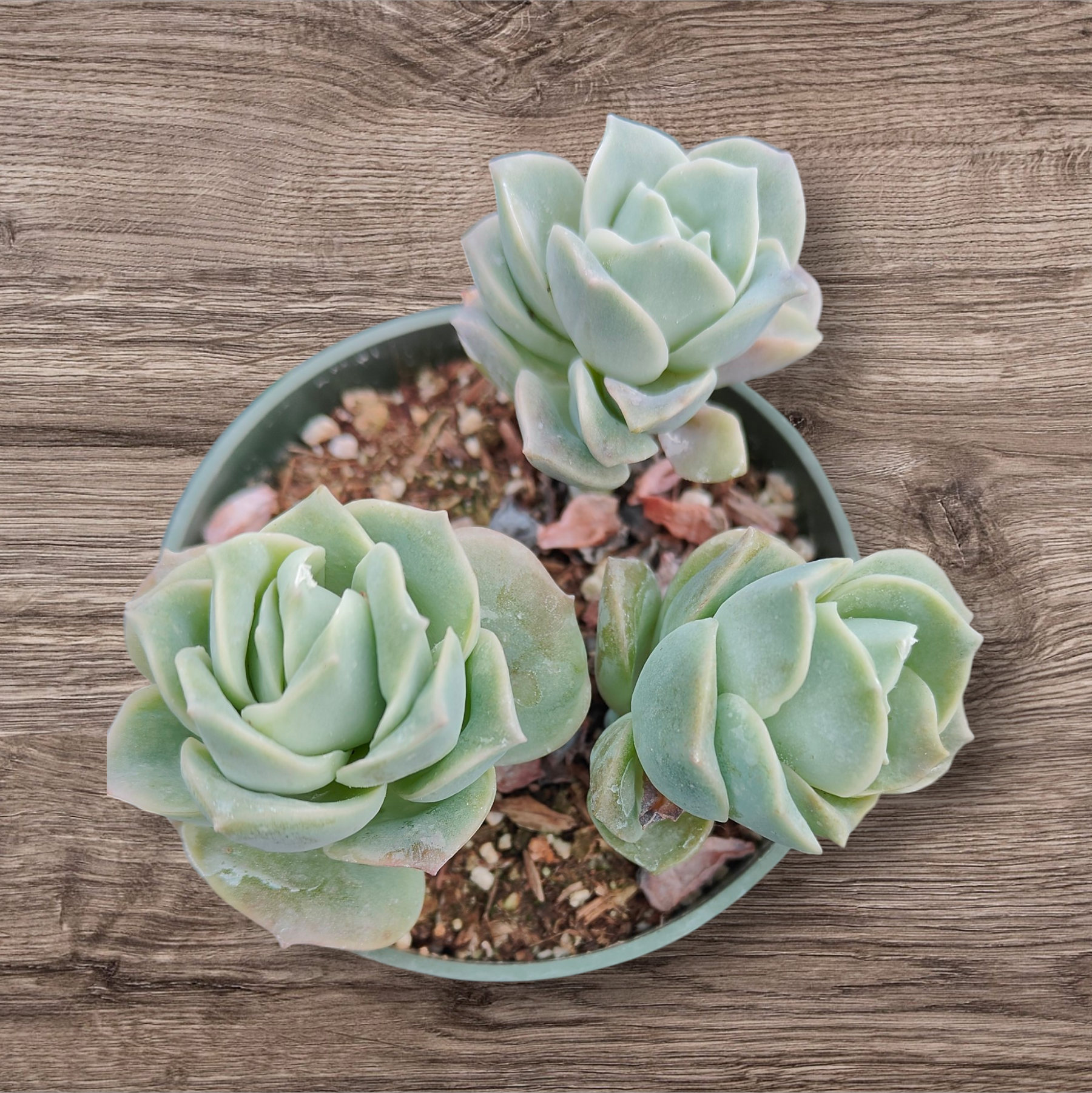
tiny rose succulent Graptoveria 'Lovely Rose'

Sale price$26.70 Regular price$29.67
Save 10%

Pay in installments of $7.42 with ShopPay, AfterPay and Klarna

Shipping Estimate
USA
  • USA
  • CAN

Ships within 48 hours · Estimated delivery Sep 7 - Sep 12

Promo Codes Available:

For Your Every Summer RSVP, with Code: SUMMER15

Description

tiny rose succulent Graptoveria 'Lovely Rose'Graptoveria Lovely Rose is a rare Korean succulent that resembles a rose with long stalks and petals in the shape of a rose. A monstrose form of Graptoveria Titubans Graptoveria are hybrid crosses between Graptopetalum and Echeveria. Due to this mixed parentage, they form a diverse genus, but most are low growing, cultivated for their beautiful shapes and colours. They produce stemless, clump forming rosettes with thick leaves. This plant has a

Graptoveria ‘Lovely Rose’ is a rare Korean succulent that resembles a rose with long stalks and petals in the shape of a rose. A monstrose form of Graptoveria Titubans Graptoveria are hybrid crosses between Graptopetalum and Echeveria. Due to this mixed parentage, they form a diverse genus, but most are low growing, cultivated for their beautiful shapes and colours. They produce stemless, clump-forming rosettes with thick leaves.

This plant has a rosette of leaves and can grow up to 6 inches in diameter. Leaves are very particular: fleshy, obovate pointed at the apex, silver-green glaucous in color. The rosette is compact and leaves tend to close toward the center taking on a shape similar to the rose blossom, for this reason this hybrid is called ‘Lovely Rose’.

The succulent can grow lonely or in clumps depending on climate conditions. This hybrid is very rare and appreciated by collectors for its particular color. For its resemblance to the rose flower it is usually used like a centerpiece.


Care Tips

Light: Lovely Rose is a succulent species that likes sunlight very much. The normal growth color is yellow-green, and when it receives sufficient light, it will turn pink or bright red, which makes the lovely rose extremely ornamental at this time. When raising a lovely rose, you can condition the intensity of light according to your needs. However, it is important to keep more than 5 hours of sunlight per day to keep the rose in color. In the hot summer and early autumn when the light is strong, proper shade is needed to avoid sunburning the leaves. The rest of the season is the more light the better, without worrying about it being sunburned. Adequate light will also prevent the lovely rose from growing. 

Water: The humidity of the potting soil should not be too high and there is a great fear of waterlogging in the pot. Therefore, when we are raising Lovely Rose, we water them and try to wait until the potting soil is dry and then water them once more thoroughly, following principle of "not dry, not watering" to avoid potting soil water, which does not allow them to grow normally and also makes the colors of Lovely Rose more vibrant.

Soil: Like to grow in loose, fertile, and well-drained soil that is not easily caked, and can be prepared with a mixture of peat, coconut coir and granular soil.

Potting: Choose high pots, and the bottom of the pot needs to have drainage holes. Lovely Rose are not particularly large, the pot does not need to be too large, in addition do not choose which small diameter pots will affect the growth.

Temperature: Optimal growth temperature between 59 - 68°F (15 -20 ℃), the growth period is mainly in the spring and autumn, summer and winter to control the temperature, the highest summer can not be higher than 95°F (35 ℃), timely ventilation and cooling, the lowest winter can not be lower than 41°F (5 ℃), timely moved to indoor maintenance to keep warm.

Humidity: Lovely Rose grows well in average household humidity levels when grown indoors. Does not like too much humidity. Normal household humidity is good for this plant.


Shipping & Handling

    • The 2 Inch Graptoveria 'Lovely Rose' plants are shipped with the pot and soil
    • The 4 Inch and larger plants are shipped bare roots without the pot and soil:
    • You will receive a very similar plant to the one shown in the photos; shape and color may vary
    • Ship within USA & its outlying territories only
    • Please visit Order Processing & Shipping info page for additional details


    Care Instructions

    Please visit our Succulent Care info page for more details.

    To ensure the health of succulents, it is important to plant them in porous, well-draining soil. Succulents require little watering, but don't like to sit in wet soil. To create an adequate cactus mix, simply add pumice, perlite, or grit to cactus soil to provide the proper drainage.

    Make sure to leave drought periods between waterings to prevent the plant from water-logging.


    Weather Conditions

    • When ordering, be mindful that living succulents can be damaged by the cold weather.
    • If you live in an area that is below 40 degrees Fahrenheit, please add a shipping warmer to your order or consider purchasing plant until the weather is more suitable.
    • Shipping Warmer: 72+ Hours Heat Packs available for $1.7 each
      Shipping Notes
      • Free Standard Shipping on $100+ Orders to the USA.
      • Except Preorder products are shipped in 48 hours.
      • Delivery to the USA:
      1. Standard Shipping : 3-10 business days
      • If time is of the essence, please consider selecting expedited delivery for faster service.
      Exchange/Return Notes
      • We offer a 30-day return/exchange service after receiving.
      • Final sale items are not eligible for returns or exchanges.
      • To process your return/exchange, please contact us at [email protected]
      • Please click here for more details>>> Return & Exchange Policy
      SKU: 83692687723

      Discover Niche Categories That Outsell tiny rose succulent

      Top-Converting Item to Boost Your Average Order

      4.2 ★★★★★
      Based on 15 reviews
      Sort
      Highest Rating
      Newest First
      Oldest First
      Product Reviews
      H
      Verified Purchase
      How Family
      West Palm Beach, US
      ★★★★★ 5
      Great reference for college US History I & Ii.
      Format: Paperback
      My college course references this book for US History I & Ii at Temple College in Texas.
      WAS THIS REVIEW HELPFUL?YesReportShare
      Reviewed in the United States on June 21, 2022
      P
      Louisville, US
      ★★★★★ 4
      A useful study
      Format: Hardcover
      This is a book that will make you angry. If you are a conservative, this book should make you feel very guilty. It is important to begin with that this book is a detour from Keyssar's larger project, which was supposed to be a history of the American working class' electoral participation. After struggling with the work for several years he realized that he needed to publish a whole book explaining what the right to vote actually was in American history. The result is a history of the slow and uneven path to universal suffrage in American history. We learn about the existence of the vote before 1776, the improvement that occured with the revolution, and the larger improvement that occured with the Jeffersonian/Jacksonian period in which the large majority of white men were able to vote. At the same time we learn of efforts to counter the expanding suffrage, such as disfranchisement of free blacks all over the country before 1861, attacks on the voting rights of paupers, felons, migrants and aliens, as well as the disfranchisment in the early 1800s of the limited voting rights women had in the early 1800s. Keyssar then goes on to discuss the narrowing of the portals from the 1860s to the 1920s, periods ironically bounded by giving the vote to blacks in the 1870s and to women by the 1920s. But in between that period nearly all blacks and many whites were disenfranchised in the south, while literacy, residence, nationality and registration systems sought to limit the vote in the North (while "asiatics" were barred in the west). The book concludes with the successful passage of the Voting Rights Act and the twenty-sixth amendment, but also with low turnout, an extremely narrow political spectrum, and government structures which limit political participation and reinforce conservative values. Much of this will not be new to historians, though never before has there been such detail and the twenty appendixes provided at the back will be invaluable for future reference. Sometimes Keyssar gives a qualititative estimate of how many Americans could vote (he suggests that perhaps 60% of white Americans could vote before 1776, a figure much lower than the 80-90% posited by more Panglossian historians). And there are many interesting details, such as the New York plan where registration was supposed to take place on Yom Kippur, conventiently leaving out many Jews. But otherwise the full results have been reserved for his upcoming work. This weakens his criticisms of American exceptionalism, since without a clear understanding of how much the vote declined in the North, we cannot see how fully the ponderous elitism of Parkman and Godkin were like the undemocratic aspects of German or Italian or even British liberalism. I am also do not agree with his description of slaves as a "peasantry." This implies that the majority of white farmers who were not slaveholders were a) not peasants and b) were otherwise indistinguishable on a class basis from the slaveholders. Recent southern agrarian history makes this assumption quite questionable. It is true that Americans were unenthusiatic as Europeans about the rise of the proletariat and rural subaltern classes, but it is insufficient to say that mass suffrage only occured because such classes were a small proportion of the population. They were also a small proportion of the population in France in 1848 and 1851 when universal male suffrage was declared, which did not prevent a greater degree of struggle over the question in that country. Enfranchising the majority of any population would raise serious issues of class domination and control regardless of the class structure. Nevertheless this is still a useful study, and reading the petty, racist, misogynist, self-serving and self-satisfied arguments against the suffrage will be a depressing experience. To think that such injustices could be continued for two centuries thanks to the endless cant of "state's rights" long after the republican content of that slogan had drained away will infuriate you.
      WAS THIS REVIEW HELPFUL?YesReportShare
      Reviewed in the United States on October 18, 2000
      R
      Verified Purchase
      Randall Lindsey
      West Palm Beach, US
      ★★★★★ 5
      Unfolding of the right to vote in the U.S.
      In my forty years of studying the history of the U.S., I find this work to be the most authoritative and complete work yet encountered. Not only is the book a thorough guide through the evolution of our democracy, it is an entertaining read. The book is a 'must' read for those who seek a perspective on many of the current issues involving voting rights.
      WAS THIS REVIEW HELPFUL?YesReportShare
      Reviewed in the United States on November 4, 2006
      J
      Verified Purchase
      Jj7484
      Cuba, US
      ★★★★★ 5
      Typical for a casebook.
      Format: Hardcover
      I had to buy this for school. It’s overpriced and horrible to read but great for what I needed it for.
      WAS THIS REVIEW HELPFUL?YesReportShare
      Reviewed in the United States on June 29, 2019
      C
      Verified Purchase
      C Cox
      Charlottesville, US
      ★★★★★ 5
      Good seller
      Format: Hardcover
      book in condition provided in description
      WAS THIS REVIEW HELPFUL?YesReportShare
      Reviewed in the United States on April 7, 2021

      recommand products