SKU: 8551663298
rare philodendrons for sale

rare philodendrons for sale Philodendron atabapoense 6" Pot / Self Watering / Without Pot

Sale price$25.51 Regular price$28.34
Save 10%

Pay in installments of $7.08 with ShopPay, AfterPay and Klarna

Shipping Estimate
USA
  • USA
  • CAN

Ships within 48 hours · Estimated delivery Jul 19 - Jul 24

Promo Codes Available:

For Your Every Summer RSVP, with Code: SUMMER15

Description

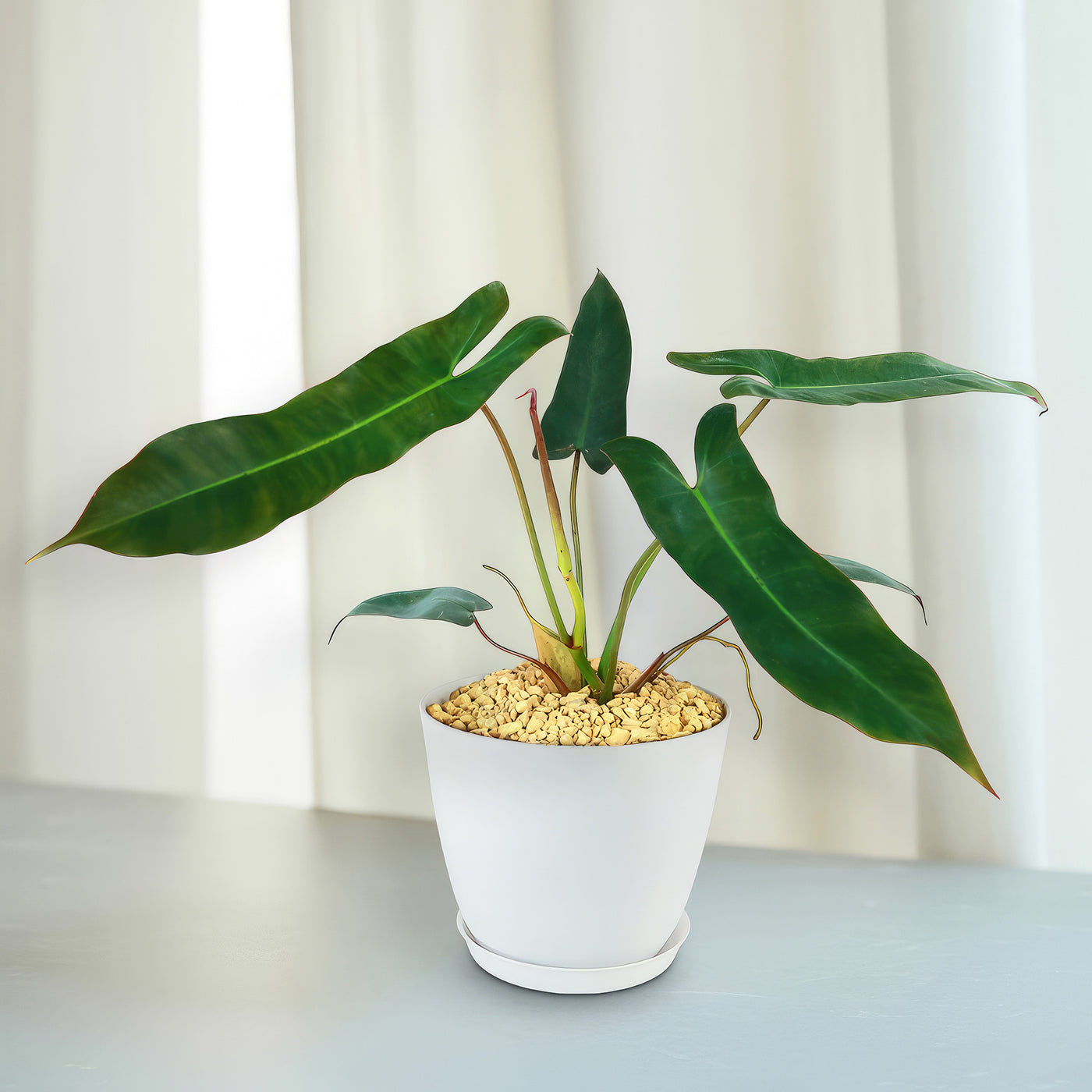
rare philodendrons for sale Philodendron atabapoense 6" Pot / Self Watering / Without PotKey Highlights Philodendron atabapoense The Philodendron atabapoense is highly sought after as a houseplant due to its fast growing, climbing nature and adaptability to indoor conditions. While it thrives in humidity, this plant is surprisingly resilient and can tolerate short dry periods if necessary. Its long, narrow leaves feature deep green tops and striking maroon purple undersides, giving it an exotic appearance. It is a hemi epiphytic plant

Key Highlights - Philodendron atabapoense 

  1. The Philodendron atabapoense is highly sought after as a houseplant due to its fast-growing, climbing nature and adaptability to indoor conditions.
  2. While it thrives in humidity, this plant is surprisingly resilient and can tolerate short dry periods if necessary.
  3. Its long, narrow leaves feature deep green tops and striking maroon-purple undersides, giving it an exotic appearance.
  4. It is a hemi-epiphytic plant that climbs trees in its native habitat and benefits from a moss pole or trellis indoors to encourage larger, elongated leaves.

The Philodendron atabapoense is a striking rare climbing philodendron that has gained popularity among plant collectors due to its elongated, lance-shaped leaves with deep green tops and contrasting maroon undersides. Unlike more common philodendrons, it has a sleek, refined appearance that makes it stand out in any indoor or outdoor plant collection. 

Philodendron atabapoense grows great indoors while maintaining an impressive size, making it a favorite among houseplant enthusiasts. When given proper support, such as a moss pole or trellis, it will produce longer, more dramatic leaves, enhancing its visual impact. In the wild, it grows as an epiphyte, climbing trees and reaching for sunlight while absorbing moisture and nutrients from the humid air. 

Native to the tropical rainforests of Venezuela and Brazil, this plant has long, narrow arrow-shaped leaves with a deep green upper surface and a burgundy to maroon underside with an illustrious shine and sheen.

This color contrast gives it an exotic appearance that is highly appealing to plant collectors.

The plant is also known for its fast-growing nature, especially when provided with adequate support, humidity, and indirect light.

When grown indoors, this Philodendron typically grows up to 6 feet tall and 3 feet wide, depending on its support structure.

In its natural habitat, it can climb much higher, reaching over 10 feet. The leaves can grow significantly longer when provided with optimal conditions, adding to their appeal as a large, dramatic houseplant. 

The flowers of Philodendron atabapoense are small and greenish-white in color. Its blooms consist of a spathe and spadix, which are typical of the Araceae family. The spathe is usually green or maroon on the outside and pale inside, enclosing the spadix that contains tiny flowers. However, it rarely flowers indoors, as it requires specific environmental triggers, including high humidity and warm temperatures. 

One unique aspect of Philodendron atabapoense is its epiphytic and hemi-epiphytic nature, meaning it can grow both in soil and attached to trees. This versatility allows it to adapt well to different growing conditions. It also has a high tolerance for humidity fluctuations, making it easier to care for than some other tropical plants. Its leaves have a leathery texture, helping reduce moisture loss and allowing it to thrive in various indoor environments. 

When and How to Water Your Philodendron atabapoense 

Like other drought-tolerant plants, the Philodendron atabapoense is an excellent choice for plant enthusiasts who prefer low-maintenance greenery. This species can withstand occasional dry spells, thanks to its ability to store moisture in its roots. However, while it is resilient, it thrives best when provided with consistent moisture, allowing the soil to dry out slightly between waterings. Overwatering can lead to root rot, so a well-draining potting mix is essential to prevent standing water.

In the spring and summer, during the active growing seasons, it requires more frequent watering to support its vigorous growth. Water the plant thoroughly when the top 1-2 inches of soil becomes dry, ensuring even hydration. The frequency of watering largely depends on environmental factors such as humidity, light exposure, and pot size. If grown outdoors, the plant may require more frequent watering during hot, dry periods. 

In fall and winter, during the dormant season, your Philodendron enters a slower growth phase and requires less water. Watering should be reduced to prevent excessive moisture build-up in the soil. Ensure the soil is dry at least halfway before the next watering. Maintaining proper humidity levels indoors can help prevent dehydration, but misting is generally unnecessary unless the air is extremely dry. 

Light Requirements – Where to Place Your Philodendron 

When grown indoors as a houseplant, this plant thrives in bright, indirect light. It should be placed near a window with filtered sunlight, such as a north or east-facing window, where it can receive 6 to 8 hours of indirect light daily.

Too much direct sunlight can scorch its leaves, while insufficient light may lead to leggy growth and slower development.

Grow lights can supplement natural light if necessary, ensuring consistent growth throughout the year.

For outdoor cultivation, this Philodendron prefers dappled sunlight or partial shade, similar to its natural rainforest habitat.

It can tolerate morning sun but should be protected from harsh afternoon rays to prevent leaf damage.

If grown under a tree canopy or shaded patio, it will flourish with at least 5 to 6 hours of bright, indirect light daily. In tropical climates, it can be grown outdoors year-round with proper light exposure. 

Optimal Soil & Fertilizer Needs 

The Philodendron atabapoense favors very airy, sandy soil that drains well. Avoid using dense, compacted soils that trap excess water, leading to root rot. Instead, make or buy a well-draining potting mix, or ideally use our specialized potting mix that contains 5 natural substrates and mycorrhizae to promote the development of a strong root system that helps your Philodendron to thrive.

For optimal growth, fertilize Philodendron atabapoense once a year in their actively growing season which is typically spring using a ratio of about 5-10-5 (NPK). Organic options like fish emulsion or worm castings can also boost soil nutrition. Stop feeding in the dormant months when the plant’s growth slows. 

Hardiness Zones & More 

When grown indoors as a houseplant, it prefers temperatures between 65°F and 80°F and humidity levels above 50%. Keeping it in a warm, humid environment mimics its natural tropical habitat, promoting lush growth. Avoid placing it near cold drafts, air conditioners, or heating vents, as extreme temperature fluctuations can stress the plant.

In the United States, this is mostly an indoor plant, but if you live in southern Florida or Hawaii then you can cultivate it outdoors in USDA zones 9-11.

It prefers high humidity and bright, indirect light similar to its rainforest origin.

If growing outdoors in cooler climates, it should be brought inside when temperatures drop below 50°F to prevent cold damage. 

If you are concerned about humidity or notice browning edges on your plant leaves. This addition will dramatically improve the health of your philodendrons. 

Wildlife – Philodendron Flowers Attract the Following Friendly Pollinators 

The Philodendron atabapoense flowers are known to attract a variety of pollinators such as bees, butterflies, hummingbirds, and beetles in their natural habitat. While the plant is primarily grown for its stunning foliage, when it does flower, these pollinators help with its reproductive cycle.

Butterflies
Bees
Hummingbirds
Lady Bugs
Multi Pollinators
Other Birds

According to the ASPCA, Philodendron atabapoense is mildly toxic to humans, and pets such as cats and dogs. The plant contains calcium oxalate crystals, which can cause oral irritation, excessive drooling, and gastrointestinal discomfort if ingested in a large amount. It is safe to touch and handle, making it a popular choice for indoor houseplants.  

How to Propagate Philodendron atabapoense 

The Philodendron atabapoense can be easily propagated through stem cuttings. Select a healthy stem with at least one node and a few leaves, then cut just below the node using sterilized shears. The cutting can be rooted in water or moist sphagnum moss before transferring it to soil. Keep the propagation medium consistently moist and place it in bright, indirect light to encourage root development. 

The Bottom Line 

Overall, the Philodendron atabapoense is a remarkable climbing philodendron with elegant foliage, rapid growth, and stunning leaf contrast. Its adaptability to indoor and outdoor conditions, along with its unique maroon undersides, makes it a favorite among plant collectors. Whether grown on a moss pole or allowed to trail in a hanging basket, it adds a touch of tropical beauty to any space. With proper care, including bright indirect light, well-draining soil, and regular humidity, it will flourish and become a standout feature in any plant collection. Order your very own Philodendron atabapoense for sale today! 

Shipping Notes
  • Free Standard Shipping on $100+ Orders to the USA.
  • Except Preorder products are shipped in 48 hours.
  • Delivery to the USA:
  1. Standard Shipping : 3-10 business days
  • If time is of the essence, please consider selecting expedited delivery for faster service.
Exchange/Return Notes
  • We offer a 30-day return/exchange service after receiving.
  • Final sale items are not eligible for returns or exchanges.
  • To process your return/exchange, please contact us at [email protected]
  • Please click here for more details>>> Return & Exchange Policy
SKU: 8551663298

Discover Niche Categories That Outsell rare philodendrons for sale

Top-Converting Item to Boost Your Average Order

4.7 ★★★★★
Based on 21 reviews
Sort
Highest Rating
Newest First
Oldest First
Product Reviews
P
Verified Purchase
P. Biealczyc
Houston, US
★★★★★ 5
Really nice
Format: Paperback
Great read and gift
WAS THIS REVIEW HELPFUL?YesReportShare
Reviewed in the United States on May 31, 2026
K
Verified Purchase
Kindra Foster
New York, US
★★★★★ 4
Classic, but a bit disappointed
I’ve always wanted to read this book. Heard a lot about it and it’s importance in the science fiction genre. But I didn’t care for Heinlein’s style of writing. There was a lot of subtle humor in it that was enjoyable, and I suspect he meant for it to be a caricature of humanity. I enjoyed the analysis of human nature throughout the story. But I was disappointed in the direction the story took toward the end. It seemed like a cheap way to develop the possibilities that had been laid out in the rest of the book. I want to believe human beings would value the opportunity and show up in a better way if such a thing really happened. I felt like the main character was so rich and unique in the beginning, but in the end, he felt flat and inscrutable. Having said all of that, maybe if I hadn’t been swayed by my own expectations, I would have enjoyed the story more. I’ll have to try some of his other books and see what I think!
WAS THIS REVIEW HELPFUL?YesReportShare
Reviewed in the United States on May 28, 2024
C
Verified Purchase
Craig in NE CT
Louisville, US
★★★★★ 5
Great story!
Format: Mass Market Paperback
I read this book as a teenager, in the 1960s, and just, now, finished rereading it, at age 65. I see that I missed many of the author's ideas (due to my youthful lusts, antics, and ignorance of life and of the Bible). "Stranger in a Strange Land" struggles with boundaries of self, morality, and what may constitute/govern a normal healthy society. The author pokes at our spiritual needs, ideas, or rituals upon which we all depend to order our lives, whether we be atheistic, pantheistic, or monotheistic. By minimizing God and godhood to the level of individual understanding and growth, the Heinlein's story posits that all philosophical views need not be antagonistic toward one another; that, by default, truth is and should be relative, given our potentially reformed natural self-interests. Whether a `religious' or irreligious person or organization is primitive, civilized, or `who-cares', Heinlein poses that, despite our ideologies that distinguish us from others, or unite us, only a growing constructive self-awareness is really important, not whether God really exists or whether we will face a final judgment. The author's trick to redemption is how we decide to get along with ourselves and our neighbors, within a `fly right, or mess up and go back to the beginning' scenario, in contrast to the biblical one-life-one-chance view. By design or default, in this story, Heinlein relegates God below human self-actualization, and allows no room for absolute truth. Heinlein's self-fulfilling self-actualization is entirely at odds with biblical Christianity and biblical Judaism, yet quite at home with most religions and faiths that rely on salvation by personal works, and reincarnation-based religions. Maybe that was part of the author's point in telling the story. When it comes to putting a halt to abusive powers, I have to chuckle at how Heinlein has Smith frustrate the overbearing powers-that-be. A thought struck me about twenty years ago that those who have power or understanding have a God-given responsibility to exercise discipline and restraint with those who lack power or understanding. Having more power or understanding than someone or something else does not obviate one's responsibility to exercise that power or understanding to better the world in which we live, nor does it entitle one to do ought but to treat others with love, respect, and decency, which, for the betterment of society and our world, may require that one's power or understanding be exercised to identify or destroy evil. Though this philosophy is exercised by the lead character within the story, the clarity of this comes late to Valentine Michael Smith, yet, sadly, such clarity does not move him to embrace an absolute God, absolute truth, nor his own existence as a created being that is not God, leaving Heinlein's view of life and after-life harshly in contrast to the biblical viewpoint, hence at odds with God. Martian or human, in the end, Heinlein simply does a shell game with his characters, when the issue of death arises, leaving readers to guess in what level the author will eventually hide them, to avoid a final judgment, leaving each soul's story to continue ad infinitum, ad nauseam, without any ultimate accountability. This is an entertaining science fiction story, yet, Heinlein's ideas, in this sexual-religious-social romp, border on theological sophistry. His ideas will probably offend most established points of view. Despite his general bravado, and so bold a topic, Heinlein omits balanced discussion among the characters, fails to deal with any absolute truth or true final judgment of evil, and perfunctorily dismisses biblical views that might be germane to cogent biblical discussion. There are two upwelling truths that the author has twisted and cheapened them considerably, by his denial of absolute truth and avoiding our accountability to God's perfect righteousness. Those are self-sacrificing love and the inevitability that every soul is responsible for her/his own thoughts and actions. Though he allows watered down versions of those traditional moral elements to remain, Heinlein (who must have seen too many money-hungry medicine shows, tent meetings, and carnival acts) relies solely on human constructive self-awareness, self-discipline, and self-empowerment to pose a stab at a positive future for humanity and the afterlife. The story's quasi-moral might read, "Find any way to beat the present system and exploit it at almost any cost, so long as no one really gets hurt." Smith's earthly end-game of self-sacrifice is a corrupted shadow of Christ's. Smith's is a twisted image of self-sacrifice, a huckster's trick to work the crowd, avoiding entirely the biblical God and plan of Christ. Heinlein's bootstrap theology, in the end, can neither respect nor agree upon one God, nor save itself from its own moral meanderings and wishful unthinking of human sin. As an author, myself, I would add that every one of our actions, gestures, and our written or spoken utterances, has its consequences, and that we are ultimately responsible, to God, for everything that we generate and utter. I believe that Heinlein's story agrees partly with my belief, except that Heinlein leaves the one true God completely out of his story. Despite Heinlein's philosophical thrust that everyone can claim "Thou art God", for self or others, I personally subscribe to the biblical view that all things and people are created by God, and that He holds us together by His Laws and will, and that there is, yet, a separation that He reserves between us and Him, that can only be bridged or reconciled through His Christ, and, furthermore, that we are the only part of His Creation that has been offered that exclusive plan of redemption. By contrast, Heinlein's story offers the carrot of constructive self-awareness as the means of possible redemption for humanity, insecurely hoping to save us from ourselves. Craig M. Szwed (Author, photographer, combat veteran, father, composer)
WAS THIS REVIEW HELPFUL?YesReportShare
Reviewed in the United States on May 18, 2013
M
Verified Purchase
M. Estopinal
Draper, US
★★★★★ 5
A True Arthurian Legend
Format: Mass Market Paperback
The Once and Future King provides an excellent perspective into the world of Arthur, the King of England. This book is divided into four sections, each dealing with the different aspects of Arthur's life, including both the good and the bad. The first book, the Sword and the Stone, has been immortalized by countless movies, such as the one by Disney. This book deals with the upbringing of Arthur, or in this case, Wart, his childhood nickname. Here we see the trials Wart must face as he learns about the many forms of leadership, courtesy of his mentor, Merlyn. The second book, the Queen of Air and Darkness, is a prelude to the collapse of Arthur's kingdom. The result of this book begins to brew throughout the entire novel, finally impacting at the end of the final book. The third book, the Ill-Made Knight, is my personal favorite. This book is about Lancelot's personal quest to become the best knight in the world. This book is filled with exciting quests that Lancelot has taken up, including such things as saving a maiden from a boiling pot of water, as well as the ill-fated quest to find the Holy Grail. The fourth and final book, the Candle in the Wind, deals with the collapse of Arthur's kingdom. Arthur's sins "come home to roost" in this book, forcing him to make decisions that could jeopardize the safety of his wife, Guenever, and his best friend, Lancelot. This novel is truly one of the classic fantasy books that one reads and never forgets. Although there are many portrayals of the Arthurian legend, this is without a doubt one of the better ones.
WAS THIS REVIEW HELPFUL?YesReportShare
Reviewed in the United States on September 6, 2004
A
Verified Purchase
Amazon Customer
Pawtucket, US
★★★★★ 5
A novel about all of life
I've read this novel (and listened to the excellent audio book narrated by Neville Jason) in all its different versions over several decades and every time come away with fresh admiration not only for White's fantastic prose style but also for his insight into all aspects of human character and the workings of society. I cannot over-emphasise how rich it all is. For those who have only read The Sword in the Stone (or seen the Disney version), it is important not to write this volume off as a children's story. Each of the four or five books that make up The Once and Future King reflects a different stage in life and experience. The greatness and the tragedy of the story is something we fully recognise only as we grow older. All of the books are wonderful, but The Ill-Made Knight (the third) is an education in adulthood. The background of the entire work from individually-published volumes is a little messy. The Kindle edition I have seems to match the Harper Voyager paperback complete edition which has the integrated four-book version (with the geese and ants integrated into The Sword in the Stone, and Madam Mim removed) and The Book of Merlyn added at the end without any changes to fix the resulting duplication. This is the form in which I am most familiar with all the parts. The Neville Jason audio book available through Audible is synchronised with the Kindle book but actually includes a different version of The Sword in the Stone (Madam Mim included). When I first listened to this, it frustrated me, because the sections on the geese and ants seem so essential. However, taking it all in its entirety, it works very well and avoids the duplication that otherwise occurs. Neville Jason's reading is of the highest quality, with clearly recognisable voices for all characters.
WAS THIS REVIEW HELPFUL?YesReportShare
Reviewed in the United States on April 14, 2014

recommand products