Pay in installments of $7.42 with
 ,
,
 and
and

Shipping Estimate
USA
- USA
- CAN
- USA
- CAN
Ships within 48 hours · Estimated delivery Oct 20 - Oct 25
 Promo Codes Available:
For Your Every Summer RSVP, with Code: SUMMER15
Description
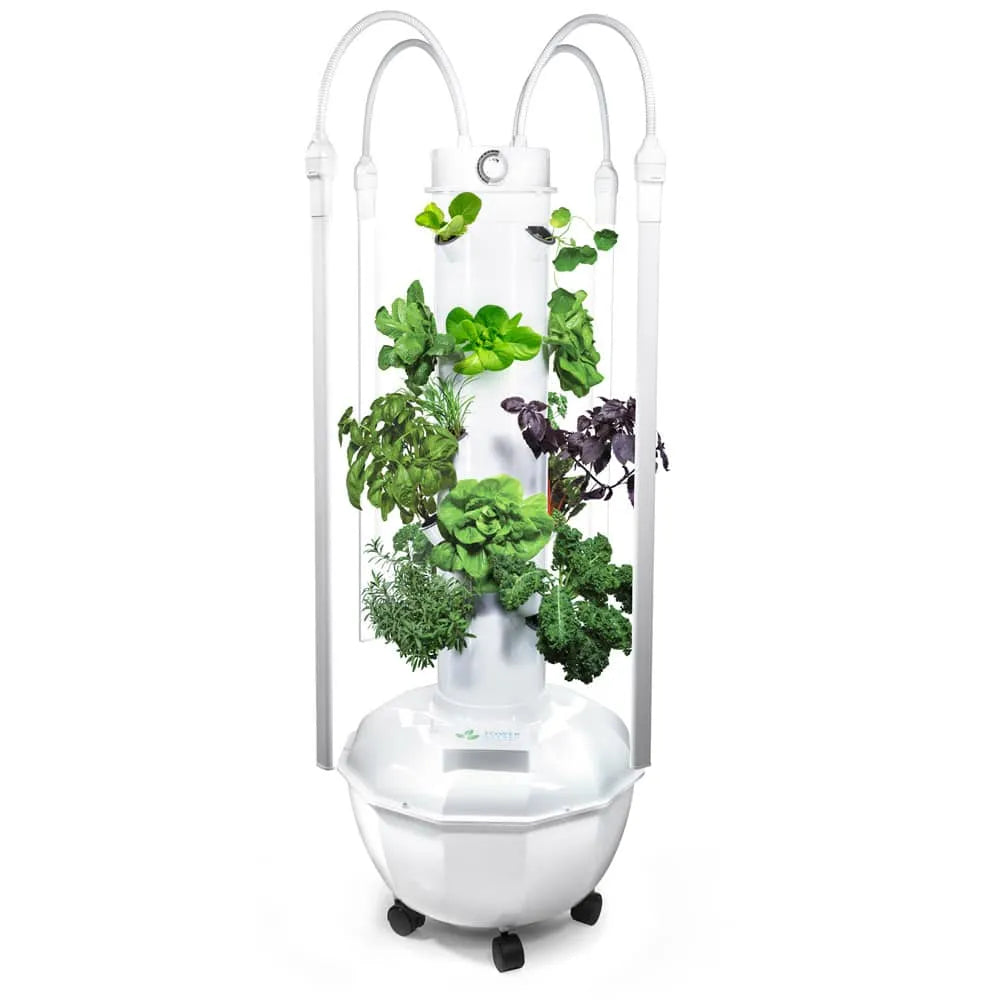
indoor plant growing system with lights Home Tower Garden with Indoor Grow Lights – Growing Hope From HomeEasily cultivate your favorite fresh produce and herbs with the Tower Garden HOME, a durable, vertical aeroponic garden designed to thrive in any environment. This all in one system allows you to start growing up to 32 plants right away, making healthy eating simpler than ever. What's Included Seedling Starter Kit: Includes a germination tray, rockwool cubes, vermiculite, net pots, and a variety of seeds for leafy greens, lettuces, and herbs. 4
Shipping Notes
- Free Standard Shipping on $100+ Orders to the USA.
- Except Preorder products are shipped in 48 hours.
- Delivery to the USA:
- Standard Shipping : 3-10 business days
- If time is of the essence, please consider selecting expedited delivery for faster service.
Exchange/Return Notes
- We offer a 30-day return/exchange service after receiving.
- Final sale items are not eligible for returns or exchanges.
- To process your return/exchange, please contact us at [email protected]
- Please click here for more details>>> Return & Exchange Policy
4.2 ★★★★★
Based on 26 reviews
Sort
Product Reviews
★★★★★ 5
Great read.
Format: Kindle
Once I started this book I kept reading. I enjoyed the story and complex issue bys with both characters, especially with the never having been with another woman for Lou. In this day of self publishing I commend you there were no errors. I will, anxiously, await your next body of work. Thank you for the great read.
,,,
WAS THIS REVIEW HELPFUL?YesReportShare
Reviewed in the United States on April 7, 2025
★★★★★ 5
Unputdownable!!!
Format: Kindle, Format: Kindle
This is about Cami, at seventeen years old her family home was broken into and her life tragically changed forever. Eleven years later and she's finally living as normal of a life as she can despite the trauma, when she receives an anonymous phone call with a cryptic message asking if she would like a "do over". Then she receives a link to a video of a boy trapped in a room with bars on the windows and she is told she has 4 days to find him. Her heart stops when she sees the boy's face because he looks so familiar, but it couldn't be what she's thinking, could it? She knows she needs to help him but was told she can't contact the police, so the next best thing she can think of is an old classmate named Rex who she remembered did something in the military with computers. Now Cami and Rex are on a race against time to figure out the secret location of where the video is coming from and where this little boy is being kept before it's too late. But there is so much more than they realize going on and they uncover more and more secrets along the way, the little boy is just the beginning of what they're about to unravel about their past and their futures.
This book was truly unputdownable! It captures your attention right from the first chapter and keeps you on the edge of your seat, grasping for answers while finding out secrets that only lead to more questions. I had no idea where this story was going or how it was going to end, and I loved that I couldn't predict what was going to happen. It had suspense, trauma, mystery, heartbreak, loss, healing, romance, found family, second chances, and a happy ending. (*Please make sure to check trigger warnings, it also does have dark topics.) Everything from the beginning to the ending was so well done, so much thought was put into these characters, their back stories, the connections, even down to the details. Five stars doesn't feel like enough for this book, Mia absolutely blew me away with this story! Books like this are why I love to read! ❤️📚
WAS THIS REVIEW HELPFUL?YesReportShare
Reviewed in the United States on October 23, 2025
★★★★★ 4
Great read
Format: Kindle
It’s honestly rare to find a book that manages to be both a gripping thriller AND an emotional, hopeful story at the same time, but this one somehow pulled it off.
The story follows Cami, whose entire life is shattered after a brutal home invasion leaves her traumatized and her mother and younger sister dead. Right before everything happened, she had just found out she was pregnant and was preparing to start her future, so watching everything get ripped away from her was absolutely heartbreaking.
Years later, Cami has rebuilt a quiet life for herself and is finally finding some sense of peace… until she receives a phone call telling her there’s a little boy being held captive somewhere in a cabin in the woods.
And that’s when everything starts unraveling again.
The search for the missing child reconnects her with Rex, a former classmate who became an outcast in the aftermath of the original tragedy. After being unfairly viewed as suspicious by the community despite being cleared, Rex lost the scholarship that was supposed to change his future and eventually enlisted in the military. Now he’s this highly skilled tech expert carrying around his own trauma and pain, and honestly I really liked his character.
What I appreciated most about this book was how layered it felt. Underneath the mystery and suspense, it’s really a story about survival, trauma, resilience, and how people try to rebuild themselves after unimaginable loss. Mia did a really good job balancing the darker subject matter with moments of hope and healing without making either side feel too overwhelming.
The opening of this book is INTENSE and immediately hooks you. There were definitely moments where my interest dipped a little in the middle because the pacing shifted and the story started unfolding in a different direction than I expected, so I had to kind of regroup and settle into what the story was trying to do. Some of the execution did not fully work for me all the time, especially with certain reveals being held back for later impact, but overall I was still really invested in uncovering the truth.
I also really liked that even some of the characters I disliked ended up getting endings that felt satisfying in their own way.
The mystery kept me engaged, the emotional elements hit hard, and the characters felt layered and human. It’s dark, tragic, hopeful, suspenseful, and ultimately a story about surviving things that should have destroyed you.
Just definitely check trigger warnings beforehand because this book does contain violence against women and some heavy subject matter.
WAS THIS REVIEW HELPFUL?YesReportShare
Reviewed in the United States on May 16, 2026
★★★★★ 5
Excellent read
Format: Kindle
One of the best books I've ever read, full of surprises. Only complaint is the f bombs, totally unnecessary, adds nothing.
WAS THIS REVIEW HELPFUL?YesReportShare
Reviewed in the United States on May 30, 2026
★★★★★ 3
Mixed feelings about this book
Format: Kindle
I do not recommend this to anyone suffering from trauma. There are some very triggering things in this book and it isn’t a justifiable risk for anyone who has PTSD.
However, if your life has been relatively “normal” and fairly mundane, then you might enjoy reading this book as an escape into a series of exciting events that put the characters through major suffering.
If books got ratings the way movies and TV shows do, I would rate it MA (mature audience) or R (restricted audience) for language, violence, sex, and thematic content. Reader discretion advised.
Pros- fast pace, twisty plot, mysteries, surprises, lots of action, hard to put down
Cons- often unrealistic portrayal of how real people would actually act in the various situations in the book, and sometimes the situations themselves felt a bit of a stretch
This was a plot-driven book with one-dimensional characters- “bad guys” predictably did and said horrible things, “good guys” reliably said and did “good” things. Nobody really surprised the reader, even when they did unexpected things, because it was more a matter of getting the full picture and then realizing that their actions were fully consistent with their place in the “good guy” or “bad guy” category.
Sometimes I found myself wondering if the author had any understanding of how trauma affects people. Those I know who suffer from PTSD or CPTSD don’t behave like the traumatized characters in this story. In many ways, it felt like a kind of wishful fantasy of how nice it would be if people who had been severely traumatized could recover in a relatively short time and in a straightforward way. Even taking some time to research how CPTSD and PTSD can affect trauma survivors could have helped the author write more realistic characters. They were overall too successful, healthy, and emotionally consistent, and said and did too many “right” things the “right” way. Conversely, when the perpetrators did things or said things, they were often too horrid and almost cartoonishly villainous.
There were a handful of ambiguous folks who defied being neatly categorized as “bad” or “good” but the central cast of characters were largely a flat and static bunch.
Nobody seemed to grow as a person or overcome any personal flaws, except for a couple of peripheral characters, and that growth happened largely off-page and was revealed at the end of the story rather than showcased as a central aspect of the book.
In terms of pacing and the twistiness of the plot itself, it was very fast-paced and intense. It was a creative story full of mysteries to solve. Many times I couldn’t pull myself away from reading it because I was so curious about how things would unfold and what was really going on.
Overall, I found it to be an interesting read, but the unconvincing way the characters behaved, in light of how real live people respond to trauma, kept taking me out of the story and making me occasionally roll my eyes or shake my head at the cluelessness of the portrayal of traumatized people.
It would require some spoilers to get more specific than that. If you don’t mind shallowly sketched characters who seem to be permanently locked into their “good guy” or “bad guy” identities, and you enjoy fast-paced thrillers with twisty plots and convoluted storylines, this one is worth your time. I wouldn’t recommend it to most of the people I personally know, though, for the reasons I mentioned.
WAS THIS REVIEW HELPFUL?YesReportShare
Reviewed in the United States on October 12, 2025