SKU: 8855605360
plants that look like a snake plant

plants that look like a snake plant Braided Snake Plant – Plant Detectives

Sale price$24.81 Regular price$27.57
Save 10%

Pay in installments of $6.89 with ShopPay, AfterPay and Klarna

Shipping Estimate
USA
  • USA
  • CAN

Ships within 48 hours · Estimated delivery Jul 16 - Jul 21

Promo Codes Available:

For Your Every Summer RSVP, with Code: SUMMER15

Description

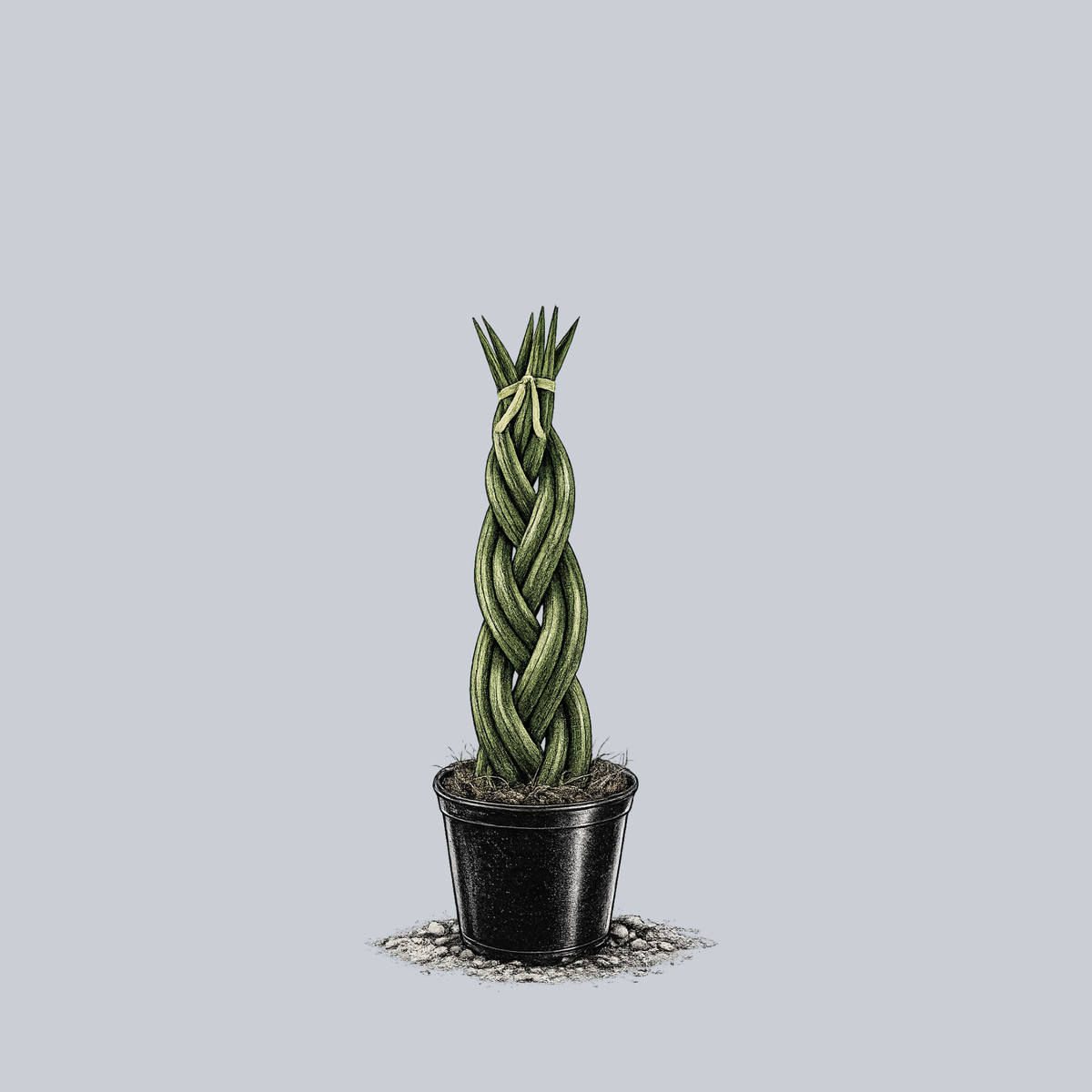
plants that look like a snake plant Braided Snake Plant – Plant DetectivesBraided Snake Plant (Sansevieria cylindrica 'Braid') Braided Snake Plant is a low maintenance, sculptural houseplant that brings a clean, modern look to desks, shelves, and floor planters. Its thick, upright leaves tolerate missed waterings and dry indoor air, making it a reliable choice for busy homes and offices. The braided form adds instant style and a finished, designed feel without needing frequent care. It also adapts to a range of indoor light

Braided Snake Plant (Sansevieria cylindrica 'Braid')

Braided Snake Plant is a low-maintenance, sculptural houseplant that brings a clean, modern look to desks, shelves, and floor planters. Its thick, upright leaves tolerate missed waterings and dry indoor air, making it a reliable choice for busy homes and offices. The braided form adds instant style and a finished, designed feel without needing frequent care. It also adapts to a range of indoor light levels, so it is easy to place where you need strong structure.

Distinctive Features

This snake plant features cylindrical, spear-like leaves that are trained into a braid, creating a bold architectural accent with a tidy footprint. The leaves are smooth, thick, and moisture-storing, typically marked with subtle gray-green striping that adds quiet texture. Growth is slow and steady, and the braided form holds its shape while new shoots may emerge at the base over time. Mature size varies by pot size and training, but it is commonly about 18 to 30 inches tall and 8 to 14 inches wide.

Growing Conditions

  • Light: Bright indirect light is ideal, but it tolerates low light and can handle some direct sun when acclimated.
  • Soil: Use a well-draining potting mix, such as a cactus or succulent blend, in a pot with drainage.
  • Water: Water only when the soil has dried out, since overwatering is the most common problem.
  • Temperature: Prefers typical indoor temperatures and should be protected from cold drafts and frost.
  • Mature Size: About 18 to 30 inches tall and 8 to 14 inches wide, depending on training and container size.
  • Humidity: Average indoor humidity is fine, and no special humidity support is needed.

Ideal Uses

  • Focal Point: Use as a focal point where the braided silhouette can anchor a tabletop or room corner with strong vertical lines.
  • Modern Decor: Place in contemporary interiors where clean shapes and simple textures support a minimalist style.
  • Office Plants: Keep at work for a durable, low-maintenance plant that stays neat with minimal care.
  • Low-Light Rooms: Use in spaces with less natural light where many houseplants struggle.
  • Entryway Accent: Position near an entry to create an immediate, structured look that feels intentional and polished.

Low Maintenance Care

  • Watering: Let the pot dry between waterings, then water thoroughly and drain excess water.
  • Light Adjustment: Rotate the pot occasionally to keep growth even, especially in lower light.
  • Cleaning: Wipe leaves with a dry or lightly damp cloth to remove dust and keep the braid looking sharp.
  • Repotting: Repot every few years when crowded, using fresh, well-draining mix and a stable pot.
  • Feeding: Fertilize lightly in spring and summer, and avoid feeding during low-light winter months.

Why Choose Braided Snake Plant?

  • Sculptural Style: Braided, cylindrical leaves create an instant design statement with a modern feel.
  • Low Water Needs: Thick leaves store moisture and tolerate missed waterings.
  • Light Flexibility: Adapts well to a wide range of indoor light levels.
  • Compact Footprint: Upright form fits neatly on floors, shelves, and tabletops without spreading.
  • Easy Care: Minimal grooming and straightforward watering make it ideal for beginners.

Braided Snake Plant is a simple way to add strong structure and a styled look with very little maintenance. Give it well-drained soil, let it dry between waterings, and place it in steady indoor light for best performance. With its durable nature and sculptural form, it stays looking polished day after day.

Shipping Notes
  • Free Standard Shipping on $100+ Orders to the USA.
  • Except Preorder products are shipped in 48 hours.
  • Delivery to the USA:
  1. Standard Shipping : 3-10 business days
  • If time is of the essence, please consider selecting expedited delivery for faster service.
Exchange/Return Notes
  • We offer a 30-day return/exchange service after receiving.
  • Final sale items are not eligible for returns or exchanges.
  • To process your return/exchange, please contact us at [email protected]
  • Please click here for more details>>> Return & Exchange Policy
SKU: 8855605360

Discover Niche Categories That Outsell plants that look like a snake plant

Top-Converting Item to Boost Your Average Order

4.5 ★★★★★
Based on 11 reviews
Sort
Highest Rating
Newest First
Oldest First
Product Reviews
M
Verified Purchase
Mary Bollinger
Battle Creek, US
★★★★★ 5
Fun read
Format: Hardcover
My daughter loves these books!
WAS THIS REVIEW HELPFUL?YesReportShare
Reviewed in the United States on January 24, 2026
S
Verified Purchase
Shava Nerad
Port Orchard, US
★★★★★ 5
You can get this online free, but I bought it. Let Fanon turn your brain inside out.
I actually like the idea of supporting a press that is publishing Fanon. When I was growing up with my dad working with the SCLC and Dr. Martin Luther King, Jr., as part of the night security crew for the summer marches, I was probably more aware than most Americans -- certainly most Americans outside of the black community -- of how much permeability there was between the nonviolent SCLC, and the Black Panther movement, for which Fanon was a seed influence. Youth in the SNCC organization, the youth group associated with the SCLC, often went back and forth between SNCC and the Panthers as they developed their activist identity and their ideas of how justice might be achieved. The phrase "by any means necessary" used by the Panthers often scared the bejeezus out of the white community. But when I sat down with my father -- who was an adherent of formal nonviolence -- he handed me Fanon to read, and told me that it was a valid investigation as to whether violence should be considered if nonviolent means were not entertained by the state. To my dad, who was a peaceful but fiercely justice-oriented man (for those of you who know the idiom "fire of Amos" he had it), he considered that without the counterpoint of the Panthers, MLK would never have gotten a hearing in Washington DC. Just the idea that there were revolutionaries in American society looking at American "apartheid" and saying, "We are willing to take care of our own if you separate us. We see our situation as that of a post-colonial slavery society and use the model of African liberation as our model. We are willing to be peaceful if we are given justice in peace, but we do not believe that you are acting in good faith and will use whatever means necessary to see you follow your own promises of justice and see justice for our own people if you will not see that done." That was actually a step down from Fanon. That was actually optimism. But all white Americans heard out of any of that was: "...by any means necessary." They didn't think of how they were creating the circumstances that might precipitate violence. That whites had created a system that instituted violence to keep slaves, and later free blacks, contained and preserve power and privilege for the white majority. It is hard for most Americans to even realize that America -- although we became independent from England -- continued as a colonial nation and economy on our own continent and territory. That all the institutions of the repression and destruction of indigenous and imported-slave cultures that happened "over there" in countries that Europeans colonized far from home, we did at home as a break-away colony, and the Europeans who conquered America never relented, compromised, or acknowledged that colonial reality in the way that the Spanish, Dutch, Portuguese, Italian, French, and British Empires did in their colonial domains. So Fanon is someone worth reading, not only for Africans, or for African-Americans, but for any American or anyone else in the world who wants to better ponder white privilege in America and how it became so very different from colonial privilege as that faded in Africa, through the lens of this Algerian revolutionary philosopher, who so influenced our Panthers. I remain committed to nonviolence personally, but I understand intensely how MLK and Malcolm balance each other. And how that can actually lead to better peaceful solutions, in a social justice conflict where the status quo has been preserved by judicial and extrajudicial violence by a superior force. This is still relevant in puppet regimes all over the world. In client states of capitalist powers and of Russia and China. In the conflicts surrounding Israel, and the conflicts throughout the Middle East and Central Asia that are often couched in sectarian terms or sectarian vs secular terms. It is vital to understanding countries like Zimbabwe or South Africa, where the dynamics of early black leadership as colonial-wannabes are creating environments of corruption and scandal, and robbing their own people. Everyone should read Fanon. If you can't afford the book here, you can find it online free. This book, and Black Skin, White Masks, both highly recommended. If you don't like Marxist/Socialist politics, try to suspend disbelief a bit. The philosophy, sociology, and psychology is amazing.
WAS THIS REVIEW HELPFUL?YesReportShare
Reviewed in the United States on March 28, 2019
T
Verified Purchase
TH
Waukegan, US
★★★★★ 5
The destruction of racism
Format: Paperback
This is a very open and candid view of racism in the early 19th century
WAS THIS REVIEW HELPFUL?YesReportShare
Reviewed in the United States on May 22, 2026
B
Verified Purchase
Benguet Bill
Fort Morgan, US
★★★★★ 5
good read
Format: Paperback
classic work on imperialism
WAS THIS REVIEW HELPFUL?YesReportShare
Reviewed in the United States on January 11, 2026
A
Verified Purchase
A. Kassahun
Cuba, US
★★★★★ 5
Must read book on African colonial sociology and politics
Fanon describes the character of (European) colonialists, the colonised Africans (the "masses" - rural and urban, the elites, the nationalists, the tribalists) wonderfully. The book is wonderfully written - Fanon must have been a good writer. Fanon is a psychiatrist, and worked in Algeria as psychiatrist, but he many have travelled other African countries too. His book shows his deep knowledge of both African and European sociology, psychology and politics. The book is still relevant; his analysis as to what will happen after the liberation of African countries is amazingly valid. He is in a way one of the most important African (though he is born in Latin America) sociologist and political scientist. Fanon's book starts on "violence", he doesn't shy away from prescribing violence in the struggle for liberation. Some find Fanon advocating violence, but that is not the case. He puts in perspective the violence perpetrated by colonists against the resulting reaction that culminates in the violence of the colonised. His clear analysis demystifies the violence that still grips Africa. Unfortunately Fanon seems to put all European in Africa as colonists. Many cases from South Africa show that that should not be the case. But his views may be due to the brutal repression he has to witness and experience in Algeria by the French government and French citizens there.
WAS THIS REVIEW HELPFUL?YesReportShare
Reviewed in the United States on March 13, 2010

recommand products