SKU: 88822919657
tiger lily florist summerlin

tiger lily florist summerlin TigerLily – The Southern Bulb Co

Sale price$24.17 Regular price$26.85
Save 10%

Pay in installments of $6.71 with ShopPay, AfterPay and Klarna

Shipping Estimate
USA
  • USA
  • CAN

Ships within 48 hours · Estimated delivery Sep 14 - Sep 19

Promo Codes Available:

For Your Every Summer RSVP, with Code: SUMMER15

Description

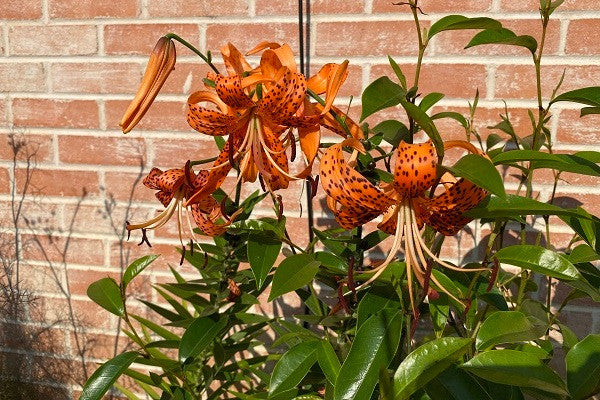
tiger lily florist summerlin TigerLily – The Southern Bulb CoDiscover the Charm of the Tiger Lily The tiger lily (Lilium lancifolium), a beloved heirloom flower with origins in Asia, has found a home in gardens across the southern U. S. Its vibrant orange, spotted blooms add a touch of exotic beauty to any landscape. A Story of Sharing and Connection: The Tiger Lily's Journey One stand I found was in northeast Texas. As I drove by, I saw tiger lilies surrounding every tree at this old home. I knocked on the

Discover the Charm of the Tiger Lily

The tiger lily (Lilium lancifolium), a beloved heirloom flower with origins in Asia, has found a home in gardens across the southern U.S. Its vibrant orange, spotted blooms add a touch of exotic beauty to any landscape.

A Story of Sharing and Connection: The Tiger Lily's Journey

One stand I found was in northeast Texas. As I drove by, I saw tiger lilies surrounding every tree at this old home. I knocked on the door and an older lady and her physically fit, middle-aged son answered. I explained what we do at the Southern Bulb Company, and the son said he would gladly share the black bulbils, (the tiny bulbs from which you can eventually grow a full sized tiger lily plant).

The gentleman, who told me he had served our country in the Army's Special Forces, walked around with me and explained his unsuccessful experience in trying to save the bulbils. Apparently, he found, they do not like to be stacked and left in a coffee can in the garage. "You can't treat them like seeds," he told me. "They'll rot on ya!" I could tell that horticulture had become his passion, and I promised him I'd plant them right away.

I thanked him, both for his military service and for his horticultural service.

Planting and Care for Your Tiger Lilies

Tiger lilies prefer a woodland setting with acidic soil and afternoon shade during their summer blooming season

Planting Time: Plant as soon as you receive the bulbs. If delayed, store them in the refrigerator.
Planting Location:
Choose a spot with about 8 hours of summer sun and well-drained soil. Don't plant during a hard freeze.

Planting Depth: Plant bulbs 2-3 times their height deep (e.g., a 2-inch bulb should be planted 4-5 inches deep).
Watering: Provide ample water as their foliage begins to appear in March and April.

Tiger Lily Multiplication: A Gardener's Delight

Once the blooms are coming to an end, knock off the bulbils and gently scratch them into the soil. With rich organic soil and some moisture, you'll have a stand of Tiger Lilies in just a few years

Attracting Pollinators and Enhancing Your Garden

Tiger lilies are a magnet for pollinators like hummingbirds, bees, and butterflies, adding life and movement to your garden. Combine them with companion plants for year-round interest:

Companion Plants: Salvias, Lantanas, Plumbago, Phlox, Alyssum, Snapdragons, Pansies, Cyclamen, Paperwhites, Narcissus, Iris, Snowflakes, Rain Lilies, Crinums, and Hymenocallis.

Tiger Lily Hardiness and Growing Zones

Tiger lilies thrive in USDA hardiness zones 3-9, making them suitable for a wide range of climates.

Shipping Notes
  • Free Standard Shipping on $100+ Orders to the USA.
  • Except Preorder products are shipped in 48 hours.
  • Delivery to the USA:
  1. Standard Shipping : 3-10 business days
  • If time is of the essence, please consider selecting expedited delivery for faster service.
Exchange/Return Notes
  • We offer a 30-day return/exchange service after receiving.
  • Final sale items are not eligible for returns or exchanges.
  • To process your return/exchange, please contact us at [email protected]
  • Please click here for more details>>> Return & Exchange Policy
SKU: 88822919657

Discover Niche Categories That Outsell tiger lily florist summerlin

Top-Converting Item to Boost Your Average Order

4.0 ★★★★★
Based on 6 reviews
Sort
Highest Rating
Newest First
Oldest First
Product Reviews
W
Walter Echo-Hawk, author of THE SEA OF GRASS.
New York, US
★★★★★ 5
Native American history at its best!
Format: Hardcover
Kent Blansett's engrossing story about the life & times of the famed Mohawk activist Richard Oakes is Native American history at its best. I appreciated the well-written context provided about the birth, growth and impact of the Red Power Movement and the pivotal role that social justice activism played in the rise of modern Indian nations in the United States today. This scholarly work helps us understand modern Native America and is a "must-read" for every Native American Studies student and scholar, as well as readers interested in important American social justice movements.
WAS THIS REVIEW HELPFUL?YesReportShare
Reviewed in the United States on April 1, 2019
P
Verified Purchase
Par
Pawtucket, US
★★★★★ 5
Excellent book on ML
Format: Paperback
This is a great book on machine learning. Topics covered are extensive - from beginner level to advanced topics including math behind different algorithms. However, not "all" algorithms are covered. Please go through the table of contents. The first part - 11 chapters - covers machine learning concepts and second part covers advanced topics with Pytorch. There are lots of excellent code and they work!! The quality of the book I received is excellent. I have gone through all 742 pages, and it has held up very well!! I used Jupyter notebook to run all examples. I created a new notebook and copied and pasted the code and ran them. This approach worked very well for me. At the same time, I could experiment with my take on the code snippets and definitely added to my knowledge. Only issue I have is on the second part of the book discussing PyTorch: (1) Some packages are a bit older version: e.g., transformer 4.9.1 whereas current version is 4.48+. It took some tweaking/recoding to get the examples working. (2) There is not much discussion on why certain architecture was chosen - e.g., number of layers, is there a rule of thumb on how to improve performance by changing these parameters? Even with CUDA the code run for a long time. Therefore, experimenting with different values of parameters become too time consuming. (3) On the same note, if I can achieve test accuracy of 90%+ using logistic regression and almost the same (perhaps one or two percent better with PyTorch with IMDB movie review dataset and that two much faster why should I use PyTorch for this dataset? Obviously, PyTorch is for certain types of problems. Discussions can be included by not adding to the exhaustive (and apt) contents. Personally I was disappointed by lack of any example on time series. Must have for ML practitioner as a reference and guide.
WAS THIS REVIEW HELPFUL?YesReportShare
Reviewed in the United States on December 20, 2024
R
Verified Purchase
Richard Hackathorn
Chelsea, US
★★★★★ 5
Excellent Textbook for Hands-On Learning of ML
Format: Kindle
This textbook is for the serious life-long learners of machine learning. There are at least two ways to ‘consume’ this book. For the expert in ML, this is a textbook to study as a clear comprehensive ML overview and then to dive into sections of interest or ignorance. The concepts are grounded in code examples and are well cited (with links) to sources. Further, this textbook is appropriate if you are TensorFlow-centric and want to broaden into cutting-edge ML models/tools coded in PyTorch. For a new learner to ML, this is a textbook to DO (not just READ) with hands-on and brain-engaged. If you realize that ML is a key life-long skill for your career, consider this textbook as part of a daily learning habit (10-30 min). From personal experience, my advice to the new learner is as follows… First, clone the GitHub repository, setup your Python environment, and study the textbook, while working through the notebooks. Go on tangents and break the code. Do this methodically as part of your daily learning habit, but do not hesitate to jump ahead several chapters to prepare for tomorrow’s meeting. There is enough excellent material here for a full year of ML adventures. I did a similar strategy with Raschka’s first textbook. About four years ago, I had finished Andrew Ng’s Deep Learning Specialization as a student in his first cohort. I knew the concepts well but could not do the actual application coding. I was surprised how my Python coding improved by following Raschka’s clean and elegant style. And Raschka’s code examples were meaty enough to be springboards into working applications. Several textbook editions later, what is different about this new edition? First, it moves you through scikit-Learn (a firm foundation) to PyTorch, instead of TensorFlow. PyTorch is a better stepping-stone, both conceptually and practically. With PyTorch, you will go further with less energy, while being able to convert your efforts into TensorFlow as needed. In addition, most of the cutting-edge ML/AI/DL research is in PyTorch. It is nice to read a recent arXiv paper, clone their repository, click on the Colab tutorial, and replicate their experiments, along with picking up a ton of new coding tricks & tips. I am excited to work through these PyTorch sections to hone my skills. Second, there is a clear recognition of model tracking and tuning practices. This is often a gap in other ML textbooks and courses. Once you progress beyond the simple demo examples in a lecture, you realize that the real work is experiments, more experiments, and still more experiments, so that you must understand what the model architecture and hyperparameters are doing to your dataset. There is good coverage of scikit-Learn pipeline, grid search, model performance, and the like. Third, ML/AI/DL practice is rapidly evolving. Every week new ML packages/services become available that could save much grief on your current project. What is refreshing about Raschka’s textbook series is that he constantly adding cutting-edge topics because he likes to stay current and to help us stay current. Hence, this edition contains recent ML treats as: transformers, self-supervised learning, autoencoders-to-GAN, graph neural networks, DBSCAN, t-SNE (with brief mention of UMAP), and PyTorch-Lightning.
WAS THIS REVIEW HELPFUL?YesReportShare
Reviewed in the United States on February 26, 2022
A
Verified Purchase
Amazon Customer
Port Orchard, US
★★★★★ 4
Just learning it
Format: Paperback
Nice learning book just have to finish it
WAS THIS REVIEW HELPFUL?YesReportShare
Reviewed in the United States on December 10, 2025
K
Verified Purchase
Kindle Customer
Louisville, US
★★★★★ 5
Very useful book
Format: Paperback
I use it for the machine learning class I teach.
WAS THIS REVIEW HELPFUL?YesReportShare
Reviewed in the United States on May 3, 2026

recommand products