SKU: 89046113119
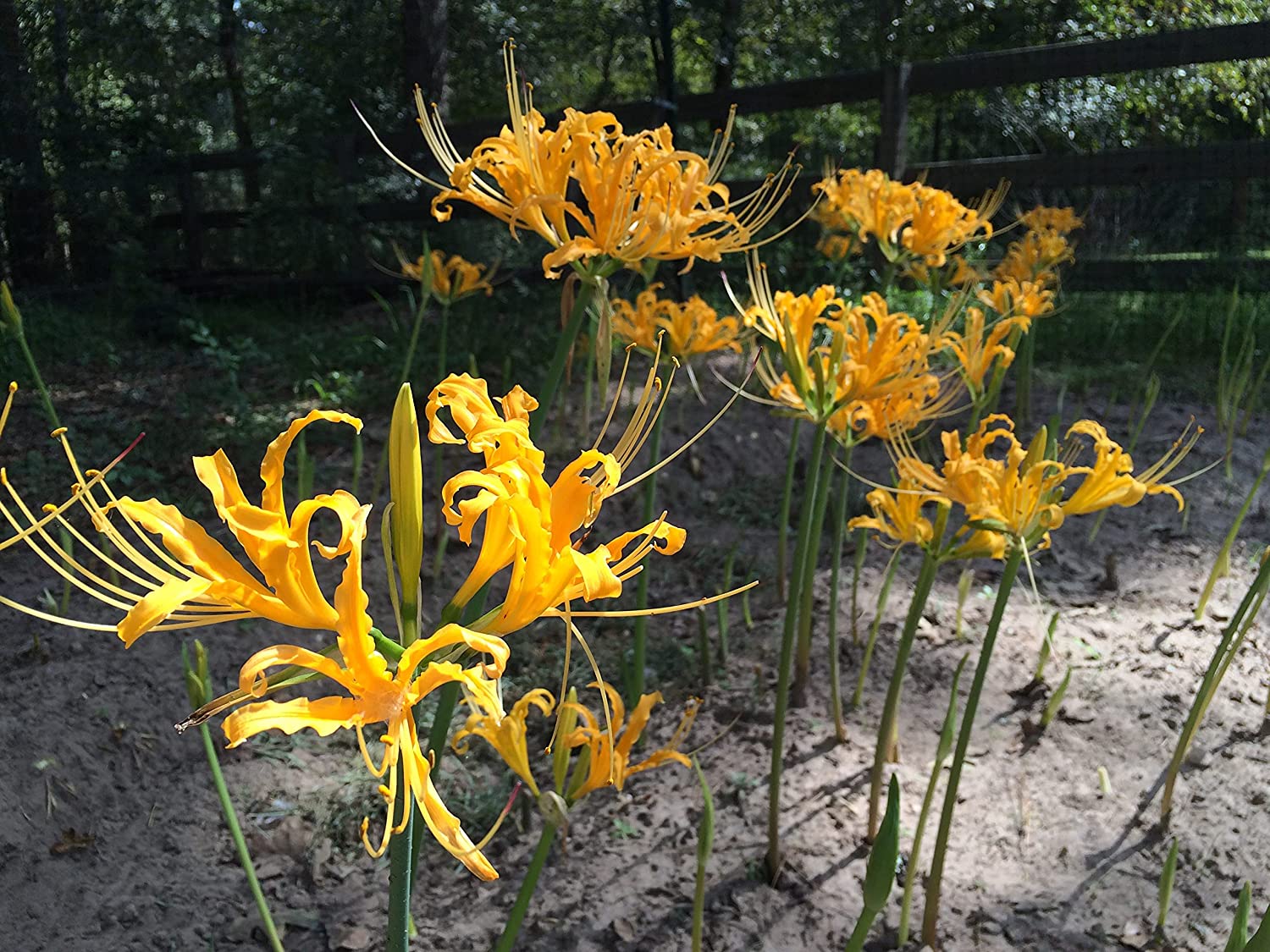
yellow spider lilies lycoris aurea

yellow spider lilies lycoris aurea Lycoris Aurea Spider Lilies Bulbs Radiata Hurricane Lily Cluster Amayllis Growing Bonsai Roots Rhizomes Corms Tubers Potted Planting Reblooming Fragrant Garden Species Blooms Flower Seeds Plant Gardening

Sale price$26.66 Regular price$29.62
Save 10%

Pay in installments of $7.41 with ShopPay, AfterPay and Klarna

Shipping Estimate
USA
  • USA
  • CAN

Ships within 48 hours · Estimated delivery Sep 11 - Sep 16

Promo Codes Available:

For Your Every Summer RSVP, with Code: SUMMER15

Description

yellow spider lilies lycoris aurea Lycoris Aurea Spider Lilies Bulbs Radiata Hurricane Lily Cluster Amayllis Growing Bonsai Roots Rhizomes Corms Tubers Potted Planting Reblooming Fragrant Garden Species Blooms Flower Seeds Plant GardeningAbout this item What is Lycoris? Lycoris has a few common names; Spider Lily, Hurricane Lily and Cluster Amayllis are just a few. Lycoris aurea (Yellow flower) Lycoris radiata (Red flower) comes from the Amaryllidaceae family and originates from China. Lycoris is a bulbous perennial with a clumping habit. These hardy members of the Amaryllis family are dormant during the Summer months and bear their beautiful flowers during Autumn before growing

About this item

  • What is Lycoris?

    Lycoris has a few common names; Spider Lily, Hurricane Lily and Cluster Amayllis are just a few. Lycoris aurea (Yellow flower) Lycoris radiata (Red flower) comes from the Amaryllidaceae family and originates from China. Lycoris is a bulbous perennial with a clumping habit. These hardy members of the Amaryllis family are dormant during the Summer months and bear their beautiful flowers during Autumn before growing foliage in the cooler months. Flowers are presented on a tall stem with 4 to 5 flowers. The flowers are made of narrow ruffled petals of brilliant golden-yellow or striking red depending on the variety with long whiskery stamens. Flat greyish-green leaves appear after flowering has finished. They like a hot sunny position during the warmer months, and grow best when they are left undisturbed. Shelter from the wind would also be recommend.

  • Benefits of Growing Lycoris

    Lycoris are a good source of low maintenance Autumn and Winter colour. They are fantastic for borders, rockeries or shrubberies. Lycoris can even be kept in pots and containers. The bulbs are best left in the ground to naturalise. If they are left undisturbed, they will produce more flowers. Lycoris make excellent cut flowers. Cut flowers will last up to 3 weeks in water.

  • Where to Plant lycoris

    Lycoris grow best in conditions where the soil drains well, and they will receive plenty of sun. They will survive with 5âââ€? hours of direct sun per day, but more sun encourages prolific flowering. If you notice water puddles 5âââ€? hours after a hard rain, scout out another site or amend the soil with organic material.

  • When to Plant lycoris

    The ideal time to plant Lycoris bulbs is between late summer and early fall. The roots will form in the autumn, with leaves developing in spring and flowers following roughly 6 weeks thereafter.

  • How to Plant lycoris

    For outdoor landscape planting, find a spot with well-drained soil where your Lycoris will receive full sun. Dig holes and plant your bulbs 6âââ€?" apart with their necks above the surface and their pointed tops facing upwards.
    For container planting, locate a vessel large enough to support your plants with adequate drainage holes and fill it with a commercial potting mix that drains well. Dig holes and plant your bulbs 6âââ€?" apart with their necks above the surface and their pointed tops facing upwards. Place your container where it will get full to three-quarters day direct sun.
    Water thoroughly to settle the soil around the bulbs.

  • How to Grow lycoris

    Water as needed during active growth periods, with no more than 1" of water per week as an estimate.
    Leave the foliage in place after blooming has finished for the season. The leaves gather sunlight, create food through photosynthesis, and strengthen the plant for the future.
    Remove the foliage when it turns yellow and withers.
    Withhold water after removing the foliage and allow your Lycoris to rest for a few months before beginning the next growing cycle.

  • Lycoris Tips & Tricks

    Amend soil with compost, finely ground bark, or decomposed manure to raise the level 2âââ€?" to improve the drainage.
    Feel free to cut flowers when in bloom for dramatic bouquet additions, as doing so will not hurt your plants.
    Ensure that your Lycoris plant never sits for long periods in waterlogged soil.
    Plant in trios or add other bulbs, annuals, or perennials, around your Lycoris to fill out container plantings and create a lush display.

Why Seedsplant ?

  • Experts in the field
  • Family owned and operated - 100 years
  • Rigorous quality control
  • We strive for your success by offering the bulb size you need
  • Affordable quality

Flower Bulb Facts of Life

Bulbs: Beauty In a Bottle:

Bulbs are a natural product. And, as such, follow a natural cycle of growth and rebirth. Enjoying their fabulous flowers means planting ahead in one season then results the next. Bulbs are among the easiest flowers to grow, not only are they affordable, but bulbs offer the most stunning colors available. Even the most novice gardener can create a breathtakingly beautiful spring garden with bulbs.

What's a Bulb?

A flower bulb is really a self-contained flower factory. Within this marvelous little package is nearly everything the flower needs to come to life! Split a bulb open, for instance, and you'll see its baby flower bud, leaves, roots, stem and food supply. All bulbs need from you is to be placed in the ground at the appropriate season of year, given a liberal drink of water then left to work their magic.

Variety:

Flower bulbs come in seemingly limitless varieties which makes them perfectly suitable for any garden design you can dream up.

Is It a bulb ?

The Difference Between Bulbs, Corms, Tubers, Roots,Today, people commonly us the term 'bulb' to refer to any plant that stores its own food underground. But, in truth, many popular 'bulbs' are not true bulbs at all. These include corms, tubers and roots and, while they all produce beautiful flowers, technically the plants are different

When To Plant

In fall, after soil temperatures are below 50ºF/10ºC. These bulbs bloom the following spring and require the cold winter temperatures for development. But let's say winter arrives and your bulbs are still in their bag. Not to worry! Bulbs are pre-programmed to grow so even if you have to plant through snow, plant your bulbs!

How To Plant

Most bulbs thrive in either full or partial sun and in almost any location with good drainage. Avoid planting at the base of hills or under drainage pipes where water collects and will rot the bulbs.

  • Dig a hole
  • Drop in the bulb
  • Water thoroughly

Tips For success

  • A larger grouping of flower bulbs are far more fab than just a few planted here and there. Think clumps of color.
  • Buy the largest bulbs you can find.
  • Note the flowering times. Not all bulbs will bloom at the same time. A little planning will greatly increase the number of months you will enjoy bulb flowers.

Passionate About bulbs

Generally speaking, the best predictor for gardening success is bulb size. Almost always, the larger the initial bulb size planted, the larger and stronger the plants will be, producing more flowers. The first year end result will be noticeable to anyone.The best predictor for gardening success is bulb size.

Shipping

All items are shipped usually within 2 working days (usually sooner) except plug plants. Plants only dispatch Monday-Thursday to avoid problems with live plants sitting in a postal depot over the weekend. During busy periods , due to the nature of product and extra care needed when packing and preparing for post, please allow up to 7 days for delivery (depending on day purchased). Plants are only dispatched when crops are ready to travel , therefore some multi orders may be delivered separately and occasionally it may be necessary to hold back dispatch until plants are ready. Shipping is either via Post  or 24/48 Hour courier depending on order size/weight etc. at our discretion. Please be patient when ordering plants as you cannot rush nature. Please be aware delivery dates shown by Seedsplant are estimates only and do not apply to live plant orders. Any orders returned to us by Post or Courier will incur a further postage charge to resend.

Returs

You may return all unopened items within 14 days of delivery for a full refund less P&P charges. Any items received damaged in transit must be notified in writing/email within 24 hours of receipt. Live plants should arrive in perfect condition , If however for some reason they do not please contact us immediately upon receipt. A full refund including original P&P will be made for any items not as described or wrong part no etc. All returns must include your full details with a copy of original receipt. You may cancel any transaction as long as notice is received before item(s) are / have been dispatched.

Contact us

You can message us through Seedsplant messages , otherwise You can write to us by email :[email protected]

Shipping Notes
  • Free Standard Shipping on $100+ Orders to the USA.
  • Except Preorder products are shipped in 48 hours.
  • Delivery to the USA:
  1. Standard Shipping : 3-10 business days
  • If time is of the essence, please consider selecting expedited delivery for faster service.
Exchange/Return Notes
  • We offer a 30-day return/exchange service after receiving.
  • Final sale items are not eligible for returns or exchanges.
  • To process your return/exchange, please contact us at [email protected]
  • Please click here for more details>>> Return & Exchange Policy
SKU: 89046113119

Discover Niche Categories That Outsell yellow spider lilies lycoris aurea

Top-Converting Item to Boost Your Average Order

4.1 ★★★★★
Based on 27 reviews
Sort
Highest Rating
Newest First
Oldest First
Product Reviews
W
Verified Purchase
Wald1900
West Palm Beach, US
★★★★★ 5
Fascinating Insights into the Origins of American Racism
Format: Paperback
This is a fantastic, must read book for anyone interested in the origins of American racism. Morgan recounts the cultural, economic and political evolution of the 17th and early 18th century Virginia, and with it, makes comprehensible the reasons why racial slavery emerged as an integral component to the development of the white community's pre-revolutionary ideals of independence and liberty. At the founding of the Jamestown colony in 1607, Virginia offered vast tracts of land available to anyone willing to make the trip and who could survive their first season (or two or three) in the New World. Unlike in England where opportunities for land ownership were constrained, the fact that Virginia land was to be had for the taking made the economic equation simple - more labor = more profits. To provide this labor, England's surplus poor (of which there was an overabundance) were sent to Virginia as indentured servants for a period of four to seven years in order to work off the costs of their relocation. Once their indenture period was over, they were free.....and poor. Over time, as established interests grabbed more and more of the land, opportunities for released bondsmen decrease, essentially creating an ever-growing class of destitute (and thoroughly despised) whites who threatened the social and political stability of the colony. Racial slavery was introduced over time to stem this proliferation of poor whites, who, after having served the term of their indenture, were free to be a "blight" on the community. These planter elites were also constantly at political war with a succession of governors appointed by the crown to manage the affairs of the colony in a manner most beneficial to the king. By enfranchising poor whites and enlisting their support for the colonial assembly, the elites were able to exercise political power over affairs of the colony in a manner most beneficial to the colonists, rich and poor alike. The result of these forces caused a major adjustment in white social strata - the role of detested poor who would only work under the threat of the lash was imposed upon enslaved blacks, and poor whites were elevated to the level of political partners with the elites. This simultaneously endowed all whites with a fierce sense of entitlement over their political rights and the prerogatives of power on the one hand, and contempt for their black slaves on the other. Liberty and equality came to be seen as inalienable birthrights while slavery was the means by which the "shiftless, lazy, indolent" poor could be transformed from burdens on society to positive (albeit brutally coerced) contributors. In other words, Virginia whites came to think of blacks with the same sense of scorn and contempt that English aristocrats held for the poor in England while, at the same time, assuming as a birthright the same sense of political entitlement enjoyed by the elite class in England. It was this, to our modern eyes, bizarre combination of egalitarian and tyrannical ideals that informed and inspired Jefferson, Washington and Madison (among others) as they participated in the formation of what would become the United States. The implication of this history on modern political discourse is obvious. Those who today passionately cite the liberty-loving ethos of the founding fathers while simultaneously exhibiting contempt for the poor are only looking at one side of the equation. For the Virginians, slavery and liberty went hand in hand; without the one there could not have been the other. A full, rich and nuanced understanding of our heritage compels us to recognize the human inclination to despise and exploit the powerless with the same vigor and passion that we celebrate the ennobling power of freedom. On a final note of criticism - while the book does a masterful job of making the origins of colonial racism comprehensible, it does so at the expense of "black experience" narratives. The story addresses issues of slavery only to the extent of discussing laws passed throughout the pre-revolutionary period in order to institutionalize it and the effect these laws had on the attitudes of whites towards blacks. I started the book expecting a far deeper dive in this area, and was disappointed by how little was presented concerning the evolution of slavery throughout the 17th century from a black perspective. After having read the book, I concede that this deeper dive was not strictly necessary in order for the author to prove his thesis, yet it would have been a stronger work had greater efforts in this area been made.
WAS THIS REVIEW HELPFUL?YesReportShare
Reviewed in the United States on February 23, 2013
R
Verified Purchase
Reader KA
Birmingham, US
★★★★★ 5
Great Historical Reading
Format: Paperback
I found "American Slavery, American Freedom" to be a thought-provoking book that contained a great deal of useful information. I wrote in the margins of the book, took notes, and highlighted entire pages. "American Slavery, American Freedom" was well-written and enjoyable to read. I had read countless books on slavery over the years. This book did not focus primarily on slavery. A detailed description of the steps and events that led to the creation of the Commonwealth of Virginia can be found in "American Slavery, American Freedom." The history of Virginia is characterized by slavery and servitude. Since many of the books I had read on slavery lacked a compelling backstory, I found this book refreshing. As far as I can tell, the author denied or downplayed the fact that Thomas Jefferson fathered many children with a slave named Sally Hemmings. The author probably worked on this book for years before its publication in 1975. There was a possibility that Edmund Morgan did not want to write about any "touchy" topics. "American Slavery, American Freedom" was a pleasure to read. I would recommend it to others.
WAS THIS REVIEW HELPFUL?YesReportShare
Reviewed in the United States on September 30, 2020
S
Verified Purchase
Sceptique500
Port Orchard, US
★★★★★ 4
Disturbing Questions
"Racism became an essential, if unacknowledged, ingredient of the republican ideology that enabled Virginians to lead the nation." writes Edmund S. Morgan in 1975, and ends this book with the rhetorical question: "Is America still colonial Virginia writ large?" These are deeply disturbing questions - questions one is compelled to ponder as one reads this lucid and dispassionate presentation of the how primitive accumulation in Virginia at the beginning of the 17th century was replaced a century later by an orderly and opulent society based on slavery. The answer to such questions is not made easy by the realisation that the only other successful republican experiment - the Athenian democracy - blossomed too on a bed of slavery. Do these questions matter today? Have we not moved on from racism? I'm afraid not. Again the voice of Morgan: "In the republican way of thinking, zeal for liberty and equality could go hand in hand with contempt for the poor and plans for enslaving them." Sounds eerily familiar? Just as today's language used to describe terrorist threats is redolent of the rhetoric that once surrounded the lynching of black bodies. Racism (albeit globalised) is re-visiting the land today, and so are republican virtues and values. The book is long, and in some ways, too detailed. Morgan delights in the telling particular, and at times one wishes he would not linger on some specifics. But this has a purpose. He wants to show the imperceptible and surreptitious mechanisms by which a society acquires its ugly and immoral traits until they become so natural as to be invisible. Step by step, event by event, law by law a construction emerges that would have horrified its founders. Yet, at the time, it seamed the logical, and the right thing to do. A strong point in Morgan's narrative is the links he highlights between the developments in Virginia and the Britain's commercial interests, migration policies, population growth and control, state revenue, and political history or thought. One can better appreciate the import of Virginia for Britain and the mother country's fixation and fascination for the North American colonies. Brash and brutal, Virginian slavery stood openly as godmother at the foundation of the American Republic. Other aspects of slavery also contributed significantly - but as they were indirect, they remained veiled and are hardly recognised even today. New England benefited greatly from its cod trade to the Caribbean, where the product that was found to be unfit for European markets was fed to the slaves, thus freeing up land that otherwise would have been used to sustain them. When will we get a total picture of slavery's import for America's economic foundations?
WAS THIS REVIEW HELPFUL?YesReportShare
Reviewed in the United States on July 8, 2003
P
Verified Purchase
Paul
Whiting, US
★★★★★ 5
how a country could develop a "national character" founded on the love of liberty while simultaneously importing thousands and t
Format: Paperback
This book lays out hte paradox, how a country could develop a "national character" founded on the love of liberty while simultaneously importing thousands and thousands of bondsmen to provided the "free people" with the necessities of life: i.e., why slavery was necessary to support the kind of freedom the white folk wanted to become accustomed to.... and implicitly, why the industrial revolution finally changed the hearts and minds of enough Americans to make slavery seem unnecessary and therefore, if was no longer a necessary evil, why it had to be overthrown. Morgan writes objectively -- but his feelings are always detectable through his writing style, which is perhaps the best academic English to be found anywhere. I found it gripping. The book was published in 1972, and has doubtless been corrected by many subsequent researchers in some of its particulars -- but it was the fountainhead for a new way of understanding American history that young people all have learned about in high school, but which many baby-boomers have never seriously encountered. Reading it accomplished a MAJOR retrofit in my sense of how the USA got to be the way it is today. Not to put too fine a point on it, the Tea Party and many trump supporters seem to adhere to the values of the original American Republicans [and to think that Black folk should be pushed back to a place where their feelings don't matter], and to long for a return to the status quo ante -- with ante referring to a time long LONG ago
WAS THIS REVIEW HELPFUL?YesReportShare
Reviewed in the United States on August 15, 2016
R
Verified Purchase
Richard C. Wolfinger
Natrona Heights, US
★★★★★ 5
U.S. American Genesis
Format: Kindle
Kindle edition worked well. Very interesting and insightful read by a first rate historian. Tells the story of how our ancestors transitioned from Englishmen to Americans. A book well worth taking the time to read.
WAS THIS REVIEW HELPFUL?YesReportShare
Reviewed in the United States on June 8, 2022

recommand products