Pay in installments of $7.26 with
 ,
,
 and
and

Shipping Estimate
USA
- USA
- CAN
- USA
- CAN
Ships within 48 hours · Estimated delivery Sep 15 - Sep 20
 Promo Codes Available:
For Your Every Summer RSVP, with Code: SUMMER15
Description
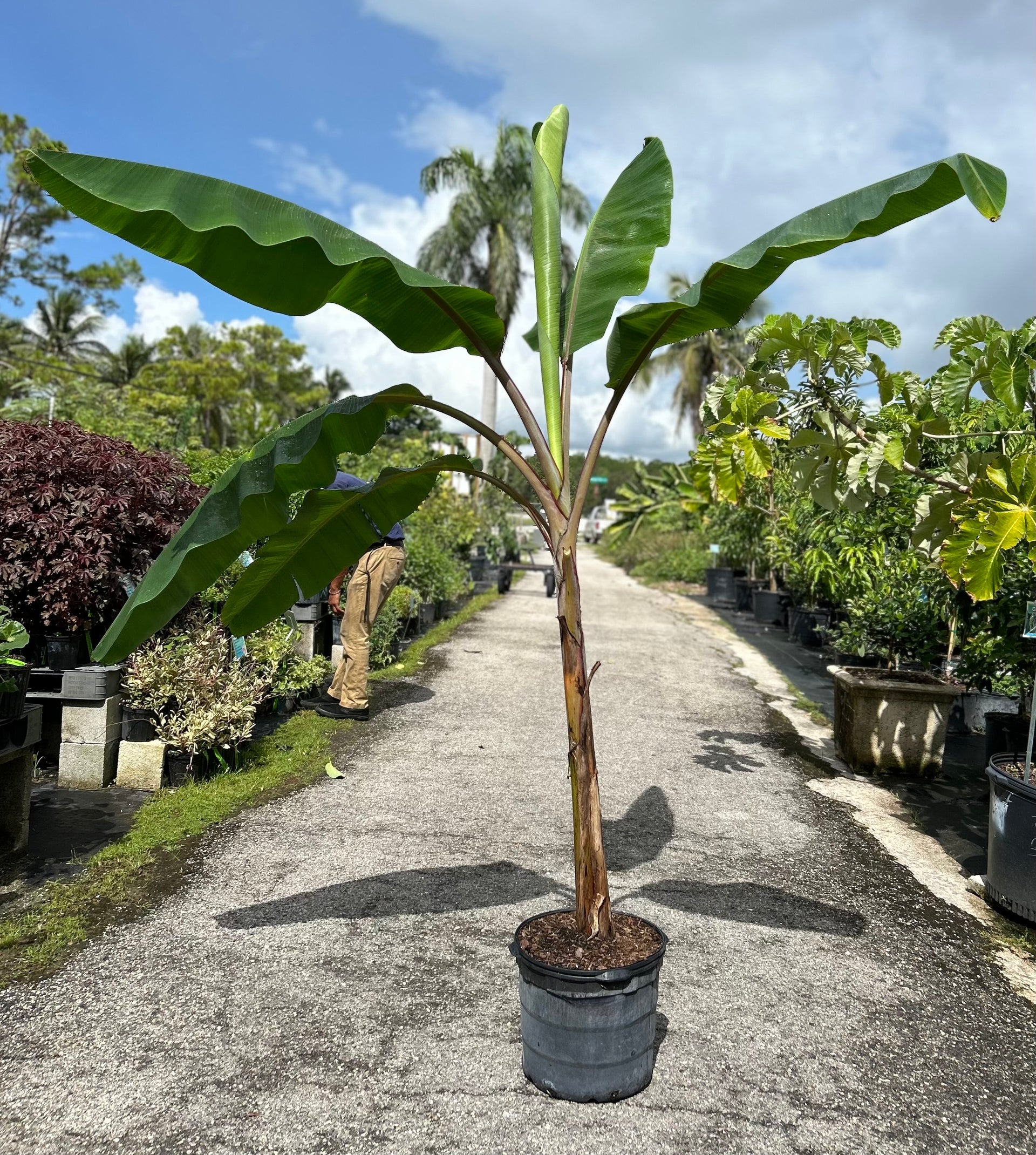
banana pot plant Banana Plant 'Dwarf Red' – Incredible Edible LandscapesDwarf Red, also known as Jamaican Red or Cuban Red (all the same plant) is an interesting and sought after banana, whose fruit has a distinct red skin. The plant also has a beautiful red tone to the leaf margins, stems, and stalk. The fruit is flavorful, rich and sweet, and has an orange color to the inner flesh, indicating high levels of beta carotene. Dwarf Red is a beauty in the landscape, and grows slowly with fruit developing at a height of 6 8
‘Dwarf Red’, also known as Jamaican Red or Cuban Red (all the same plant) is an interesting and sought after banana, whose fruit has a distinct red skin. The plant also has a beautiful red tone to the leaf margins, stems, and stalk. The fruit is flavorful, rich and sweet, and has an orange color to the inner flesh, indicating high levels of beta carotene. ‘Dwarf Red’ is a beauty in the landscape, and grows slowly with fruit developing at a height of 6-8 ft.
_________________________________________________________________
Latin name - Musa x paradisiaca
Bananas are one of the easiest and most exciting fruit producing "trees" to grow in Florida! Botanically speaking they are not a tree, but rather a large herbaceous plant. Most varieties will produce their first bunch about 12 months after planting, with routine harvests every 3-6 months at maturity. Banana plants are beautiful in the landscape, and can be fit into smaller spaces than most trees. Overall, bananas may in fact be our #1 favorite fruiting plant to grow for many reasons, including their resiliency, year-round fruit production in South Florida, and the vibrant energy they offer to any landscape.
Banana plants as we know them are the result of thousands of years of human selective breeding efforts, in an effort to improve their usefulness as a food crop. As the Latin name Musa x paradisiaca suggests, modern Bananas are a hybrid of two original wild species: Musa acuminata and Musa balbisiana. These originated in two different regions of Southeast Asia: M. acuminata from the tropical islands, and M. balbisiana from the mainlands at higher elevation. The two species naturally hybridized, and eventually variations with seedless fruit were discovered, forming the foundation for the Banana that we know and love today.
Banana plants grow from an underground root mass called a corm. The roots are very shallow and grow quickly, seeking water and nutrients in the soil. When planting Bananas in your yard, it’s important to note that they do best when fertilized, watered, and mulched well.
After growing for a period of time, Banana plants will flower and produce a large “bunch” of fruit at the top of the plant. After several months, when the fruit is mature and ready to be picked, the entire fruit-bearing stalk is cut down, and the fruit is harvested. During this time, small “pups” form at the base of the plant, and grow quickly. After the main fruiting stem is harvested and cut down, the next-largest pup will grow to be its successor, fruiting once again within the next few months. From the time of initial planting to first harvest, with good cultivation, it can take an average of 12 months for fruit to develop and mature, and after initial fruiting you can expect a harvest every 3-6 months. The Banana plant will produce additional pups which can be dug up and removed, and replanted elsewhere. We recommend, in order to keep your banana plant productive and vigorous, to limit each plant to 3-4 pups at most and remove the excess. Banana plants do require a special type of maintenance which is different from other fruiting trees, but are quite rewarding in exchange and we consider them one of the best fruiting plants to grow in South Florida. We have more Banana plants than any other type of fruit planted at our farm.
Banana cultivars exhibit a vast diversity of growth habits, fruiting tendencies, flavor and sugar/starch levels, and visual appearance. Plantains are actually the same species, but are put into a different category due to the larger, starchier fruit which is mostly eaten cooked, either green or ripe. Our collection of both Bananas and Plantains has grown over the years, and we have learned to appreciate each variety for its unique characteristics.
We categorize Banana varieties by a few metrics.
Height: The height at which the fruit typically hangs. Leaves usually extend higher.
Production: Whether the plant is a heavy or light producer, and frequency of harvest.
Fruit quality: Overall taste, and typical use of the fruit (i.e. fresh eating “dessert” bananas, or cooking bananas)
Hardiness: Overall toughness and vigor of the plant, including wind resistance and resistance to pests and disease. This does not include cold tolerance– all bananas are damaged by freezing temperatures, however some will recover quicker than others.
Check the individual listings for each variety for a fuller understanding of each banana and its various qualities. We are continuously evaluating the plants at our farm and will update these listings as new information comes to light.
_________________________________________________________________
Size: Varies by cultivar
Sun Requirements: Full sun to part shade (Full sun=highest production, Shade=reduced)
Cold Hardy: 32 degrees
Harvest Season: Year-round
Watering requirements: Loves water, but can tolerate dry periods as long as they are mulched heavily
Shipping Notes
- Free Standard Shipping on $100+ Orders to the USA.
- Except Preorder products are shipped in 48 hours.
- Delivery to the USA:
- Standard Shipping : 3-10 business days
- If time is of the essence, please consider selecting expedited delivery for faster service.
Exchange/Return Notes
- We offer a 30-day return/exchange service after receiving.
- Final sale items are not eligible for returns or exchanges.
- To process your return/exchange, please contact us at [email protected]
- Please click here for more details>>> Return & Exchange Policy