SKU: 95100247904
indoor plants string of pearls

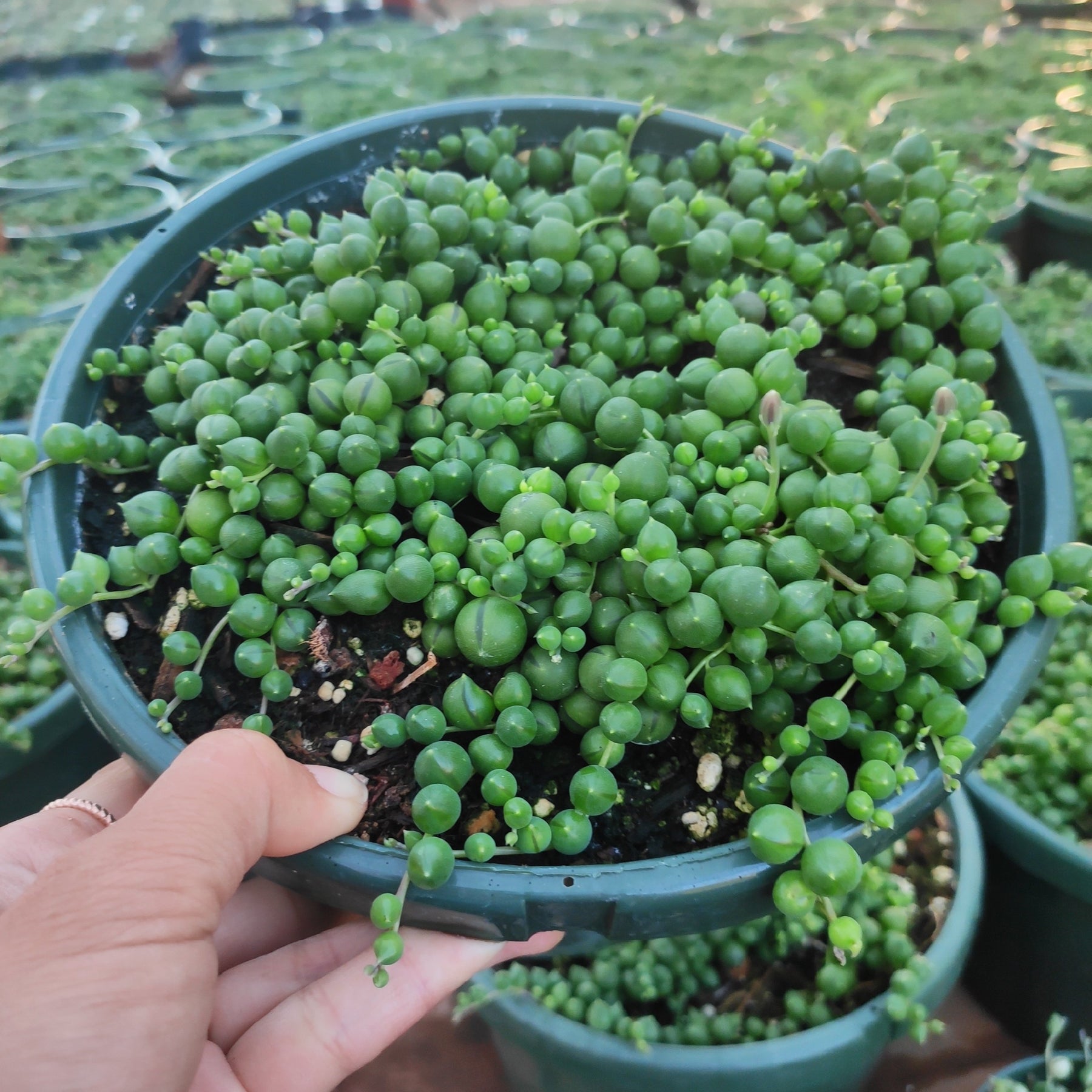
indoor plants string of pearls String of Pearls Senecio rowleyanus 4 Inch

Sale price$25.92 Regular price$28.80
Save 10%

Pay in installments of $7.20 with ShopPay, AfterPay and Klarna

Shipping Estimate
USA
  • USA
  • CAN

Ships within 48 hours · Estimated delivery Oct 21 - Oct 26

Promo Codes Available:

For Your Every Summer RSVP, with Code: SUMMER15

Description

indoor plants string of pearls String of Pearls Senecio rowleyanus 4 InchString of Pearls is commonly grown as a houseplant or an outdoor ornamental in frost free climates. It is often grown in hanging baskets to allow the trailing stems to spill downward. It could also be grown in a flat dish, allowing it to maintain the trailing growth habit seen in the wild. Indoor containers can be moved outside for the growing season but need to be acclimated gradually to prevent sunburn, should be protected from excess rainfall, and

String of Pearls is commonly grown as a houseplant or an outdoor ornamental in frost-free climates. It is often grown in hanging baskets to allow the trailing stems to spill downward. It could also be grown in a flat dish, allowing it to maintain the trailing growth habit seen in the wild.

Indoor containers can be moved outside for the growing season but need to be acclimated gradually to prevent sunburn, should be protected from excess rainfall, and must be moved back indoors before frost.

The plant grows from weak surface roots, producing trailing stems up to three feet long on the ground which can root where they touch soil to form dense mats. It often grows under bushes or between rocks which provide some protection from intense sunlight. The alternate, water-storing leaves are the size and shape of small peas (each to 1/4” diameter) with a small pointed tip on the end and a thin stripe of dark green along the side.

The round shape of the leaves minimizes the surface area exposed to dry desert air and therefore reduces evaporative water loss but also reduces the surface area where photosynthesis can occur compared to a normal thin, flat leaf.


Care Tips

Light: Ideals are full to partial sunny locations or only bright locations directly behind a window.  The String of Pearls plant can spend the summer in the garden or on the balcony. There it must be slowly accustomed to the sun, which is no longer filtered through a window. Otherwise its leaves may burn.

Water: Senecio rowleyanus is a succulent plant and can store water in its thick leaves. It does not have to be watered until the soil is nearly dry. Water sparingly if placed cool to temperature during winter.

Soil: Not only a cacti mix is suitable, peat-free mixtures for indoor plants, herbs or vegetables can also be used. 

Temperature: A cool winter location at temperatures between 10 to 15 °C (50 to 59 °F) is required to get Senecio rowleyanus to bloom. However, it can also be wintered at room temperature. Minimum temperature is 5 °C (41 °F).

Potting: In the first year after purchase or repotting, Senecio rowleyanus does not require fertilization. Liquid fertilizer can be given every 4th to 8th week if the plant is actively growing. The growing season usually lasts from spring to autumn.

Humidity: Any average household humidity level is fine for String-of-Pearls, but try to keep it at about 50% or higher.


Shipping & Handling

    • The 2 Inch and 4 Inch String of Pearls plants are shipped with the pot and soil
    • The 6 Inch and 8 Inch String of Pearls plants are shipped bare roots without the pot and soil:
    • You will receive a very similar plant to the one shown in the photos; shape and color may vary
    • Ship within USA & its outlying territories only
    • Please visit Order Processing & Shipping info page for additional details


    Care Instructions

    Please visit our Succulent Care info page for more details.

    To ensure the health of succulents, it is important to plant them in porous, well-draining soil. Succulents require little watering, but don't like to sit in wet soil. To create an adequate cactus mix, simply add pumice, perlite, or grit to cactus soil to provide the proper drainage.

    Make sure to leave drought periods between waterings to prevent the plant from water-logging.


    Weather Conditions

    • When ordering, be mindful that living succulents can be damaged by the cold weather.
    • If you live in an area that is below 40 degrees Fahrenheit, please add a shipping warmer to your order or consider purchasing plant until the weather is more suitable.
    • Shipping Warmer: 72+ Hours Heat Packs available for $1.7 each
      Shipping Notes
      • Free Standard Shipping on $100+ Orders to the USA.
      • Except Preorder products are shipped in 48 hours.
      • Delivery to the USA:
      1. Standard Shipping : 3-10 business days
      • If time is of the essence, please consider selecting expedited delivery for faster service.
      Exchange/Return Notes
      • We offer a 30-day return/exchange service after receiving.
      • Final sale items are not eligible for returns or exchanges.
      • To process your return/exchange, please contact us at [email protected]
      • Please click here for more details>>> Return & Exchange Policy
      SKU: 95100247904

      Discover Niche Categories That Outsell indoor plants string of pearls

      Top-Converting Item to Boost Your Average Order

      4.4 ★★★★★
      Based on 26 reviews
      Sort
      Highest Rating
      Newest First
      Oldest First
      Product Reviews
      J
      Verified Purchase
      J. E. Lindsey
      Draper, US
      ★★★★★ 5
      Great Contrasts
      Format: Paperback
      Cowan tells us, "This is a book about apologetics methodology, not a book of apologetics per se. That is, it is not a book that seeks to do apologetics as much as a book that discusses how one ought to do apologetics" (8). Cowan has achieved the stated purposes of this book in many ways, but due to limited space I will stay focused on three examples; Glossary of Key Terms and Concepts, format, and conclusion by Cowan. Glossary of Key Terms and Concepts (21-24) in this initial section of the book provide a clear and useful starting place for persons who are not academically familiar or comfortable with many terms used in the book. The fact that the key terms section included and defined conceptual terms supports the stated purpose of the book being a methodological rather than an apologetic book with multiple views from various writers' specific understandings and preferred styles of apologetics. As a new person to formal apologetics, this section helped launch me smoothly into the methodological discussions. I returned to these pages a few times to reacquaint myself with meaningful concepts. The format of the discussion with proponents making a methodological case for their form of apologetic followed by critiques from supporters of other apologetic systems brought clarity to the five methods addressed in this book. This format help to highlight both strengths and weaknesses in methods. Cowan as the general editor achieved the goal of keeping the writers away from apologetics and on the goal of providing defense and critiques of these five methods. Each supporter had a unique "tee-up" to their sections. Craig starts by stating, "...methodology in Christian apologetics...raising the age-old issue of the relationship between faith and reason." He goes on further in his introduction to tell a story about his struggle at Wheaton College and why his methodology was helpful to his faith (26). Habermas clarifies that his form of evidential apologetics is, "...characterized as the one-step approach..." (92).This initial piece of information was insightful to me and a helpful clarification between classical and evidential methods. Feinberg on Cumulative Apologetics points out, "A good place to begin the discussion of apologetic methodology is to ask about the nature of the case for theism and Christianity" (148). Frame was probably the most direct in his initial statement by saying, "In apologetics, as in every aspect of the Christian life, the most important thing is to glorify God. Therefore, it is important for us to look in God's Word, the Bible, to see if our Lord gives us any directives relevant to the apologetic task" (208). In principle agree, but I will admit, I find his form of apologetics to be too circular in nature to be convincing to an unbelieving skeptic - as a standalone method. Christians I think would all say, well of course. Clark's section begins with stories meant to set the stage that it is reasonable have faith. Clark writes, "My suppose-this and suppose-that stories are intended to raise the problem of the relationship of our important beliefs to evidence" (267). Each of the five supporters of their method successfully introduced their unique method of apologetics. Cowan regarding to his conclusions says, "Hopefully, this will not only help you, the reader, make your own decisions regarding apologetic methodology, but will also provide a basis for further discussion of the topic among scholars. Cowan's conclusions assured that main points of agreement and disagreement were clear. Here as with the other sections, the textual comments were method focused. My criticism is pointed at the spirit of the debate. The writers did not draw enough contrasting between apologetic methods to clearly show that their individual method should be favored. I think the tone was a little too stilted in the direction of "playing" nice. In a book that purports to have five methods, there were times it seemed like only three or four methods. I guess this is inescapable give that each apologetic style can share some parts in common with another. Yet Craig shares my feeling here, I believe, based on his statement, "Pity our poor editor! Ideally he would like to find a wild-eyed fideist on one end of the spectrum and a hard-nosed theological rationalist on the other. Instead he winds up with a presuppositionalist who argues like an evidentialist..." (122). Overall Five Views on Apologetics provides a good compare and contrast resource for anyone interested in these five common methods of apologetics.
      WAS THIS REVIEW HELPFUL?YesReportShare
      Reviewed in the United States on March 18, 2011
      M
      Verified Purchase
      Mimi
      Fort Morgan, US
      ★★★★★ 5
      Condense Analysis of 5 of the most notable Apologist
      Format: Paperback
      Looking for a quick reference guide to the major theorist of Apologic study, this book is a great resource.
      WAS THIS REVIEW HELPFUL?YesReportShare
      Reviewed in the United States on October 12, 2024
      W
      Verified Purchase
      Will L.
      Lexington, US
      ★★★★★ 5
      Not an Intro to Apologetics
      Format: Paperback
      This book is not for the first-time student of apologetics. It's deep and, at times, difficult. However, for anyone with a serious interest in apologetics, this is a great way to find out which method suits your apologetic style and why. It was eye-opening for me. I am confident that God can use most (if not all) of the five distinct methods covered in the book. But it was very helpful to me to consider pros and cons of each and decide which approach seemed appropriate for me. Great book, if you feel ready for it!
      WAS THIS REVIEW HELPFUL?YesReportShare
      Reviewed in the United States on July 25, 2006
      R
      Verified Purchase
      rkveale
      Los Angeles, US
      ★★★★★ 4
      Good overview of apologetic methods but ....
      Format: Paperback
      I very much enjoy the counterpoint series by Zondervan. It can help me quickly come up to speed in a variety of theological topics. This book has 5 contributors and each one presents, each one comments on each other's essay and finally each one has some concluding remarks which allows the reader to readily judge the competing opinions. However after reading the various approaches it appears to me that the apologetical approach one uses is not as important as learning the various theistic arguments (both positive and negative) and then putting them into practice. I'm not convinced that studying apologetic methods will be that helpful. This is because the various approaches overlap and also because when actually talking with people one must be very flexible and move deftly with the flow of conversation. Yet still I give this book 4 stars as there are 5 top Christian thinkers contributing to this subject. On a personal note, one reason I read this book is because I was puzzled by presuppositional apologetics. I stand firmly in the reformed camp and I audited iTunesU courses in apologetics from Reformed Theological Seminary and Westminster Theological Seminary and was still confused on how presuppositional apologetics works in actual practice. I must sat that after reading this book I still don't see how this approach is useful in defending the faith. I have respect for John Frame but this apologetical approach seems more like a non-approach. I'll be moving on to more fruitful endeavors such as actually learning specific defenses for the Christian faith.
      WAS THIS REVIEW HELPFUL?YesReportShare
      Reviewed in the United States on November 23, 2011
      S
      Verified Purchase
      Slemmonade
      Carnegie, US
      ★★★★★ 5
      Academically Helpful: Not a How To Book
      Format: Kindle
      I have to say that I respect all of the apologists who contributed to this book. As a student of apologetics it is interesting to see the perceptions of the different methodologies, but there is no real guidance on "how to defend the faith"...so, there's that. Truth be told, all of their methods have a place and time...it is up to the reader to discern when and where.
      WAS THIS REVIEW HELPFUL?YesReportShare
      Reviewed in the United States on March 12, 2014

      recommand products