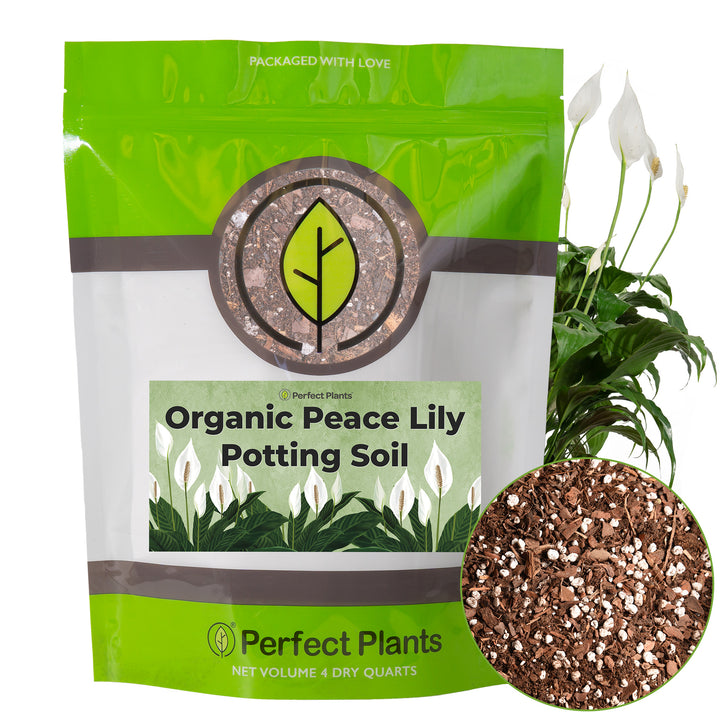
SKU: 9575025113
peace lily seeds pictures

peace lily seeds pictures Buy Peace Lily Potting Soil for Sale

Sale price$20.34 Regular price$22.60
Save 10%

Pay in installments of $5.65 with ShopPay, AfterPay and Klarna

Shipping Estimate
USA
  • USA
  • CAN

Ships within 48 hours · Estimated delivery Sep 18 - Sep 23

Promo Codes Available:

For Your Every Summer RSVP, with Code: SUMMER15

Description

peace lily seeds pictures Buy Peace Lily Potting Soil for SaleKeep Your Peace Lily Thriving with the Right Soil Give your peace lily the perfect growing environment with our premium Peace Lily Soil, a specially formulated blend that balances moisture retention with excellent drainage. Unlike ordinary mixes, this potting soil for peace lily is designed to meet adequate peace lily soil requirements, preventing root rot while encouraging vibrant green leaves and long lasting white blooms. How to Repot Peace Lily

Keep Your Peace Lily Thriving with the Right Soil 

Give your peace lily the perfect growing environment with our premium Peace Lily Soil, a specially formulated blend that balances moisture retention with excellent drainage. Unlike ordinary mixes, this potting soil for peace lily is designed to meet adequate peace lily soil requirements, preventing root rot while encouraging vibrant green leaves and long-lasting white blooms.

How to Repot Peace Lily Plants

Repotting is simple with the right peace lily repotting soil. Gently remove your plant from its container, loosen the root ball, and trim away any dead roots. Place in a slightly larger pot, then fill in with our nutrient-rich peace lily soil mixture. Water well and return to a bright, indirect light location for best results.

When to Repot a Peace Lily Plant

Peace lilies should be repotted every 1–2 years or whenever roots begin to crowd the pot. Fresh peace lily soil mix provides better aeration, replenished nutrients, and the ideal loamy texture for new growth. Spring is the best time to refresh your peace lily for healthier roots and more blooms.

Ingredients in Our Peace Lily Soil Mix Recipe

This chunky, loamy mixture is the best soil for peace lily, providing both aeration and water retention to prevent overwatering issues.

  • Composted Pine Bark  –  Improves airflow and supports strong root systems

  • Peat MossRetains the perfect amount of moisture while creating a slightly acidic environment

  • PerliteEnhances drainage and prevents compaction

  • Coconut CoirEco-friendly fiber that supports root strength and consistent hydration

  • Granite Sand – Adds grit for drainage and soil stability

  • Dolomite Lime – Balances pH and adds calcium & magnesium for overall plant health

Why Gardeners Love Our Peace Lily Soil

  • Well-Draining Yet Moisture-Retentive – Prevents root rot while keeping soil evenly hydrated

  • Encourages Vibrant Blooms – Nourishes healthy foliage and signature white flowers

  • Perfect for Semi-Aquatic Houseplants – Works beautifully for peace lilies and other tropicals

  • Convenient Sizes – Available in 4 qt. and 8 qt. resealable bags for easy indoor repotting

  • Hand-Mixed in the USA – Over 40 years of horticultural expertise in every bag

With our premium Peace Lily Soil, you’ll have the perfect foundation for lush growth and thriving blooms—keeping your peace lily happy, healthy, and beautiful season after season.

Happy planting!

Shipping Notes
  • Free Standard Shipping on $100+ Orders to the USA.
  • Except Preorder products are shipped in 48 hours.
  • Delivery to the USA:
  1. Standard Shipping : 3-10 business days
  • If time is of the essence, please consider selecting expedited delivery for faster service.
Exchange/Return Notes
  • We offer a 30-day return/exchange service after receiving.
  • Final sale items are not eligible for returns or exchanges.
  • To process your return/exchange, please contact us at [email protected]
  • Please click here for more details>>> Return & Exchange Policy
SKU: 9575025113

Discover Niche Categories That Outsell peace lily seeds pictures

Top-Converting Item to Boost Your Average Order

4.1 ★★★★★
Based on 29 reviews
Sort
Highest Rating
Newest First
Oldest First
Product Reviews
S
Verified Purchase
Stephanie Kelly
Los Angeles, US
★★★★★ 5
Silly little book
Format: Hardcover
My daughter love this book. We read it over and over again until I had to make her choose something different t. The story is so cute and the illustrations are really fun.
WAS THIS REVIEW HELPFUL?YesReportShare
Reviewed in the United States on March 29, 2026
K
Verified Purchase
Keri
Charlottesville, US
★★★★★ 5
Great book
Format: Hardcover
Love this book. I bought two of the other books in this series. My niece loved it.
WAS THIS REVIEW HELPFUL?YesReportShare
Reviewed in the United States on April 3, 2026
S
Verified Purchase
Samantha Laubenstine
Whiting, US
★★★★★ 5
Perfect for spring time!
Format: Hardcover
Such a great book series I love reading it to my boys!
WAS THIS REVIEW HELPFUL?YesReportShare
Reviewed in the United States on March 31, 2026
A
Verified Purchase
Ashley Mandrell
Fort Morgan, US
★★★★★ 5
Good buy
Format: Hardcover
This is a super cute book! It teaches about spring and we enjoy reading it!
WAS THIS REVIEW HELPFUL?YesReportShare
Reviewed in the United States on February 19, 2026
D
Verified Purchase
Don Morris
New York, US
★★★★★ 5
"Racial Capitalism"
Format: Paperback
Cedric J. Robinson’s Black Marxism is first a history of Black people appearing in historical texts as far back as Herodotus (c. 484 – c. 425 BCE) in ancient Greece, and second a history of “the collisions of the Black and white ‘races’ beginning in the fifteenth and sixteenth centuries.” Robinson’s thesis connects the evolution of capitalism to its roots in racism (racialism) understood in broad terms to comprise the subjugation of one class/group/nation/race by another (the Irish by the English in the nineteenth century, for example). He uses the term “racial capitalism” to express this process—the necessity of opposing classes for the function of capitalism. As a result, “racialism,” he says, “would inevitably permeate the social structures emergent from capitalism.” Keynes attributed the slow change in the “standard of life of the average man” until the beginning of the eighteenth century to “the remarkable absence of important technical improvements and to the failure of capital to accumulate.” Capital is accumulated, in Marx’s view, through the accretion of “surplus labor” which is the extra time a worker “must add to the working time necessary for his own maintenance . . . in order to produce the means of subsistence for the owners of the means of production.” Robinson ties capitalism’s early exploitation of surplus labor to slave labor and the slave trade noting, “historically, slavery was a critical foundation for capitalism.” Robinson traces the forced transport of Black people from Africa (the diaspora) to Europe, as well as Central, South, and North America as a foundation of early capitalism (and slavery as its form of “primitive accumulation” of capital). In his discussions of slavery, Robinson stresses the sense of the enslaved people with respect to their captors in terms of the slaves’ resistance, hostility, and defiance of the masters—their “Black radicalism.” As Robinson’s text approaches the twentieth century and the influence of Marx, his focus narrows to the significance and character of specific Black leaders including W. E. B. Du Bois, C. L. R. James, and Richard Wright and their respective connections to Marxism’s diverse interpretations. Marxism, says Robinson, “has proven insufficiently radical to expose and root out the racialist order that contaminates its analytic and philosophic applications or to come to effective terms with the implications of its own class origins.”
WAS THIS REVIEW HELPFUL?YesReportShare
Reviewed in the United States on September 2, 2022

recommand products