SKU: 96734241520
aspca snake plant

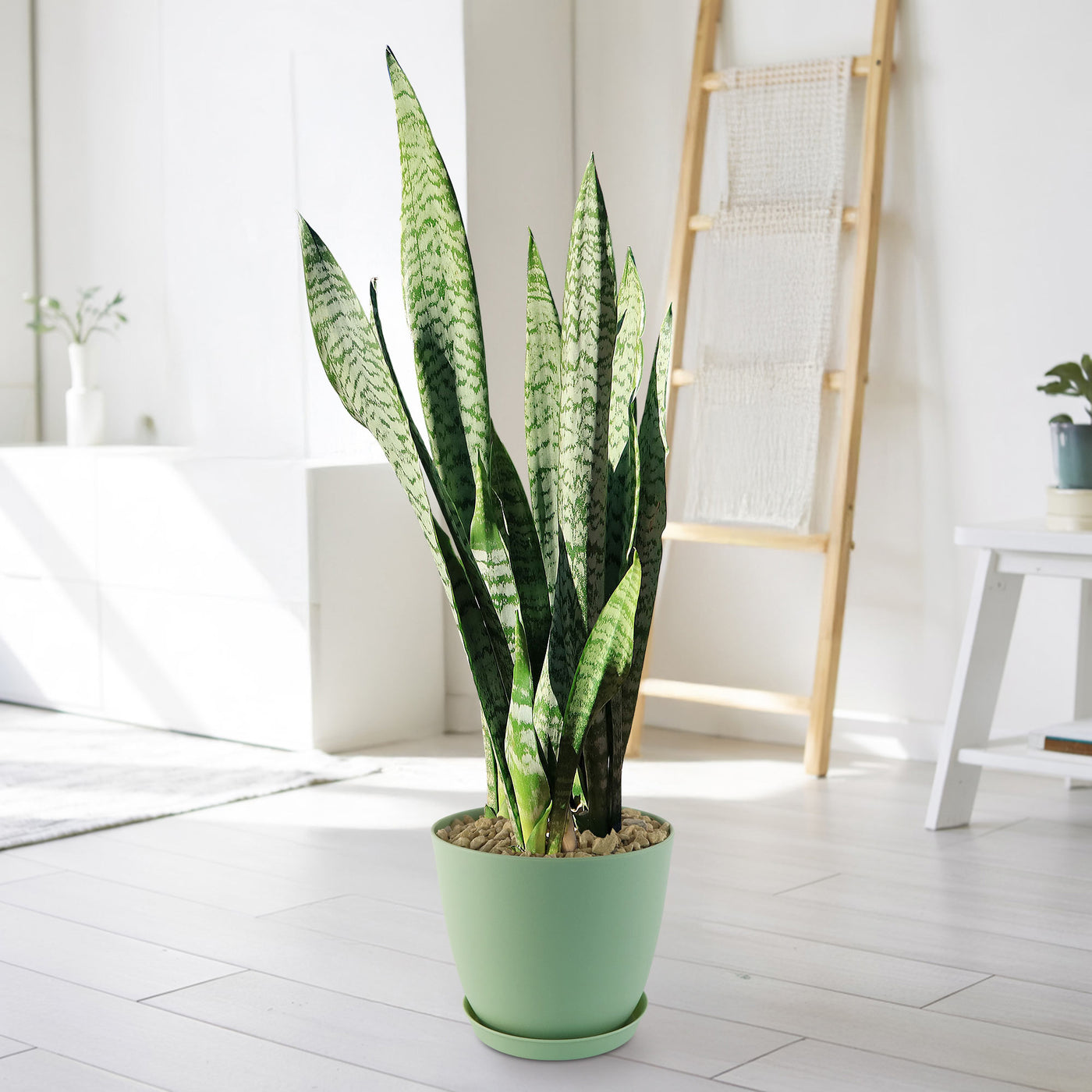
aspca snake plant Mother in Law Plant ‘Sansevieria trifasciata’ Snake Plant

Sale price$21.76 Regular price$24.18
Save 10%

Pay in installments of $6.04 with ShopPay, AfterPay and Klarna

Shipping Estimate
USA
  • USA
  • CAN

Ships within 48 hours · Estimated delivery Jul 22 - Jul 27

Promo Codes Available:

For Your Every Summer RSVP, with Code: SUMMER15

Description

aspca snake plant Mother in Law Plant ‘Sansevieria trifasciata’ Snake PlantIntroducing the Mother in law plant, known as Sansevieria trifasciata (syn. Dracaena trifasciata), a popular hardy houseplant that belongs to the Sansevieria snake plant genus. Native to West Africa, the Sansevieria trifasciata has several other names such as the mother in law tongue plant, Viper's Bowstring Hemp, Saint George's Sword, and Devil's Tongue. These names often refer to the long, sword like leaves that resemble the sharp tongue of a snake.

Introducing the Mother-in-law plant, known as Sansevieria trifasciata (syn. Dracaena trifasciata), a popular hardy houseplant that belongs to the Sansevieria snake plant genus. 

Native to West Africa, the Sansevieria trifasciata has several other names such as the mother-in-law tongue plant, Viper's Bowstring Hemp, Saint George's Sword, and Devil's Tongue. These names often refer to the long, sword-like leaves that resemble the sharp tongue of a snake. This attractive, low-maintenance houseplant can tolerate drought and low light, making it an excellent choice for offices. 

Like other snake plants, these Sansevieria trifasciata mother-in-law tongue plants are known for their tall, upright leaves that grow in a rosette pattern.

These thick and fleshy dark green leaves have variegated patterns of light gray-green.

The leaves can grow up to 12 feet tall in their native habitat, but when grown indoors, they can grow as tall as 2 feet, adding a dramatic touch to any space.  

The mother-in-law tongue flowers are greenish-white and appear on long stalks that rise above the leaves from spring to summer. These Night-blooming snake plant flowers are fragrant and have a lily-like appearance. However, it's important to note that snake plant blooming is relatively rare indoors, and most Snake plant varieties are appreciated for their attractive leaves rather than their blooms.

Mother in Law Plant Key Features & Benefits

  1. NASA identified the Mother-in-Law Plant as a top air-purifying plant, effective at removing toxins like formaldehyde and toluene.
  2. Its waxy, upright leaves help reduce water loss, making it highly drought-tolerant.
  3. It is considered a symbol of good luck and protection in various cultures, often placed indoors for positive energy.
  4. The Mother-in-law snake plant filters indoor air, supports better mental health, and may reduce allergies, with a lifespan of 5–25 years.
  5. The snake plant releases oxygen at night, making it a great plant for improving bedroom air quality while you sleep.

The Dracaena trifasciata is an excellent beginner plant because of its adaptability to various growing conditions and its easy-to-grow nature, making it a decorative addition indoors.

Other popular snake plants are: the variegated snake plant with yellow variegated edges, the Zeylanica snake plant, the Bird's nest snake plant, and the Cylindrical snake plant

When and How to Water Your Snake Plant 

The mother-in-law's tongue plant is known for its ability to tolerate drought and is relatively low maintenance when it comes to watering. In general, it's best to allow the soil to dry out between waterings to avoid overwatering, which can lead to root rot. Your Snake plant prefers watering once every 2-3 weeks in the growing season and once every 4-6 weeks in the dormant season.

In the spring and summer, during the growing season, you can water your mother-in-law plant about once every 2-3 weeks. Be sure to thoroughly saturate the soil, allowing the water to drain out of the bottom of the pot to prevent waterlogged roots. 

In the winter months, when the plant is in a dormant phase, you can reduce watering frequency to once every 4-6 weeks. This allows your mother-in-law's snake plant to rest and prevents overwatering during its slower growth period. 

You can check the moisture level of the soil by sticking your finger about an inch or two into the soil. If it feels dry at that depth, it's a good indication that it's time to water. However, if the soil still feels slightly moist, it's best to wait a bit longer before watering. 

Light Requirements - Where to Place Your Mother-in-Law Plant 

When growing indoors, your snake plants will thrive and grow best in bright, indirect light for 4-6 hours a day.

Placing your Snake plants near a window where they can receive filtered sunlight throughout the day is ideal.

However, they can also tolerate artificial light, making them suitable for offices or rooms with limited natural light. 

When growing outdoors, the Snake plants Sansevieria, prefers bright, indirect light for at least 4-6 hours a day. They can tolerate some direct sunlight, but it's best to provide them with some shade during the hottest parts of the day, especially in regions with intense sunlight. Partial shade or filtered sunlight is generally ideal for outdoor Sensevieria trifasciata Snake plants.

Optimal Soil & Fertilizer Needs 

The Sansevieria trifasciata favors very airy, sandy potting soil that drains well and should be fertilized once a year in spring. Planting them in ordinary soil will result in compacted roots, stunted growth, and most likely root rot. Instead, make or buy a well-drained cactus potting mix, or ideally use our specialized succulent potting mix that contains 5 natural substrates and mycorrhizae to promote the development of a strong root system that helps your Snake plants to thrive. 

As for fertilizer, the mother-in-law’s tongue plants are not heavy feeders; you can apply a diluted, balanced NPK (5-10-5) liquid fertilizer once a year during the growing season, which is typically spring. It's best to use a general-purpose houseplant fertilizer and dilute it to half the recommended strength.

Remember, it's important not to over-fertilize your Sansevieria Snake plant, as this can lead to the build-up of salt in the soil. This can cause damage to the roots and negatively impact the overall health of the plant. So, when in doubt, it's better to err on the side of caution and fertilize sparingly. 

Hardiness Zones & More 

In the United States, this is mostly an indoor plant, but if you live in southern Florida or Hawaii, then you can cultivate it outdoors in USDA zones 9-11.

In colder zones, the succulent plant Snake Sansevieria can still be grown, but it will need to be grown indoors or in a greenhouse during the winter months to protect it from freezing temperatures. 

While household humidity is generally good enough, these large snake plants will do even better with some extra moisture in the air. Please set up a humidifier nearby or grow them in naturally humid rooms like your bathroom or kitchen. 

How to Best Grow Snake Plant Indoors

When grown indoors, these adorable mother-in-law tongue plants thrive in warm and humid conditions, making them perfect for cozy indoor spaces. With temperatures between 60°F and 75°F, this lovable Dracaena trifasciata is sure to feel right at home. Just make sure not to let them get too chilly - anything below 50°F could spell disaster for your lovey-dovey snake plants.

Wildlife - Snake Plant Attracts the Following Friendly Pollinators

The Mother-in-law's Snake plant is a popular houseplant that is known to attract friendly pollinators such as bees, hummingbirds, and butterflies. These pollinators are drawn to the plant's unique flowers, which emit a sweet scent and provide a source of nectar. By welcoming these beneficial insects into your home or garden, you can help support local ecosystems and promote biodiversity.

Butterflies
Bees
Hummingbirds
Lady Bugs
Multi Pollinators
Other Birds

According to ASPCA, the mother-in-law plant is mildly toxic if ingested, primarily due to the presence of saponins. These compounds can cause gastrointestinal distress in both humans and animals, with symptoms like nausea, vomiting, and diarrhea. However, it is safe to touch and handle, making it a popular choice for indoor plants in homes with pets or children.

How to Propagate Your Mother-in-Law's Plant

For mother-in-law snake plant propagation, you can do this easily by offsets and leaf cuttings. When the plants grow at least four inches tall, divide or take cuttings of the healthy leaves to propagate your snake plant in the spring or summer. New shoots can also be potted on their own.

Repotting a snake plant is crucial for its care, recommended every three to five years. It's important to notice roots growing out of the pot's holes, water draining too quickly, roots filling the container, stunted growth, and a dull appearance.

Key Takeaways

  1. The Sansevieria trifasciata is commonly called the “Snake Plant” due to its long, upright leaves with wavy, green banding that resembles snake skin.
  2. This plant was featured in NASA’s Clean Air Study, which found it effective at filtering indoor air pollutants like formaldehyde, benzene, and trichloroethylene.
  3. It is considered a symbol of good luck and positive energy in Feng Shui, often placed near entrances or workspaces to promote protection and prosperity.
  4. The plant is extremely drought-tolerant, storing water in its thick, upright leaves and thriving with very little attention.
  5. This mother-in-law snake plant is one of the easiest houseplants to grow, making it a favorite for beginners and those with busy lifestyles.

Final Thoughts

Overall, the Snake plant or Mother-in-law plant (Dracaena trifasciata) is a low-maintenance houseplant that thrives in a variety of conditions. It is native to West Africa and is well-known for its ability to tolerate neglect and survive in low-light environments. This mother-in-law plant has long, sword-shaped leaves that are typically dark green with light green horizontal stripes, giving it a unique and striking appearance. In terms of snake plant care, it prefers a well-drained potting mix with terra cotta pots and only needs to be watered sparingly, as overwatering can lead to root rot. Additionally, it can tolerate a warm indoor temperature between 60-75 degrees Fahrenheit and does not require frequent fertilization.

Whether you're a beginner or an experienced plant lover, the Dracaena trifasciata Snake plant for sale is a fantastic choice that will bring beauty and freshness to your home or office.

Shipping Notes
  • Free Standard Shipping on $100+ Orders to the USA.
  • Except Preorder products are shipped in 48 hours.
  • Delivery to the USA:
  1. Standard Shipping : 3-10 business days
  • If time is of the essence, please consider selecting expedited delivery for faster service.
Exchange/Return Notes
  • We offer a 30-day return/exchange service after receiving.
  • Final sale items are not eligible for returns or exchanges.
  • To process your return/exchange, please contact us at [email protected]
  • Please click here for more details>>> Return & Exchange Policy
SKU: 96734241520

Discover Niche Categories That Outsell aspca snake plant

Top-Converting Item to Boost Your Average Order

4.7 ★★★★★
Based on 27 reviews
Sort
Highest Rating
Newest First
Oldest First
Product Reviews
D
Verified Purchase
D. Alexander
Carnegie, US
★★★★★ 5
Buy this one, forget the rest
This is one of the most powerful handheld electric blowers available. If you're serious about getting the job done quickly, this is the baseline. The next power tier is a gas backpack blower at five times the cost, then an even more powerful backpack, and then four-digit specialty tools from companies like Billy Goat. I bought the Worx because I didn't want to spend three hours raking a half-acre of grass. My trial run was an hour of continuous use with matted wet leaves and driveway sand. It fast became apparent that to be efficient, a blower has to move leaves without being on top of them. Blowing from six inches just makes everything scatter as piles build up. You end up crisscrossing the section you just cleared to deal with the strays. The further your breeze carries, the more direct the flight path of the leaves. This range, and the ability to scour stubborn leaves from the ground, comes from air speed (MPH). At the same time, though, you need a big enough wall of air to move more than one leaf at once. That comes from the size of your pipe opening. The two multiplied together determine your total air volume over a duration, or CFM (cubic feet per minute). In physics-land (with spherical cows and turbulence-free pipes, spared from the icy hand of marketing), CFM is the best measure of a blower's work capacity. MPH, you can change by varying the size of the pipe; a smaller pipe makes a smaller column of air moving at a faster speed (and more impressive advertising), which is why a lot of consumer-class blowers have tiny nozzles. (I'm looking at you, Sun Joe SBJ601E.) But there's a cost to adding MPH: it kills efficiency. The energy to move a volume of air goes up with the square of speed, so if you design your blower for 160 MPH, you'll get half the CFM of a 110 MPH blower from the same power. Something to mull if the blower is powered by a battery. Still, if you know either speed or CFM, and the size of the pipe, you can calculate the other (assuming the manufacturer isn't misleading you by quoting CFM at the fan and MPH at the end of the pipe). To get CFM from MPH and the radius of a round pipe, the calculation is (radius^2)*(mph)*(1.92). That's (1.69^2)(110)(1.92) for this blower's 110 MPH and 3 3/8" pipe, with the result arriving right at the rated number of 600 CFM. Anyway, the Worx has enough volume and speed to blow mounds of wet leaves from six feet and dry ones from ten or more. It's impressively powerful. I was switching arms every few minutes as they wore out from the backward force. Only some really baked-on mud would have benefited from a pipe-reducer attachment. Thanks to ape-like proportions or the secure fit of my spandex leaf-blowing onesie, clothing suction from the rear-directed air intake hasn't been a bother. ALTERNATIVES: I almost bought Toro's highly-rated "Ultra" combination blower to minimize bagging, but the vacuum functionality didn't seem that useful in videos. Maybe it'd be adequate to clean an enclosed deck area or a small yard with a scattering of dry leaves. For a larger yard, it looks like a time sink relative to a standalone mulcher. Likewise the blowing capacity, which, at 410 CFM, trails the Worx by quite a lot. Cordless tools were also tempting. There's a 20V DeWalt people seem to like that's rated at (a perhaps optimistic) 400 CFM. Because it's a similar fan design to the Worx, we can compare power directly. DeWalt's standard battery is 20V (or so we'll stipulate; it's closer to 18V under load) and 5 amp-hours, so we're looking at 100 watt-hours total output. 15 minutes of runtime translates to a sustained draw, best case, of 400W. Assuming 90% efficiency in the brushless motor, that's 360W actually moving air. (When new. Expect a performance drop over time and battery replacements by year three.) Compare this Worx: 12 amps at 120V equates to 1440 watts sustained, in this case feeding a 2-pole AC/DC motor that's perhaps 55% efficient. 12A is close to the maximum a device can reasonably expect from a typical 15A household socket. Even with nearly half of our power lost to heat and noise, the remaining 790W is over double what the DeWalt can manage. It's no coincidence that 600 CFM cordless blowers (Greenworks and Kobalt come to mind) have 80V/2.5Ah batteries with twice the DeWalt's capacity. Their runtime at full tilt? The same fifteen minutes, with three extra pounds to lug around from a chunk of lithium that costs more than the blower it attaches to. And what of gas blowers? The handheld versions have around 1 HP with CFM from 450 to 500. They're usually tuned for higher MPH than the Worx, so they're likely to be a little better with wet leaves and a little worse with dry ones. Backpack blowers up the displacement and make between 1.5 and 5 horsepower. The models that you might find on the back of a professional landscaper can manage nearly 1000 CFM with speeds around 200 MPH. That's a considerable difference, but you pay for it at the checkout and in weight: figure 10 pounds or so for a handheld (relative to 7ish for this unit, plus some cord) and 20 or more for a backpack. As of mid-2020, two other corded blowers are worth a hard look: Toro's F700 and Worx's WG521. The Toro arrived first in 2019 with a hefty 720 CFM rating, a bigger two-arm handle, and a better cord retention mechanism. The WG521 is the response: 800 CFM and 135 MPH (claimed) from a ~4" nozzle, albeit still intended for one arm. All three blowers are beastly and often close in price; pick whichever best channels your inner Tim Allen. ACCESSORIES: A motor this powerful benefits from a thick (low gauge) cord for longer runs. You lose a bit of performance with thinner cord. The generic orange 50-foot extension everyone has is 16-gauge. Feeding a 12A load for 50 feet, it'll have a voltage drop of about 5V. Heavier 14-gauge loses 2.5V on the same run, and industrial 12-gauge, only 1.5V. The scale is linear, so if you double up that 16-gauge cord for a 100-foot run, you'll lop off 10V. How's that play out here? From a short and fat cable (that the cheesy plastic strain-relief piece won't actually accommodate; just tie an overhand knot over the two plugs instead), we'd expect a 1440W draw (12A * 120V, or a bit less because the house wiring itself has some drop). Losing 5V drops the total to 1380W. That's about what I found when I tested the Worx with a watt meter. 12ag / 3 ft = 1423W 14ag / 100 ft = 1352W 16ag / 50 ft = 1351W 16ag / 50 ft + 14ag / 100 ft = 1280W With the progressive thumb dial at the lowest setting, minimum draw was 260W. For shorter runs, disconnect extensions you don't actively need. Every cable sheds a percentage of the energy it carries to heat. As above, skinny cables lose more. Coiled on the ground and coupled with a high-load device like the Worx, they can build up enough heat to start melting insulation, which tends to cause sheepish expressions and insurance claims. This blower is also loud enough to merit hearing protection. On an A-weighted scale (approximating human hearing), measured outdoors from three feet, it makes 82 dB on low and 91 dB on high. Indoors or near a wall, volume jumps by 10 dB and subjectively doubles. While the sound character emulates a vacuum, my Shark only measures 72 dB indoors; you'd have to run over a rat's nest of lamp cords to make one this loud. Amazon has a number of comfortable muffs for less than a Jackson that'll keep your ears intact. You can find electric blowers with more toys, but few that'll get the job done as fast as this one. It's a bargain at the asking price. I'll update if I catch any reliability problems.
WAS THIS REVIEW HELPFUL?YesReportShare
Reviewed in the United States on December 1, 2016
R
Verified Purchase
R. Klein
Grantham, US
★★★★★ 5
Light, and easy to use for blowing leaves
I bought this in the fall of 2025, and found it very easy to use. I also have a Toro blower/vac, that I use to grind up leaves in the fall. While this appliance is only good for blowing leaves, it does a good job of it. It's quieter than the Toro, and considerably lighter in weight. I find it much less fatiguing on the hand than the Toro. It has multiple speeds, so is versatile. You don't ALWAYS want maximum wind from these things, depending on the job and the space. The weight, comfortable handle, balance, and lower noise are the top advantages to this machine. Because this is a corded model, there's no concern over battery life. You can blow the afternoon away without a care. Only time will tell when it comes to durability. 🤞🏻
WAS THIS REVIEW HELPFUL?YesReportShare
Reviewed in the United States on January 13, 2026
T
Verified Purchase
Teng Ma
Houston, US
★★★★★ 5
Great Power for the Price
Really impressed with this blower. It’s lightweight, easy to handle, and has plenty of power to clear grass and leaves quickly. Perfect for quick yard cleanups. Definitely worth.
WAS THIS REVIEW HELPFUL?YesReportShare
Reviewed in the United States on April 18, 2026
O
Verified Purchase
Over and Under
Battle Creek, US
★★★★★ 5
The Black and Decker BESTA510 is a KEEPER plus it's made in the USA 🇺🇲
Style: String Trimmer
Well folks🙂 I have to tell you this has been a nice weed eater that cuts really good and it's LIGHTWEIGHT and it's powerful👍 and at a PRICE that can't be beat...it's way more powerful than some battery and electric weed eaters that I have.. like a Ryobi... And supposedly a commercial grade Ryobi $200 😤.. Anyway 🙂 This electric weed eater is very good and I'll take that PEPSI challenge any day 😀 when comparing it to some other weed eaters PLUS it doesn't USE LINE like other electric weed eaters that I've used.. at least that's been my experience.. This is a KEEPER weed eater from Black & Decker👍....it handles tall grass and even some hedge... though it probably shouldn't be used for hedge but it's TOUGH 😀 and better than any battery weed eater I used especially with the power and cutting... The power alone and convenience of NOT rushing through the job with the battery pack and charging ect imo is worth the cord drag 🙂... and much better than a battery weed eater or other electric weed eaters.. This just cuts better 👍... With MORE power consistently and constantly through the whole job... So in conclusion 🙂 the Black & Decker BESTA510 weed eater in my opinion is a KEEPER and this model has been around for a while which speaks for itself not to mention Black & Decker has been around for years.... This weed eater OVERALL (pound for pound ) is a solid performer with many mostly liking this weed eater and Black & Decker products overall.. Thanks for reading🙂.. I hope my review helps... and Did I mention It's made in the USA...🇺🇲..🙂...
WAS THIS REVIEW HELPFUL?YesReportShare
Reviewed in the United States on September 6, 2025
L
Verified Purchase
Lucas B Hager
Chelsea, US
★★★★★ 5
No problems all the way to the end of the spool
Style: String Trimmer
I had an old Greenworks string trimmer that I found in the basement after I moved into my new home. Maybe it was just old, but the auto-feed didn't work well, the line was always running out, and I spent more time rewinding the spool than cutting down weeds. I had almost lost my faith in string trimmers entirely. You can spend $300 on one, but how much better are they? I didn't know. This Black & Decker was only $50, and although it's corded, my roommate convinced me it was worth not having to do the dance of recharging batteries, plus having full 110v power. Some (easy) assembly required out of the box, and this thing was basically plug & play. I did read through the owner's manual first, which gave amateur me some confidence through a few helpful tips. I use it not only for cutting down weeds, but also for cleaning out weeds from the cracks in my sidewalk, and the edger wheel is very helpful for that. More importantly, the line had no problems all the way to the end of the spool. Faith restored, there are good string trimmers in the world. That being said, be aware that the line it comes with isn't very long. My lawn is medium-size, and it ran out about halfway through. The Black & Decker replacement spools are $10 / 30 ft (much longer), but it goes through line, so this could really add up. Replacing the spool was easy, and I was able to finish my lawn with plenty line to spare. A quick search on Amazon reveals off brand spools at $15 / 12-pack. I haven't tested them yet, but the price difference is so great that I'm going to give them a chance.
WAS THIS REVIEW HELPFUL?YesReportShare
Reviewed in the United States on August 19, 2023

recommand products