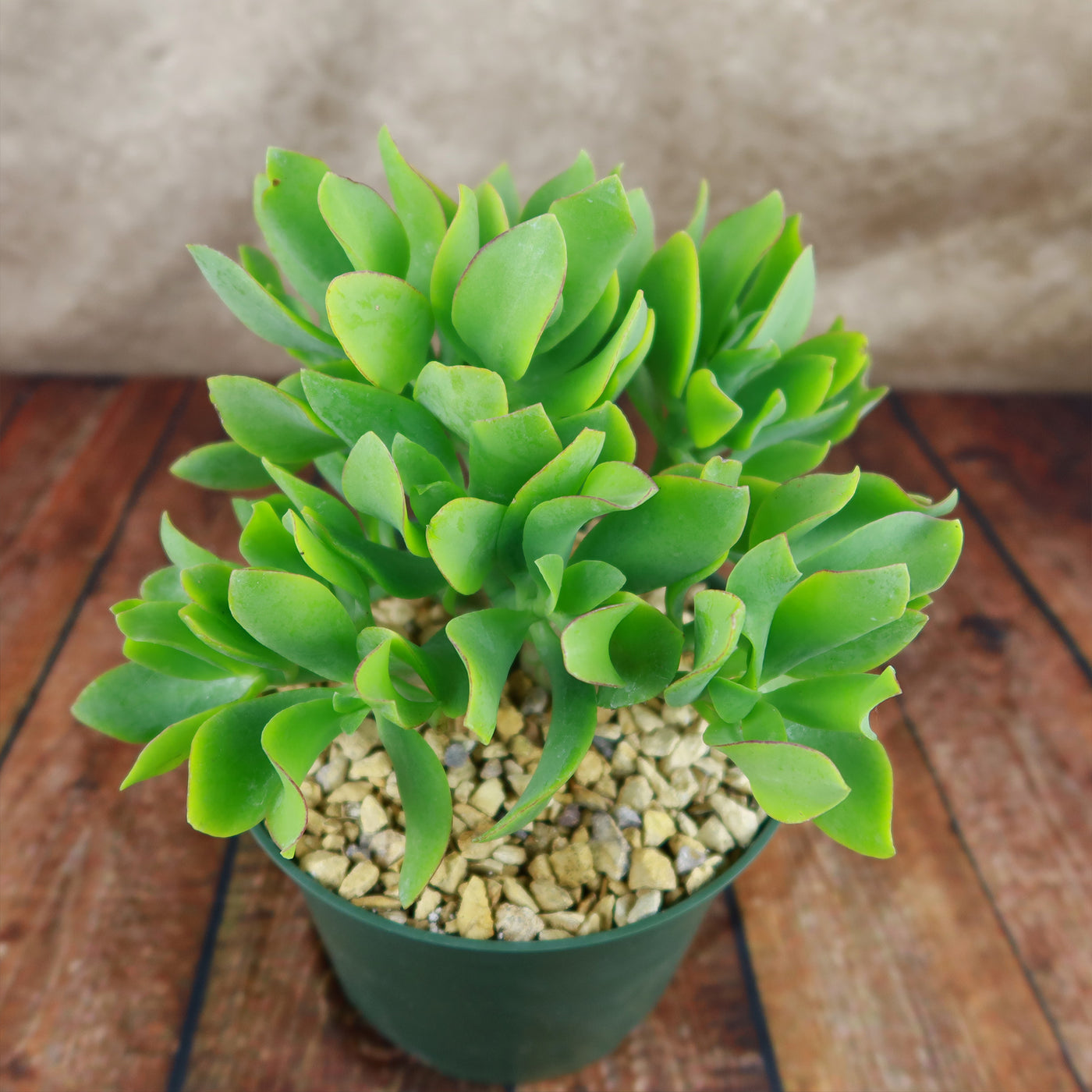
SKU: 97467537912
ripple jade succulent

ripple jade succulent Ripple Jade

Sale price$23.92 Regular price$26.58
Save 10%

Pay in installments of $6.64 with ShopPay, AfterPay and Klarna

Shipping Estimate
USA
  • USA
  • CAN

Ships within 48 hours · Estimated delivery Sep 3 - Sep 8

Promo Codes Available:

For Your Every Summer RSVP, with Code: SUMMER15

Description

ripple jade succulent Ripple JadeWelcome to the world of Ripple jade, also known as Crassula arborescens 'Undulatifolia' a stunning perennial, evergreen succulent that's bound to leave you in awe and a vibrant member of the Crassula genus! This ripple jade succulent is like no other! Its thin, wavy leaves make it the perfect addition to any arrangement that needs a little extra pizzazz. Let me tell you, when given room to grow, this stunning crassula arborescens will form a dense and

Welcome to the world of Ripple jade, also known as Crassula arborescens 'Undulatifolia' - a stunning perennial, evergreen succulent that's bound to leave you in awe and a vibrant member of the Crassula genus! This ripple jade succulent is like no other! Its thin, wavy leaves make it the perfect addition to any arrangement that needs a little extra pizzazz.  

Let me tell you, when given room to grow, this stunning crassula arborescens will form a dense and mounding shrub up to 4 feet tall! With some good pruning skills, you can turn your ripple jade into an adorable bonsai-like masterpiece. Now, while flowers are quite rare on this jade plant, don't count it out just yet because, in late winter, it can produce clusters of white, pink star-shaped blooms that'll leave your jaw hanging.  

It grows in large numbers on rocky slopes in South Africa in the wild; however, it also works as an attractive landscaping shrub in frost-free climates and as a houseplant. 

So, if you're looking for something unique and exciting to add to your succulent collection or arrangement - look no further than the ripple jade! 

Watering Needs 

The ripple jade succulent is a species that requires minimal watering. It's important to only water them when the soil has dried out, as overwatering can cause root rot. Succulents, including this ripple jade crassula, are prone to rot if their roots are constantly submerged in moisture.  

As a drought-tolerant plant, the Crassula arborescens plant has developed an effective mechanism for storing water in its leaves. Oftentimes, people worry about underwatering their plants when they're actually giving them too much water - succulents, in particular, don't thrive well in damp soil, which can lead to root problems. 

Light Requirements 

The ripple jade can withstand full sun, but it prefers to grow in areas with some partial shade. Learn to adjust your ripple jade succulent to avoid burns if the location where you have the plant is exposed to a lot of sunlight. Gradually increase the exposure until it can handle the full sun. 

It's critical to remember that during a heatwave or periods of extreme heat, your Crassula arborescens undulatifolia could still sustain sun damage or get sunburned. In this situation, you can protect the plant by moving it indoors or to a shaded area. 

Optimal Soil & Fertilizer Needs 

The ripple jade favors very airy, sandy soil that drains well. Planting them in ordinary soil will result in compacted roots, stunted growth, and root rot. Instead, make or buy a well-draining potting mix, or ideally, use our specialized potting mix that contains over-organic mycorrhizae to promote the development of a strong root system that helps your succulent to thrive.  

Organic fertilizers equal to 5-10-5 (NPK) also last longer and keep your soil alive by adding other beneficial compounds and microbes that encourage plant health and nutrient absorption. So, skip those harsh chemicals and give your succulent some love with some awesome organic fertilizer! 

Hardiness Zones & More 

Typically grown in hot, arid desert regions, the ripple jade succulents thrive indoors in warm, dry surroundings. If you live in USDA regions 9 to 11, you can also grow these succulents Crassula arborescens outdoors year-round, but they are not cold- or frost-tolerant, so you should plant them indoors or put them in a pot and move them indoors during the winter if you live outside of these regions.  

Keep your crassula jade plant away from cold, drafty windows and air vents if you are growing it indoors in a cold climate. 

Be sure to add Crassula arborescens 'Undulatifolia’ to your home or garden and enjoy its low maintenance care while admiring its impressive display year after year. 

Shipping Notes
  • Free Standard Shipping on $100+ Orders to the USA.
  • Except Preorder products are shipped in 48 hours.
  • Delivery to the USA:
  1. Standard Shipping : 3-10 business days
  • If time is of the essence, please consider selecting expedited delivery for faster service.
Exchange/Return Notes
  • We offer a 30-day return/exchange service after receiving.
  • Final sale items are not eligible for returns or exchanges.
  • To process your return/exchange, please contact us at [email protected]
  • Please click here for more details>>> Return & Exchange Policy
SKU: 97467537912

Discover Niche Categories That Outsell ripple jade succulent

Top-Converting Item to Boost Your Average Order

4.3 ★★★★★
Based on 7 reviews
Sort
Highest Rating
Newest First
Oldest First
Product Reviews
B
Verified Purchase
Bookphile
Los Angeles, US
★★★★★ 5
Practical and eye-opening guide for parents
Format: Kindle
This book had a profound effect on my thinking about how to be a parent. I don't think of myself as the type who hovers, but I'm starting to understand that I hover more than I realize. It's not that the author is advocating for hands-off parenting. Instead, she points out a lot of the ways in which parents take the reins and deny their kids all sense of control, and how detrimental that can be. We want our kids to grow up to be responsible and capable adults, but how can they do that when we take away their sense of autonomy? This book made me realize it's more important for me to teach my kids life skills like how to manage their time than it is for me to be managing every detail. My doing so comes from good intentions and a desire to see them succeed, but at the same time it conveys subtle messages to them I don't want conveyed. I read a lot of psychology and social science books because the research just plain fascinates me. While this book offers a lot of anecdotes, it's also infused with an excellent grasp of research. Lahey's background in education shines through, and her suggestions are grounded in the same evidence-based research that I've read. If kids seem different today, it's because they are, and it's not just technology that's driving this change, it's the way parents treat their children and how they view them. We want them to be successful, but in our test-driven, high achieving culture, we are sometimes guilty of emphasizing the wrong things. After reading a great deal about helpless college students, children suffering from stress-related ills, and the mental health problems plaguing universities, this book helped me form an idea as to why this may be: rather than teaching our children to work for the things they want, we're setting them on a prescribed path and sending them the message that they're only okay as long as they follow that prescribed path. Reading this book makes the mystifying question of why children don't want to take risks quite clear: because we've taught them that there's nothing worse than failure. Yet this book doesn't just discuss research, it also offers a lot of practical solutions for parents. Fair warning, though: not all of these suggestions are easy to swallow. This is where some of the pain came in for me, because I saw myself reflected in some of the behaviors Lahey suggests parents need to break. Giving her suggestions a try isn't going to be easy from a parenting standpoint, and it will require me to retrain myself as well. I also think there's a lot of value in how this book offers some very good insight into the educational system, which I think is a big benefit to parents who don't come from a teaching background. Lahey proposes that parents and teachers work as partners, and she offers suggestions for how parents can open up dialog with their kids' teachers. Considering how adversarial our current culture and politics paint the relationship between educators and parents, there is a great deal of value in this aspect of the book. It doesn't serve anyone for parents and teachers to be at one another's throats, not when both sides want the same thing. This book offers constructive ways parents can form that partnership with teachers, so that everyone can work together toward the same goal. I highly recommend this book to both parents and educators.
WAS THIS REVIEW HELPFUL?YesReportShare
Reviewed in the United States on September 29, 2015
A
Verified Purchase
Amazon Customer
Bozeman, US
★★★★★ 5
I thoroughly enjoyed reading this and as the Principal of a Middle ...
Format: Hardcover
I thoroughly enjoyed reading this and as the Principal of a Middle School, I found much truth in what she has written. I found myself thinking back to my days as the parent of burgeoning, wonderful and successful adults. The suggestions Ms. Lahey offers to her readers are based in experience and in conversations with her peers and others in the field of child-rearing and education. These are ideas that have worked for her, and others, and she passes along that wisdom and experience. Interestingly, I passed this book on to my 33 year old daughter who works in the private sector with a small, but growing, tech company. She has found the ideas presented here very valuable in dealing with her co-workers, the people who report to her, and even her boss, all of which I found very interesting. The best thing about this book is Ms. Lahey's voice. She sounds compassionate, not absolute, "this is the ONLY way you should ...". She puts out the propositions and then provides what she found as possible courses of action, I would highly suggest that any parent of young children, any teacher and certainly any building principal read this book with great gusto!
WAS THIS REVIEW HELPFUL?YesReportShare
Reviewed in the United States on October 22, 2015
K
Verified Purchase
Kennon McCaa
Carnegie, US
★★★★★ 5
Extraordinarily Helpful - A total game changer
Format: Kindle
I read this book at the recommendation of my son's school counselor. It was a total eye opener and will greatly impact and change the way I raise my son going forward. This book could have easily been titled, "The way I used to parent" because it is so accurate down to so many details as it describes my parenting techniques and motivations. I have made many changes already and my son doesn't quite understand who I am anymore. I'm certain that he appreciates the changes although he's a bit disoriented currently, but I know he will be better off in the long run. I wish there were more anecdotes or perhaps several role playing scenarios added to help offer more suggestions on how to handle more situations but the book was extremely helpful and insightful regardless. Most of the anecdotes I saw play out in our family or with other students from my son's school within hours or days of reading the book. It was amazing.
WAS THIS REVIEW HELPFUL?YesReportShare
Reviewed in the United States on November 22, 2016
R
Verified Purchase
Richard Scott
Belleville, US
★★★★★ 3
Good book for parents
Format: Hardcover
A good review for parents to keep as they struggle, but as reviewer noted a bit oversimplified. I bought after had listened to a panel on Forum discussed screen time. As a grandparent, sitting with my wife each on our I pads, I recall eating at restaurants when you look an see so many n smart gadgets texting, tweeting selfing and wonder where the talk is. I did post a photo of a wee grandchild playing while tv playing and three other in room were on their gadgets. The discussion was good. No answers. But, the discusses all recommend Lahey's book. In a period when helicopter parents strive for kids and overpower them, success comes without self motivation, and absent of failing , or at least the skills needed to overcome failure, grit and resilience and desire. Good to,learn early that they are part of a community and tasks are performed not for bribes or pay, but part of all pulling together. She spends a few pages on bullying and how to deal with it. Certainly for sandbox or recess in early years letting kids figure out how to work together through squabbles and fights is good. How do we handle the issues when kids get older? Teddy Roosevelt said learn to box. Sometimes really big kids pummel the weak. Stepping in may be needed. Bullying which now is felt a larger part of school with snubbing, nasty notes, cliques causes no bodily harm, but is part of life. Dealing with it Is a difficult task for teachers and parents. I applaud the new generation of teachers and parents who work as teams. A quarter century ago the moms at our kids elementary school were called the mafia moms. No prisoners. I recall an episode when well dressed ladies said whatever the vogue n radon gas wrong, ..they knew cause they could read and they didn't have to learn what their kids were saddled with and the new math, now very old, was wrong. Maybe now teachers and parents can complain together about the evil core, or how much time the teachers should spend prepping for a test.
WAS THIS REVIEW HELPFUL?YesReportShare
Reviewed in the United States on January 16, 2016
B
Verified Purchase
Basil tree 45
Chelsea, US
★★★★★ 4
Good tips, though possibly over-obvious to some...
Format: Kindle
if you're prone to be a helicopter parent. If you're not, then I would say read it anyway so you can see where other parents might be approaching parenting. It pretty much fits in with other parenting books I've read such as "How Children Succeed" by Paul Tough, and "Grit" by Angela Duckworth. As with any parenting book, how useful you find it depends on what you're already doing. One of the examples that the author uses in the book is that of a kid forgetting his/her lunch at home. If you "rescue" the kid by driving his lunch to school, then there's no motivation for him to remember it in the future. Got it! When I was a kid and I forgot my lunch at home, I was not then able to concentrate at school for fear of my mother's reaction when I got home. She needed to "teach me a lesson" by shaming me for forgetting it, cussing me out, turning it into a moral issue, and giving me the silent treatment for several days. When that's the consequence for forgetting a lunch, then going hungry for a day seems trivial. In fact, it would be less stressful to simply declare that I'm no longer bringing lunch to school anymore so that I can't possibly forget it again, and protect myself from a bipolar parent's mood swings. But some parents can't even let their kids go hungry for the day, even though suffering the consequence's of one's behavior doesn't even feel like punishment. If you had a parent like mine, you would hardly need to read this book, and yet I would recommend it so you can understand what other people's parents are doing. My kid is 2 now. I pretty much let him learn from experience, although I outright ban dangerous and unhygienic behaviors. This book pretty much reinforces my approach anyway.
WAS THIS REVIEW HELPFUL?YesReportShare
Reviewed in the United States on August 2, 2017

recommand products