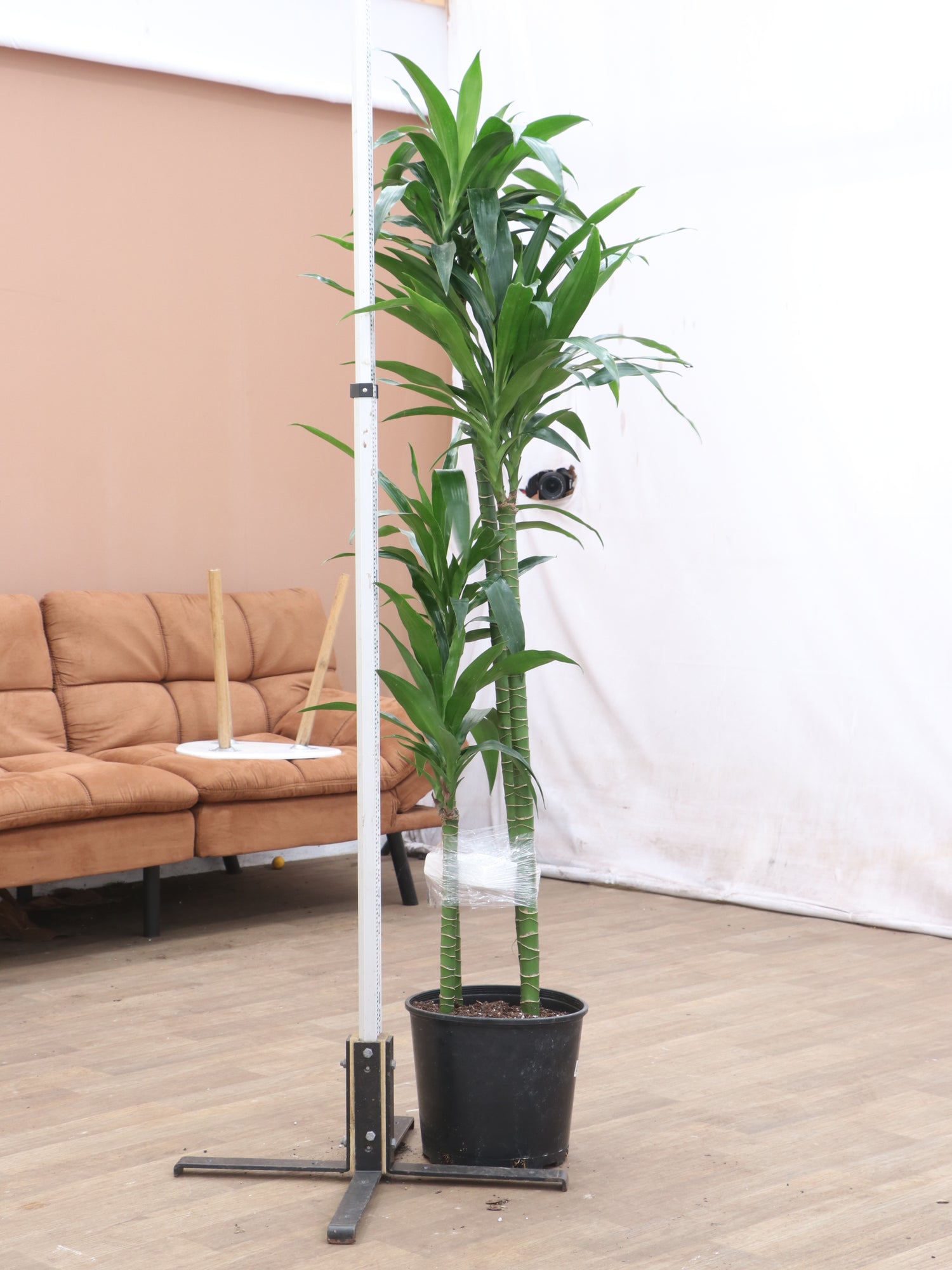
SKU: 97841137726
large indoor plants b&q

large indoor plants b&q Large Lisa Cane

Sale price$23.18 Regular price$25.75
Save 10%

Pay in installments of $6.44 with ShopPay, AfterPay and Klarna

Shipping Estimate
USA
  • USA
  • CAN

Ships within 48 hours · Estimated delivery Sep 6 - Sep 11

Promo Codes Available:

For Your Every Summer RSVP, with Code: SUMMER15

Description

large indoor plants b&q Large Lisa CaneDescription The Lisa Cane brings calm, steady beauty into your home with her glossy dark green leaves and wonderfully forgiving nature. Shes won the hearts of plant parents everywhere with her ability to thrive even when life gets busy. Native to southeast Africa, your Lisa Cane plant will grow into a beautiful 6 8 feet (1. 8 2. 4 meters) tall companion over the years, adding that perfect touch of greenery without demanding constant attention. Our

Description

The Lisa Cane brings calm, steady beauty into your home with her glossy dark green leaves and wonderfully forgiving nature. She’s won the hearts of plant parents everywhere with her ability to thrive even when life gets busy.

Native to southeast Africa, your Lisa Cane plant will grow into a beautiful 6-8 feet (1.8-2.4 meters) tall companion over the years, adding that perfect touch of greenery without demanding constant attention. Our customers tell us their Lisa Cane has become such a reliable presence in their homes, quietly growing and bringing joy for decades to come.


Care

How do you take care of a Lisa Cane plant?

Lisa Cane care is wonderfully simple and forgiving - place your plant in bright indirect light, water when the soil feels dry, and give gentle monthly feeding during the growing season. The best thing about this plant is understanding it is.

Dracaena Lisa care follows the same gentle approach as other low-maintenance houseplants. It’s perfect for both beginners and experienced plant parents who appreciate reliable, beautiful results without stress.


How often do you water a Lisa Cane plant?

Water your Lisa Cane plant every 10-14 days when the top 2-3 inches of soil feel completely dry to touch. This lovely plant prefers staying slightly dry rather than soggy, making it wonderfully forgiving if you sometimes forget watering.


Where is the best place to put a Dracaena Lisa Cane indoors?

The best home for your Dracaena Lisa Cane is near an east or west-facing window where bright, filtered light pours in. Don't worry if you have lower light conditions - this adaptable plant handles them beautifully. Just avoid direct sunlight.


Is a Lisa Cane high maintenance?

The Lisa Cane tree is one of the most low-maintenance companions you could ask for, truly forgiving of occasional neglect and busy schedules. We're always amazed by how this reliable plant continues to thrive and bring beauty to homes.


Do Lisa Canes like to be misted?

Lisa Canes absolutely appreciate regular misting, especially during dry winter months or in air-conditioned spaces where humidity tends to drop. This gentle care keeps those beautiful glossy leaves looking healthy and vibrant, which we know you'll love seeing every day.


Do Lisa Canes need full sun?

Lisa Canes don't need full sun at all - in fact, direct sunlight can actually harm their beautiful dark green foliage. They're much happier in medium to bright indirect light and will even tolerate lower light conditions with grace.


What sort of fertilizer does Lisa Cane need?

Your Lisa Cane thrives with gentle liquid fertilizer applied once or twice monthly during spring and summer when actively growing. You can skip feeding entirely during fall and winter, as this is when this wise plant rests.


Pet-friendly?

Like all Dracaena varieties, the Lisa Cane contains compounds that aren't safe if your furry friends decide to take a nibble. We recommend keeping this beautiful plant somewhere your pets can admire it safely from a distance.


Is the Lisa Cane plant poisonous to cats?

The Lisa Cane plant is toxic to cats and can cause vomiting, weakness, and digestive upset. Place your new plant in a spot where your feline friend can appreciate its beauty without being tempted to treat it as a snack.


Is the Lisa Cane plant toxic to dogs?

The Lisa Cane plant is toxic to dogs and can cause vomiting, diarrhea, and loss of appetite. Position this beautiful plant where your four-legged family member can enjoy looking at it while staying safely away from those tempting leaves.


Factoids

Is Lisa Cane a Dracaena?

Lisa Cane is a Dracaena - specifically, it's a cultivar of Dracaena deremensis called 'Lisa,' beloved for its compact, upright growth habit. The "cane" part of the name refers to those tall, sturdy stems that give it such presence.


How big does Lisa Cane get?

Your Lisa Cane will typically reach 5-8 feet tall indoors, about 2.5 feet across at the top. The moderate growth means you can enjoy watching it develop gradually over the years without worrying about it outgrowing your space too quickly.


Where did Lisa Cane get its name from?

The Lisa Cane is the 'Lisa' cultivar of the Dracaena family, with "cane" referring to those beautiful upright stems. We don't know who Lisa was, but this plant has earned its place as a member of countless plant families.


Buy a Lisa Cane

We'd love to help you welcome this dependable beauty into your home, where it can become a cherished part of your household for years to come. The Dracaena Lisa benefits include its forgiving nature, beautiful presence, and that wonderful ability to thrive alongside your busy life.

Our live video shopping calls let you meet your exact Lisa Cane before it arrives at your door, so you can choose the perfect specimen that speaks to you.

Shipping Notes
  • Free Standard Shipping on $100+ Orders to the USA.
  • Except Preorder products are shipped in 48 hours.
  • Delivery to the USA:
  1. Standard Shipping : 3-10 business days
  • If time is of the essence, please consider selecting expedited delivery for faster service.
Exchange/Return Notes
  • We offer a 30-day return/exchange service after receiving.
  • Final sale items are not eligible for returns or exchanges.
  • To process your return/exchange, please contact us at [email protected]
  • Please click here for more details>>> Return & Exchange Policy
SKU: 97841137726

Discover Niche Categories That Outsell large indoor plants b&q

Top-Converting Item to Boost Your Average Order

4.2 ★★★★★
Based on 11 reviews
Sort
Highest Rating
Newest First
Oldest First
Product Reviews
R
Verified Purchase
Roselis Correos Silega
Whiting, US
★★★★★ 3
Excelente
Size: 60 Count (Pack of 1)
Buena
WAS THIS REVIEW HELPFUL?YesReportShare
Reviewed in the United States on April 7, 2026
Y
Verified Purchase
yicenia
Charlottesville, US
★★★★★ 5
Good quality
Size: 60 Count (Pack of 1)
Excellent product good smell and size stomach upset
WAS THIS REVIEW HELPFUL?YesReportShare
Reviewed in the United States on November 10, 2025
C
Verified Purchase
Christopher Middleton
Battle Creek, US
★★★★★ 5
Great value, quality ingredients, absolute MUST-HAVE!
Size: 60 Count (Pack of 1)
Can’t believe how cheap these are! I’m on my second bottle and i can tell when I’ve forgotten to take them as I feel a bit sluggish. These help with energy, my skin looks more ‘glowy’ and I tend to be in a more chipper mood. Another awesome plus to these are the extra Ingredients specifically for women’s health; cranberry being one less supplement To worry about.
WAS THIS REVIEW HELPFUL?YesReportShare
Reviewed in the United States on August 17, 2019
P
Verified Purchase
Paul R. Waibel
Cuba, US
★★★★★ 5
Defining Christian Education
What distinguishes a truly Christian education from what a student might receive from a secular university or college, or one that is merely "church-related"? Renewing Minds by David S. Dockery is an attempt at defining Christian higher education. Dockery is a noted scholar and President of Union University (TN), a liberal arts college which is fast becoming one of the premier Christian universities in America. As defined by Dockery, Christian education is all about instilling in students a Christian world and life view that prepares them "to think Christianly, to think critically, to think imaginatively," thus "preparing them for leadership and preparing them for life" (26-27). The goal is not to brainwash or program students in a particular doctrinal or theological point of view. The one who has a Christian liberal arts education need not fear the challenges of secular scholarship. Rather, the educated Christian is able to appreciate the culture in which be or she lives while being "able to bring truth to bear on the prevailing zeitgeist of that culture" (111). Armed with a Christian worldview firmly rooted in biblical revelation, the Christian is able to challenge "the presuppositions of our contemporary culture, both secular and Christian [emphasis added], which in their current forms seems to be pragmatic, disjointed, and unconnected" (113). Christian higher education must take place in a university setting that "is not a church" but "a faith-informed, faith-affirming, and grace-filled community. . ."(141). It is a community of believers seeking truth within an atmosphere of academic freedom operating within the limits set by the historic orthodox faith. It is an academic community in which the faculty are active scholars and teachers, and where the students are pursuing an intellectual understanding of their faith and not merely pursuing the skills and knowledge necessary for employment. Whether you are a parent seeking a Christian college or university for a child, or simply one who desires a better understanding of what Christian higher education really is, Renewing Minds is must reading.
WAS THIS REVIEW HELPFUL?YesReportShare
Reviewed in the United States on March 25, 2008
A
Allen Mickle
Boise, US
★★★★★ 5
Best Book on the Integration of Faith and Learning
Format: Paperback
A problem area in Christian ministry is the area of Christian higher education. As we continue to progress through the 21st century we continue to see the decline of the Christian higher education movement. What was once a strong area in the Christian ministry, Christian higher education is failing. The Bible College movement has been in decline for sometime. Schools are folding without the students or the funds to stay open. Most people are going to secular colleges and universities over Christian schools. One of the major problems with Christian higher education has been the failure to critically interact with the movement and offer an approach to dealing with this decline. David Dockery has helped fill this void with his recent volume, Renewing Minds. Dockery, President of Union University in Jackson, TN, is extremely qualified to write in this capacity. A clear and thoughtful theologian, he has extensive experience in the areas of leading and administrating a Christian higher education institution. Not only has he lead Union University he also serves as chairman of the board of the Council for Christian Colleges and Universities. With recommendations from J. I. Packer, R. Albert Mohler, Chuck Colson, and a foreword by Robert P. George of Princeton University, this is a volume that should be seriously considered by all who love Christian education. In Chapter 1, Dockery highlights the problem in America. He writes, "I believe that the integration of faith and learning is the essence of authentic Christian higher education and should be wholeheartedly implemented across the campus and across the curriculum. This was once the goal of almost every college in America. This is no longer the case.... What happened was a loss of an integrated worldview in the academy. There was a failure to see that every discipline and every specialization could be and should be approached from the vantage point of faith, the foundational building block for a Christian worldview" (pp. 5-6). Tracing the history of the departure of American schools into secularism and surveying the kinds of Christian higher education institutions in North America leads to a defense of the system derived from Matthew 22:36-40 and the Great Commandment to love the Lord your God with your mind! The rest of the book explains how to go about obeying the Great Commandment in Christian higher education. Chapter 2 builds on this by explaining from the Scriptures the role of the Christian higher education institution and deals especially with the role of the Church, and therefore the Christian higher education institution in society. Chapter 3 explains the process of shaping a Christian worldview and the impact on this on Christian higher education. Chapter 4 is about reclaiming the Christian intellectual tradition. Dockery writes here after tracing the history of the Christian intellectual tradition "Certainly we all learn apart from the great Christian intellectual tradition, apart from the vantage point of faith. But we cannot connect these things into a unified whole, we cannot fully understand the grand metanarrative; we cannot truly grasp how to explore and engage the issues in history and science, business and health care, apart from this approach to learning. Thus we must seek to sanctify the secular because Jesus Christ has come to earth" (p. 84). Chapter 5 addresses the issues of integrating faith and learning. Chapter 6 addresses the necessary concept of developing a place of belonging and community where scholars, educators, staff, and students live together, share, serve, and learn. Chapter 7 begins to offer practical ways of establishing this grace-filled academic community. Chapter 8 articulates how to develop a theology of Christian higher education. Developing this theology would have positive implications for the academic community and the individual. Chapter 9 serves as the culmination of the book with thinking globally about the future. With the changes in communication we must embrace the new in order to communicate the orthodoxy of the past into a new global world. This means listening as much as talking especially as global Christianity begins to reflect non-Western images, positions, and principles. Christian higher education does not just simply say the West is best but listens to all Christian voices in order to best communicate the timeless truth in new ways. This is then concluded by an extensive bibliography on the integration of faith and learning. Dockery's book fills a great need in the area of Christian higher education. He states the issues and the problems, traces the history of Christian higher education, articulates a biblical defense of the integration of faith and learning as well as a comprehensive theological defense. Not only does he articulate this at an academic level but he does not neglect the spiritual aspect of things, emphasizing not just "smart" Christians but "spiritual" Christians. The movement from "theory" to "practice" in Dockery's book is exceptional. I hardly find anything in it that I would disagree with or anything I wish I say that I did not see in the book. It is an even handed treatment that should be read by those who care about Christian higher education and especially those involved in Christian higher education. May we see a renewal of a close integration of faith and learning on our campuses as we emphasize the great truth that all truth is God's truth. May we raise up godly men and women who are passionate about the truth and about serving Christ in the world around them through the Great Commission. And may those of us involved in Christian higher education lead the way through authentic spirituality grounded in the truth. Highly recommended!
WAS THIS REVIEW HELPFUL?YesReportShare
Reviewed in the United States on October 10, 2009

recommand products