SKU: 72215870706
buffered tuner pedal

buffered tuner pedal The TX Interfacer - The Ultimate Pedalboard Junction Box

Sale price$20.13 Regular price$22.37
Save 10%

Pay in installments of $5.59 with ShopPay, AfterPay and Klarna

Shipping Estimate
USA
  • USA
  • CAN

Ships within 48 hours · Estimated delivery Jul 26 - Jul 31

Promo Codes Available:

For Your Every Summer RSVP, with Code: SUMMER15

Description

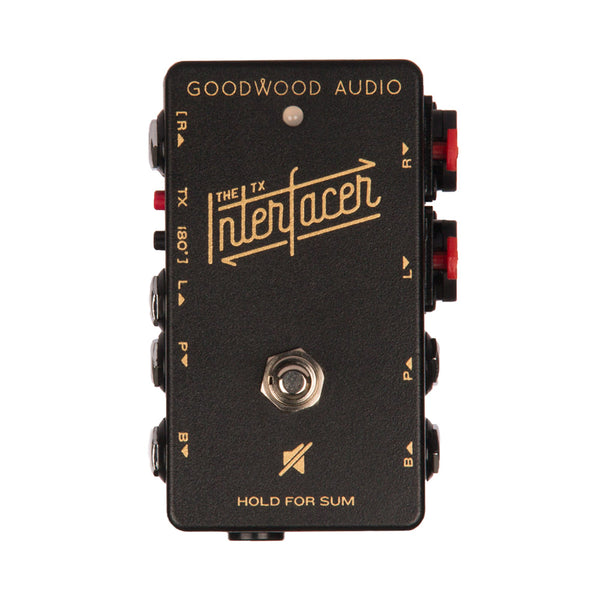
buffered tuner pedal The TX Interfacer - The Ultimate Pedalboard Junction BoxInput and output buffers. Two types of summing. Master mute. Tuner send. Isolation. Summing The TX Interfacer has two types of summing: Stereo Sum and Split Sum. To access these two modes, use the internal DIP switch to select which mode is best for you. Stereo Sum This is the default mode The TX Interfacer ships with. In this mode use stereo effects as normal. When summed, the left and right inputs are merged and the exact same signal is sent to the

Input and output buffers. Two types of summing. Master mute. Tuner send. Isolation. 


Summing

The TX Interfacer has two types of summing: Stereo Sum and Split Sum. To access these two modes, use the internal DIP switch to select which mode is best for you.

  1. Stereo Sum – This is the default mode The TX Interfacer ships with.  In this mode use stereo effects as normal. When summed, the left and right inputs are merged and the exact same signal is sent to the left and right outputs.
  2. Split sum – Still use stereo effects as normal. When summed, the right input is ignored and the left input is split to both left and right outputs.

Ground Lift & Phase Correction


The TX Interfacer comes with ground lift and phase correction for players that want to run more than one amp.

  1. Ground Lift – A ground loop is never a welcome sound - a loud buzz when two amps are being used at certain venues - but it doesn't have to waste your time.  Simply push the black pushbutton on Interfacer and the ground loop will be eliminated! 
  2. Phase Correction – When using multiple amps it is possible that the amps being used are out of phase with each other.  One speaker is moving in while the other is moving out.  Correct this easily by pushing the black and red pushbuttons in - inverting the phase on one amp by 180 degrees. 

Master Mute

Hit the foot switch on The TX Interfacer to mute your signal before it reaches your amps. No matter what craziness is happening on your board, the master mute has the final say on what does or doesn’t get sent to your amp.


Inputs

There are two inputs on The TX Interfacer; a moveable buffered input and a passive input.

  1. Passive Input – Best to use if you have effects on your board such as a vintage wah or fuzz that don’t quite sound the same with a buffer before them. After your last fuzz or wah pedal you can then plug into the buffered input of The Interfacer to make use of the buffer and dedicated tuner output. The passive input can also be used for off-board expression pedals and tap tempo.  Permanently connect either a TS or TRS cable from the passive send to a pedal that can receive expression or tap control and then patch an expression or tap pedal into the passive input.
  2. Moveable Buffered Input – The buffered input can be moved anywhere in your mono signal chain. Simply plug into the passive input, put all the pedals want you want before your buffer here. After the last pre-buffer pedal, plug into the buffered input to make use of the buffer and always on tuner output.


All Interfacers are made with high quality, durable components.

IMPORTANT - Use only 9vDC centre negative plug to power!  100mA
Dimensions including all jacks and switches in the box are: 115mm long x 77mm wide x 70mm high.

Input Impedance (B. In, L and R inputs): 1Meg
Output Impedance (B. Out, Tuner Out, L and R outputs): 500 ohms

Shipping Notes
  • Free Standard Shipping on $100+ Orders to the USA.
  • Except Preorder products are shipped in 48 hours.
  • Delivery to the USA:
  1. Standard Shipping : 3-10 business days
  • If time is of the essence, please consider selecting expedited delivery for faster service.
Exchange/Return Notes
  • We offer a 30-day return/exchange service after receiving.
  • Final sale items are not eligible for returns or exchanges.
  • To process your return/exchange, please contact us at [email protected]
  • Please click here for more details>>> Return & Exchange Policy
SKU: 72215870706

Discover Niche Categories That Outsell buffered tuner pedal

Top-Converting Item to Boost Your Average Order

4.6 ★★★★★
Based on 15 reviews
Sort
Highest Rating
Newest First
Oldest First
Product Reviews
C
Verified Purchase
cloud-learner
Louisville, US
★★★★★ 3
have some good contents but too general
Format: Paperback
The book covers some good points, but overall, it's too general.
WAS THIS REVIEW HELPFUL?YesReportShare
Reviewed in the United States on June 28, 2024
E
Verified Purchase
Engineer Dude
Fort Morgan, US
★★★★★ 3
Why Politics in a Tech Book????
Format: Kindle
Well... I'm surprised to see the book blatently calls out its dedication to Black Lives Matter, which is in all caps so I assume it's referring to the political organization. It goes on to speak of 2020 being the year of an "awakening of injustices of systematic racism"... I thought I was buying a technical book??? Had I known this political bs was included I wouldn't have purchased it! However, I bought and I'm still reading it. If the politics goes away and the TECHNICAL content is good I'll update my review.
WAS THIS REVIEW HELPFUL?YesReportShare
Reviewed in the United States on December 13, 2020
P
Verified Purchase
PeaceBee
Fort Morgan, US
★★★★★ 2
Not good use of time
Format: Paperback
It’s not clear who this book targets - neither experts nor novice will benefit. There are expert perspectives, only few of these are helpful, rest are too generic to be of any use. For instance the last entry is one an engineer who shares how she went from zero to expert in cloud engineering in six months but fails to mention a single resource or pathway for others to follow.
WAS THIS REVIEW HELPFUL?YesReportShare
Reviewed in the United States on April 2, 2022
N
Nilendu Misra
Charlottesville, US
★★★★★ 3
Uneven compendium of tips and insights, but still very useful
Format: Kindle, Format: Kindle
“In theory, theory and practice are the same. In practice, they are not" is why such bottom-up insights and lessons from the field are the fastest way to learn real life stuff. This series had a GREAT start with "Engineering Management" - I guess because it is way more subjective than Cloud Engineering and offered a variety of non-overlapping POVs. This one is a mixed bag, perhaps because "Cloud Engineering" was perceived amorphously by the authors. The scope was broad - from cloud-native (architecture), to cloud-ready (topology), to cloud-operations, to choosing tech (e.g., Lambda/serverless), to -ilities and economics -- it is like celebrating Halloween, Christmas and Labor Day together in a single long weekend. I would give it 4/+ stars if at least 25% of such a book was "superb", giving 3 because about 10% of the book is. That still leaves 10 solid insights or learning that would otherwise take many failures to learn. And failures, especially in this emerging domain of complexity, is VERY expensive. Would love to see more books like this. Let's summarize some key insights - -- Real-time visibility across the entire DevOps lifecycle is key to winning in cloud. -- Operations, especially operations at scale, is extremely hard. So, wherever possible, use Managed Services. -- Distinguish between "availability" and "uptime" and measure each separately, and concretely. -- In FaaS/Serverless, calling a function synchronously increases debugging complexity. -- Good code is like good joke - it needs no explanation. -- "Building your app or platform on top of the abstractions that a cloud provider gives you does not make the underlying layers stop existing. In many cases, it makes them even more important." That makes the failure modes LESS obvious than we were used to. Therefore having "extreme visibility" into your systems will help "separate the issues at the layer you're focused on from the fundamental system issues". i.e., just because what was under the hood is now even less visible, don't forget them. Many recent "cloud failures" have been in networking fault domains. -- Cloud is not optimized for replacing static infrastructures. -- Containers, service meshes and serverless jumpstart dev productivity but they also change the attack surface of apps and infra. -- "Number of containers that are alive for 10 sec or less has doubled to 22%". 73% of all containers live for 30 minutes or less. -- Adopt an "assume breach" stance for everything. Have a break-glass account. -- Ensure you have a thorough understanding of where and how secrets are secured. -- Grey failures (transient degradation of services) are often worse than complete crashes, since the latter have a short feedback loop. -- Resilience engineering has existed as a sub-discipline within safety sciences. We just recently started applying its concepts in technology. Resilience can be thought of as a "socio-technical system" with Robustness ("system X has property Y that is robust in sense Z to perturbation W"); Reliability (consistent operations or service levels); Rebound (ability to deal with a chaotic situation using structures developed AND deployed BEFORE the chaos). In other words, robustness protects systems against a SPECIFIC type of failure mode. When a system is robust in many dimensions, it approaches good resilience to failure. -- Resilience is something you "do", not something you "have". Resilience is a verb. -- Moving from one class of nines to the next is 10 times more expensive. -- Production System really means "system that someone else, anyone else, can hold you accountable for". -- Most common theme across incidents is that something, somewhere was surprising. -- Incidents are unplanned investments...your challenge is to maximize ROI. -- We used to think of scale in two dimensions - horizontal (more) and vertical (bigger). In cloud, think of "scale out" (when demands increase) and "scale in" (when demand decreases). -- Architecture diagram is also a map of failure modes. -- Async communication is a friend of Cloud Reliability. -- Test in production is a competitive advantage. The complexity of traffic patterns going through high-scale production systems is increasingly harder to reproduce in a controlled env. -- Hundreds of open issues is fine, but if the repo has gone months (or, years!) without a release, THAT is a warning sign. -- It is hard to write good tests for bad code. -- Platforms come and go. But first principles and patterns will always exist, because they are the ones and zeros.
WAS THIS REVIEW HELPFUL?YesReportShare
Reviewed in the United States on November 6, 2023
M
M. Klocker
Phoenix, US
★★★★★ 2
Shallow, biased and significantly overpriced
Format: Paperback
Well, this purchase was a disappointment. 20% of the pages are dedicated to just highlighting the bios and backgrounds of the many different authors that contributed this great wisdom. And let me be clear, the authors are solid. They are professionals with credible backgrounds and experience. But it's the format and constraints of this book that makes it virtually impossible for that to shine through. Because the rest of the book (80%) is dedicated to the so called "97 things every cloud engineer should know". And unfortunately the average length of one of these "things" is about 1.5 pages long, and as such extremely shallow and in about 30% of the cases straight up promotions for specific company services. You will find Google cloud advocates telling you to use managed services, of Google of course. AWS engineers telling you to avoid them and use IaaS. LaunchDarkly employees telling you to use feature flags. The list goes on. The TL;DR: here is that if you have built anything on the cloud in the last 2 years, this book is going to be a waste of your time and money. You are better of googling: "cloud best practices" and dedicating 2h to reading the first 10 non-ad related search results.
WAS THIS REVIEW HELPFUL?YesReportShare
Reviewed in the United States on March 23, 2022

recommand products