SKU: 89589673938
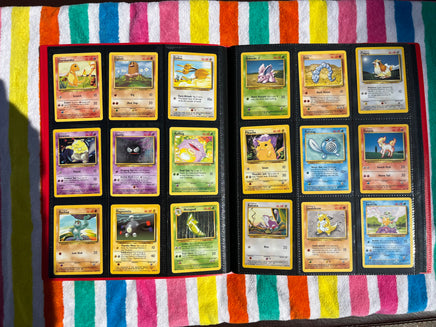
102 pokemon cards

102 pokemon cards Base Set Complete Master Set (102/102) 1999| TradingCardSets.Com

Sale price$21.47 Regular price$23.86
Save 10%

Pay in installments of $5.96 with ShopPay, AfterPay and Klarna

Shipping Estimate
USA
  • USA
  • CAN

Ships within 48 hours · Estimated delivery Sep 3 - Sep 8

Promo Codes Available:

For Your Every Summer RSVP, with Code: SUMMER15

Description

102 pokemon cards Base Set Complete Master Set (102/102) 1999| TradingCardSets.ComComplete Pokmon TCG base set (102 102). Includes all 102 original English Base Set cards from 1999. Base Set is the first expansion card release. Base Set has 102 cards total including the infamous 4 102 Base Set Charizard, as well as other Pokmon, trainer, and energy cards. Base Set was released in the United States on January 9 1999. All cards are authentic, official Pokmon TCG (Trading Card Game) Cards. All cards are in English. All cards are raw

Complete Pokémon TCG base set (102/102). Includes all 102 original English Base Set cards from 1999. 

Base Set is the first expansion/card release. Base Set has 102 cards total including the infamous 4/102 Base Set Charizard, as well as other Pokémon, trainer, and energy cards.  Base Set was released in the United States on January 9 1999. 

All cards are authentic, official Pokémon TCG (Trading Card Game) Cards. All cards are in English. All cards are raw (ungraded) unless otherwise stated. Card conditions in this particular set range from Near Mint to Moderately Played. Cards are carefully stored and shipped protected in an included high-quality side load binder. Send us an e-mail at [email protected] or use the chat feature to ask for photos of the complete set for sale or any individual cards! We sell a large number of sets and the set in the photographs may be a set that we previously sold and not the exact cards for sale! For more information be sure to check our Frequently Asked Questions (F.A.Q.) section! 

Base Set Complete Master Set (102/102) 1999 Card List:

1/102 Alakazam (Holo)

2/102 Blastoise (Holo)

3/102 Chansey (Holo)

4/102 Charizard (Holo)

5/102 Clefairy (Holo)

6/102 Gyarados (Holo)

7/102 Hitmonchan (Holo)

8/102 Machamp (Holo)

9/102 Magneton (Holo)

10/102 Mewtwo (Holo)

11/102 Nidoking (Holo)

12/102 Ninetales (Holo)

13/102 Poliwrath (Holo)

14/102 Raichu (Holo)

15/102 Venusaur (Holo)

16/102 Zapdos (Holo)

17/102 Beedrill

18/102 Dragonair

19/102 Dugtrio 

20/102 Electabuzz

21/102 Electrode

22/102 Pidgeotto

23/102 Arcanine

24/102 Charmeleon

25/102 Dewgong

26/102 Dratini

27/102 Farfetch'd

28/102 Growlithe

29/102 Haunter

30/102 Ivysaur

31/102 Jynx

32/102 Kadabra

33/102 Kakuna

34/102 Machoke

35/102 Magikarp

36/102 Magmar

37/102 Nidorino

38/102 Poliwhirl

39/102 Porygon

40/102 Raticate

41/102 Seel

42/102 Wartortle

43/102 Abra 

44/102 Bulbasaur

45/102 Caterpie

46/102 Charmander

47/102 Diglett

48/102 Doduo

49/102 Drowzee

50/102 Gastly

51/102 Koffing

52/102 Machop

53/102 Magnemite

54/102 Metapod

55/102 Nidoran

56/102 Onix

57/102 Pidgey

58/102 Pikachu

59/102 Poliwag

60/102 Ponyta

61/102 Rattata

62/102 Sandshrew

63/102 Squirtle

64/102 Starmie

65/102 Staryu

66/102 Tangela

67/102 Voltorb

68/102 Vulpix

69/102 Weedle

70/102 Clefairy Doll

71/102 Computer Search

72/102 Devolution Spray

73/102 Imposter Professor Oak

74/102 Item Finder

75/102 Lass

76/102 Pokemon Breeder

77/102 Pokemon Trader

78/102 Scoop Up

79/102 Super Energy Removal

80/102 Defender

81/102 Energy Retrieval

82/102 Full Healh

83/102 Maintenance

84/102 PlusPower

85/102 Pokemon Center

86/102 Pokemon Flute

87/102 Pokedex

88/102 Professor Oak

89/102 Revive

90/102 Super Potion

91/102 Bill

92/102 Energy Removal

93/102 Gust of Wind

94/102 Potion

95/102 Switch

96/102 Double Colorless Energy

97/102 Fighting Energy

98/102 Fire Energy

99/102 Grass Energy

100/102 Lightning Energy

101/102 Psychic Energy

102/102 Water Energy

Disclaimer: Please note that while the images shown on our listings are not pictures of the exact cards in each set. You will receive one of each of the cards shown in the photos, but the cards received will not be the exact cards pictured. These images are from previously sold sets and serve as a reference. Every card is unique and the actual cards you receive may vary from those shown in the images. We adhere to card condition guidelines and are committed to transparency in our descriptions and titles. For additional peace of mind, we welcome requests for front and back close-ups of any specific cards prior to your purchase. By placing an order, you acknowledge and agree to these terms.

Shipping Notes
  • Free Standard Shipping on $100+ Orders to the USA.
  • Except Preorder products are shipped in 48 hours.
  • Delivery to the USA:
  1. Standard Shipping : 3-10 business days
  • If time is of the essence, please consider selecting expedited delivery for faster service.
Exchange/Return Notes
  • We offer a 30-day return/exchange service after receiving.
  • Final sale items are not eligible for returns or exchanges.
  • To process your return/exchange, please contact us at [email protected]
  • Please click here for more details>>> Return & Exchange Policy
SKU: 89589673938

Discover Niche Categories That Outsell 102 pokemon cards

Top-Converting Item to Boost Your Average Order

4.3 ★★★★★
Based on 14 reviews
Sort
Highest Rating
Newest First
Oldest First
Product Reviews
D
Verified Purchase
Diana D
Phoenix, US
★★★★★ 5
Very well written and easy to read.
Format: Paperback
Few people are as qualified as Philip Meyer to write a book on storytelling for lawyers. With a background as a trial lawyer, he has plenty of practical, real-life experience in the courtroom. His approach is not that of an academic giving purely theoretical advice, but that of a seasoned lawyer who knows the ins and outs of the legal profession. His experience as a professor (of both law and writing) has honed his ability to effectively communicate his ideas to a broad audience. Not only is this book helpful for the practicing lawyer, it is also useful and not too complex for the legal neophyte or casual reader. This book breaks storytelling (narrative) down to its core components and analyzes them one by one. In the process of analyzing each part of a story, Philip Meyer skillfully explores each component with a non-legal example (e.g. movies, books, etc.) before applying it to a legal example (e.g. courtroom proceedings, appellate briefs, closing arguments, etc.) By first analyzing each part of a story (i.e. plot, setting, etc.) from a well-known story that resonates with the reader, he sets a strong foundation before transitioning to a legal story, thus making it easy for the reader to identify and better understand each part of the legal story. I highly recommend this book to anyone remotely interested in storytelling and persuasion as they relate to the legal profession.
WAS THIS REVIEW HELPFUL?YesReportShare
Reviewed in the United States on November 22, 2016
J
Verified Purchase
JR
Cuba, US
★★★★★ 4
Must Read for Novice Litigators
Format: Paperback
This book is a great starting point for developing the skill of storytelling for lawyers as was intended by the author. The author gives you the basics for developing the plot, characters, style, setting, and narrative for your trial with excellent examples. The author is a law professor and the book seems geared for the law student or novice lawyers getting into litigation. I only gave the book 4 out of 5 stars because of a couple of minor problems. However, the chapter on narrative needs further exposition and appears to be written in rushed manner. In addition, the physical binding of the book is of poor quality requiring me to glue the cover back on. Finally, the author missed the point that the lawyer's job is to look at his case as a giant puzzle to be solved and then explained as a story.It is not enough to understand your case but equally imperative that you communicate your case which is best done through the storytelling technique. This is a must read for lawyers getting up to speed on litigation. For further exposition on legal storytelling for lawyers after reading Meyer's book on Storytelling for Lawyers, I recommend the following: ABA webinar available with an internet search for "Storytelling for Lawyers"
WAS THIS REVIEW HELPFUL?YesReportShare
Reviewed in the United States on July 25, 2018
T
Verified Purchase
Tahoeman
Bozeman, US
★★★★★ 5
Much needed guide to narration in law practice
Format: Paperback
Meyer’s “Storytelling for Lawyers” is an important contribution to the literature on narration in law practice. We know that successful courtroom rhetoric can best be viewed through the prism of storytelling. But the literature does not contain a practical and detailed analysis of the elements of narration as used in law practice—that is, plotting, characterization, point of view, style, and settings in place and time. Meyer’s book fills this gap. It is blessedly free of jargon and full of practical examples of good legal storytelling. But the importance of this book goes well beyond providing practical assistance to litigators. It serves as a much-needed introduction to the principles of narration for teachers and students of literature, creative writing, and popular culture, who have lacked a readable introductory guide to the elements of successful storytelling.
WAS THIS REVIEW HELPFUL?YesReportShare
Reviewed in the United States on February 10, 2014
D
Verified Purchase
David R. Papke
Whiting, US
★★★★★ 5
Recommended for All Lawyers
Format: Paperback
Meyer proves his initial point that much of what lawyers do is storytelling, and he achieves his goal of providing a primer on narrative theory for lawyer-storytellers. The book is sophisticated but written in an engaging way using non-technical language. Examples from legal and literary works abound, and they range from courtroom arguments and appellate briefs on the one hand to an essay by Joan Didion and Vonnegut's "Slaughterhouse Five" on the other. Meyer's favorite stories are found in Hollywood movies, and although he seems unaware of the accomplishment,Meyer provides fresh interpretations of such movies as "HIgh Noon" and"Jaws." I strongly recommend "Storytelling for Lawyers" for all law students, lawyers, and judges.
WAS THIS REVIEW HELPFUL?YesReportShare
Reviewed in the United States on May 7, 2014
D
Verified Purchase
DoubtfulReader
Lexington, US
★★★★★ 3
Notes on Legal Style by a Law Professor and Experienced Lawyer.
Format: Kindle
BOOK REVIEW: MEYER, Philip N., Storytelling for Lawyers ISBN: 978-0-19-5396638 Read June, 13th-27th, 2017. This book discusses storytelling tools by presenting a series of examples of good storytelling, both in legal settings and in literary works and movies. If theoretical explanations are sometimes a bit dry, the frequent quoting of practical examples conveys fluidity and speed to the book. After an introduction presenting lawyers as storytellers, it deals with the roles played in storytelling by Plots (chapters 2 and 3); Character (4 and 5); Voice, Perspective, Details and Images, and Rhytm and Speed (which relate to Scene and Summary) (chapter 6); Place or Story Environment (chapter 7) and Narrative Time. Focusing maybe too narrowly on legal storytelling before American juries, plot is almost equated with melodrama. Films like Jaws and High Noon are extensively discussed, as Gerry Spence’s Closing Argument on Behalf of Karen Silkwood. The chapters on character offer interesting insights on character classification (“round” characters, with psychological depth, prone to suffer transformation as the story evolves, vs. “flat” ones), while discussing the tools for telling how a character is, as opposed to simply showing the psychological nature of each character’s character through dialogue or the actions the character performs. Examples include Tobias Wolff’s This Boy’s Life and Jeremiah Donovan’s Closing Arguments on Behalf of Louis Failla, in a 13-week trial the Author could scrupulously attend in person. Discussions on Voice, Perspective, Details and Images, Scene and Summary, criticize the basic assumptions of the neutrality of lawyers’ voices, exemplifies how to manage details to suggest ideas and emotions, draw on the distinction between showing and telling, and offers interesting insights into the narrative theory’s concept of stretch (the slowing of the narrative rhythm in relation to the narrated story’s). Environment depiction storytelling tools deals with Joan Didion’s The White Album and the Judicial Opinion in a Rape Case, quoting also from W. G. Sebald’s The Emigrants and the Petition Briefs in Reck v. Ragen and Miranda v. Arizona. Further examples are Kathryn Harrison’s While They Slept and the Petitioner’s Brief in Eddings v. Oklahoma. Finally, the chapter on Narrative Time draws on Kurt Vonnegut’s Slaughterhouse Five and explores time, rhythm or speed, discussing more deeply stretch and the relation of time of the narrative itself with the time of the facts dealt with in the narrative. Chronology is discussed and criticized; Analepsis or Flashback is didactically explained and exemplified, both in general storytelling theory and in its legal use; the same holds for Prolepsis (Flash-forward) and Ellipsis (the intentional omission of a part of the narrative, often with the purpose of emphasizing the omitted event. Pacing and Rhythm are discussed in more lenght, with the caveat - repeated somewhat throughout the book - that legal stories are often left unfinished by the lawyer, in order to allow the jurors or judges fill the end with their decision. The Author remarks his purpose was to suggest possible tools and ways of dealing with problems which arise in legal storytelling, and he delivers what he promises.
WAS THIS REVIEW HELPFUL?YesReportShare
Reviewed in the United States on June 27, 2017

recommand products